
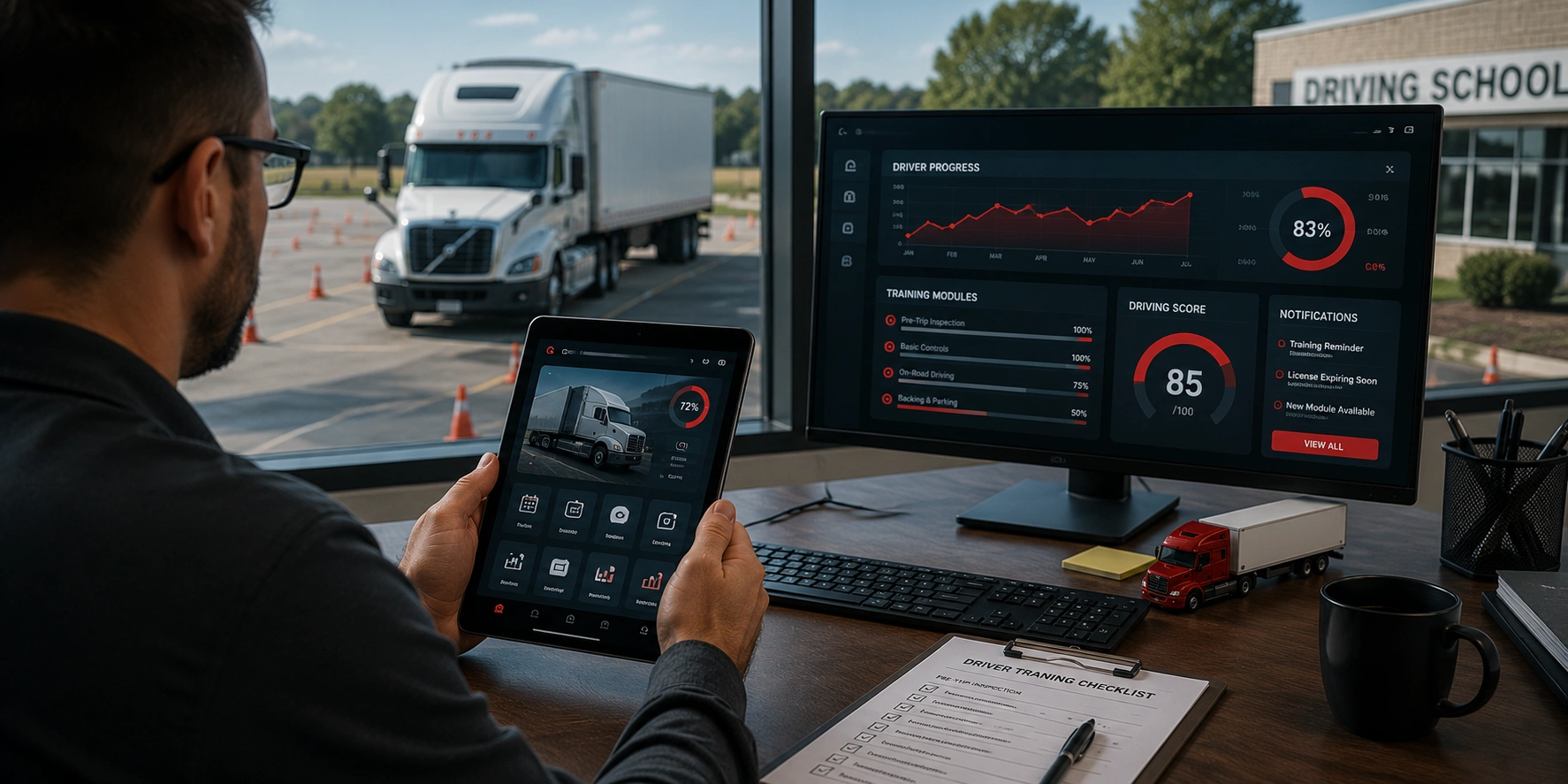

Most driving schools in the United States still run their day-to-day operations utilizing tools that were never intended for them. Scheduling is done using shared calendars. BTW logs are completed by hand. For compliance tracking, schools rely on fragmented data stored in email threads, Excel spreadsheets, or filing cabinets.
Despite being highly specialized businesses, driving schools and CDL training programs still employ outdated and inefficient operational models. In fact, the U.S. trucking industry is projected to grow to over 160,000 drivers by 2030.
In the meantime, the CDL shortage is putting pressure on schools to train, log, and graduate students in as little time as possible while maintaining compliance with all requirements.
Schools moving towards dedicated driving school mobile and web app development services are seeing considerable gains in compliance, time savings, reduced overhead, and fewer errors. This guide explains the primary operational challenges programs are experiencing, the technology they can implement to address them, and the results that can be achieved by deploying it.
The Operational Problem: Most Programs Are Not Measuring Correctly
Running a driving school is a complex process, and some of the challenges are not visible from the outside. For starters, each instructor has to be certified in many areas and often has to be available at a specific time and assigned to a specific vehicle. Beyond that, each student is able to book lessons depending on a myriad of factors, including payment status and progress, as well as a student’s eligibility. Lastly, a vehicle’s condition determines which sessions it can support.
These variables must be handled with care to avoid compounding errors. An instructor might be allocated to multiple overlapping sessions. Logs are incomplete, which results in a compliance issue. An ELDT test has not been completed.
Manual variables also have compounding errors. It wastes time for instructors when sessions are double booked. Compliance logs are incomplete if they contain gaps. Missed ELDT milestones will delay a student’s completion of their CDL skills test.
There are specific requirements and regulations for CDL programs. The FMCSA’s Entry-Level Driver Training regulations took effect in February 2022 and require Training Provider Registry (TPR) sign-up, as well as documented theory instruction and required behind-the-wheel hours. CLP holders are unable to take the CDL skills test if the ELDT requirements are not fulfilled.
The biggest complaint is that Operators are very knowledgeable about the legislation, but are given unstructured tools in a controlled environment, so delays, omissions, and errors result in unplanned costs and audits.
What Digital Transformation Actually Requires in This Industry
The term “digital transformation” is overused across most sectors, but for driving schools and CDL programs, they have a true and specific definition
Automated, paperless, and disconnected workflows can all be replaced with integrated software systems to meet the operational and compliance needs of driver training.
The most successful CDL schools use technology in an intelligent way and take a systematic approach. This starts with identifying where the greatest manual process friction occurs, defining the data requirements of that process, and then building or acquiring a system that captures that data at the point of entry.
Automation of Scheduling
As a school scales up, the first noticeable operational stress is scheduling driving lessons. Over time, scheduling becomes cumbersome, repetitive, and increasingly error-prone.
With automated systems, learners are able to book lessons using a web portal or application. Instructors are alerted in real-time to any changes to their lessons. Administrators are provided a complete operational overview without the need for any manual work.
For schools with a fleet of over ten training vehicles, the first year with scheduling automation typically results in a full return on investment (ROI), with automation-related benefits compounding thereafter. Automated scheduling delivers the same set of rules consistently and reliably.
BTW Log Digitization
An essential document for the compliance of any driving school program is the behind-the-wheel (BTW) log. Applications designed for the capture, storage, and retrieval of BTW data must be built with the legal requirements of BTW logs in mind.
Digital BTW logging reduces the time spent on data entry and helps to retain logs that are at risk of compromising compliance within the system. The biggest impact of a digital system is the design of compliance.
Compliance of the digital BTW logging system enables a digital sign and seal to log instructional sessions. Logs are securely stored and are available on demand, significantly reducing the time to respond to an audit. The system is designed to sign and populate logs for instructional sessions with fields completed by the instructor and then generate a summary of each learner’s performance. AI can also assist with identifying incomplete logs. What AI cannot do, however, is replace the instructor’s sign-off.
FMCSA ELDT Compliance Technology
Certified CDL programs have a higher operational standard relative to traditional driving schools. This stems from the Federal Motor Carrier Safety Administration (FMCSA) entry-level driving training (ELDT) regulations. These requirements include minimum training content, the minimum training hours, as well as the training organizations providing the certificates and booking documents for the driving tests.
Learning management systems (LMSs) have the capacity to handle course delivery and assessment. However, they lack a structured filing system and record formats required by the FMCSA. Consequently, most CDL programs have to run a parallel documentation process to their LMSs, creating the very manual work they sought to eliminate.
The CDL compliance technology needs to account for the separation of theory and practice driving hours and generate training certificates to the FMCSA audit standard. Custom CDL software and CRM development services embed this separation, certificate generation, and TPR-ready record architecture directly into the compliance layer from the first sprint. All documentation must be crosslinked to the CLP holder’s enrollment and remain audit-ready if required. It must consolidate all documentation to eliminate manual data transfers.
AI Applications in Driver Training: Practical Use vs. Misleading Possibilities
For the past year, the DriveTech industry has heavily incorporated Artificial Intelligence (AI) technologies, resulting in much optimism. While some of these technologies are gaining recognition, other technologies have been implemented with a measurable impact. The following are some of the use cases.
AI and Adaptive Curriculum
Artificial Intelligence (AI) has the ability to create a fully automated learning system that can collect and analyze data to provide targeted instruction to learners. At times, before the completion of a driving maneuver, the system may display a particular assessment activity, or even a simulation. It serves as a data-informed optimization pathway for the next learning task, in preparation for the driving practice session.
Each of these activities is marked complete by the instructor before moving forward. The result is more efficient use of instructional time and better-prepared students.
Instructor and Program Performance Analytics
Tracking lessons, student completion rates, timelines, and instructor activity yields insights that self-assessments alone cannot explain. Program Directors can see which instructors have the highest first-attempt pass rates, what lesson types contribute to BTW logging errors, and where student attrition is occurring. Data collected at this level contributes to the continual improvement of programs.
Automated Compliance Reporting
Manually creating ELDT progress reports, BTW hour logs, and TPR documents is time consuming and error prone. Reporting tools designed with the capability of using training data to fulfill reporting requests provide significant relief to program coordinators.
AI cannot and should not be used to replace in-vehicle training, real-time assessors, and the instructor of record’s professional and legal responsibility. It is an overstatement of the capability of the technology.
Simulator Integration: How to Get More Capacity Without More Vehicles
The cost, risk, and complexity of teaching trainees how to perform certain driving manoeuvres with a real vehicle have made driving simulators especially attractive, as backing up, adverse weather conditions, and emergency stop driving can be done without a real vehicle.
The argument in favor of simulators for CDL training is quite clear. They lead to a reduced number of hours spent on the road in order to be able to do an emergency stop. The use of simulators is not without restriction: the Simulator hours of training may be credited toward the in-vehicle training requirements in only a few of the states.
Therefore, the in-vehicle training requirements would still need to be met. Some states allow credit; others do not. This changes frequently. Verify current rules with your state licensing authority or a transportation law specialist before factoring simulator hours into your compliance framework.
The critical integration issue is record continuity. Simulator session data must be incorporated into the same student record as on-road BTW data. Programs that maintain these records separately create documentation gaps that will complicate compliance reporting and audit responses.
How Telematics and Fleet Data Contribute to Modern Driving Schools
Driving schools and CDL programs with larger instructor rosters and training routes are beginning to incorporate telematics systems into their daily operations. The systems provide real-time data visibility and aid in the data-based decision-making process on both vehicle and instructor management.
Every telematics solution has its own Application Programming Interface (API) format, reporting structure, and data management systems. Due to the telematics data controllers or inherent behavior of the systems, integration work done for one vendor cannot likely be used for a different vendor.
Telematics systems interface with the core modules of a driving school management system. Using telematics tools in isolation creates datasets in the systems causing staff to engage in data reconciliation. This adversely affects operational efficiency and increases administrative burden.
Key Applications of Telematics in Driving Schools
Vehicle Utilization Tracking
Telematics systems assist school management in assessing the use of training vehicles by different instructors and across various locations and instructional time slots.
Driver Behavior Monitoring
Training programs can analyze the driving behavior of instructors during their driving sessions using telematics systems.
Predictive Maintenance
Systems and modules that manage the maintenance schedule of a vehicle can be more efficient when managed and controlled through telematics data that defines the vehicle’s driving range and usage.
Route Verification and Lesson Validation
GPS can be used to substantiate the completion of driving training routes and Behind the Wheel (BTW) sessions.
Essential Features to Build a Scalable Tech Stack Architecture
Driving schools face the common misconception of purchasing a set of applications. For scheduling, driving schools use one application. For payments, one application. For compliance tracking, one application. For student communication, one application.
In practice, these disconnected systems create operational fragmentation. The following operational functions are typically required within a unified platform:
| Area | Point Solution Approach | Integrated / Scalable Architecture |
|---|---|---|
| Scheduling | Separate scheduling app with manual instructor coordination | Centralized scheduling tied to instructors, vehicles, students, and location availability |
| Payments | Standalone payment gateway with disconnected records | Payments automatically linked to student accounts, lesson history, and invoicing |
| Compliance Tracking | Spreadsheet or isolated compliance tool | Real-time compliance records connected to attendance, certifications, testing, and audit logs |
| Student Communication | Independent SMS/email platform | Unified communication system triggered by scheduling changes, reminders, and compliance events |
| Reporting | Manual reconciliation across systems | Consolidated operational and financial dashboards with centralized reporting |
| Data Management | Duplicate records across platforms | Single source of truth for students, instructors, vehicles, and certifications |
| Multi-Location Operations | Separate systems per branch | Shared infrastructure with location-specific permissions and standardized workflows |
| Scalability | Increased admin overhead as enrollment grows | Processes scale without proportional increases in staffing |
| Compliance Risk | Higher risk from inconsistent or missing records | Automated record synchronization and audit-ready documentation |
| Customization | Limited workflows based on vendor constraints | Tailored workflows aligned to operational and regulatory requirements |
Note- The build-versus-buy decision depends on program size, growth trajectory, and compliance complexity. A three-instructor school has different requirements than a fifty-instructor CDL program operating across multiple locations. What is consistent across both is the need for integration. Disconnected systems create disconnected records. Disconnected records create compliance risk. Custom software development for driving schools builds that integration layer as a unified platform rather than a set of disconnected point solutions requiring manual reconciliation.
Why Compliance as Operational Infrastructure Matters
Most driving school operators treat compliance as an administrative burden imposed by regulation, rather than as a driver of growth. In practice, strong compliance systems function as operational infrastructure that directly supports scale, stability, and credibility.
Manual vs. Digital Compliance Systems
Programs that invest early in structured compliance systems gain a compounding operational benefit over time.
Manual Compliance Processes
- Depends heavily on individual staff habits
- Increase the risk of incomplete or inconsistent records
- Create delays during audits or reporting periods
- Become difficult to scale across multiple instructors or locations
Digital Compliance Systems
- Standardize documentation automatically
- Maintain centralized student and training records
- Improve reporting accuracy and accessibility
- Support real-time updates and audit readiness
Challenges US Driving Schools Face in Digital Transformation
Digital transformation in driver training is not a straightforward technology procurement exercise. Programs encounter a consistent set of structural obstacles that slow adoption, increase costs, and limit outcomes when not addressed directly.
Vendor Fragmentation
Compliance complexity is the first barrier. Driving schools operate under federal FMCSA mandates and state-level DMV requirements simultaneously, and those requirements do not always align. Building systems that satisfy both without manual workarounds demands deep regulatory awareness from the development team.
Telematics vendor fragmentation compounds the problem. No dominant standard exists across fleet tracking providers. Each vendor uses a different data format and API structure, which means integration costs accumulate with each additional tool a school adopts.
API Inconsistency
Instructor adoption of digital tools remains a practical constraint. Instructors hired for their driving expertise are not always comfortable with new software, particularly when it is introduced without adequate training or support.
Budget sequencing is a challenge for smaller programs. The upfront investment required for a well-integrated platform often arrives before the operational savings are visible, creating a timing problem for operators with limited capital.
Integration Cost Accumulation
State regulation variation means that a system built for compliance in one state may require significant modification before it can be used in another. Programs operating across state lines, or those planning to expand, need systems designed with that variability in mind from the start.
The Role of Mobile Technology in Modern CDL and Driving School Operations
Student expectations around mobile access are not a preference variable. They are an operational baseline. A program that requires students to call or email to schedule lessons, or that provides progress updates only through desktop portals, creates unnecessary friction at every stage of the training relationship.
A well-designed student-facing application covers lesson booking and modification, pre-lesson theory content and assessment delivery, real-time instructor communication, progress tracking against state and program milestones, and document submission for DMV and enrollment requirements.
Student-Facing Mobile Module
A well-designed student application should support:
- Lesson scheduling and rescheduling
- Progress tracking against program milestones
- Access to theory content and assessments
- Real-time communication with instructors
- DMV and enrollment document submission
- Notifications for upcoming lessons, tests, and compliance requirements
Instructor-Facing Mobile Module
Instructor applications operate in a far more demanding environment. These tools are used inside training vehicles and in areas where internet connectivity may be unreliable. Custom mobile app development for driving school instructor apps must be architected for offline-first operation. BTW, log entry, session sign-off, and student record access must all function without a reliable connection. Key requirements include:
- Fast and reliable BTW log entry
- Offline functionality during poor connectivity
- Accurate synchronization once connectivity returns
- Minimal navigation friction while managing lessons
- Real-time access to student records and schedules
Investment Planning and Realistic Cost for DriveTech Development
Technology investment conversations in this industry often stall because operators lack a realistic frame for what different levels of development cost. The ranges below are planning benchmarks, not quotes. Actual costs depend on specific requirements, integration complexity, and the development partner selected.
| Solution Type | Typical Cost Range | Best Fit For | Advantages | Limitations |
|---|---|---|---|---|
| Off-the-Shelf Driving School Management Software | $100–$500/month | Small to mid-sized driving schools | Faster setup, lower upfront investment, standard scheduling and payment tools | Limited customization, weaker ELDT compliance support, integration limitations |
| Custom Module Development | $15,000–$80,000 | Schools needing specific operational improvements | Tailored solutions for BTW logs, ELDT tracking, CRM integration, or compliance automation | May still require integration with existing systems |
| Full Custom Platform Development | $80,000–$300,000+ | Large CDL programs and multi-location operators | Unified CRM, scheduling, compliance, reporting, and mobile infrastructure built around operational workflows | Higher upfront investment and longer development timeline |
| Hybrid Approach (Custom + Existing Platforms) | Varies based on scope | Growing schools transitioning from legacy systems | Balances speed, flexibility, and cost while extending current systems | Can still create integration complexity if architecture is poorly planned |
Driving school platforms require developers who understand compliance-sensitive workflows, real-world instructor usage conditions, state and federal documentation requirements, offline synchronization challenges, and operational workflows tied to training vehicles and schedules.
The more useful question is not what technology costs but what current manual processes cost. Administrative overhead, compliance mistakes, scheduling inefficiencies, and student attrition all carry measurable expenses. The ROI analysis must account for both sides of that equation.
Where Is the Industry Headed Towards?
State DMVs are accelerating the shift toward digital record submission. The FMCSA’s compliance framework for CDL programs is becoming more structured, not less. Student expectations for digital access are rising across all demographics the industry serves.
Programs that invest in scalable digital infrastructure now are positioning themselves ahead of requirements that will eventually apply to everyone. The operational advantages they build compound over time. Better systems generate better data. Better data supports better decisions. Better decisions produce better program outcomes.
Programs that delay this investment face a more disruptive and more expensive transition later. Competitors who moved earlier will have built operational and reputational advantages. Those competitive advantages are difficult to close after the fact.
Technology alone is not the objective. The real objective is building systems that make instruction more effective, compliance more reliable, and growth more manageable. That is what digital transformation in DriveTech actually means.
Final Assessment: Where to Start
If you are evaluating your current infrastructure against what is outlined here, the honest starting point is a gap analysis:
- Where are your highest-friction manual processes?
- What compliance documentation is currently at risk if audited?
- Where does your student or instructor experience create friction or attrition?
- What does your current tech stack cost in money, time, and errors?
Those answers determine where to invest first. Programs reaching that stage often evaluate whether custom driving school platforms are necessary to support their operational and compliance requirements.
Frequently Asked Questions
What does digital transformation actually mean for a US driving school or CDL program?
It means replacing disconnected manual processes with a connected operational system. Scheduling, student records, BTW logs, ELDT documentation, payments, and instructor workflows stop living in separate spreadsheets, paper folders, and standalone tools, and start operating on shared data. The goal is not adding software for its own sake. It is removing the administrative overhead, compliance risk, and scheduling friction that limit how many students a program can train well.
Where does AI add real value in CDL training, and where does it not?
AI is most useful where it works on data your program already generates: flagging students whose performance patterns predict a road-test failure, personalizing theory review around weak curriculum domains, automating routine scheduling and reminder communication, and surfacing instructor coaching signals from telematics and simulator sessions. It does not replace instructors, certify competence, or satisfy an FMCSA requirement on its own. Treat AI output as decision support that a qualified instructor reviews, not as an authority on training outcomes.
Are driving simulators worth the investment for a CDL program?
Simulators pay off when they reduce vehicle hours spent on skills that do not require a real truck: pre-trip inspection sequences, hazard recognition, adverse weather scenarios, and repeated practice of maneuvers a student is failing. The value depends on integration. A simulator that exports session data into your training records extends the student profile and supports remediation. A standalone simulator that produces reports nobody imports becomes an expensive supplement with no measurable effect on completion or pass rates.
What telematics data is most useful for driver training?
The signals that correlate with training quality and safety outcomes: harsh braking and acceleration events, cornering behavior, speed relative to posted limits, following distance, idle time, and route or geofence adherence during BTW sessions. Tied to a student and a session, this data turns instructor assessment from memory-based narrative into evidence. It also documents that training occurred as recorded, which matters during audits and liability disputes.
Do instructor mobile apps really need to work offline?
Yes. Instructor tools are used inside training vehicles, on rural routes, in yards, and in areas with unreliable coverage. If BTW log entry, session sign-off, or student record access fails without a connection, instructors fall back to paper and the data reaches the system late or not at all. Offline-first architecture with reliable synchronization and conflict handling once connectivity returns is a requirement for this category of application, not an enhancement.
Should a program replace its existing systems all at once?
Rarely. Phased migration is lower risk for programs that are actively training students. Start with the highest-friction process identified in your gap analysis, usually scheduling or BTW documentation, and run the new system alongside existing tools until the data is trusted. Plan the historical data migration explicitly, since legacy records are often incomplete or inconsistently formatted, and budget for instructor and staff training. Most failed implementations fail on adoption and data quality, not on technology.
What should a driving school budget, and where should it start?
As planning benchmarks: off-the-shelf management software runs roughly $100–$500 per month, targeted custom modules $15,000–$80,000, and a full custom platform $80,000–$300,000 or more, with hybrid approaches varying by scope. Start with the gap analysis rather than the price list. Quantify what your current manual processes cost in administrative hours, compliance exposure, unused vehicle and instructor capacity, and student attrition. That number determines both where to invest first and what level of investment is justified.


