

Guaranteed Expert Consultation Within 1 Hour. Click Here!

Guaranteed Expert Consultation Within 1 Hour. Click Here!

Built for USA Startups · Princeton, NJ

Custom CDL Truck Driving School Software Services in New Jersey, USA

Custom CDL truck driving school software is a purpose-built management platform for FMCSA-registered truck driver training providers - covering student enrollment and CDL licence class management, Behind-the-Wheel (BTW) training scheduling, ELDT completion tracking, FMCSA Training Provider Registry (TPR) reporting, DOT physical compliance monitoring, and instructor coordination - engineered for the federal regulatory requirements that commercial truck driver training imposes on every US CDL school.

Speak With an AI Solutions Expert
Years of Experience
30+
Years Experience
Projects Delivered
100+
Projects Delivered
Development Speed
Faster Development
Regional Ranking
#1
App Developer NJ, FL, NY

Built for Startups. Trusted by Enterprises.
Designed to Scale from Day One.

Get a quick expert response within 1 hour.

Your idea is fully secured under our NDA & Confidentiality policy.
Deloitte Technology Fast 500 award Inc. 5000 fastest-growing companies award USPAACC Fast 100 Asian American business award NJBIZ business of the year award NJ 50 Fastest Growing Companies award

NewAgeSysIT engineers CDL truck driving school software services designed specifically for FMCSA-registered training providers. The platform combines five major operational areas into a unified system: student enrollment and CDL class management (Class A, B, C), BTW and range scheduling, ELDT tracking with direct TPR reporting, instructor and vehicle management, and payment and training package administration.

For CDL schools, training providers, trucking companies with in-house programs, and franchise networks, this goes beyond system upgrades. It lays the foundation to run a scalable, compliant, and highly operational training business. With custom CDL school app development, we help you reduce audit exposure, maximize fleet utilization, and ensure each training cycle is executed with full-fledged operational control.

What is Custom CDL Truck Driving School Software?

Custom CDL truck-driving school software is a management system designed to serve FMCSA-registered commercial truck driver training providers. Custom CDL truck driving school software is a management system purpose-built for FMCSA-registered commercial truck driver training providers, covering the operational, scheduling, and regulatory compliance workflows unique to CDL education that general driving school platforms can't support. Unlike a generic CDL school management software framework, this platform is purpose-built around the three federal requirements that define the gap.

ELDT Rule (49 CFR Part 380) mandates that every first-time CDL applicant, as well as every upgrade applicant, must complete ELDT from an FMCSA-approved provider. The driving schools need to track each student’s training completion and report it directly to the FMCSA Training Provider Registry. Also, the TPR reporting standard requires schools to submit completion data for each student, based on CDL class and training type, in a specified FMCSA-defined data format; i.e., a structured reporting requirement that no generic platform supports out of the box. For DOT physical medical certificate tracking, CDL students should hold a valid DOT physical before scheduling any BTW session, and schools that fail to track certificate expiry create compliance liability and scheduling breakdowns.

CDL licence class management adds a fourth compliance dimension: Class A includes combination vehicles, Class B covers heavy straight vehicles, and Class C deals with special-purpose vehicles, each with unique curriculum requirements, BTW hour thresholds, and knowledge test components that should be independently managed within the same platform. Generic driving school software fails to meet any of these requirements. A custom CDL driving school platform built particularly for FMCSA-registered providers addresses all the needs.

Who Needs Custom CDL Truck Driving School Software?

Custom CDL truck driving school software serves four distinct US operator profiles, each managing FMCSA compliance standards, BTW scheduling complexity, and student throughput demands that traditional driving school management tools can’t handle. NewAgeSysIT builds a CDL training management system for the operator profiles below.

FMCSA-Registered CDL Training Schools

Standalone CDL schools on the FMCSA Training Provider Registry manage BTW scheduling across multiple trucks and instructors, ELDT completion tracking per student, and TPR submissions for every graduating cohort. At 50-500+ students monthly, manual processes generate auditable compliance failures that threaten TPR standing for school owners and operations directors.
Trucking Companies with Internal CDL Training Programs

Class I, II, and III carriers running internal CDL programmes need student management integrated with HR onboarding, fleet scheduling for BTW sessions, DOT compliance tracking, and ELDT reporting to the FMCSA. Disconnected systems cost fleet managers and HR directors in delayed driver deployment and direct audit exposure.

CDL School Franchise & Multi-Location Networks

CDL franchise networks managing enrollment, BTW scheduling, instructor workforces, and TPR reporting across locations cannot operate in location-level silos. Franchise owners and regional operations directors require centralized administrative control with location-specific execution, built on a multi-tenant architecture that can handle distributed compliance data at scale.

Community Colleges & Vocational Schools Offering CDL Programs

Community colleges and vocational schools offering CDL certification carry a dual compliance burden: FERPA standards for student academic records and FMCSA ELDT tracking with TPR reporting requirements. Workforce development directors and vocational programme coordinators need a unified system bridging academic administration and federal driver training compliance.

Custom CDL School Software Development Services We Provide

NewAgeSysIT delivers custom CDL truck driving school software services for six service tracks: FMCSA-compliant student and training management systems, BTW and range scheduling platforms, ELDT tracking and TPR reporting tools, instructor and vehicle management systems, student mobile apps, and CDL knowledge test preparation platforms, which cover the full operational and regulatory software stack of a US commercial truck driving school. All service tracks are built in accordance with FMCSA ELDT, making it an architectural requirement rather than a configurable add-on. This is a unique scope from general driving school software. CDL school platforms should address federal compliance requirements, such as ELDT tracking under 49 CFR Part 380, TPR reporting to the FMCSA database, and DOT physical certificate management, which have no equivalent in passenger vehicle driver education. The six service tracks below reflect that operational reality.

CDL Student Management & Enrolment System

The CDL driving school that processes high-volume student intake can’t afford enrollment gaps that pave the way for downstream compliance failures. NewAgeSysIT builds student management systems that encompass CDL licence class selection across Classes A, B, and C; endorsement-type registration for HazMat, Tanker, Passenger, and School Bus; prior licence history; and FMCSA ELDT consent acknowledgement. With DOT physical medical certificate tracking, you can automatically flag expired certifications before scheduling any BTW session. A purpose-built CDL student enrollment and DOT physical tracking platform ensures these two workflows operate as a single, connected compliance layer rather than parallel manual processes.

BTW Training Scheduling & Range Management

Without purpose-built Behind-the-Wheel scheduling software for truck driving schools, CDL operations could experience truck conflicts, instructor double-bookings, and range slot collisions, impacting daily training capacity. NewAgeSysIT develops BTW scheduling systems that adopt conflict detection across multiple trucks, instructors, and ranges. The platform also tracks cumulative BTW hours for each student against the FMCSA ELDT mandates: 30 hours for Class A and 15 hours for Class B.

The platform lets you schedule training locations and ensures the right type of truck is available and not double-booked for each session. It also supports range management across training pads, on-road routes, and back-alley courses, with vehicle availability calendars segmented by truck type. For operations managers who schedule 20 to 100 BTW sessions daily, this makes the difference between a full training day and a wasted day.

FMCSA ELDT Tracking & TPR Reporting System

TPR reporting is the highest-risk manual process across every CDL school operation and is also most likely to expose a school to an FMCSA audit when it fails. NewAgeSysIT builds automated ELDT tracking systems that log every student’s hours of Theory Instruction, BTW Instruction, and Range Instruction for each CDL class and training type. The system also generates FMCSA-specified completion data formatted for direct submission to the TPR database. It triggers compliance alerts when ELDT requirements are incomplete before CDL exam scheduling. Manual TPR data entry is eliminated completely, along with the reporting errors that keep the TPR registration status at risk.

Instructor & Fleet Vehicle Management

An instructor with a lapsed CDL credential or a class authorisation mismatch creates a direct 49 CFR Part 380 violation - one that most CDL school management systems fail to catch before the training session is conducted. Most CDL school management systems don’t catch this failure until an audit occurs. NewAgeSysIT develops instructor management systems that track CDL class credentials, state certification status, FMCSA qualification provisions, and assigned vehicle types, with auto-reminders for credential expiry before it becomes a violation. Fleet management includes truck inventory, maintenance scheduling, insurance certificate tracking, and vehicle availability calendars integrated into BTW session scheduling.

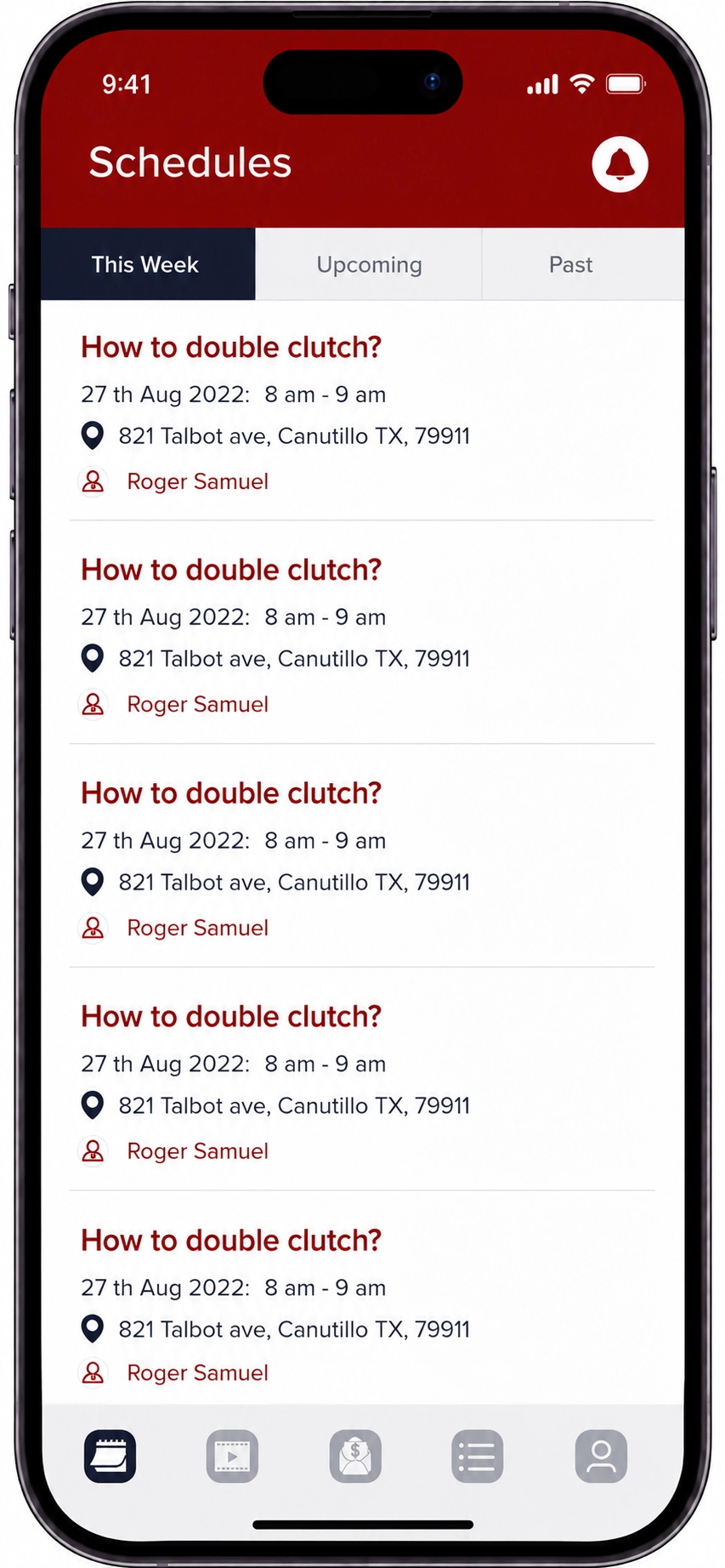
Student Mobile App for CDL Trainees

When a CDL student has to manage training enrollments, DOT certificate uploads, BTW bookings, and ELDT tracking across disconnected channels, it can create an unnecessary administrative burden. NewAgeSysIT builds a CDL school mobile app with an ELDT progress dashboard as the central student-facing feature, delivered as a React Native application for both Android and iOS, covering the entire student workflow. The application tracks cumulative BTW hours against FMCSA minimums, handles DOT physical expiry alerts, and augments CDL permit submissions. It also includes knowledge test preparation based on class and endorsement type, Firebase FCM push notifications, and integrated Stripe payment processing. Every student action that previously needed school staff intervention is managed in-app.

Theory Instruction & Knowledge Test Preparation Platform

The theory instruction completion should be fed directly into ELDT tracking to ensure accurate TPR reporting. Using a disconnected LMS forces manual data handling, increases administrative overhead, and increases compliance risk. NewAgeSysIT builds web- and mobile-based theory instruction platforms that deliver FMCSA ELDT-aligned curriculum under 49 CFR Part 380, Appendices A & B—Federal Motor Carrier Safety Regulations, air brakes, pre-trip inspection, combination vehicles, hazardous materials, and driver wellness. With AAMVA-aligned practice knowledge tests by state, progress monitoring, weak-area identification, and direct integration into the ELDT tracking module, theory completion status automatically flows to TPR reporting, eliminating the need for manual input.

Core Features of High-Performance CDL School Management Software

High-performance CDL school management software combines FMCSA compliance automation, conflict-free BTW scheduling, real-time student progress tracking, and administrative reporting into a unified platform - built for the specific regulatory and operational requirements of US commercial truck driver training. Each feature below exists because a CDL school without it incurs costs in lost training hours, audit exposure, or manual administrative overhead.

FMCSA Compliance & Regulatory Features

If your school is removed from the FMCSA Training Provider Registry, you cannot enrol new CDL applicants. Compliance failures are preventable with the right software. NewAgeSysIT builds compliance features that eliminate manual dependencies. The features are automated per-student ELDT completion tracking against the Range, Theory, and BTW hour requirements for each CDL class. It also includes a TPR reporting engine that generates FMCSA-specified submission data without manual data entry, DOT physical certificate tracking with automated expiry alerts before any BTW session is scheduled, instructor credential monitoring with expiry alerts under 49 CFR Part 380, digital ELDT consent management, and downloadable, audit-ready documentation. These capabilities altogether constitute FMCSA audit-ready compliance software for CDL training providers, covering every documentation requirement an inspector can request.

BTW Scheduling & Range Management Features

Real-time BTW scheduling eliminates double-booking across trucks, instructors, and ranges for 20 to 100 daily sessions without manual intervention. NewAgeSysIT builds scheduling systems that alleviate the issue. With real-time conflict detection across all ranges, trucks, and instructors; cumulative BTW hour tracking per student updated after each session; automatic enforcement of maintenance blackout dates for vehicle availability calendars by truck type; parallel range zone scheduling; Class A and Class B CDL training management system must enforce these distinctions automatically so that instructor qualification mismatches and hour threshold differences between the two classes can't be left to manual oversight. Additionally, automated Twilio SMS and Firebase Cloud Messaging notifications help students and instructors confirm session details without admin intervention.

Student Management & Progress Features

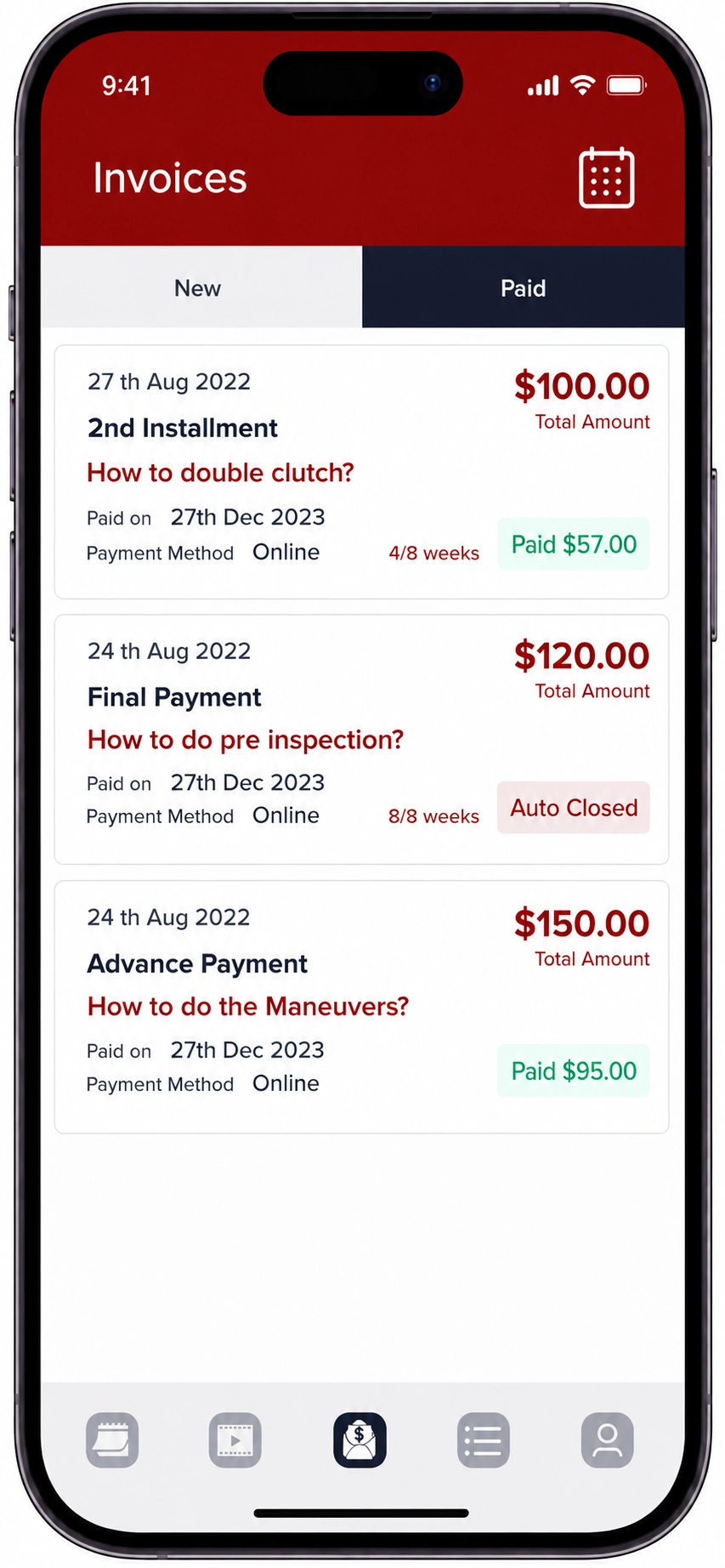
A student who reaches the skills test with an incomplete ELDT record can create a compliance failure that the school can’t quickly recover from. Every student profile in NewAgeSysIT’s system contains a complete data set needed to prevent that outcome: CDL licence class, endorsements, permit number, DOT physical status, and real-time ELDT completion status, all of which are simultaneously visible to administrators, students, and instructors. Training package management encompasses Class A full programmes, endorsement-only packages, and Class B upgrades with validity and pricing tracking. Stripe payment processing manages auto-payment reminders and instalment plans. Additionally, the DOT physical certificates, ELDT consent forms, and CDL permit copies are securely stored in AWS S3. The system enforces test readiness certification, where a student can't be advanced to the skills test until all ELDT requirements are verified complete.

Admin, Reporting, & Communication Features

A CDL school owner who can’t see instructor utilization, daily BTW session load, and revenue by package type in real time makes operational decisions without the data to support them. NewAgeSysIT develops admin dashboards that precisely surface total students by CDL class, daily sessions, active packages, instructor capacity, and regular revenue on a single screen. This positions the platform as automated TPR data-submission software for CDL schools, with the monthly reporting cycle running without staff intervention.

Business performance reports cover revenue by package, enrollment trends, and pass rate analytics. Multi-channel notifications with Twilio, AWS Simple Email Service (SES), and Firebase FCM, automatically manage booking confirmations, DOT physical expiry alerts, and payment reminders. Role-based access ensures operations managers, school owners, instructors, and students see only what they require. Multi-location support offers franchise operators centralized visibility across all locations through a single admin panel.

FMCSA Compliance Requirements Built Into CDL School Software

FMCSA compliance is not a feature layer in CDL school software - it is the foundational operating requirement. Under 49 CFR Part 380, every FMCSA-registered training provider must track student ELDT completion, report to the Training Provider Registry, and maintain audit-ready documentation for every graduated student. Non-compliance results in removal from the TPR registry - eliminating the school's ability to enrol new CDL applicants. More than a background compliance consideration, it is an operational foundation against which every CDL school software should be measured.

FMCSA Entry-Level Driver Training (ELDT) Rule Compliance

From February 7, 2022, every first-time CDL and upgrade applicant should complete approved Entry-level Driver training from a registered TPR provider before appearing for the CDL skills test. Both Behind-the-Wheel Instruction and Theory Instruction should be reported and completed; 30 BTW hours at least for Class A and 15 for Class B. Once a school fails to report the completions accurately, FMCSA won’t process the student’s skills test application. The student can't take the test, and the school's graduation rate declines, and its FMCSA TPR standing becomes subject to review, a compounding operational and regulatory risk. NewAgeSysIT's purpose-built ELDT software for CDL schools eliminates these gaps by automatically logging Theory and BTW completions for each student and generating TPR-formatted data, ensuring TPR standing is never at risk due to tracking gaps.

FMCSA Training Provider Registry

TPR reporting needs schools to submit every student’s completion data that includes CDL permit number, class trained, completion date, and training type, in an FMCSA-defined format, within 10 business days of completion. At volume, manual reporting is where compliance can degrade. A single data entry error, a missed submission window, or a mismatch in formatting is enough to keep your school’s TPR status risk-prone. NewAgeSysIT builds dedicated FMCSA TPR reporting software that removes these variables entirely, replacing manual entry with automated, format-validated submissions. Each required data point is automatically gathered, formatted, and packaged for submission, ready to be uploaded directly or exported to the TPR portal. It lets your compliance record stay clean, and TPR status stays intact.

DOT Physical, CDL Credential, and State Compliance

Scheduling a BTW session for any student with an expired DOT medical examiner’s certificate forms a compliance violation as per 49 CFR Part 391, which spreadsheet-based tracking can miss. NewAgeSysIT’s platform monitors certificate expiry and notifies students and admins before expiry, ensuring that non-compliant students reach the BTW scheduling stage. At the state level, Texas DPS, California DMV, and Florida DHSMV each have CDL programme approval standards beyond federal minimums. The platform incorporates state-specific documentation and field requirements, rather than forcing schools to manage that gap outside the system. Test readiness track links directly to ELDT completion, so no student is advanced to the skills test until they meet the federal training requirements.

Technology Stack for CDL School Software Development

NewAgeSysIT builds custom CDL school software on the same proven technology stack as the confirmed Driving School SRS - NestJS/Node.js backend, Angular web admin, React Native mobile apps, PostgreSQL and MongoDB databases, and AWS cloud infrastructure - with CDL-specific compliance modules layered on top of the foundational architecture.

AWS infrastructure is configured with auto-scaling for peak enrolment periods and supports multi-location CDL franchise networks, ensuring platform performance doesn’t degrade as student intake increases. The client owns the whole codebase at delivery, and it includes no licensing fees, student charges, or vendor dependency on NewAgeSysIT’s continued operation.

Layer Technologies
Backend API Node.js · NestJS
Web Admin Panel Angular
Student Mobile App (iOS & Android) React Native
Database PostgreSQL · MongoDB
Authentication OAuth 2.0 · JWT
FMCSA Compliance ELDT tracking module · TPR reporting engine · DOT physical tracker
Communications Twilio · Firebase FCM · AWS SES
Cloud Infrastructure AWS EC2 · AWS S3 · AWS RDS
Payments Stripe API
DevOps Docker · Kubernetes · GitHub Actions
CDL-Specific Integrations FMCSA TPR API · AAMVA CDL test content · Google Maps API

Our CDL School Software Development Process

NewAgeSysIT follows the same phased, sprint-based development process as the confirmed Driving School SRS - Planning, Design, Development, Testing, and Deployment - with CDL-specific FMCSA compliance validation built into every development phase, not added at the end.

Stage 1: CDL School Discovery & Requirements Analysis

Before drawing any architecture, NewAgeSysIT maps the driving school’s CDL programme offerings across Class A, B, and C, BTW fleet size, FMCSA TPR registration status, instructor count, student volume, and state-centric approval requirements. The client receives a Business Requirements Document, an FMCSA compliance checklist, a system architecture, and a project roadmap, so that the full scope is agreed upon before committing to development costs.

Stage 2: FMCSA Compliance Architecture Design

The process follows designing and documenting the ELDT tracking data model, TPR reporting format, DOT physical compliance workflow, and role-based access structure before writing a single line of code. Compliance architecture sign-off is never an assumption, but a mandatory requirement carried through to development.

Stage 3: UI/UX Design for All Components

Before development starts, the wireframes and prototypes for the Admin Panel, instructor interfaces, and Student Mobile App are created in Figma and approved by stakeholders. All CDL-specific UI components, including the BTW hour progress tracker, DOT physical expiry indicator, and ELDT completion dashboard, are analyzed at this stage rather than being redesigned mid-sprint.

Stage 4: Agile Sprint-Based Development

Our team follows a two-week sprint model with a compliance-first priority order. ELDT tracking and TPR reporting engine go first, followed by BTW scheduling, then the Student Mobile App, and finally the Admin Dashboard. Stripe and Twilio integrations follow during mid-programme sprints.

Stage 5: FMCSA Compliance Testing & Integration Validation

ELDT tracking accuracy is evaluated against 49 CFR Part 380 standards. TPR data export format is tested against FMCSA specifications. API testing via Postman validates TPR data export format against FMCSA specifications. Also, it includes regression testing of DOT physical expiry alerts, Stripe payment workflows, and BTW conflict detection. The client doesn’t receive a platform that passes its first TPR submission; they receive one that has already been proven to pass.

Stage 6: QA, UAT, & Deployment

We conduct User Acceptance testing with CDL school administrators, instructors, and students. The TPR reporting workflow has been confirmed with the driving school’s FMCSA compliance officer, and deployment has been made to AWS EC2 and RDS. The React Native Student app gets submitted to the Play Store and App Store. Before go-live, the AWS CloudWatch monitoring gets configured.

Stage 7: Post-Launch Support & Compliance Updates

FMCSA updates the requirements in 49 CFR Part 380 over time. NewAgeSysIT offers SLA-backed post-launch support that covers regulatory update tracking, AWS infrastructure management, Stripe issue resolution, and feature iteration with the school’s operational scale. The platform remains compliant with changes in the regulatory landscape. As a result, you get a platform that is stable, compliant, and operationally ready to handle changes in requirements.

Why Choose NewAgeSysIT for CDL School Software Development in The United States?

NewAgeSysIT builds CDL school software with FMCSA ELDT compliance, TPR reporting, and DOT physical tracking as core architecture requirements - not optional configurations - giving US CDL schools a technology partner that understands the federal regulatory obligations that determine whether a school can operate. Selecting the right truck driver training software means choosing a vendor whose architecture was built for FMCSA requirements from day one. NewAgeSysIT eliminates this risk across five major dimensions.

  • A Validated Architecture as the Starting Point NewAgeSysIT has a dedicated driving school management system, SRS (Software Requirements Specification), which the CDL platform extends. By accelerating discovery and validating the core architecture, the client need not fund a vendor’s learning curve in school management software fundamentals.
  • FMCSA Compliance Built as Core Architecture TPR reporting, ELDT tracking, and DOT physical management are foundational elements defined at the architectural level, not features added later to a generic school management system. These capabilities are incorporated into the core platform design from the start to ensure regulatory compliance and operational consistency. Compliance is not treated as an add-on layer but is embedded in the platform, enabling accurate reporting, minimizing administrative risk, and ensuring an audit-ready system at all times.
  • A Scheduling Engine Built for Commercial Training Operations BTW scheduling across multiple truck types, FMCSA-qualified instructors, and range zones, with real-time conflict detection and cumulative BTW hour tracking against regulatory minimums, has been built to meet the specific operational requirements of a CDL school rather than repurposing from a common booking system.
  • One Team, Three Integrated Components The student app, admin panel, and optional Instructor app are delivered as a fully integrated system by a single development team. It includes no inter-vendor integration failures or compatibility gaps between components that were discovered post-go-live.
  • Full IP Ownership, No Ongoing Fees Complete source code transfers to the client upon project completion. It involves no SaaS licensing, vendor lock-in, or per-student fees. The platform stays as an owned asset rather than a recurring liability.

Flexible Engagement Models for CDL School Software Development

NewAgeSysIT offers three engagement models for CDL school software development, such as end-to-end platform delivery, dedicated team augmentation, and compliance consulting, designed for the operational and regulatory realities of US CDL school operators. The engagement models cover the full range, all of which include FMCSA ELDT compliance architecture and full client IP ownership as standards.

End-to-End CDL Platform Delivery

NewAgeSysIT offers a comprehensive CDL school management system, including a Student Mobile App, Admin Panel, ELDT tracking engine, and TPR reporting module, as a fully managed project. The client defines what the platform should do; NewAgeSysIT owns everything from discovery to deployment, including delivery, compliance architecture, and quality assurance. This model is the right fit for CDL schools without in-house engineering, seeking to build a custom truck driver training management system tailored to the school's operational profile, fleet size, and compliance requirements.

Dedicated CDL Software Development Team

For CDL school software companies and franchise networks that have an in-house Chief Technology Officer, NewAgeSysIT delivers dedicated engineers for NestJS backend, React Native mobile, Angular admin, and FMCSA compliance module, who integrate directly into the existing team. NewAgeSysIT manages HR, recruitment, payroll, and benefits. The client directs the roadmap and retains complete control of the project. Unlike direct hires, you can scale engineering capacity on demand with zero employment overhead.

FMCSA Compliance Consulting & Architecture Review

For schools that evaluate their existing platform against FMCSA ELDT requirements before proceeding with a rebuild, NewAgeSysIT offers a senior consultant who reviews the existing system, understands compliance gaps, and defines the TPR reporting roadmap and software architecture needed to close them. The deliverable is a written FMCSA compliance gap analysis and a CDL software architecture blueprint, providing a precise, clear picture of what the existing system covers before any development investment is made.

CDL School Software Development Cost in the United States

Custom CDL school software development cost is determined by FMCSA compliance scope, number of platform components, BTW scheduling complexity, fleet size, and student volume requirements, with ELDT tracking and TPR reporting as mandatory non-optional cost components for any FMCSA-registered CDL training provider. It trades a one-time development investment for a permanent manual compliance overhead alongside regular audit exposure. ELDT monitoring and TPR reporting are not optional features; they are incorporated into every viable CDL school software build.

Factors Affecting CDL School Software Development Cost

The final investment is determined by seven variables. FMCSA compliance depth is a non-optional baseline cost for every viable CDL school platform. Also, the factors include the number of platform components required, BTW scheduling complexity between a three-truck single-location school and a 30-truck franchise network; fleet size and the conflict detection logic as mandated; if a theory instruction and knowledge test preparation module is incorporated; student mobile app scope; and multi-location franchise architecture, adding significant backend complexity to the admin and reporting layer.

Estimated Cost by Platform Scope

Platform Scope Components Estimated Cost
FMCSA Compliance Module Only TPR reporting, DOT physical tracking, and ELDT dashboard added to existing software $15,000 – $35,000
Admin Panel & Compliance Module Angular web admin with all management modules $40,000 – $80,000
Full Two-Component System Admin Panel + Student Mobile App + ELDT tracking $70,000 – $140,000
Enterprise CDL Platform Admin Panel + Student App + Theory Platform + Multi-Location $140,000 – $300,000

All ranges are indicative for the US market. Final cost is confirmed after the discovery and requirements analysis.

CDL Software MVP for New and Growing Schools

The CDL software MVP covers everything every FMCSA-registered school needs to operate in compliance with FMCSA regulations from day one. It includes the Admin Panel with ELDT tracking, TPR reporting module, BTW scheduling, and student payment management. ELDT tracking and TPR reporting are in the MVP because they are federal operational requirements, not features to phase in later. The Student Mobile App will follow in a second sprint once admin operations and the compliance architecture are stable in production. MVP delivery: $40,000–$90,000 in 12-18 weeks. It ensures the creation of a compliant, production-ready CDL school platform without a multi-year build timeline.

Build Your Custom CDL School Management Platform Today

Request a Free CDL Software Consultation with NewAgeSysIT

CDL schools that manage ELDT tracking manually, submit TPR reports by hand, and schedule BTW sessions with spreadsheets don’t run a lean operation; they run a compliance risk and absorb operational costs that compound with each cohort. Transitioning to FMCSA-compliant CDL school management software resolves both problems, eliminating manual compliance overhead and giving operations the infrastructure to scale.

NewAgeSysIT provides a free consultation with a senior developer who understands the FMCSA ELDT requirements, CDL school operational workflows, and TPR reporting architecture. The outcome involves a clear scope assessment, an initial cost range according to the school’s specific operational profile, and a detailed recommendation, like custom build, addition of compliance modules, or a dedicated team, based on what you actually need. A CDL school cannot operate without a compliance infrastructure. This consultation defines exactly what your platform must include to meet FMCSA requirements and scale without operational risk.

Schedule a Strategy Call to Discuss Your CDL Truck Driving School Software

Work with a team that defines your platform architecture, validates your feature scope against real operational requirements, and aligns your system with a structured, SRS-driven development approach. Whether you are building a new driving school platform or replacing existing systems, this consultation gives you a clear, execution-ready roadmap with defined components, integrations, and cost visibility.

FAQs

Questions founders often ask

What are CDL truck driving school software development services?

CDL truck driving school software development services involve designing and building purpose-built management platforms for FMCSA-registered training providers, covering student enrollment, BTW scheduling, ELDT tracking, and TPR reporting, which help schools streamline operations, eliminate compliance risk, and manage student records efficiently.

Why do CDL schools in the United States invest in custom software development?

CDL schools invest in custom software development to eliminate manual ELDT tracking and TPR reporting overhead, prevent compliance failures that put their FMCSA Training Provider Registry standing at risk, and scale BTW scheduling across multiple trucks, instructors, and ranges without operational breakdowns.

What is custom CDL school software and how does it work?

Custom CDL school software is a tailored management platform built around specific FMCSA training workflows, which works by integrating student records, automating ELDT tracking, and enabling real-time TPR reporting across systems, improving compliance and operational decision-making.

What features are included in CDL truck driving school software services?

CDL school software development services include features such as student enrollment with CDL class management, BTW scheduling and range management, ELDT tracking with TPR reporting, instructor and fleet vehicle management, DOT physical compliance, and analytics dashboards, which support efficient training delivery and student progress.

Can CDL school software be customized for franchise networks and multi-location providers in the US?

CDL school software can be customized for franchise networks and multi-location providers using a multi-tenant architecture that gives regional operations directors centralized administrative control with location-specific execution, distributed compliance data handling, and consolidated reporting across every site.

What is the FMCSA Training Provider Registry and why is it important?

The FMCSA Training Provider Registry is the federal registry where every CDL training provider must submit student completion data within 10 business days of completion, which is important because failed or inaccurate submissions put the school's TPR standing at risk and prevent students from being cleared for their CDL skills test.

How does the platform improve student engagement and communication?

The platform improves student engagement and communication by centralizing student records, automating booking confirmations and DOT physical reminders, and enabling Twilio SMS and Firebase FCM push notifications, which helps schools deliver timely communication and reduce administrative back-and-forth across the training cycle.

Can custom CDL software be built specifically for trucking companies and CDL schools in the USA?

Custom CDL software can be built specifically for trucking companies and CDL schools in the USA by tailoring features such as student tracking, BTW scheduling workflows, ELDT and TPR reporting tools, and FMCSA integrations, which ensures compliance with federal training standards and alignment with operational needs.

What are the benefits of custom CDL school software over off-the-shelf driving school platforms?

Custom CDL school software offers advantages over off-the-shelf driving school platforms by providing FMCSA-aligned ELDT and TPR functionality, better scalability across multi-location fleets, and seamless integrations with the FMCSA TPR API and AAMVA test content, which helps schools avoid limitations and build systems that match their exact compliance requirements.

How long does it take to develop CDL school software in the USA?

CDL school software development timelines in the USA depend on project complexity and feature scope, with a typical MVP including ELDT tracking, TPR reporting, and BTW scheduling delivered in 12 to 18 weeks, which allows schools to launch compliantly and expand capabilities through phased iterations.

How much does CDL school software development cost in the United States?

CDL school software development costs in the United States vary based on features, integrations, and platform scope, ranging from $15,000 to $35,000 for an FMCSA compliance module up to $140,000 to $300,000 for an enterprise multi-location platform, which allows schools to choose flexible development approaches that align with their budget and long-term growth plans.

Are CDL school software solutions scalable for growing training providers in the United States?

CDL school software solutions are scalable for growing training providers in the United States by using AWS auto-scaling cloud infrastructure and modular architecture, which enables systems to handle increasing student intake, instructor count, BTW session volume, and franchise locations without performance issues.

How secure are CDL school applications developed in the USA?

CDL school applications developed in the USA are secure by implementing OAuth 2.0 and JWT authentication, role-based access control, AWS S3 encrypted storage for DOT certificates and ELDT consent forms, and AWS CloudWatch monitoring, which helps protect sensitive student records and maintain compliance system integrity.

Are CDL school software solutions compliant with FMCSA regulations?

CDL school software solutions are designed to support FMCSA compliance by incorporating ELDT tracking against 49 CFR Part 380, automated TPR reporting, DOT physical certificate monitoring under 49 CFR Part 391, and audit-ready documentation, which ensures student training data is stored and submitted according to federal regulatory standards.

Can CDL school software integrate with the FMCSA TPR and AAMVA test content?

CDL school software integrates with the FMCSA TPR and AAMVA test content by using secure APIs and federal interoperability standards, which allows seamless completion data submission, reduces manual entry errors, and improves training workflow decision-making.

What technologies are used for CDL school software and mobile app development in the USA?

CDL school software and mobile app development in the USA use modern technologies such as Node.js with NestJS for the backend, Angular for the admin panel, React Native for iOS and Android, PostgreSQL and MongoDB databases, and AWS cloud infrastructure, which ensure performance, flexibility, and reliable system integration.

Can theory instruction and knowledge test prep features be included in CDL school software?

Theory instruction and knowledge test prep features can be included in CDL school software by delivering FMCSA ELDT-aligned curriculum under 49 CFR Part 380, AAMVA-aligned practice tests by state, and direct integration into the ELDT tracking module, which helps expand training delivery and improve student pass rates.

How does CDL school software improve operational efficiency?

CDL school software improves operational efficiency by automating ELDT tracking and TPR submissions, reducing paperwork, and centralizing student and fleet data management, which helps schools save time, reduce compliance errors, and optimize instructor and truck utilization.

Is custom CDL school software suitable for new and growing schools in the United States?

Custom CDL school software is suitable for new and growing schools in the United States because it enables rapid MVP delivery in 12 to 18 weeks, flexible scaling across student cohorts and locations, and tailored FMCSA-aligned features, which helps schools launch compliantly and adapt to evolving regulatory needs.

Why should U.S. CDL schools choose a software development company with a presence in New Jersey?

U.S. CDL schools choose a software development company with a presence in New Jersey because it enables better collaboration, time zone alignment with US training providers, and faster communication on FMCSA compliance scope, which helps ensure smoother project execution and reliable ongoing support across regulatory updates.

Let's Build Your Next Big Thing — Together!

We grow strong with a 100% in-house team, 30+ years of industry expertise, and proven results. From concept to launch, we deliver innovation with precision and reliability.

Your idea is 100% protected by our non-disclosure agreement

Guaranteed expert consultation within 1 hour

Call directly: 1-609-919-9816

Our HQ
NewAgeSysIT
4390 US-1, Suite 110, Princeton, NJ 08540

Talk to Our Experts Today

Get a free project estimate in under 60 minutes.

🔒 Your idea is protected under NDA & confidentiality policy