
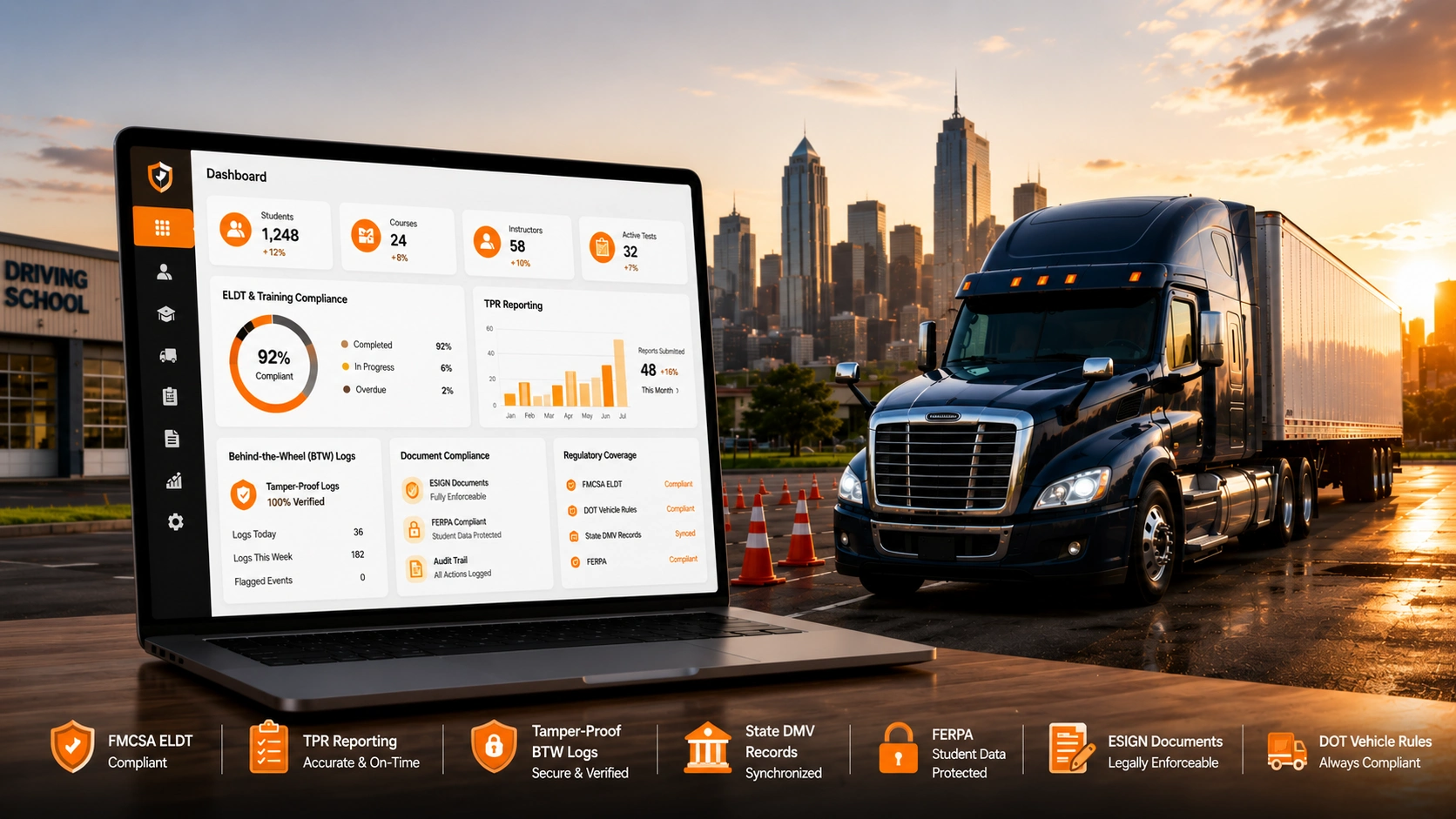

Driving school software compliance in the USA involves more regulatory layers than many DriveTech founders expect. CDL programs must follow FMCSA ELDT documentation and Training Provider Registry (TPR) reporting rules. Every driving school must maintain DMV-compliant student and training records. Schools that receive federal education funding may also fall under FERPA requirements.
The compliance stack becomes even more complex for CDL operators. DOT vehicle safety regulations apply to training fleets and instructor operations. California-based schools must also address CCPA student data privacy obligations. Digital enrollment forms, waivers, and BTW consent documents must meet the enforceability standards of ESIGN and UETA.
Each framework creates different operational risks. FMCSA TPR non-compliance is the most serious compliance risk for CDL programs. Removal from the Training Provider Registry can immediately stop a school from legally training new CDL applicants. State DMV record failures may also trigger audits, penalties, or license suspension.
BTW session logs remain one of the most universally applicable compliance requirements across the industry. Every driving school needs defensible training records, regardless of FMCSA, FERPA, or DMV status. Missing or inconsistent logs can quickly create problems during audits, disputes, or insurance investigations.
Teams building platforms through driving school mobile and web app development services or custom CDL software and CRM development services benefit from planning compliance early. Retrofitting audit trails, reporting workflows, and document controls after launch usually costs far more in time, risk, and engineering effort.
The US Driving School Software Compliance Stack
US driving school software must operate within a layered compliance environment. Each regulation applies differently based on program type, funding structure, student location, and vehicle operations. Understanding how these frameworks overlap helps DriveTech teams plan compliance requirements early.
- FMCSA ELDT and TPR (CDL programs): This is the most consequential compliance requirement for CDL training programs. Federal rules require documented completion of training across curriculum domains. Schools must also submit records electronically to the FMCSA Training Provider Registry and retain records for at least three years. Non-compliance can result in removal from the TPR.
- State DMV record-keeping: Each US state sets its own requirements for driving school record-keeping and formatting. These rules often cover BTW hours, instructor assignments, vehicle records, and graduation documentation. Missing or inconsistent records can lead to audits, penalties, or suspension of a school license.
- FERPA (federally funded schools): Schools that receive federal education funding may be subject to FERPA student privacy requirements. Non-compliance can create funding risks and potential enforcement action.
- DOT vehicle safety regulations: Commercial vehicles used for CDL training must comply with FMCSA safety standards, inspection requirements, minimum insurance requirements, and equipment rules.
- CCPA (California students): Student contact details, payment information, and training records may qualify as protected personal information. CCPA applies to schools that meet its revenue or data thresholds.
- Digital document enforceability: Enrollment agreements, BTW consent forms, and parental authorization records must comply with ESIGN and UETA standards. Unenforceable documents can create serious liability exposure during disputes or claims.
This guidance is strategic and technical, not legal advice. Qualified transportation, education, and privacy counsel should be engaged for specific compliance determinations.
FMCSA ELDT Compliance: The Highest-Stakes Regulatory Requirement for CDL Programs
FMCSA Entry-Level Driver Training (ELDT) compliance carries the most serious regulatory consequences for CDL training programs. The framework governs how providers register, document, and report driver training to the federal government. Software supporting CDL programs must meet each requirement from day one.
- Training Provider Registry (TPR) registration: CDL programs must register with the FMCSA TPR and stay in good standing. Registration requires meeting curriculum, instructor, and facility standards.
- ELDT documentation requirements: Providers must document each trainee’s completion of theory and BTW training for each curriculum domain. Each entry requires an instructor’s sign-off and electronic transmission to the TPR within the required timeframes.
- TPR submission data: Submissions must include trainee name, SSN or federal ID, date of birth, training type, completion date, and provider information. The data must follow the FMCSA’s format.
- Record retention: CDL training records must be retained for at least three years after training completion. Records must remain available for FMCSA audit during that period.
- CLP enforcement: CDL behind-the-wheel training cannot begin until the Commercial Learner’s Permit has been held for 14 days. Software must enforce this restriction at the scheduling layer and not just display it as a warning.
- Non-compliance consequences: FMCSA can remove non-compliant providers from the TPR, immediately ending their authority to train CDL applicants.
These requirements are federal regulatory obligations and should be treated as operational guidance, not legal advice. Qualified transportation law counsel is essential for specific compliance determinations.
BTW Log Compliance: The Most Universally Applicable Driving School Obligation
Behind-the-wheel (BTW) session logs are the most universally required compliance element for US driving schools. They apply to every school providing BTW instruction, regardless of FMCSA, FERPA, or CDL status. BTW logs are legal compliance documents, not optional training metadata.
- State DMV record requirements: Most states require BTW logs to capture student identity, session date and time, instructor of record, and vehicle used. Cumulative hours toward licensing are also required. The format must satisfy each state’s audit standards.
- ESIGN and UETA compliance: Digital BTW session logs with electronic instructor sign-off must comply with the federal ESIGN Act. They must also meet state UETA requirements to be legally enforceable. Logs that fail these standards can be challenged in court when the school needs them most.
- Immutability after sign-off: BTW session records must not be alterable after instructor sign-off. Post-session modification creates compliance and legal risks that digital architecture must prevent by design, typically through append-only storage or cryptographic signing.
- State retention periods: Most US states require driving school student records to be retained for three to seven years. Software must support retention, archiving, and audit-accessible retrieval during that time.
Cybersecurity: The Operational Compliance Foundation for Driving School Platforms
Cybersecurity is the operational layer that holds every other compliance commitment together. For US driving school platforms, security is both a regulatory requirement and an obligation to student trust.
- Sensitive data combination: Driving school platforms hold student identity information, minor student records, payment card data, and BTW training records. Schools covered by FERPA also store protected education records. This combination makes cybersecurity simultaneously a compliance requirement and a duty of care to students.
- Data breach notification: Most US states require notification to consumers within 30 to 90 days of a breach affecting personal information. Driving school platforms need a documented incident response plan with state-specific notification timelines built in.
- BTW log integrity as a security requirement: Tamper-evident storage for BTW session records serves two purposes. It satisfies the legal requirement for immutability and the security requirement to prevent unauthorized alteration of compliance records.
- Minor student data protection: Platforms serving students under 18 hold particularly sensitive personal data. Enhanced access controls and stricter monitoring match the sensitivity of minor student records. They also align with security best practices and regulatory expectations.
DOT Regulations and CDL Licensing Rules for Driving School Technology
DOT regulations and CDL licensing rules determine how CDL training platforms manage vehicles, licensing workflows, and operational records. These requirements go beyond FMCSA ELDT reporting and impact daily training operations.
- DOT vehicle inspection tracking: CDL training vehicles must pass the required DOT safety inspections. Platforms that monitor inspection dates and provide renewal alerts help schools maintain valid certifications.
- FMCSA insurance minimums for CDL training: Commercial vehicles used for CDL training must maintain minimum liability insurance coverage. Storing insurance documents and tracking renewals helps prevent lapses.
- CDL licensing pathway support: Software should accurately represent the CDL process, including CLP issuance, the 14-day holding period, skills testing, and license application workflows.
- State CDL licensing variation: States have different testing procedures and licensing requirements. Multi-state CDL programs must accurately support these differences.
- USDOT Number tracking: Schools operating commercial vehicles must keep active USDOT registration and renewal records.
DOT inspection requirements, FMCSA insurance minimums, and CDL licensing obligations should be treated as operational guidance, not legal advice. Qualified transportation law counsel is recommended for specific compliance determinations.
The Real Cost of US Driving School Software Compliance
Compliance costs are often underestimated during early DriveTech planning. Most compliance work happens at the architecture level and rarely appears in standard development estimates. Building compliance into the platform from the start typically adds 15–25% to development costs. Retrofitting compliance after launch can increase costs by 50–100%.
- FMCSA ELDT and TPR integration: Usually costs $15,000–$40,000. It is one of the most underestimated compliance investments and the most critical for CDL operations.
- State DMV compliance architecture: Immutable BTW logs, DMV-formatted exports, and audit-ready reporting typically add $8,000–$20,000.
- FERPA-aware access controls: Schools that receive federal education funding may spend an additional $5,000–$15,000.
- ESIGN and UETA compliance: Digital enrollment agreements, BTW consent forms, and parental consent workflows generally add another $8,000–$20,000.
The operational impact of non-compliance is far higher. FMCSA TPR removal can stop CDL training operations, and DMV license suspension can shut down a driving school entirely. Unenforceable BTW logs can also fail when a liability claim is filed.
Building Compliance-First US Driving School Software Architecture
A compliance-first architecture does not increase costs compared to standard approaches. Addressing regulatory requirements during design is more cost-effective than making changes after deployment. The following components provide the technical foundation for ongoing compliance.
FMCSA ELDT and TPR Infrastructure
This includes ELDT curriculum tracking by CDL class and endorsement type, plus instructor sign-off capture. The architecture also covers a TPR submission queue with error handling and FMCSA audit report generation. The scheduling layer should enforce CLP requirements by preventing BTW sessions from being booked before the 14-day holding period is met.
BTW Log Immutability and DMV Compliance
Append-only session log storage, with cryptographic or database-level immutability, protects records from alteration after a session ends. State DMV-formatted record export produces training records in the format each state requires for audit.
FERPA-Compliant Data Architecture (If Applicable)
Role-based access controls restrict student record access to only what is necessary. Instructors can view only their assigned students. Disclosure management enables consent-based sharing when records are released to third parties.
CCPA Consumer Data Rights
Student data must be exported within 45 days. The deletion pipeline must comply with FMCSA and DMV retention requirements. Opt-out management is required for California students.
Digital Document Compliance
Enrollment agreements, BTW consent forms, and parental consent records must comply with ESIGN and UETA. These documents require clear intent to sign, identity confirmation, timestamped signatures, and version tracking.
These components can be implemented through custom software development or custom mobile app development workflows, depending on the platform type and delivery requirements.
Common US Driving School Software Compliance Failures
Many driving school compliance failures come from preventable workflow and recordkeeping gaps. These issues often remain hidden until a DMV audit, FMCSA review, or liability dispute exposes them.
- FMCSA TPR data format errors: Missing required fields or incorrect ELDT submission formats can trigger TPR submission failures and compliance investigations.
- CLP 14-day violations: Some platforms allow BTW sessions before a student has held a CLP for 14 days. Purpose-built CDL software should automatically block these scheduling errors.
- Mutable BTW session records: Standard editable session logs allow records to be changed after training is completed. These records often fail under DMV audit scrutiny.
- FERPA misidentification: Schools that receive federal education funding may be subject to FERPA requirements. Ignoring FERPA applicability creates student record compliance risks.
- Non-ESIGN-compliant enrollment documents: Simple checkbox agreements without ESIGN or UETA-compliant identity verification may become unenforceable when schools need them during disputes or claims.
Final Thoughts
To achieve US driving school software compliance, several frameworks must be addressed in parallel: FMCSA ELDT documentation, immutable BTW logs, state DMV data formats, FERPA, where applicable, DOT vehicle standards, and ESIGN-compliant digital documents. Define each requirement before starting architectural design. Software built on these principles supports regulatory audits and protects school licensing.
If your team is developing US driving school or CDL software, plan compliance into the architecture. Align with FMCSA ELDT requirements, create tamper-proof BTW logs, and follow state DMV data formats. Digital records should also meet ESIGN standards. Addressing each step early reduces regulatory risk and safeguards school operations.
Learn more about how we work with DriveTech teams at NewAgeSysIT.
Frequently Asked Questions
What is FMCSA ELDT, and which drivers must complete it?
Entry-Level Driver Training (ELDT) is an FMCSA requirement governing first-time CDL applicants. They must complete both theory and behind-the-wheel training from an FMCSA-registered provider before seeking a Class A or B CDL, a CDL upgrade, or a hazmat, passenger, or school bus endorsement. Providers must document completion across each curriculum domain and transmit it to the Training Provider Registry.
How quickly must training completion be reported to the FMCSA TPR, and how long are records kept?
Registered providers must document each trainee’s completion, with instructor sign-off, and transmit it electronically to the FMCSA Training Provider Registry within the required timeframes. CDL training records must be retained for at least three years after completion and remain available for FMCSA audit during that period. Non-compliance can result in removal from the TPR, which immediately ends a provider’s authority to train CDL applicants.
What is the CLP 14-day rule, and how should software enforce it?
CDL behind-the-wheel training cannot begin until the Commercial Learner’s Permit has been held for 14 days. Software must enforce this at the scheduling layer by preventing BTW sessions from being booked before the holding period is met, not simply displaying it as a warning. Platforms that allow early booking create CLP 14-day violations that surface during audits.
Why do BTW session logs need to be immutable?
BTW session logs are legal compliance documents, not optional training metadata. Records must not be alterable after instructor sign-off, since post-session modification creates compliance and legal risk. This is typically achieved with append-only storage or cryptographic signing, so logs hold up under DMV audits, liability disputes, and insurance investigations. Most states also require these records to be retained for three to seven years.
When does FERPA apply to a driving school?
Schools that receive federal education funding may be subject to FERPA student-privacy requirements. That means treating training performance records as protected, and applying role-based access controls and consent-based disclosure management. Ignoring FERPA applicability creates student-record compliance risks and potential funding or enforcement consequences.
What standards must digital enrollment and consent documents meet?
Enrollment agreements, BTW consent forms, and parental authorization records must comply with the federal ESIGN Act and state UETA requirements to be legally enforceable. Compliant documents need clear intent to sign, identity confirmation, timestamped signatures, and version tracking. Simple checkbox agreements without ESIGN/UETA-compliant identity verification may become unenforceable exactly when a school needs them during a dispute or claim.
How much does compliance add to driving school software cost?
Building compliance into the platform from the start typically adds 15–25% to development costs, while retrofitting it after launch can increase costs by 50–100%. As a rough guide, FMCSA ELDT and TPR integration usually runs $15,000–$40,000, state DMV compliance architecture adds $8,000–$20,000, FERPA-aware access controls add $5,000–$15,000, and ESIGN/UETA document workflows add another $8,000–$20,000.


