
Welcome to Blogs
Discover actionable insights, in-depth research, and expert perspectives, all in one place.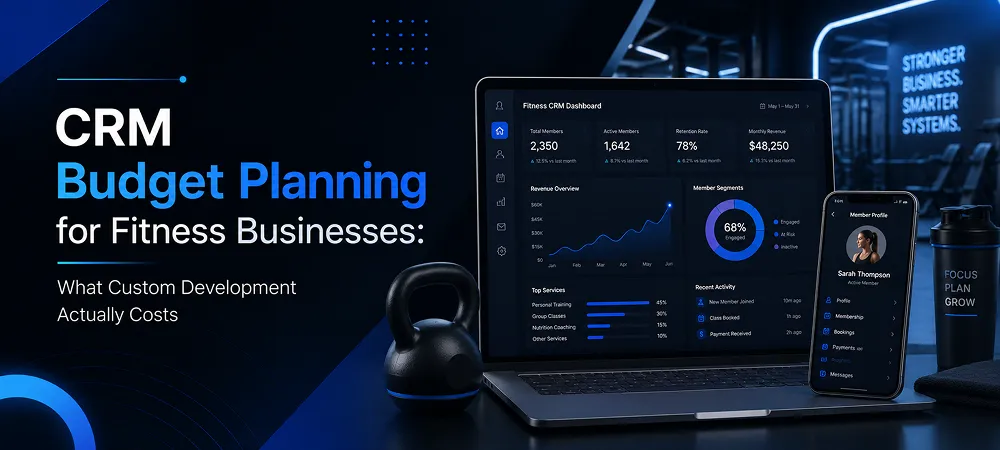
Fitness 6 min read
CRM Budget Planning for Fitness Businesses: What Custom Development Actually Costs

Why Fitness CRM Cost Estimates Are Consistently Unreliable
Custom CRM development cost estimates for fitness businesses share a consistent flaw. They scope the member-facing app and stop there.
The member-facing iOS and Android apps, the instructor companion app, and the admin web portal are distinct. Also, the payment processing integration, the wearable API connections, and the automation sequences are each unique engineering deliverables. None of these appear in an estimate for “a gym management app.”
Founders who receive that initial number and proceed on it encounter 40-70% budget overruns mid-project, when scope reality becomes unavoidable.
Teams partnering with custom fitness mobile and web app development specialists avoid this failure pattern through upfront component scoping. Custom fitness CRM development produces budgets that hold through launch when estimating every major platform component. These include member app, instructor app, admin portal, billing architecture, wearable integrations, and automation sequences.
This article provides realistic development cost ranges for US fitness CRM projects by scope tier. It also covers the components most commonly missing from initial estimates and outlines ongoing operational costs after launch. All figures are 2026 planning ranges; actual project costs depend on specific scope, team structure, and technology decisions.
For US fitness startups, getting the budget right is where the entire CRM lifecycle either gets built on solid ground, or doesn’t get built at all.
Off-the-Shelf vs Custom: The Build vs Configure Decision
US fitness operators should evaluate off-the-shelf platforms before committing to custom development.
Mindbody serves large gyms and multi-location operators. Wodify is built for CrossFit and functional fitness. Zen Planner targets martial arts, yoga, and boutique fitness. PushPress is positioned as a modern gym management alternative.
Each provides pre-built member management, class scheduling, and billing functionality at annual subscription costs between $3,000 and $15,000. It is significantly below the investment required for custom development.
Configure off-the-shelf when the business’s membership structure, member-facing experience, and workflow are adequately served by an existing platform’s feature set. The subscription cost is lower, implementation is faster, and the vendor handles the ongoing maintenance.
Build custom when the competitive advantage depends on a member experience that the existing platforms cannot deliver. This applies when membership tier architecture is too complex for the platform configuration. It also applies when wearable integrations must go beyond a platform’s native connections.
Custom development also fits fitness technology products with white-label or multi-tenant requirements. These needs are different from managing a single gym.
Custom Fitness CRM Development Cost by Scope Tier
The following ranges are 2026 planning estimates. Actual project costs depend on feature depth, team location, and architecture decisions specific to each build.
Entry-Level Fitness CRM
This tier covers a member-facing mobile app for iOS and Android, basic member profiles, class booking, and scheduling. It also includes attendance tracking, simple membership billing across 1-2 tiers with monthly billing cycles, and automated post-class review requests. Scope excludes wearable integration, complex automation sequences, and an admin web portal.
Typical planning range: $50,000 to $100,000. Timeline: 10 to 16 weeks.
Mid-Scale Fitness CRM
This tier adds an instructor companion app and a web-based admin portal to the member app. Membership billing supports multiple tiers with configurable billing cycles, freeze functionality, and dunning management.
Lead capture and trial conversion automation covers email and SMS sequences. Progress tracking and goal management are included. Payment processor integration with Stripe or equivalent is in scope.
Typical planning range: $120,000 to $280,000. Timeline: 18 to 30 weeks.
Full Fitness Platform
This tier adds wearable integrations like HealthKit, Google Health Connect, Fitbit, and Garmin. The features include multi-location and franchise support, corporate account billing, and advanced automation sequences covering churn prediction triggers. Win-back campaigns, referral programs, white-label capability, and an analytics dashboard round out the full-platform feature set.
Typical planning range: $300,000 to $700,000 or above. Timeline: 6 to 14 months.
Cost Drivers That Most Estimates Miss
The line items below are consistently absent from initial fitness CRM estimates and consistently present in final project invoices. Accounting for them at the budgeting stage determines whether the project lands within range. Without that planning, teams typically face emergency scope reduction halfway through development.
Instructor companion app: The member-facing app is almost always scoped. The instructor app covers class check-in, real-time member profile access, session note entry, and class roster view. This is rarely included in the initial estimate. Typical addition: $25,000 to $60,000.
Admin web portal: Gym managers and operations staff need a browser-based interface for reporting, member management, billing oversight, and campaign management. Typical addition: $20,000 to $50,000.
Wearable API integration per platform: Each wearable platform is a separate engineering integration. OAuth implementation, data normalization, sync architecture, and compliance documentation are required for each. Typical addition: $10,000 to $25,000 per platform. Four platforms at mid-range add $60,000 to a project scope that assumes a single integration.
Payment processor integration and billing complexity: Standard Stripe integration typically ranges from $5,000 to $15,000. Corporate invoicing, multi-location revenue splitting, and franchise fee calculation each add $15,000 to $40,000, depending on complexity. Membership tier and billing complexity are the primary cost drivers.
On-demand content library: Platforms that include workout video content require streaming infrastructure, a content management system, and video delivery architecture. Typical addition: $30,000 to $100,000 or above, depending on library scale and streaming requirements.
Ongoing Cost After Launch
Custom fitness CRM platforms carry ongoing operational costs that are separate from initial development. Planning for these costs before committing to a build helps represent the total cost of ownership in the business case.
App Store maintenance: Apple and Google update iOS, Android, HealthKit, and Health Connect annually. App Store compliance reviews and SDK updates require regular engineering attention. Budget 10 to 15 percent of the initial development cost annually for platform maintenance.
Cloud infrastructure: Hosting for a mid-scale fitness platform typically costs $500 to $2,500 per month. The cost depends on active user volume and data storage requirements. Full platforms with wearable data storage and video content run higher.
Wearable platform updates: HealthKit and Google Health Connect update their APIs on annual cycles. Each major update may require integration maintenance. Budget $5,000 to $15,000 per year for wearable platform maintenance.
Ongoing feature development: Successful fitness CRM platforms evolve based on operator feedback and member behavior data. A quarterly development sprint to maintain competitive feature sets typically ranges from $15,000 to $40,000 per quarter.
Automation scope includes lead nurturing, conversion sequences, and win-back campaigns.
Budget All Components, Launch Within Range
Custom fitness CRM development costs are predictable when every product component is explicitly scoped before development begins.
Fitness founders encounter budget overruns when they scope only the member app and billing system. They often miss the instructor app, admin portal, wearable integrations, and automation sequences. Founders who explicitly scope and price every component build platforms that launch within budget. These platforms also deliver the member experience that justifies the investment.
If your fitness CRM development estimate covers only the member-facing app and billing, ask for a broader scope review. Your development partner should price the instructor companion app, admin web portal, and wearable integration per platform. They should also scope automation sequence development and App Store compliance maintenance before they commit to a project budget.
Learn more about digital transformation solutions from one of the leading AI software companies in the United States.
FAQ
How much does custom fitness CRM development cost in the USA?
Custom fitness CRM development can range from approximately $50,000 to $700,000+, depending on scope. Typical ranges are $50,000–$100,000 for an entry-level CRM, $120,000–$280,000 for a mid-scale platform, and $300,000–$700,000+ for a full fitness platform. Wearables, multi-location support, complex billing, automation, white-label architecture, and analytics can significantly increase the budget.
How much does an entry-level fitness CRM cost?
An entry-level custom fitness CRM may cost approximately $50,000–$100,000. This scope can include iOS and Android member access, basic profiles, class scheduling, attendance, simple membership billing, and limited automation. It generally excludes a separate instructor application, advanced admin portal, wearable integrations, complex membership rules, franchise functionality, and sophisticated lead or retention automation.
How much does a mid-scale fitness CRM cost?
A mid-scale custom fitness CRM may cost around $120,000–$280,000. This tier can include a member app, instructor companion app, admin web portal, multiple membership tiers, freezes, dunning workflows, progress tracking, goal management, lead nurturing, trial conversion automation, and payment integration. The final budget depends on workflow depth, platforms supported, integrations, UI complexity, and backend architecture.
How much does a full custom fitness platform cost?
A full fitness platform can cost approximately $300,000–$700,000 or more. Advanced scope may include Apple Health, Health Connect, Fitbit, and Garmin integrations, multi-location operations, franchise support, corporate billing, churn triggers, win-back automation, referrals, white-label functionality, and analytics. Enterprise pricing rises when the software serves multiple businesses or locations rather than operating as a single-gym CRM.
What factors increase fitness CRM development costs the most?
Major cost drivers include the number of applications, membership billing complexity, wearable integrations, multi-location architecture, automation, and administrative workflows. A member app, instructor app, and admin portal are separate engineering components. Costs also rise with corporate billing, revenue splitting, video streaming, advanced analytics, white-label support, and integrations that require custom authentication, synchronization, normalization, or compliance work.
How much does wearable integration add to fitness CRM development?
Budget approximately $10,000–$25,000 per wearable platform as a planning range. Apple HealthKit, Health Connect, Fitbit, and Garmin should be treated as separate integrations because each has different authentication, permissions, data structures, and synchronization requirements. Supporting four ecosystems can therefore add substantial scope, especially when wearable data must be normalized into one member progress and coaching model.
How much do an instructor app and admin portal add to the budget?
An instructor companion app typically runs roughly $25,000–$60,000, and an admin web portal approximately $20,000–$50,000. The instructor application can include class rosters, check-in, member history, and session notes. The admin portal typically supports member management, billing oversight, reporting, campaigns, configuration, and operational controls that should not be placed inside the member-facing application.
How much does payment and membership billing integration cost?
A standard payment processor integration may add approximately $5,000–$15,000. Costs increase when the platform also handles corporate invoicing, complex membership tiers, freezes, dunning, revenue sharing, or franchise fees. These workflows require more than processing card payments because billing rules must remain synchronized with membership status, access rights, cancellations, renewals, and financial reporting.
Core Development
Keep exploring the custom services.

AI Software Development
Custom AI Software Development
Build intelligent, production-ready software from machine-learning models to AI-driven automation designed around your business goals.
Learn more
Mobile App Development
Custom Mobile Application Development
Native and cross-platform mobile apps that are fast, secure, and built to scale across iOS and Android.
Learn more
Web App Development
Custom Web Application Development
Scalable, secure web applications, from customer portals to complex dashboards, tailored to how your business actually works.
Learn more



