
Welcome to Blogs
Discover actionable insights, in-depth research, and expert perspectives, all in one place.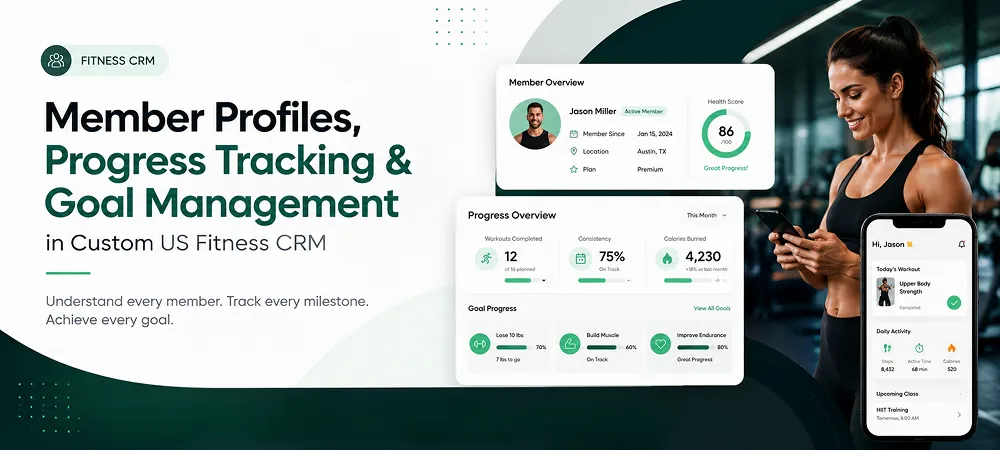
Fitness 7 min read
Member Profiles, Progress Tracking & Goal Management in Custom US Fitness CRM

Why a Fitness CRM Member Profile Is Different from a Contact Record
Fitness CRM member profiles and progress tracking are distinct from a contact record in a generic CRM platform. A contact has a name, email, phone number, and a history of interactions.
A fitness member has a fitness history with goals set, milestones reached, classes attended by type, and personal bests recorded. They also accumulate trainer notes and health context that make every automated or human touchpoint relevant rather than generic.
Teams investing in custom fitness mobile and web app development understand that the member profile is the operational core of the entire system. Everything downstream depends on the quality and completeness of the data captured here. These include the relevance of automated messages, the insight coaches have before each session, the accuracy of churn risk signals, and the personalization depth of the member app experience.
A purpose-built custom fitness CRM development captures this longitudinal fitness record from the moment a prospect first makes contact.
Member profiles and progress tracking form the foundational data layer of the fitness CRM lifecycle management.
This article covers a production fitness CRM member profile and how progress tracking converts attendance data into fitness intelligence. It also talks about how goal management creates the sustained engagement that drives long-term member retention.
The Complete Fitness CRM Member Profile
A production fitness CRM member profile is structured across four data layers, each serving a distinct operational function.
Identity and Contact Layer
This layer captures name, contact details, and the member’s preferred communication channel: SMS, email, or app push notification. For minor members, parental or guardian contact and consent documentation are stored here. Source tracking records how the member first discovered the business: Google Ads, referral, walk-in, or social media. Source attribution at the member level enables accurate marketing ROI analysis across acquisition channels.
Health and Fitness Context
Health intake data, like relevant conditions, movement restrictions, injuries, and medical clearances, inform instructor preparation and support liability management. In business contexts involving medical fitness or clinical wellness programming, this data may carry HIPAA-adjacent regulatory implications. Operators should consult qualified legal counsel to determine applicable data-handling requirements for their specific model.
Fitness baselines establish a measurement reference point: initial assessment results covering aerobic capacity, strength benchmarks, flexibility scores, and body composition. Progress is only meaningful when measured against a documented starting point. A custom mobile app can surface these baselines to members in their personal dashboard. This makes their starting point and trajectory visible in every session.
Membership and Billing Record
Current membership tier, start date, billing cycle, payment method, freeze history, and cancellation history are stored in this layer. A member who freezes twice and approaches their third anniversary represents a different retention opportunity than a three-month member with perfect attendance. The billing record gives the CRM and coaching team the context to engage each member appropriately at each lifecycle stage.
Engagement History
The engagement layer captures the complete class attendance log, which includes class type, instructor, and attendance streak data. It also includes a booking history showing classes booked versus attended. Communication history records every automated and manual message sent to the member, with open and click data. This layer is the source of truth for churn risk signals and re-engagement timing.
Progress Tracking: Turning Attendance Data into Fitness Intelligence
Raw attendance data tells an operator whether a member is showing up. Progress tracking tells them whether that member is improving, plateauing, or quietly disengaging. These are different questions with different operational implications.
Attendance trend analysis makes the difference visible. A member attending 15, 12, and 6 sessions in months one, two, and three, respectively, exhibits a declining engagement pattern. A fitness CRM can track individual attendance trends against each member’s own historical baseline rather than against a studio-wide average. It flags this member for coach intervention before a cancellation request arrives.
Milestone tracking triggers celebratory moments automatically. First 10 sessions, 100th visit, a first personal best in a key movement. The CRM detects these events and sends an acknowledgement at peak satisfaction moments. Members receiving recognition at the right time show stronger retention than those reaching the same milestones without any business response.
Performance tracking by class type gives members a training history that is more motivating than session count. Cycling power output trends, running pace progression, CrossFit benchmark improvements, and yoga milestone data offer a rich fitness progression. A coach who reviews a member’s recent performance data before a PT session delivers a qualitatively different experience than one working from memory alone.
Goal Management: The Retention Engine
The most retention-predictive behavior a new member exhibits is setting a specific, time-bound fitness goal at the point of joining. Members with an active goal consistently show 40-60% longer average tenure than members who joined without a defined objective. This is because every session has a purpose tied to a measurable outcome.
A production fitness CRM built through custom software development services supports multiple goal types to accommodate the full range of member motivations. Weight and body composition goals link to check-in tracking and wearable data.
Performance goals: running a 5K under a time target, reaching a strength benchmark; link to class performance records. Habit goals: attending three times per week for eight weeks; link to attendance tracking. Wellness goals connect to wearable-sourced data on sleep quality and recovery metrics.
Automated goal check-ins maintain awareness between visits without requiring manual coach intervention at scale. A message sent at the halfway point shows the member their progress chart against their goal timeline. This keeps motivation high and reinforces the member’s sense of forward momentum. The system does the work; the member experiences personalized attention.
Goal completion is a critical re-engagement trigger. When a member reaches a goal, the CRM should initiate a goal renewal conversation. It should acknowledge the achievement and prompt the next challenge. Members without an active goal are the highest churn-risk segment in any fitness CRM database. Goal completion without replacement is a reliable early warning signal.
Churn Prediction from Member Profile Data
Member profile depth is what makes churn prediction operational rather than theoretical. The signals are present in the data long before a cancellation request is submitted.
There are a few churn risk indicators accumulated in a member profile. They include attendance frequency falling below that member’s own historical baseline and goal completion without goal renewal. It also spans a shift from premium class types to standard ones and an increasing no-show rate. The other indicators are a pause in wearable data sync, where a device was previously connected, and reduced app session frequency.
No single signal is definitive. Their combination, weighted against each member’s individual pattern, is highly predictive.
A fitness CRM can produce a churn risk score for each member, updated on a defined cadence. It gives coaches and operations managers a prioritized intervention list through an admin dashboard built with web application development services. Proactive outreach to the top 10% highest-risk members each week recovers more memberships than reactive responses to submitted cancellation requests.
AI integration and adoption services can extend this capability further. ML-based churn prediction on longitudinal member behavior data surfaces at-risk members before observable decline begins. It enables intervention at the optimal moment. This is a functional data capability, not a guarantee of individual outcomes.
Member Data Is the Foundation of Every Downstream CRM Decision
Member profile depth, progress tracking, and goal management are the foundational capabilities that separate a fitness CRM from a basic booking system. US fitness businesses that invest in these capabilities consistently achieve higher retention rates than businesses that track attendance only. This is because rich member data gives coaches and automated systems the context to engage every member as an individual.
Your fitness CRM might capture less member data than you need to answer the question: “What does this specific member need from me this week?” Build a richer member profile architecture with goal tracking, progress history, and churn risk signals. This is the investment that makes every other CRM automation significantly more effective. To explore what that architecture looks like for your operation, consult a reliable CRM development partner. Learn more about digital transformation solutions from one of the leading AI software companies in the United States.
FAQ
What should a fitness CRM member profile include?
A fitness CRM member profile should include contact details, communication preferences, membership history, attendance, fitness goals, assessment baselines, progress milestones, trainer notes, and engagement history. It can also store relevant health or movement information when appropriate. Combining these records gives coaches and automated CRM workflows enough context to personalize communication, track progress, and identify changes in member engagement.
How is a fitness CRM member profile different from a normal CRM contact?
A standard CRM contact mainly records identity, communication, and sales interactions. A fitness CRM member profile adds a longitudinal fitness history, including classes attended, personal bests, goals, assessments, membership changes, trainer notes, and progress. This richer record helps fitness businesses understand what each member is trying to achieve and how their engagement is changing over time.
How does progress tracking work in fitness CRM software?
Fitness CRM progress tracking compares current member activity with previous performance and documented baselines. The platform can track attendance frequency, fitness assessments, personal bests, workout performance, body-composition measurements, and goal progress. Rather than showing only how many sessions someone attended, progress tracking helps coaches determine whether the member is improving, plateauing, or becoming less engaged.
What fitness goals should CRM software support?
Fitness CRM software should support multiple goal types because members join for different reasons. Common categories include weight or body-composition goals, strength benchmarks, running or endurance targets, attendance habits, flexibility milestones, and broader wellness objectives. Each goal should include a measurable target, timeframe, baseline, progress updates, completion status, and ideally a process for setting the member’s next goal after completion.
How can goal tracking improve fitness member retention?
Goal tracking gives each member a clear reason to continue participating and makes progress visible between sessions. A CRM can trigger check-ins, milestone recognition, progress updates, and coach outreach based on the member’s goal timeline. When a goal is completed, the system can prompt a new objective. Maintaining an active progression path helps prevent the membership experience from becoming an open-ended series of unrelated visits.
How can attendance data help identify members at risk of cancelling?
Attendance becomes more useful when compared with each member’s previous behavior. A drop from a member’s normal visit frequency, increasing no-shows, longer periods between sessions, or changing class participation can indicate declining engagement. A fitness CRM can flag these patterns for coach outreach before a cancellation request arrives, allowing the business to intervene while the member is still active.
What milestones should fitness CRM software automatically track?
Useful milestones include first visits, attendance streaks, 10th or 100th sessions, personal bests, goal completion, membership anniversaries, and significant fitness-assessment improvements. The CRM can automatically detect these events and trigger recognition through the member app, email, SMS, or coach dashboard. Milestone automation gives staff opportunities to acknowledge progress without requiring someone to manually monitor every member record.
How can trainer notes improve a fitness CRM member profile?
Trainer notes preserve coaching context that would otherwise remain in one instructor’s memory. Notes can document session observations, exercise preferences, limitations, progress, modifications, and follow-up priorities. When authorized staff can review relevant history before a session, members receive more consistent coaching across instructors. Structured notes are especially valuable when a fitness business grows beyond one trainer or operates across multiple locations.
Core Development
Keep exploring the custom services.

AI Software Development
Custom AI Software Development
Build intelligent, production-ready software from machine-learning models to AI-driven automation designed around your business goals.
Learn more
Mobile App Development
Custom Mobile Application Development
Native and cross-platform mobile apps that are fast, secure, and built to scale across iOS and Android.
Learn more
Web App Development
Custom Web Application Development
Scalable, secure web applications, from customer portals to complex dashboards, tailored to how your business actually works.
Learn more



