
Welcome to Blogs
Discover actionable insights, in-depth research, and expert perspectives, all in one place.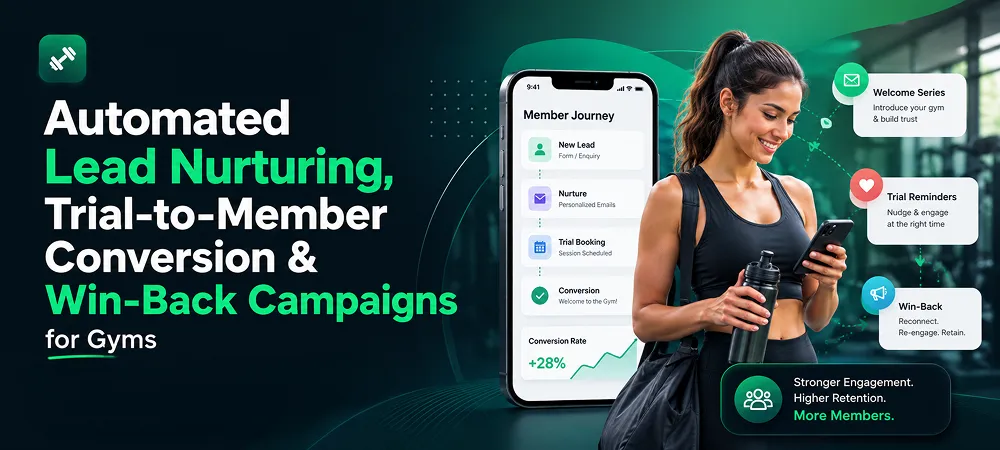
Fitness 6 min read
Automated Lead Nurturing, Trial-to-Member Conversion & Win-Back Campaigns for Gyms

Why Most Gym Lead Follow-Up Fails
Most US fitness businesses do not have a lead volume problem, but they have a follow-up consistency problem. Gym lead nurturing in most US fitness businesses suffers from a structural gap. The inquiries arrive, receive one or two manual responses, and then go cold. This is because the operator is running a fitness business, not a sales operation.
The prospect might inquire about a trial class on a Thursday evening and might receive no reply until Monday morning. The person would have already made a decision, and it is rarely in the gym’s favour.
The average US fitness business converts 20-30% of first-contact inquiries into trial visits, and 30-40% of trials into memberships.
Operators running structured custom fitness mobile and web app development can have built-in automation. They convert 40 to 55 percent of inquiries into trials and 50 to 65 percent of trials into memberships. The difference is not salesmanship; it is follow-up consistency at every stage of the prospect journey.
Teams investing in custom fitness CRM development build these sequences directly into the platform. These include lead capture, immediate response, trial nurture, conversion offer, and win-back automation operating without manual intervention. This article covers each layer of that automation stack.
Lead Capture and Immediate Response Architecture
Multi-Channel Lead Capture
Fitness leads arrive through several sources. These cover website contact forms, social media direct messages, Google Business Profile calls, paid search landing pages, and walk-in referrals.
A fitness CRM can centralize them into a single lead pipeline with source tracking at the point of capture. It gives operators accurate visibility into lead volume by channel and enables channel-specific follow-up sequences. This is tailored to how each prospect found the business.
A web application-based trial booking widget embedded on the studio website creates a qualified lead record automatically. The prospect name, contact details, preferred class type, and requested visit date are captured without manual data entry. Every inquiry enters the CRM immediately, with source attribution intact, and triggers the appropriate automation sequence from that moment.
Immediate Response Automation
An automated response within five minutes of inquiry submission is the single highest-impact conversion improvement available to most fitness operators. A prospect comparing multiple studios in the same afternoon is far more likely to convert with the business that responds first with a clear, relevant message. The automated response should acknowledge the specific trial class requested and confirm availability. It should include a direct booking link that removes any friction from the next step.
Automated SMS responses require TCPA-compliant opt-in consent under US federal law. Opt-in should be collected at the inquiry form stage. The communication method should be clearly confirmed with the prospect before automated messages begin.
The Trial-to-Membership Conversion Sequence
Most trial class visitors make their membership decision within 48 to 72 hours of their visit. The conversion window is short. The fitness CRM conversion sequence must activate the right messages in the right order before the prospect’s motivation dissipates, or a competitor captures their attention.
A structured trial conversion sequence operates across four touchpoints. Within four hours of trial class completion, an automated thank-you message references the specific class attended. It includes a direct link to membership options.
At 24 hours post-trial, a personalized follow-up asks how the member is feeling. The message reinforces the community and coaching quality they experienced. At 48 hours, a membership offer with a limited-time incentive, the first month at a reduced rate. The offer also covers a complimentary personal training assessment or a referral bonus, creating a decision window with a defined close.
If no conversion occurs by days 5-7, a final outreach message reaches the prospect before the lead is marked cold. They are then moved to a longer-term re-engagement list. Each automated message is personalized using the data already in the member profile. The class type attended, the instructor’s name, and the prospect’s stated fitness goal are captured during the trial booking process.
Coach-triggered conversion adds a human layer where automation alone is insufficient. When a trial visitor doesn’t arrive within 24 hours, a notification to the class instructor enables a personal follow-up call. This combination of automated sequencing and targeted human outreach consistently outperforms either approach in isolation.
Win-Back Campaigns for Former Members
Former fitness members are the most cost-efficient re-acquisition audience in a gym’s CRM. They already know the facility and trust the brand enough to join once. These members can be reacquired at a fraction of the new member acquisition cost.
The challenge is reaching the former members at the right moment with the right message. This is a problem that CRM segmentation and scheduled campaign automation solve at scale.
Win-back segmentation starts with the cancellation reason. A member who cancelled after three years and cited relocation is a great re-engagement target. Whereas a member who never attended after joining and cited a lack of motivation is a different target.
A fitness CRM can capture cancellation reasons, tenure, membership tier, and time since cancellation. This enables campaign messaging that reflects why the member left and what has changed since.
Seasonal timing drives win-back conversion rates. January, April, and September represent the three highest-conversion windows for fitness re-acquisition campaigns. It is aligned with New Year goal-setting, the pre-summer motivation spike, and the post-summer routine reset. A CRM that has former member segments built and campaign-ready at these moments captures re-acquisitions that manual outreach consistently misses.
Returning member incentives outperform generic promotional offers. A reduced first-month rate, a complimentary personal training session, or a buddy pass acknowledges the prior relationship. This reduces the psychological friction of returning.
The offer structure should be tier-specific: a former premium member receives a different incentive than a former basic member.
Referral Automation and Review Request Sequences
The most cost-efficient lead source for any fitness business is satisfied members. A CRM can trigger referral requests at peak member satisfaction moments through a custom mobile app push notification. This can be immediately after a personal best, at a membership anniversary milestone, or following a goal achievement. It generates warm leads that convert at two to three times the rate of cold marketing leads.
Referral tracking in the CRM records which member generated each referral, enabling appreciation acknowledgement and channel performance analysis.
Google review requests follow the same timing logic. A CRM-triggered review request is sent 24 to 48 hours after a highly positive interaction. It can be a first class, a milestone achievement, or a particularly strong session. This is the highest-converting review generation mechanism available to local fitness businesses.
Fitness studios with 200 or more Google reviews and a 4.7+ average rating consistently outperform competitors in local search conversion. The CRM creates the trigger; the member provides the signal.
Automation That Converts: Without Adding Sales Headcount
US fitness operators who build structured automation sequences for lead nurturing, trial conversion, and member re-acquisition consistently improve conversion rates. This is achieved without adding sales staff. The leads are already arriving, and the former members already exist in the database. Systematic automation recovers the revenue that inconsistent manual follow-up leaves unconverted.
Your fitness business might be converting less than 50 percent of trial visitors into memberships. Build a structured trial-to-membership conversion sequence with personalized post-trial follow-up, a limited-time offer window, and coach notification triggers. This automation investment typically produces a measurable revenue improvement within 90 days of deployment. To explore what that build looks like for your operation, discuss your requirements with a leading CRM development partner. Learn more about digital transformation solutions from one of the leading AI software companies in the United States.
FAQ
What is automated lead nurturing for gyms?
Automated gym lead nurturing uses CRM workflows to follow prospects from their first inquiry through trial booking and membership conversion. A fitness CRM can capture leads from website forms, ads, referrals, calls, and other channels, then trigger relevant follow-ups automatically. The goal is to prevent promising leads from being lost because staff are busy or follow-up is inconsistent.
How can a fitness CRM improve lead follow-up?
A fitness CRM creates a lead record as soon as an inquiry arrives and can immediately trigger booking links, trial information, reminders, and staff notifications. Every interaction remains connected to the prospect’s record. This creates consistent follow-up across evenings, weekends, and busy periods while giving employees visibility into which leads have booked, responded, attended a trial, or still require personal outreach.
How quickly should a gym respond to a new fitness lead?
Gyms should generally respond as quickly as practical while the prospect’s interest is still high. CRM automation can acknowledge an inquiry immediately, confirm the requested class or service, and provide a direct booking link without waiting for staff availability. High-intent leads can also generate alerts for personal follow-up. The objective is to remove friction between the initial inquiry and the next meaningful action.
How does trial-to-member conversion automation work?
Trial conversion automation starts when a prospect books or completes a trial session. The CRM can send reminders before attendance, a personalized thank-you afterward, membership information, and follow-up messages over the following days. If the prospect does not convert, the system can notify a coach for personal outreach or move the lead into a longer-term nurture sequence instead of simply marking it lost.
What information should gyms use to personalize trial follow-up?
Useful personalization data includes the class attended, instructor, stated fitness goal, trial date, lead source, attendance behavior, and previous interactions. A prospect interested in strength training should not receive exactly the same follow-up as someone looking for yoga or weight management. Personalization makes automated sequences more relevant while allowing the CRM to maintain consistent communication across a large lead pipeline.
What is a gym win-back campaign?
A gym win-back campaign is a targeted re-engagement sequence for former or lapsed members. Fitness CRM software can segment former members by cancellation reason, previous membership tier, tenure, last visit, and time since cancellation. The gym can then send relevant return offers, new-program announcements, class recommendations, or personal outreach rather than sending the same generic promotion to every former member.
Which former members should a gym target with win-back campaigns?
Prioritize former members using behavioral and membership context rather than treating every cancellation equally. Useful factors include why they left, how long they were members, previous attendance, membership type, and time since cancellation. Someone who left because of scheduling may respond to new class times, while a former long-term member may benefit from personalized outreach acknowledging their previous relationship with the gym.
Can fitness CRM software automate referral campaigns?
Yes. A fitness CRM can trigger referral invitations after relevant member milestones such as sustained attendance, membership anniversaries, completed goals, or other engagement events. The CRM can also record who generated each referral and measure whether referred prospects ultimately convert. Referral automation works best when it makes sharing easy while avoiding repetitive requests that could make otherwise positive member interactions feel overly promotional.
Core Development
Keep exploring the custom services.

AI Software Development
Custom AI Software Development
Build intelligent, production-ready software from machine-learning models to AI-driven automation designed around your business goals.
Learn more
Mobile App Development
Custom Mobile Application Development
Native and cross-platform mobile apps that are fast, secure, and built to scale across iOS and Android.
Learn more
Web App Development
Custom Web Application Development
Scalable, secure web applications, from customer portals to complex dashboards, tailored to how your business actually works.
Learn more



