
Welcome to Blogs
Discover actionable insights, in-depth research, and expert perspectives, all in one place.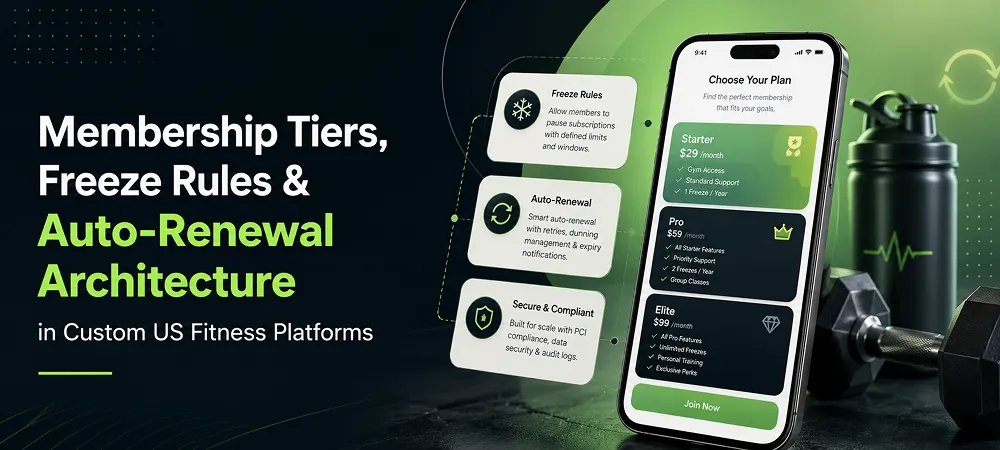
Fitness 7 min read
Membership Tiers, Freeze Rules & Auto-Renewal Architecture in Custom US Fitness Platforms

Why Membership Architecture Is an Engineering Problem, Not Just a Pricing Decision
Fitness CRM membership tiers and architecture present a challenge most fitness operators do not anticipate when they choose a platform. A business with three membership tiers and a simple monthly billing cycle can operate on most commercial fitness CRM software.
A business can have eight-tier variants, corporate account billing, family plan pricing, location-based access rules, and seasonal freeze windows. It can also cover earned upgrade paths and a dunning management requirement. This describes a custom engineering problem, not a configuration task.
Membership architecture decisions are increasingly a differentiator among US fitness Platforms built for scale. Teams building on custom fitness mobile and web app development architecture must define membership structure earlier. Those decisions determine whether the CRM scales cleanly or requires manual intervention at every billing cycle.
Access permission enforcement, freeze policy logic, auto-renewal disclosure compliance, and payment failure handling are all architecture decisions. These are not settings to configure after launch.
Purpose-built custom fitness CRM development encodes these rules into the platform from the start. This article covers the engineering architecture of membership tiers, freeze functionality, auto-renewal compliance, and dunning management for custom fitness platforms.
Membership tier and billing architecture form the operational infrastructure layer of the full fitness CRM lifecycle management.
Membership Tier Architecture
Tier Definition and Access Permissions
Each membership tier should be a configurable object with clearly defined attributes. These include price, billing cycle, access permissions covering which locations and class types are included, and booking window priority. They also span guest pass allowances, personal training session inclusions, and digital content access: app features and video library availability. This data model gives the CRM the information it needs to enforce tier rules programmatically at every touchpoint.
Permission enforcement must operate at the booking and check-in layer, not just as a display in the member profile. A member who attempts to book a class that their tier does not include should be flagged at booking time. The system should display a clear explanation and prompt an upgrade path at the point of restriction. Discovering the error at the door creates a service failure that no amount of follow-up can fully recover. A web application-layer enforcement model handles this consistently across every access point.
Corporate and Group Account Architecture
Corporate accounts require a billing model where a company purchases a block of memberships for employees. These are invoiced to the company rather than to individual payment cards. The CRM must handle corporate invoice generation, employee seat allocation, and individual member profile management under the corporate account umbrella. These should not collapse the distinction between the corporate billing entity and the individual member records it contains.
Family plans introduce an account hierarchy model. They cover a primary account holder, associated sub-members with individual profiles, and a single consolidated billing record. The relationship data structure must support this hierarchy at the profile, booking, access, and billing layers simultaneously. Operators who attempt to model family plans as separate individual accounts consistently encounter reconciliation problems at billing time.
Earned Tier Progression
Loyalty-based tier upgrades reward members who reach attendance milestones and refer a defined number of new members. Members who hold their membership for a specified duration earn access to higher-tier benefits. CRM logic must track progression criteria for each member’s profile and automatically trigger tier upgrades when conditions are met. It includes any associated billing adjustments, notification sequences, and updated access permissions.
Freeze Architecture: Design for Real Member Behaviour
A fitness CRM that handles freeze requests poorly creates one of the highest-friction member service interactions in the business. Members who cannot pause a membership cleanly cancel permanently instead. The business could have avoided the revenue outcome with better freeze architecture. Freeze design is as much a retention mechanism as it is a billing feature.
Freeze configuration should be defined per membership tier, not applied uniformly across all tiers. Parameters include the maximum freeze duration allowed within every 12 months. They also include the freeze fee structure, allowing a free freeze for documented medical reasons.
Elective freezes may carry a nominal monthly fee. Rules should define the minimum freeze period to prevent gaming. Advance notice requirements give the billing system time to adjust. The policy should also cap the maximum number of freezes permitted per membership year.
Each parameter should be configurable by tier without requiring a code change.
Access restriction during the freeze period needs consistent enforcement across booking, check-in, and app entry, not limited to the billing side alone. A member who is frozen should not be able to book a class through the app. They should also encounter an access refusal at the door. The freeze state must propagate to every access enforcement point in real time.
Freeze return automation is the final piece. When a freeze period ends, the CRM should automatically reactivate access permissions. It should also send a welcome-back message with the upcoming class schedule. This follows a retention check-in if the member has not booked within 48 hours of reactivation. This automated re-engagement sequence turns freeze return into a conversion moment rather than a passive event.
Note that some US states have specific membership pause rights under consumer protection law. Consult applicable state regulations when designing freeze policy enforcement.
Auto-Renewal Compliance and Dunning Management
Auto-renewal disclosure is a legal architecture requirement in the US, not a preference. California, New York, and a number of other states have enacted auto-renewal laws requiring clear pre-renewal notice. It also needs an accessible digital cancellation mechanism and documented disclosure at the point of initial purchase.
The fitness CRM billing system must generate pre-renewal notifications on a defined schedule. It should provide a compliant cancellation pathway and maintain a disclosure compliance record for each member. Operators should verify applicable state requirements with qualified legal counsel before finalising their billing architecture.
A production pre-renewal notification sequence operates across three touchpoints. These are: a 30-day reminder, a 14-day reminder, and a 3-day final notice. Each should contain the upcoming renewal amount, the renewal date, and a direct cancellation link.
Members often cancel because they did not know a renewal was approaching. This is the most preventable churn in any fitness CRM billing system. The notification sequence converts this preventable churn into informed retention decisions.
Dunning management handles the revenue recovery dimension of billing failure. An automated retry schedule reduces permanent payment failures. It attempts payment on day one, day three, and day seven after the initial failure. This approach captures transient card issues before they become cancellations.
Member notification at each retry attempt keeps the member informed and reduces the service escalation rate. Access restriction timing can be set to restrict immediately upon failure or allow a grace period. This is a policy decision that the CRM must enforce consistently once defined. A manual recovery workflow for members disputing payment failures completes the dunning architecture.
Multi-Location and Franchise Membership Architecture
Multi-location fitness operators need memberships defining which locations are included, at what access level, and how cross-location booking is resolved. A member holding a premium multi-location membership should have their access permissions enforced consistently at check-in across all locations. This should be enforced from a single centralised membership record, with no location-by-location configuration required at each site.
Franchise billing architecture requires a financial model that separates member payment processing. Member payments flow to the individual franchise location, while the franchise fee is calculated as a percentage of membership revenue reported in the CRM, flowing separately to the franchisor. The CRM must automate this separation.
Operators who attempt to reconcile this split outside the CRM through manual processes consistently encounter reporting errors. They also face delayed franchise fee settlements at scale.
The member profile itself must be centralised across all locations the member visits. Attendance history, communication history, and goal progress data should be visible to any coach at any location. This is because a member visiting a new site receives the same quality of personalized acknowledgment expected at their home location.
Membership tier complexity is one of the primary cost drivers in fitness CRM development. It is covered in CRM Budget Planning for Fitness Businesses: What Custom Development Actually Costs.
Architecture First, Scaling Second
Fitness membership architecture is an engineering discipline. It determines whether a growing fitness business can scale without billing exceptions, administrative workarounds, or member service escalations. Without the right architecture, teams spend operational capacity managing gaps between platform limits and business needs.
US fitness operators should define membership tier structure, freeze logic, auto-renewal compliance, and dunning management before choosing a CRM platform. Doing so significantly reduces the risk of re-platforming costs that arise when complex membership rules are retrofitted onto inflexible off-the-shelf systems.
Your fitness business might have outgrown the membership tier and billing logic of your current platform. Design custom membership architecture that handles your specific tier variants, freeze policies, and auto-renewal compliance before development begins. This produces a billing system that scales without manual intervention rather than one requiring operational workarounds at every renewal cycle. To explore what that architecture looks like for your operation, visit NewAgeSysIT.
FAQ
What is membership tier architecture in fitness CRM software?
Membership tier architecture defines how pricing, billing frequency, facility access, class eligibility, booking priority, guest passes, training sessions, and digital benefits are represented in the fitness CRM. Instead of hard-coding each plan, these attributes should remain configurable. The same membership record can then consistently control billing, booking, check-in, mobile-app access, and upgrade eligibility across the platform.
What should a fitness membership tier include?
A membership tier should define price, billing cycle, included locations, eligible classes, booking windows, guest allowances, personal-training benefits, digital content, freeze rules, and renewal settings. Access permissions should be enforced when members book or check in, not simply displayed in their profile. Configurable tier objects make it easier to introduce new plans without requiring software changes for every pricing or benefit adjustment.
How should family and corporate memberships work in a fitness CRM?
Family plans should maintain separate member profiles under one primary billing relationship, while corporate plans should separate the company paying the invoice from employees receiving memberships. Each individual still needs independent attendance, goals, bookings, and access permissions. Separating the billing entity from the member identity prevents reconciliation problems and makes family, employer-sponsored, and group memberships easier to manage as the business scales.
How should membership freeze rules work in gym software?
Freeze rules should be configurable by membership tier. Common settings include minimum and maximum freeze duration, annual freeze limits, advance-notice requirements, freeze fees, qualifying reasons, and the date billing resumes. The system should record each freeze period and automatically apply the appropriate billing and access rules. Configurability is important because policies can differ by plan, location, business model, and applicable state requirements.
What should happen to member access while a gym membership is frozen?
The membership’s freeze status should propagate consistently across booking, check-in, digital content, and other access-controlled features. When the freeze ends, the CRM can automatically reactivate eligible access and notify the member. Operators may also trigger a welcome-back or engagement workflow. The exact access policy should follow the membership agreement and applicable law rather than being implemented only as a billing-system status.
What auto-renewal features should US fitness membership software support?
Fitness platforms should support clear renewal disclosures, affirmative consent records, renewal dates, pricing, notification rules, cancellation methods, and evidence of what terms the member accepted. Requirements vary by jurisdiction and membership structure, so these rules should be configurable. For example, California imposes specific consent, cancellation, and renewal-notice requirements for covered automatic-renewal and continuous-service offers.
Do gyms have to provide “click-to-cancel” membership cancellation in 2026?
There is no currently effective nationwide FTC “Click-to-Cancel” rule from the 2024 rulemaking. The Eighth Circuit vacated that rule on July 8, 2025, and the FTC began a new rulemaking process in March 2026. However, state laws can impose their own cancellation requirements. Fitness platforms should therefore support configurable cancellation workflows based on the jurisdictions in which the business operates.
How should California gym software handle automatic renewals?
California’s Automatic Renewal Law requires covered businesses to clearly present renewal terms and obtain affirmative consent. It also requires an easy-to-use cancellation mechanism. For certain initial terms of one year or longer, renewal notices are generally required 15–45 days before renewal. Free or discounted trials lasting more than 31 days have separate advance-notice timing requirements. Fitness platforms should make these rules configurable.
Core Development
Keep exploring the custom services.

AI Software Development
Custom AI Software Development
Build intelligent, production-ready software from machine-learning models to AI-driven automation designed around your business goals.
Learn more
Mobile App Development
Custom Mobile Application Development
Native and cross-platform mobile apps that are fast, secure, and built to scale across iOS and Android.
Learn more
Web App Development
Custom Web Application Development
Scalable, secure web applications, from customer portals to complex dashboards, tailored to how your business actually works.
Learn more



