
Welcome to Blogs
Discover actionable insights, in-depth research, and expert perspectives, all in one place.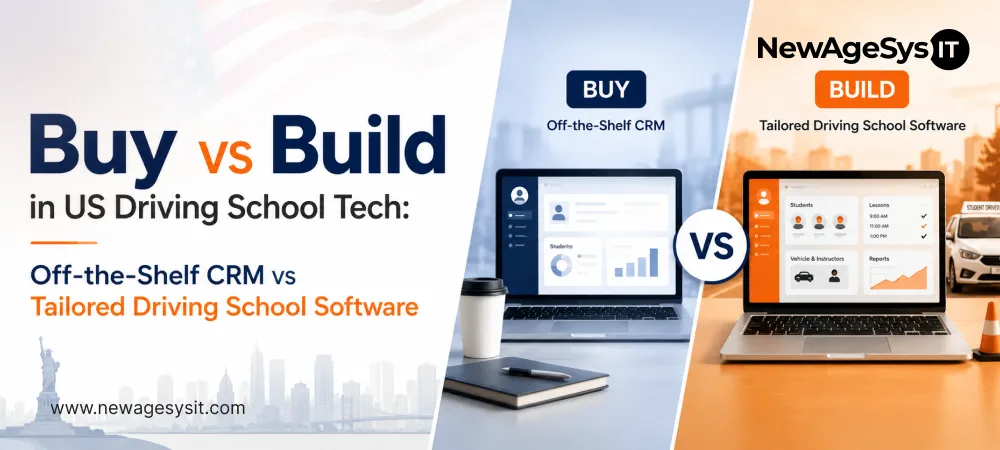
Driving School Software 6 min read
Buy vs Build in US Driving School Tech: Off-the-Shelf CRM vs Tailored Driving School Software in 2026

| This article is part of our series on Digital Transformation in US Driving Schools & CDL Training: AI, Automation & Scalable DriveTech Innovation |
Software choices by the owners of driving schools are rather explicit. You simply perform a Google search for a suitable software platform that has decent ratings and check its monthly cost.
The choice of software allows establishing all kinds of records, compliance reports, workflows, and operations of your business. Once the limitation of such software is reached, you become its hostage.
Each time your driving school expands and has new software requirements, the question of buying or developing a driving school CRM or investing in custom driving school app development arises. Every new requirement brings with itself a need to assess the current software.
What works well in terms of scheduling doesn’t have to work for federal compliance reporting, a gap that custom CDL software and CRM development services are specifically built to address. Software that is suitable for 50 students per year isn’t good enough for 2000.
Buying or developing a software solution for a driving school is never just a one-time decision.
What the Off-the-Shelf Driving School CRM Market Gives You
There are three categories of platforms that US driving schools typically evaluate. Each comes with a different set of real-world limitations worth understanding before you decide on driving school SaaS vs custom.
Purpose-Built Driving School Platforms
Two of the most advanced programs that focus on managing driving schools are Driving School Manager and DriveEdu.
Both programs suffice for running driving schools with a regular passenger car license curriculum and only one site.
Most of these android app development platforms were not built for FMCSA TPR integration, GPS route documentation, or state-specific DMV record generation. To perform these functions, a certain engineering and legal effort should be made.
However, CDL driving schools with multi-state curriculums quickly surpass these systems’ capabilities.
Scheduling & CRM Programs for General Businesses
Schools use web application development software like Vagaro, Acuity, or Salesforce due to their intuitiveness and advice by consultants.
Customizing these applications, you will be able to manage the scheduling process at your driving school. However, these applications are incapable of creating DMV-compliant BTW or FMCSA ELDT compliant documents regardless of customization.
The actual cost includes:
- Subscription cost
- Customization cost
- Time spent on manual DMV document generation
- Staff time required to convert documents into DMV format
CDL-Specific Software
The market for CDL-specific software is very limited. Most CDL programs adapt a generic driving school platform with manual FMCSA workarounds. Others build their own custom mobile app development software or use available market solutions.
All three options have problems that make them less than ideal. For these reasons, programs are increasingly opting for custom CDL software and CRM development services.
The platform must be compliant. Schools subject to FERPA or state privacy obligations must verify platform compliance before vendor selection. Finding this kind of gap during a DMV audit is both costly and unnecessary.
Perks of Choosing Custom Driving School Software Development
Driving schools evaluating custom driving school mobile and web app development services typically start their discussions with features. That’s a mistake. They should start with compliance architecture. This is where custom software development clearly distinguishes itself.
FMCSA TPR integration built to specification
Custom development builds the exact TPR solution the CDL program requires. Data fields, transmission timing, and error handling are all configurable to specification.
State-specific DMV record format compliance
Custom iOS app development software generates records in the state-required format from day one, eliminating manual reformatting before DMV submission.
BTW compliance logging built for legal defensibility
Specific GPS integration for route planning with training, instructor authentication for sign-off, and export features that meet audit requirements. All customized to your compliance needs.
Telematics integration for your actual fleet
CDL programs using Samsara, Geotab, or Verizon Connect require fleet performance data linked to student compliance data. Off-the-shelf driving school CRM provides basic telematics integration. Custom development fills the gap and provides the required depth of integration.
A student portal that reflects your school
Custom driving school software gives a branded student experience that functions well, looks like it belongs to your school, and communicates something real.
Buy vs Build Driving School Software for US Schools: Detailed Comparison
| Decision Factor | Buy SaaS When… | Build Custom When… |
| Compliance Requirements | Standard scheduling and billing workflows are enough | FMCSA TPR integration, DMV-specific records, FERPA controls, or audit trails are required |
| Competitive Differentiation | Feature does not create unique value | AI analytics, branded apps, personalized dashboards, or GPS coaching create market advantage |
| Scale Economics | Small operations with limited students or locations | Large multi-location schools where SaaS per-student pricing becomes expensive over time |
| Telematics Integration | Basic fleet tracking is enough | Deep integration between vehicle data, compliance logs, and student performance is needed |
4 Factor Framework to Decide on Buy vs Build
Compliance Architecture Requirements
Start with compliance architecture, not features. Does your school require FMCSA TPR integration? Does your state DMV need a record format that your current system cannot deliver? Do you have FERPA responsibilities for specific access controls or audit trails?
If you answered yes to any of the above, your compliance demands have outstripped what most off-the-shelf applications were designed to address. This is not a comment on the limitations of these systems — these applications were developed with a different compliance framework. Pushing compliance requirements onto a system without the right architecture creates a permanent manual burden and compounding compliance risk.
Competitive Differentiation
Consider whether a particular capability allows you to truly differentiate from other schools using the same SaaS platform. If competitors use the same scheduling system and student portal, there is no technology-based differentiation.
AI-driven predictive analytics for student completion and a proprietary mobile application are difficult to imitate. These capabilities are built around the specific operational needs of the school. Even the most intelligent booking and payment systems are generic. Categorize your offering before making a purchasing decision.
Scale Economics Over Three Years
This is the assessment most driving school owners skip and the one they most regret two years down the road.
A SaaS platform with per-location or per-student pricing may initially seem reasonable for small enrollments. However, that pricing model can be painful as your business scales. A per-student fee that works for 300 active students can become a cost burden at 2,500. Model three-year costs against projected enrollment and location growth before committing to a SaaS platform.
Integrating Telematics
If your program requires fleet training data that is integrated with student compliance data, off-the-shelf options for this level of integration are very limited. Custom development is not just preferable; it is practically the only option.
Schools that need mobile student, instructor, and compliance systems in a single platform should evaluate custom mobile app development.
Take Action Before You Lose
Choosing driving school software is not simply a choice between custom and off-the-shelf.
Schools with documented compliance requirements and realistic three-year cost models build more defensible technology architectures. Schools that make reactive vendor decisions under operational pressure spend years on platforms that cannot meet their needs.
Driving schools that evaluate FMCSA compliance requirements, state DMV record standards, and three-year cost modeling before selecting a platform build stronger technology foundations. That structured approach consistently produces better long-term compliance and cost outcomes.
Team NewAgeSysIT works with US driving schools and CDL programs on exactly these decisions, from initial compliance architecture assessment through full platform development and ongoing support. Connect to make the right decision today! Learn more about digital transformation solutions from a leading AI software company in the United States.
Core Development
Keep exploring the custom services.

AI Software Development
Custom AI Software Development
Build intelligent, production-ready software from machine-learning models to AI-driven automation designed around your business goals.
Learn more
Mobile App Development
Custom Mobile Application Development
Native and cross-platform mobile apps that are fast, secure, and built to scale across iOS and Android.
Learn more
Web App Development
Custom Web Application Development
Scalable, secure web applications, from customer portals to complex dashboards, tailored to how your business actually works.
Learn more



