
Welcome to Blogs
Discover actionable insights, in-depth research, and expert perspectives, all in one place.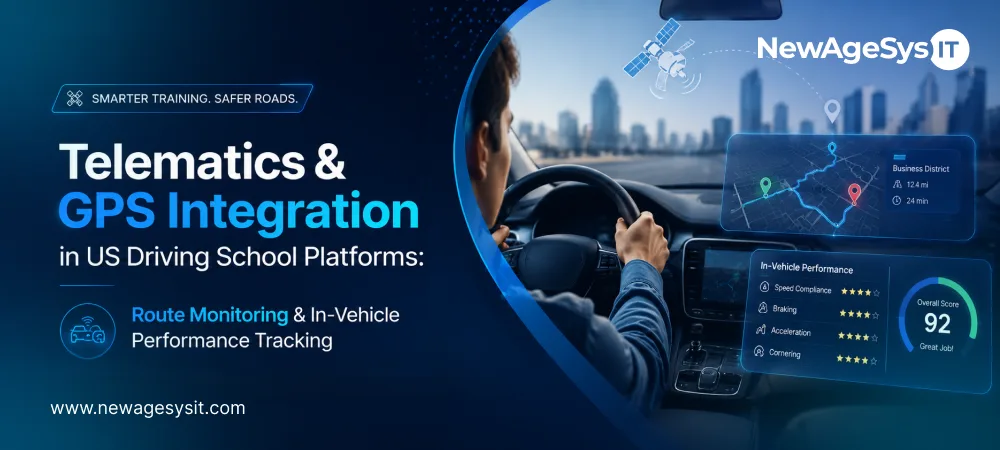
Driving School Software 10 min read
Telematics & GPS Integration in US Driving School Platforms: Route Monitoring And In-Vehicle Performance Tracking

| This article is part of our series on Digital Transformation in US Driving Schools & CDL Training: AI, Automation & Scalable DriveTech Innovation |
CDL compliance documentation requires geographic evidence, not just time-based BTW logs. State DMV and FMCSA each require verifiable records. Instructors need objective data to coach students effectively.
That is precisely why GPS telematics becomes a game changer for driving school platforms in the USA. Driving schools which utilize the use of GPS telematics to track the routes, speed profile, and braking behavior during the training sessions will have proof of each recorded hour and every conversation during coaching time.
This article explores how telematics GPS integration works in American driving school platforms, what CDL programs require from it, and what kind of data architecture should be created to withstand the pressure of regulations. The role of AI algorithms working with the gathered telematics information is explained further in the AI & Automation in US Driving Schools.
Schools building this capability through driving school mobile and web app development services and custom CDL software and CRM development services are treating telematics as a core platform requirement.
Why Telematics Data Matters for US Driving School Platforms
Commercial fleets have used telematics for years to reduce accidents, lower insurance costs, and improve driver behavior. The data works. DriveCam and similar systems have proven that behavioral driving data measurably changes how drivers operate vehicles.
The same rationale can be found in CDL training programs as well. While telematics data is effective at improving driver conduct for commercial fleets, it is equally effective in pre-licensing driver training. But in addition to that, driving schools have another element – that of compliance, which is not an issue for commercial fleets.
In a CDL training program, telematics data helps threefold. First, it provides an evidence-based basis for coaching. Second, it adds objectivity to FMCSA ELDT compliance records by providing evidence of geographic location. Third, telematics data provides program directors with visibility that manual record-keeping simply does not offer.
Driving schools that are still relying on paper logging sheets and instructor attestation have not only become technologically obsolete. They expose themselves to unnecessary compliance risks.
GPS Route Tracking for BTW Compliance Documentation
An hour log records the student was in the vehicle for one hour. A GPS route record shows exact
routes traveled, roads covered, and whether training adequately prepared them for the road test. These are completely different pieces of information.
GPS Session Logging
Every BTW session must provide a comprehensive GPS report detailing starting and ending addresses, the full route, session duration, and total distance traveled. This capability can be seamlessly delivered via custom Android development and iOS app development services, enabling real-time data entry for instructors in the field. ‘This information attaches directly to the session log in the training management system.
As far as DMV audits are concerned, a BTW session log with a GPS track attached is much more convincing than a time stamp and a signature. It eliminates the need to prove whether or not the training was performed at a certain time and place.
Route Diversity Analysis
This is one of the least used capabilities of GPS tracking software in American driving schools.
GPS data across a student’s full training history answers a simple compliance question: has this student driven the road types their state requires?
Many state driver training standards require exposure to specific road conditions. Without GPS analysis, compliance with that requirement is assumed. With it, gaps are visible before the road test rather than after a failed attempt.
FMCSA On-Road Hour Documentation for CDL Programs
For CDL programs, GPS route data attached to ELDT session logs adds objective geographic evidence to federal training records. Federal Hours of Service tracked in the FMCSA databases are validated through GPS route tracks and not dependent solely on instructor documentation. In an FMCSA audit, this validation will be a distinct advantage.
Privacy Policy for the Collection of GPS Route Data
GPS route data is very sensitive data that requires proper handling. Privacy policies covering GPS data collection, retention periods, and student rights must be in place before data collection begins. In California, CCPA provides the right of deletion of GPS route data, just like any other form of personal data.
Fleet Telematics Integration for CDL Programs: The Performance Data Layer
While GPS reveals the route, telematics shows the way the student drives the route. In the CDL program, behavioral data is what differentiates coaching from training.
Major Telematics Platforms US CDL Programs Work With
Samsara is one of the most popular telematics solutions used in US commercial vehicles and is also found in many CDL training programs. It offers real-time GPS vehicle tracking, detects harsh braking and acceleration, analyzes speed and provides driver coaching information via a documented API. CDL programs using commercial fleet vehicles are likely already
operating with Samsara deployed.
Geotab offers advanced telematics information such as trip replay, engine faults, and driver scorecard analysis. The rich data available from Geotab allows for a great fit within CDL training programs where performance evaluation after driving sessions is an integral part of the curriculum. Instructors can replay every minute of a driving session without relying on manual notes.
Verizon Connect also offers GPS location tracking and a driver scorecard. The system is often used by many trucking companies in their sponsored CDL training programs. Since candidates receive their driver’s education in company-owned trucks equipped with Verizon Connect, instructors are also able to use data from Verizon Connect systems which they do not control or own.
CDL Training Performance Metrics From Telematics
Hard braking incidents serve as one of the best sources of coaching feedback for CDL training. Maintaining following distance and anticipating events are basic skills for CDL operations. Hard braking incident data provides coaches with precise information based on timestamps from each training period rather than depending on what they saw from their seats.
Speed compliance data reflects how fast or slow the learner drives relative to posted speed limits over the entire course. Proper speed management during CDL training is an important factor in determining the level of situational awareness. Telematics helps identify trends in speed compliance across multiple periods of training.
Acceleration incidents involve harsh accelerations from either stopping or changing lanes. Driving smoothly is one of the elements graded on the CDL skills test. Precise data on the acceleration incidents helps the coach provide more concrete feedback.
Lane departure incidents, where hardware enables, involve tracking movements outside lane markings while performing class A combination vehicles. Driving within the lanes is a whole different skill when a trailer is attached to the towing vehicle.
Telematics API Integration: What Actually Makes This Hard
Each telematics provider has its own unique API structure. For example, Samsara, Geotab, and Verizon Connect all have distinct methods of authentication, events data structure, and delivery patterns. Schools often use a custom software development service for unified telematics integration. Driving schools looking to create a telematics integration platform for CDL programs covering several trucking companies cannot rely on a single vendor’s API.
Data normalization converts all events from various telematics vendors into the training
management system’s internal event structure.. This way, you prevent the creation of data silos for each individual vendor. Thanks to data normalization, your platform performs analysis consistently regardless of which device the data comes from.
This is one of the biggest advantages of CDL programs that develop custom telematics integrations through custom CDL software and CRM development services over those attempting to make third-party applications work together.
Connecting Telematics Data to FMCSA Compliance Records
Telematics can add value that exceeds driving improvement. For CDL programs, the ability to tie telematics to FMCSA ELDT certification creates a defensible compliance record superior to that created using attestation only.
Telematics in ELDT Documentation
GPS routing information and telematics event data from CDL training drives can be used to verify training was performed where and for how long as stated in the program’s ELDT records. In an FMCSA audit of the program’s compliance documentation, telematics-supported records will hold up better than records that are attestation only. The distinction could make a difference in a thorough audit.
Fleet Maintenance and Compliance with FMCSA Safety Standards
Telematics can enable a maintenance tracking process for CDL training fleet vehicles that keeps them compliant with FMCSA vehicle safety standards. Alerts when vehicles near mileage milestones for mandatory inspections eliminate manual monitoring in compliance management processes. Running a CDL program that uses a training vehicle not compliant with FMCSA vehicle standards is a solvable problem via telematics.
Hours of Service Considerations for CDL Training Vehicles
For CDL schools making use of commercial vehicles under the FMCSA Hours of Service rules, telematics could enable ELDs to be compliant with training vehicles. Whether HOS and ELD apply to a specific CDL training operation depends on vehicle type and program design. Confirm applicability with qualified transportation law counsel.
FMCSA Audit Support
In case an audit notice is sent by FMCSA, telematics data will be a second line of evidence in support of on-road hours logged in the ELDT record. A program which can provide GPS traces and event logs for every on-road session during audit is a program from a strong position to face any such audit.
In-Vehicle Performance Coaching Integration
Data itself cannot make a coach change his/her behavior. Well-crafted coaching reports, however, are the ones that could actually make that happen. Telematics integration into a driving school software will only be useful when the information is presented to someone who has the authority to do something with it.
Post-Session Coaching Reports for Instructors
After each CDL on-road session, the platform generates a structured performance summary for the instructor: hard braking count, speed exceedances, harsh acceleration events, and the full route driven tracked via a custom mobile app development service. Instructors come to the next session with specific data rather than general impressions. Coaching becomes a conversation about evidence rather than a conversation about memory.
Student-Facing Performance Dashboards
Students enrolled in CDL training who can see their own telematics performance metrics from every single lesson experience self-awareness in a way that is not provided by instructor-based verbal feedback, often delivered via a web application development service for browser access. Students who see hard brake counts decline across sessions have objective evidence of performance improvement.
Trend Analysis Across Multiple Sessions
Trend analysis identifies which students need targeted coaching in specific driving skills. It will help us to spot which students make progress, while others do not.
Benchmarking Against CDL Road Test Standards
Comparing individual performance against program averages and CDL skills test standards identifies road test readiness.
Building a Unified Telematics Data Architecture for Driving School Platforms
Telematics Integration by itself will fall flat. Telematics becomes fully useful when compliance data, performance analytics, and privacy requirements are connected in a single normalized data layer.
Normalized Event Data Schema across Providers
Normalizing Samsara, Geotab, and Verizon Connect events into a common internal schema
enables cross-vehicle and cross-vendor analysis without provider-specific reports.. Telematics becomes fully useful when compliance data, performance analytics, and privacy requirements are connected in a single normalized data layer.
Connecting GPS Route Data with ELDT Session Log Data
The relationship of each GPS route data entry to its respective ELDT session log will allow us to validate compliance records geographically. This type of data relationship needs to be built within the data architecture to be effective. Attempting to do so on top of an already established system will be considerably harder and less reliable.
Retention Policy Aligned With FMCSA Requirements
The records from telematics related to FMCSA ELDT training must be maintained for three years, just like the ELDT records themselves. The telematics data retention policy needs to match the federal requirement as opposed to having an independent retention policy.
Built-In Privacy Compliance Through the Data Layer
GPS location data retention rules, CCPA deletion of data in telematics record, and the inclusion of information regarding vehicle tracking in student enrollment materials are all part of the data layer. Built-in privacy compliance through the telematics infrastructure during the design process will yield a more secure and cost-effective solution compared to imposing a privacy policy on top of existing infrastructure.
Final Thoughts
CDL training programs that integrate telematics with FMCSA ELDT records and student performance analytics produce stronger compliance documentation and more effective training than programs still relying on time-based hour logs. The gap between the two is not about technological sophistication. It is about whether training records can withstand scrutiny and whether coaching is specific enough to actually change student behavior.
If your CDL training program is planning telematics GPS integration, designing a unified data architecture connected to FMCSA ELDT records and student performance analytics before implementation gives you the strongest possible foundation for both compliance and coaching outcomes. The NewAgeSysIT team works with US driving schools and CDL programs on telematics integration from data architecture design through full platform development and ongoing support.
Learn more about digital transformation solutions from a leading AI software company in the United States.
Core Development
Keep exploring the custom services.

AI Software Development
Custom AI Software Development
Build intelligent, production-ready software from machine-learning models to AI-driven automation designed around your business goals.
Learn more
Mobile App Development
Custom Mobile Application Development
Native and cross-platform mobile apps that are fast, secure, and built to scale across iOS and Android.
Learn more
Web App Development
Custom Web Application Development
Scalable, secure web applications, from customer portals to complex dashboards, tailored to how your business actually works.
Learn more



