
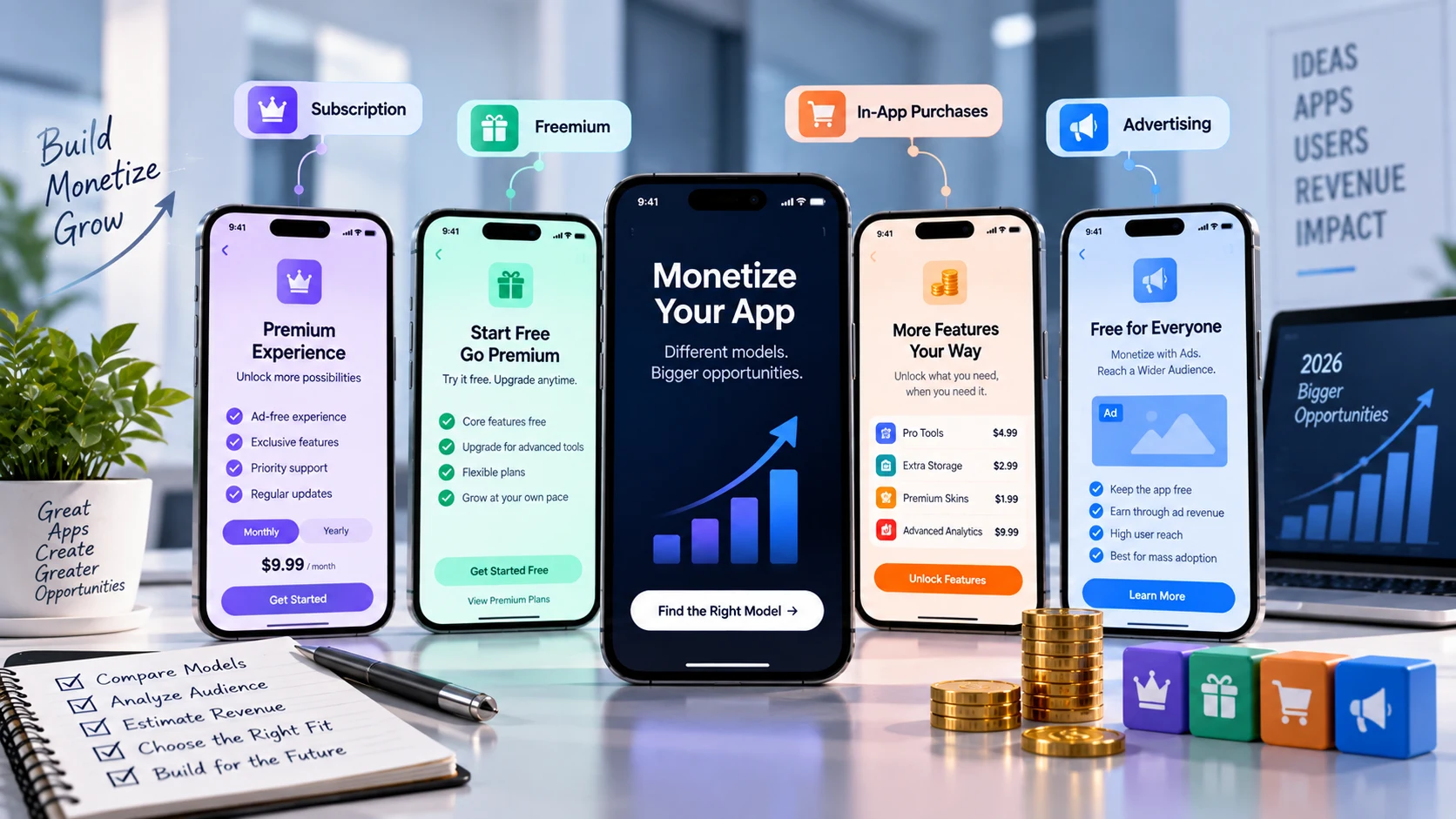

This article is part of our series on : App Monetization Strategies: The Best Practices for US App Founders to Choose the Right Revenue Model Before Writing a Line of Code in 2026
Introduction: Eight Models, One Decision Before Development
Every monetization model solves a different problem. Subscription serves ongoing access. Freemium serves conversion funnels. IAP serves transactional spending. Advertising serves attention at scale. B2B licensing serves enterprise buyers. Marketplace commission serves two-sided transactions. Each requires a different backend, a different UX, and a different compliance posture.
Choosing the wrong one after launch forces a rebuild. Choosing the right one before development starts turns the monetization decision into a buildable scope. That is what the app monetization models compared to 2026 analysis is actually for. Not a ranking. A match between the model and the specific app being built.
This article covers all eight models with current benchmarks. It closes with the app monetization decision framework that turns a vague “which model?” question into a specific answer for a specific app category. The revenue model each founder picks here determines everything the development team builds next.
Founders scoping custom mobile app development around a monetization model defined up front avoid the most common budget overrun in mobile projects. The same logic applies to web application development when the billing dashboard or payment portal is part of the deliverable. Both architecture paths depend on this model decision being settled first.
Subscription
Recurring monthly or annual payment for continued access. Of all eight models, subscription produces the most predictable revenue. It also commands the highest valuation multiples per investor benchmarks. A subscription app with low churn and growing MRR is the most fundable version of a mobile product.
Annual plans at a discount reduce churn compared to monthly billing. The reason is behavioral, not financial. An annual subscriber has already committed psychologically. Monthly subscribers re-evaluate every 30 days. Subscription fatigue is a real headwind, though. The average US consumer’s active subscription count has grown steadily over the past five years. Industry estimates commonly cite six to eight active subscriptions per person. Verify the specific figure against a current source before using it in budget projections.
Trial-to-paid conversion is the metric that matters most for subscription apps. A well-designed free trial converts at a meaningfully higher rate than a cold paywall. Industry benchmarks vary by category. Fitness and productivity apps tend to convert trials at higher rates than entertainment or news apps. The subscription vs freemium vs IAP choice often comes down to whether the app’s value is best delivered as ongoing access or as individual transactions.
Best for: content platforms, productivity tools, SaaS, health and fitness, entertainment, and any app where continued access is the natural value exchange.
Revenue model: monthly or annual recurring charge, typically $4.99 to $14.99 for consumer apps. B2B subscription pricing runs significantly higher.
Valuation signal: subscription revenue commands materially higher valuation multiples than advertising or IAP revenue. If a fundraiser is planned, this matters.
Architecture requirement: recurring-billing backend, entitlement-check endpoints, webhook listeners, and paywall screens with A/B test slots. RevenueCat or native StoreKit 2 and Play Billing integration is the standard path.
Freemium and In-App Purchases
Freemium
Free core product with a paid upgrade for premium features. The entire economic model lives or dies on one ratio: free-to-paid conversion. Industry benchmarks commonly cite low single-digit conversion rates for most consumer apps. A well-designed free trial converts at a notably stronger rate. The gap between those two numbers is the gap between a sustainable business and a free app that never pays for itself.
Making the free tier too generous kills conversion. Users get enough value that the paid tier feels unnecessary. Making the free tier too limited kills retention. Users leave before they ever reach the upgrade prompt. The design challenge is finding the line where the free experience is genuinely useful but visibly incomplete.
Freemium works best when premium features solve a specific, felt pain point. A productivity app that limits cloud storage on the free tier gives users a reason to upgrade that grows with their own usage. A social app that gates cosmetic features behind a paywall relies on status signaling, which works differently in different audiences.
Best for: productivity apps, professional tools, fitness, entertainment, and any app where a natural feature boundary separates free from paid.
Architecture requirement: feature-flag system, entitlement management, paywall with dynamic copy, and analytics tracking conversion events at each stage of the free-to-paid funnel.
In-App Purchases (IAP)
One-time purchases of virtual goods, content, or permanent feature unlocks within a free app. IAP is the dominant monetization model in mobile gaming. Industry reports from Sensor Tower and data.ai consistently show IAP as the largest single revenue category in mobile. Specific dollar figures shift every quarter. Citing a precise market-size number requires sourcing it to a current report.
IAP splits into two types: consumables and non-consumables. Consumables (in-game currency, extra lives, boosts) are purchased repeatedly. Non-consumables (permanent content unlocks, feature upgrades) are purchased once. Consumable IAP generates higher lifetime revenue per user because the purchase repeats. Non-consumable IAP generates a one-time spike.
Best for: games, social apps, lifestyle apps, and any product with virtual goods or content that users want to buy individually rather than subscribe to.
Architecture requirement: product catalog, purchase flow, restoration logic, server-side receipt verification, and fraud-detection rules for consumable purchases.
The subscription vs freemium vs IAP decision is not about which model is “better.” It is about which model matches the app’s value delivery. Ongoing access fits subscription. Feature upgrades fit freemium. Individual transactions fit IAP.
In-App Advertising and Hybrid Models
In-app advertising
Displaying ads to free users generates revenue from attention rather than from direct payment. A meaningful share of apps worldwide rely primarily on advertising revenue. The percentage is somewhat lower for US-specific apps, where subscription and IAP adoption run higher than global averages.
Revenue varies by ad format, and the differences are significant. Current in-app advertising eCPM benchmarks break down roughly as follows (verify exact figures against a current industry report before finalizing projections):
| Ad Format | Typical US eCPM Range | User Experience Impact |
|---|---|---|
| Rewarded Video | Highest (often $10 to $30+) | Low negative impact; user-initiated |
| Interstitial | Mid-range (often $4 to $15) | Moderate; interrupts flow |
| Banner | Lowest (often $0.50 to $3) | Low revenue; persistent visual cost |
These ranges shift by category, by platform, and by quarter. iOS eCPMs generally run higher than Android eCPMs. Finance, healthcare, and shopping apps command premium rates. Casual games sit lower.
Apple’s App Tracking Transparency (ATT) opt-in rates directly affect iOS eCPM. Lower opt-in means less precise targeting, which means lower bid prices from advertisers. ATT opt-in rates vary by app category and by how well the permission prompt communicates value to the user.
Advertising has a real scale threshold. Below a meaningful monthly-active-user count, the ad revenue generated is less than the retention cost ads impose on the user experience. Rewarded ads are the exception. They work at a smaller scale because the user chooses to engage.
Best for: high-volume consumer apps, games, news and content apps, and utilities with frequent daily opens.
Hybrid app monetization model
Combining two or three revenue streams is now standard among top-grossing apps. Industry estimates suggest hybrid adoption has grown from a minority approach to the norm over the past three years. Verify the specific trend percentage against a current analyst report before citing it.
Common hybrid combinations include:
- Subscription plus IAP: A fitness app charges a monthly subscription for workout plans. It also sells individual meal-plan packs as one-time IAP. Both revenue streams serve different user segments within the same app.
- Freemium plus ads: The free tier shows ads. The premium subscription removes ads and adds features. This is one of the most common hybrid app monetization model structures in consumer apps today.
- IAP plus rewarded ads: A game sells in-game currency directly through IAP. It also lets users earn currency by watching a rewarded video ad. Both paths generate revenue. The rewarded path also improves engagement metrics.
The in-app purchase advertising hybrid model 2026 approach requires all revenue streams instrumented from day one. Adding a second stream after the app ships means rebuilding the analytics pipeline and the user flow, not just dropping in another SDK.
How each of these models translates into a specific technical build, whether that means RevenueCat, Stripe Connect, or an enterprise billing portal, is covered in Building App Monetization Into Your Architecture: RevenueCat, Stripe, AdMob, Apple StoreKit & Google Play Billing Integration for US App Founders.
B2B Enterprise Licensing, Marketplace Commission, and Data Monetization
The first five models serve consumer buyers. The next two serve business buyers and platform participants. The distinction matters because the buyer relationship, the sales process, and the payment architecture are all different.
B2B app licensing vs marketplace commission
B2B enterprise licensing makes the app free for end users. The business pays per seat, per deployment, or per usage tier. Revenue per customer is the highest of any model. A single enterprise contract can exceed what hundreds of consumer subscriptions generate. But enterprise sales require a sales process, longer deal cycles, and an admin portal for the buyer’s IT team.
Internal tools, field-service apps, enterprise SaaS, and healthcare apps fit this model. The line items a founder scoping custom software development for B2B billing should expect include invoice generation, usage-based metering, role-based access, and an admin dashboard.
Marketplace commission takes a percentage of transactions between buyers and sellers on the platform. Ride-sharing, service booking, freelance marketplaces, and e-commerce aggregators use this model. The payment architecture is distinct from every other model. Split-payment logic, seller onboarding, payout scheduling, and commission configuration all require Stripe Connect or comparable infrastructure.
The B2B app licensing vs marketplace commission decision depends on who pays and how. In B2B licensing, one buyer pays on behalf of many users. In marketplace commission, many buyers and many sellers transact, and the platform takes a cut.
Best for B2B licensing: internal tools, field-service apps, enterprise software, healthcare platforms.
Best for marketplace commission: two-sided marketplaces, service booking, ride-sharing, freelance platforms.
Data monetization
Licensing anonymized user data or audience segments to third parties. CCPA, GDPR, Apple’s ATT rules, and Google’s evolving Privacy Sandbox have all tightened restrictions on this model. Data monetization is the least viable standalone strategy for a US app in 2026. It carries disproportionate regulatory risk relative to the revenue it generates.
It can exist as a supplementary stream in an app with large-scale behavioral data. But building a primary business case around it is not advisable given the current privacy enforcement posture from both regulators and platforms.
The platform and FTC rules each model triggers are detailed in Apple App Store, Google Play & FTC Compliance for App Monetization: What Every US App Founder Must Know Before Choosing a Revenue Model.
The Five-Question App Monetization Decision Framework
Five questions turn into a vague “which model should I use?” into a specific, buildable answer.
Question 1: What is the app category, and what do users expect?
User expectations are shaped by category norms. Productivity users expect subscriptions. Game players expect free-to-play with IAP. Marketplace users expect free access with seller-side fees. Going against category expectations is possible but requires strong justification, because the onboarding friction of an unexpected monetization model is real.
Question 2: What is the target user’s willingness to pay?
A professional tool serving CPAs has different price tolerance than a casual photo editor serving teenagers. Willingness to pay determines whether subscription, freemium, or advertising is the viable path. It also sets the ceiling on subscription pricing and IAP price points.
Question 3: What scale does unit economics require?
Advertising needs high DAU to generate meaningful revenue. Subscription can work with a smaller, higher-paying base. Marketplace commission needs transaction volume on both sides. B2B licensing needs a smaller number of higher-value contracts. Each model has a different break-even threshold.
Question 4: What does Apple and Google commission exposure look like?
IAP and subscriptions processed through native in-app purchase carry 15 to 30 percent commission under standard terms. External payment links currently carry 0 percent in the US on both platforms. B2B and physical-goods transactions are exempt entirely.
The two platforms reached $0 through different legal paths. The stability of each is different. Founders need to understand both before choosing a commission-management approach.
Apple’s $0 posture is temporary. The Supreme Court granted certiorari on Apple’s appeal in June 2026. Oral argument is expected in the October 2026 term. A merits decision is not expected until late 2026 or early 2027. Apple has stated it will continue charging $0 while the petition is pending. The Court could set a “reasonable” commission rate that changes this math. Build with a configurable commission variable on the Apple side.
Google’s situation is structurally broader. A jury found Google maintained a full illegal monopoly over Android app distribution and billing in December 2023. The October 2024 injunction does not just permit payment links.
It requires Google to open Play Store distribution to rival app stores. Starting July 22, 2026, third-party app stores appear inside Google Play in the US. Google lost its appeal. The Supreme Court declined review. This injunction is final and non-appealable. Epic and Google proposed a settlement that would have introduced 9 to 20 percent tiered fees on external transactions. On July 15, 2026, both parties jointly withdrew that settlement.
The original injunction is now the sole governing order. Google charges $0 with no pending fees and no further appeals possible. Build the Google-side flow with confidence.
The App Store commission bypass decision changes the math for every subscription and IAP app. The current $0 window is unusually favorable, but the Apple side carries real uncertainty. The Google side does not.
Question 5: What monetization architecture is easiest to build now and iterate later?
Some models layer well. Adding rewarded ads to a freemium app is a lighter lift than retrofitting subscription management onto an app built without recurring-billing infrastructure. Answering this question before the first sprint prevents the most expensive kind of technical debt: a revenue-system rebuild with live users.
These five questions do not produce a universal answer. They produce a specific recommendation for a specific app. A content app, a B2B field-service tool, and a marketplace each land on different models. The goal is a decision the development team can build around from day one.
The app monetization models compared 2026 analysis above covers all eight options. The app monetization decision framework narrows them to one. What remains is translating that model into a development scope, a compliance posture, and a realistic budget.
Final Thoughts
US app founders who work through all eight models against their specific app category and audience make a monetization decision the development team can actually build around from day one. Copying a competitor’s model by default skips the analysis that determines whether the model fits the app’s buyer relationship, scale requirements, and commission exposure.
The subscription vs freemium vs IAP choice, the hybrid app monetization model question, the B2B app licensing vs marketplace commission fork, and the in-app advertising eCPM benchmarks that determine whether ads are even viable at a given scale are all inputs to the same decision. Getting that decision right before the first development sprint is the single highest-ROI step a founder can take.
NewAgeSysIT scopes every app built around a monetization model defined in the first conversation, not bolted on after launch. Learn more about digital transformation solutions from one of the leading AI software companies in the United States.
If you’re choosing a monetization model, running these five questions against your specific app category produces a decision your development team can build the right architecture around from the start.
FAQ
What are the main app monetization models?
Common models include subscriptions, freemium upgrades, one-time in-app purchases, advertising, hybrid models, enterprise licensing, and marketplace commissions. Some businesses also consider data licensing, although platform policies and privacy laws can significantly restrict that model. The right choice depends on what users receive, who pays, how often value is delivered, transaction type, acquisition cost, retention, and app-store payment requirements.
When is a subscription model best for an app?
Subscriptions work best when the app provides continuing value such as regularly updated content, cloud services, ongoing software functionality, or evolving features. Apple requires auto-renewable subscriptions to provide ongoing value and generally requires a subscription period of at least seven days. Founders should model acquisition cost, trial conversion, retention, churn, renewal rates, and customer lifetime value rather than assuming recurring revenue automatically produces a stronger business.
When must an app use Apple In-App Purchase or Google Play Billing?
For Apple apps, digital features or functionality unlocked inside the application generally fall under In-App Purchase rules, although US storefront apps currently have broader ability to link to external purchasing mechanisms. Google Play Billing is designed for digital products, content, and subscriptions, while physical goods and services use other payment methods. Store rules should therefore be analyzed by transaction type and storefront rather than applying one payment rule to every purchase.
What is the difference between freemium and in-app purchases?
Freemium describes the access model: users receive a useful free experience and pay to unlock additional value. In-app purchase describes a transaction mechanism for digital items or functionality. A freemium app can monetize through subscriptions, non-consumable feature unlocks, consumable products, or several methods together. The free tier should demonstrate meaningful value without eliminating the reason to upgrade.
What should founders know before monetizing an app with advertising?
Advertising requires more than inserting an ad SDK. The platform should account for consent, age rating, ad placement, frequency, reporting, attribution, privacy disclosures, and user experience. Apple requires App Tracking Transparency permission when app-collected data is used for tracking across other companies’ apps or websites. Apple also restricts targeted advertising based on sensitive health, classroom, and children’s data.
Can US apps link users to external payment methods?
Currently, Apple allows apps on the US App Store storefront to include buttons, external links, and other calls to action directing customers to alternative purchasing mechanisms without the external-link entitlement required in some other regions. Apple’s litigation with Epic remains active, however, and the US Supreme Court granted review on June 30, 2026. Google also allows qualifying US alternative-billing and external-link programs, but applicable Play service fees begin October 1, 2026.
Is a hybrid monetization model better than using one revenue stream?
Not automatically. Combining subscriptions, IAP, or advertising can diversify revenue, but each additional stream adds entitlement, analytics, pricing, UX, tax, support, and compliance complexity. Hybrid monetization works best when each stream serves a distinct user need. For example, a free tier may use advertising while a subscription removes ads and unlocks premium functionality.
How do marketplace commissions work in a mobile app?
A marketplace typically collects or facilitates a buyer payment, routes funds to a seller or service provider, and retains a platform fee. The payment architecture may require seller onboarding, identity verification, refunds, disputes, payouts, tax reporting, and reconciliation. App-store rules depend heavily on what is being purchased. Physical goods and qualifying real-world services are treated differently from digital goods consumed inside the app.


