
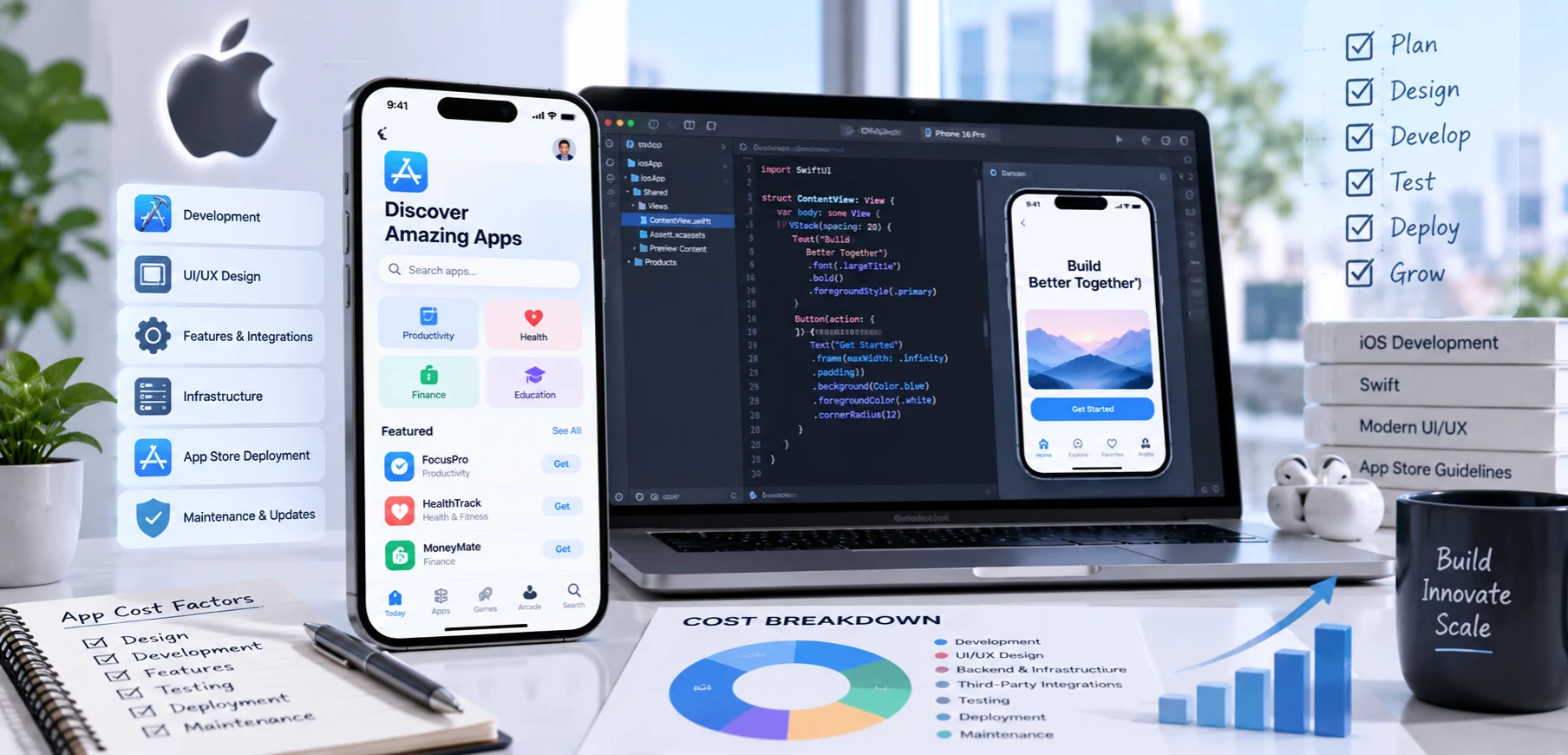

- iOS app development cost: US agencies typically charge $25,000 to $70,000 for a simple iPhone app, $70,000 to $150,000 for a mid-complexity app, $150,000 to $300,000 for a complex app, and $300,000 to $500,000 or more for an enterprise platform. NewAgeSysIT’s hybrid rates of $25 to $49 per hour bring a simple app to about $10,000 to $44,000.
- What drives the cost: app size and complexity, features, design, API integrations, the hiring model, team size, team location, and testing.
- Hidden costs: the $99 yearly Apple Developer Program fee, App Store commissions of 15% to 30% on digital sales, hosting and third-party services, yearly iOS updates, and maintenance of 15% to 25% of the build cost each year.
- Why iOS pays off: iOS accounts for about 61% of mobile OS usage in the US, and the App Store generated about $117 billion in consumer spending in 2025, well over double Google Play’s $49 billion.
- How to save: start with an MVP, use agile development, lean on Apple’s built-in frameworks and pre-built components, and choose a team with the right mix of cost and accountability.
How much does it cost to build an iOS app in 2026? With a US agency, expect about $25,000 to $70,000 for a simple iPhone app, $70,000 to $150,000 for a mid-complexity app, $150,000 to $300,000 for a complex app, and $300,000 to $500,000 or more for an enterprise platform. At NewAgeSysIT’s rates of $25 to $49 per hour, those tiers typically run about $10,000 to $44,000, $22,500 to $98,000, $50,000 to $196,000, and $100,000 or more.
Choosing iOS for your custom mobile app development is a smart move for many US businesses. Once you decide to build for iPhone, the next question is usually, “How much does it cost to build an iOS app?” The honest answer is that iOS app development cost depends on many factors, from features and design to the team you hire.
The market case for iOS is strong. iOS accounts for about 61% of mobile OS usage in the US, and iPhone users spend far more on apps than Android users. But with estimates online ranging from a few thousand dollars to over $700,000, it’s hard to know what to budget.
This guide cuts through the noise with realistic 2026 numbers: pricing by complexity, features, category, and team, plus the hidden costs, App Store fees, and new Apple requirements that affect your budget.
Formula to Calculate the Estimated Cost of iOS App Development
Here is a simple formula for estimating the average iPhone app development cost:
Estimated cost = (UI/UX design hours + iOS development hours + backend development hours + testing and project management hours) × hourly rate
For example, an app that needs 150 hours of design, 500 hours of iOS development, 250 hours of backend work, and 150 hours of testing and project management adds up to 1,050 hours. At NewAgeSysIT’s rates of $25 to $49 per hour, that comes to about $26,250 to $51,450. The same hours at US agency rates of $100 to $200 per hour would cost $105,000 to $210,000.
The sections below explain each part of the formula and the factors that push the total up or down.
How Much Does iOS App Development Cost in 2026?
Complexity is the best starting point. Here is what US agencies typically charge for a native iOS app, alongside NewAgeSysIT’s estimates:
| Complexity | What it usually includes | Typical US agency cost | Typical timeline | NewAgeSysIT effort | NewAgeSysIT estimate |
|---|---|---|---|---|---|
| Simple app | A handful of screens, sign-in, basic backend, and push notifications | $25,000 to $70,000 | 2 to 4 months | 400 to 900 hours | $10,000 to $44,100 |
| Mid-complexity app | Payments, maps, search, integrations, and an admin panel | $70,000 to $150,000 | 4 to 7 months | 900 to 2,000 hours | $22,500 to $98,000 |
| Complex app | Real-time features, AI, multiple user roles, and compliance needs | $150,000 to $300,000 | 6 to 12 months | 2,000 to 4,000 hours | $50,000 to $196,000 |
| Enterprise platform | Several connected apps, single sign-on, offline sync, and heavy integrations | $300,000 to $500,000+ | 9 to 18+ months | 4,000 to 8,000+ hours | $100,000 to $392,000+ |
The median US software developer earned $135,980 in May 2025, or roughly $65 an hour before benefits, tools, and overhead, which is why US agencies commonly bill $100 to $200 or more per hour.
Most iOS apps also need a browser-based admin panel for managing users, content, and orders. That dashboard is a web app development project of its own, so check that every quote you compare includes it.
If you want to test your idea first, a native iOS MVP typically costs $15,000 to $25,000 at the basic level with US agencies, and about $11,000 to $73,500 with NewAgeSysIT depending on complexity. Our guide MVP Development Cost Explained: Factors, Estimates, and Cost Saving Strategies! covers MVP budgets in detail.
Planning for Android too? Building a second native app usually adds about 20% to 33% to a single native build, because the backend and much of the design are shared. For a side-by-side view of every platform option, see Mobile App Development Cost in 2026: A Detailed US Pricing Breakdown.
iOS App Development Cost Breakdown: Key Factors to Consider
A simple app with basic features costs far less than a feature-rich app with custom design and complex backend integrations. The location and structure of your team matter just as much. Understanding these cost drivers helps you plan a budget that fits your goals, whether you’re building a small app or an enterprise solution.
Factor 1: App Size and Complexity
Larger apps with more screens, content, and features need more development time. Smaller, focused apps cost less. Here is what typically separates each level:
Basic app features
- User authentication: simple sign-in and account creation
- User interface: a clean, intuitive interface with a limited number of screens
- Core functionality: essential features such as displaying information or completing simple tasks
- Database integration: a basic database for storing and retrieving user data
- Push notifications: simple alerts and updates
Mid-level app features
- Improved authentication: Face ID, Touch ID, or social sign-in
- Custom UI elements: tailored design components for a better experience
- Additional functionality: search, in-app messaging, and payments
- Advanced data handling: larger datasets and more complex data relationships
- Analytics: tools to track user behavior and app performance
Complex app features
- Advanced user management: multi-factor authentication and role-based access
- Complex functionality: real-time collaboration, machine learning, and augmented reality
- Highly custom UI/UX: gestures, animations, and interactive elements
- Backend integration: complex systems and APIs that keep data in sync
- High-end security: secure data storage and industry compliance, such as HIPAA for healthcare
The pricing table above shows how these levels translate into cost and timeline.
Factor 2: Features and Functionality
Every feature adds hours. Here are common iOS features with typical effort at NewAgeSysIT’s rates of $25 to $49 per hour:
| Feature | What it includes | Approximate hours | NewAgeSysIT cost |
|---|---|---|---|
| Sign-up and login | Email and social sign-in, Sign in with Apple, and Face ID or Touch ID | 40 to 80 | $1,000 to $3,920 |
| User profiles and settings | Profile editing, preferences, and account deletion | 30 to 60 | $750 to $2,940 |
| Push notifications | Alerts and reminders through Apple Push Notification service | 20 to 50 | $500 to $2,450 |
| In-app purchases and subscriptions | StoreKit setup, receipts, and subscription management | 60 to 140 | $1,500 to $6,860 |
| Apple Pay checkout | Fast checkout for physical goods and services | 30 to 80 | $750 to $3,920 |
| Maps and location | MapKit or Google Maps, directions, and geofencing | 60 to 160 | $1,500 to $7,840 |
| Chat and messaging | Real-time chat, media sharing, and read receipts | 80 to 200 | $2,000 to $9,800 |
| Video calling | One-to-one or group calls | 100 to 240 | $2,500 to $11,760 |
| HealthKit integration | Reading and writing health and fitness data with user permission | 80 to 200 | $2,000 to $9,800 |
| Widgets and Live Activities | Home Screen widgets and real-time Lock Screen updates | 40 to 100 | $1,000 to $4,900 |
| Apple Watch companion app | A watchOS app that works alongside the iPhone app | 150 to 400 | $3,750 to $19,600 |
| Offline mode and iCloud sync | Local storage that syncs across a user’s devices | 80 to 200 | $2,000 to $9,800 |
| On-device AI features | Smart suggestions, summaries, or search using Core ML or Apple’s Foundation Models framework | 120 to 320 | $3,000 to $15,680 |
| AR features | ARKit experiences such as virtual try-ons or 3D product views | 160 to 400 | $4,000 to $19,600 |
| Admin panel | Web dashboard for users, content, and orders | 100 to 250 | $2,500 to $12,250 |
| Analytics and reporting | Usage tracking, dashboards, and exports | 40 to 120 | $1,000 to $5,880 |
Add design, testing, and project management on top of feature hours. These estimates are approximate and depend on your requirements.
On-device AI is a growing cost saver on iOS. Apple’s Foundation Models framework lets apps use the on-device model behind Apple Intelligence without paying per-request fees to a cloud AI provider, although cloud AI still makes sense for heavier tasks. Designing and testing those features well is specialized AI agent development work.
Factor 3: App Category
Each category comes with its own complexity, features, and user expectations. Games and marketplaces cost more because they need more development and testing, while simple utility apps cost less. Compliance needs and third-party integrations add to the total in regulated categories.
| App category | What drives the cost | Typical US agency cost | NewAgeSysIT estimate |
|---|---|---|---|
| Gaming and entertainment | Gameplay, graphics, leaderboards, and in-app purchases | $50,000 to $300,000 | $45,000 to $171,500 |
| Business and productivity | Workflows, integrations, and user roles | $40,000 to $250,000 | $20,000 to $122,500 |
| Education and learning | Courses, video, quizzes, and progress tracking | $60,000 to $250,000 | $22,500 to $107,800 |
| Travel and booking | Search, booking, payments, and maps | $50,000 to $250,000 | $25,000 to $122,500 |
| Retail and shopping | Catalog, cart, checkout, and order tracking | $40,000 to $350,000 | $20,000 to $122,500 |
| Social networking | Profiles, feeds, messaging, and moderation | $50,000 to $250,000 | $30,000 to $122,500 |
| Health and fitness | Workout tracking, HealthKit, and subscriptions | $50,000 to $300,000 | $22,500 to $122,500 |
| Medical and healthcare | Video visits, scheduling, secure messaging, and HIPAA safeguards | $40,000 to $250,000+ | $25,000 to $122,500 |
| Fintech and banking | Accounts, payments, identity checks, and fraud controls | $80,000 to $350,000+ | $37,500 to $171,500 |
| On-demand services | Customer, provider, and admin apps with real-time tracking | $80,000 to $200,000+ | $37,500 to $147,000 |
Timelines follow the complexity tiers above. Full-scale wellness platforms and enterprise systems can cost more.
Factor 4: App Design
Design is a significant share of iOS app development cost. Custom animations, detailed illustrations, and high-resolution graphics take more time, and your app needs to look right on every iPhone and iPad screen size it supports. Following Apple’s Human Interface Guidelines, supporting Dark Mode and Dynamic Type, and running design iterations based on user feedback all add to the design budget.
| Design task | Typical cost |
|---|---|
| UX research and wireframes | $500 to $5,000 |
| UI design (final visual screens) | $1,500 to $15,000 |
| Clickable prototype | $500 to $3,000 |
| Animations and illustrations (optional) | $500 to $10,000 |
| Branding, such as a logo and style guide (optional) | $1,000 to $10,000 |
Apple’s Liquid Glass design language, introduced with iOS 26, is now part of every build: apps recompiled with Xcode 27 adopt it automatically, so custom tab bars and navigation elements may need design updates. An experienced UI/UX design team can plan for that from the first wireframe.
Factor 5: API and Third-Party Integrations
Integrations connect your app to payments, maps, sign-in providers, and business systems. The number of integrations, their complexity, and the quality of each provider’s documentation all affect cost.
Payment integration
How you charge users depends on what you sell:
- Digital goods and subscriptions, such as premium features or content, generally must use Apple’s In-App Purchase system, which carries App Store commissions. In the US, apps can now also link users to an outside website to pay.
- Physical goods and real-world services, such as retail orders, food delivery, or rides, can use payment processors such as Stripe, PayPal, or Braintree.
| Payment option | What it costs |
|---|---|
| Apple In-App Purchase | 15% to 30% commission on digital sales |
| Card processors such as Stripe | A percentage plus a fixed fee per transaction, for example 2.9% plus 30 cents on Stripe’s standard US plan |
| Apple Pay | No extra fee from Apple. You pay your payment processor’s normal rate |
Processor pricing changes often and varies with volume and region, so confirm current rates with each provider.
Third-party integrations
Maps, social sign-in, analytics, CRMs, and booking or travel APIs each add integration hours, and many also charge usage fees as your app grows. Apple’s MapKit comes with the Apple Developer Program, which can lower mapping costs for iPhone-only apps, while Google Maps Platform charges by usage beyond its free monthly limits. A typical integration takes about 40 to 160 hours, or $1,000 to $7,840 at NewAgeSysIT’s rates.
Factor 6: Hiring Model
Your hiring approach has a major effect on cost, and each option has trade-offs:
| Hiring model | Typical hourly rate | Best for | Watch out for |
|---|---|---|---|
| Freelancer | $25 to $80 | Small apps, prototypes, and quick fixes | Limited capacity and continuity |
| Outsourced agency | $40 to $150 | Full builds with design, development, and testing | Time zone gaps and communication overhead |
| In-house team | $60 to $120+ | Long-term core products | Salaries, benefits, recruiting, and management |
| US-managed hybrid team | $25 to $49 at NewAgeSysIT | Full builds on a tighter budget | Choose a partner with clear US accountability |
In-house developers give you direct control, but they’re the most expensive option once you add benefits, equipment, and management to a median developer salary of $135,980. Freelancers are flexible and affordable for smaller tasks, but quality and availability can vary. Offshore and hybrid teams reduce costs significantly, though distant time zones and limited oversight can slow projects down, which is why US-managed teams are a popular middle ground.
If you want dedicated developers who work as an extension of your team, you can hire mobile app developers instead of scoping a fixed project.
For a deeper look at rates and hiring trade-offs, see Cost to Hire Mobile App Developers (2026; Important Factors).
Factor 7: Team Size
A larger team can finish faster but costs more per month and takes more coordination, while a smaller team saves money but may take longer. Here is who typically works on an iOS app:
| Role | What they do | Typical involvement |
|---|---|---|
| iOS developer | Builds the app in Swift and SwiftUI | One to two on a simple app, three or more on a complex one |
| Backend developer | Builds servers, databases, and APIs | One, often shared with other projects on smaller apps |
| UI/UX designer | Designs flows, screens, and prototypes | Heavy early on, lighter during development |
| QA engineer | Tests features, devices, and performance | Part-time early, heavier before each release |
| Project manager or scrum master | Plans sprints, tracks progress, and manages risk | Part-time on small projects, full-time on large ones |
| Business analyst | Turns business goals into requirements | Mostly during discovery and planning |
Factor 8: Location of the Development Team
Where your team is based changes the hourly rate more than almost anything else:
| Region | Typical agency hourly rate |
|---|---|
| USA | $100 to $200+ |
| UK | $60 to $100+ |
| Poland | $35 to $65 |
| Ukraine | $30 to $60 |
| Brazil | $30 to $55 |
| India | $20 to $40 |
| Vietnam | $20 to $45 |
| NewAgeSysIT (US company with its own offshore centers) | $25 to $49 |
Local teams make collaboration easier but cost more, while nearshore and offshore teams save money and need strong communication habits to stay on track.
Factor 9: App Testing
Testing makes sure your app works, performs well, stays secure, and looks right on every supported device. Apple’s TestFlight lets you run beta tests with real users before launch at no extra cost.
| Testing type | Average time | Cost at $25 to $49 per hour |
|---|---|---|
| UX testing | 10 to 60 hours | $250 to $2,940 |
| Functional testing | 50 to 200 hours | $1,250 to $9,800 |
| Performance testing | 10 to 30 hours | $250 to $1,470 |
| Security testing | 50 to 120 hours | $1,250 to $5,880 |
| Device and iOS version testing | 20 to 60 hours | $500 to $2,940 |
Want to figure out what your iOS app will cost? Get an instant estimate from our app cost calculator.
Try the App Cost Calculator →iPhone App Development Cost: What Are the Hidden Costs?
Hidden costs are the most common reason iOS budgets run over. They come from App Store fees, compliance work, scope changes, third-party services, and the ongoing work of keeping an app current.
| Hidden cost | What to expect |
|---|---|
| Apple Developer Program | $99 per year to publish on the App Store |
| Apple Developer Enterprise Program | $299 per year, only for apps distributed privately to your own employees |
| App Store commission | 15% to 30% of digital sales: 15% for developers earning up to $1 million a year under the Small Business Program and on subscriptions after the first year, and 30% otherwise |
| Mac computers and test devices | iOS apps are built in Xcode, which runs only on macOS, and you need real iPhones (and iPads, if supported) for testing |
| Xcode Cloud (optional) | Apple’s build and testing service includes 25 compute hours a month with the developer program, with paid tiers for more |
| Payment processing | Processor fees on physical goods and services, for example 2.9% plus 30 cents per Stripe transaction |
| Backend hosting and third-party services | Grows with your user base, including maps, SMS, email, analytics, and AI usage fees |
| Maintenance and yearly iOS updates | Commonly 15% to 25% of the build cost each year |
| Privacy and compliance work | App Store privacy labels, privacy manifests, age ratings, and industry rules such as HIPAA |
App Store fees and regulations. Every app must pass Apple’s review, so follow the App Store Review Guidelines closely and provide clear documentation to avoid delays or rejections. Commissions apply only to digital goods and services sold in the app.
Maintenance and updates. After launch, you’ll need regular updates for new iOS versions, bug fixes, security patches, and user feedback. Planning this budget early keeps your app reliable and your users engaged. Our guide App Maintenance Cost: A Detailed Breakdown of the Costs Involved covers it in depth.
Many businesses also keep their original team on board for ongoing maintenance and support services, since that team already knows the codebase.
App Store Rules and Updates That Affect Your 2026 Budget
- iOS 27 is out. Apple released iOS 27 on September 14, 2026, alongside its new iPhones, so apps need testing and updates for the new version.
- New build requirements every spring. Since April 28, 2026, apps uploaded to App Store Connect must be built with Xcode 26 and the iOS 26 SDK. Apple typically raises this requirement each spring, so plan for an iOS 27 SDK requirement in 2027, even though Apple hasn’t announced the date yet.
- Liquid Glass can no longer be skipped. Apps rebuilt with Xcode 27 automatically adopt Apple’s newer Liquid Glass design, because the temporary opt-out no longer works.
- Updated age ratings. Apple introduced a new age rating system that required developers to answer updated age rating questions in early 2026.
- Age verification laws. Texas’s App Store Accountability Act became enforceable in late May 2026, and similar laws in other states are scheduled to follow.
- US payment links. Since April 30, 2025, apps in the US can link users to outside payment pages, and Apple has charged no commission on those purchases while the courts decide what fee it may charge. The Supreme Court agreed to review the case.
iOS vs Android App Development: Which Is Better for Your Business?
Here is why many businesses choose iOS first:
- Higher app revenue. The App Store generated about $117 billion in consumer spending in 2025, compared with $49 billion for Google Play, so iPhone users are a strong audience for subscriptions and paid features.
- The largest US audience. iOS accounts for about 61% of mobile OS usage in the US, so an iOS-first launch reaches most American smartphone users.
- Enterprise data security. Apple’s platform supports centralized device management, strong encryption, and bring-your-own-device (BYOD) programs, which is why many businesses prefer it for internal apps. Pairing that foundation with expert IT security and cybersecurity services keeps company data protected.
- Consistent quality. Apple’s App Review process checks every app before release, which helps maintain quality standards and user trust.
- Low fragmentation. Apple supports a limited range of devices, and most users update iOS quickly, so testing takes less time than on Android.
That said, Android reaches more devices worldwide and a large share of US users. If your audience is split, Android app development or a cross-platform approach may be the better long-term fit.
For Android pricing, see Android App Development Cost in the United States: Pricing & Outsourcing Factors.
Best Tips to Optimize Your iOS App Development Budget
Accurate estimates, clear objectives, and smart trade-offs keep an iOS budget under control. Launching a minimum viable product first lets you gather user feedback before investing in every feature.
- Focus on key features. Launch with what users need most and save the rest for later updates. A focused first release reaches the market faster, costs less, and still meets your users’ core needs.
- Use Apple’s frameworks and pre-built components. Apple’s own frameworks, such as SwiftUI, StoreKit, MapKit, and HealthKit, along with proven third-party libraries, cut development time compared with building everything from scratch.
- Consider cross-platform when you need both platforms. If you plan to launch on Android too, a shared codebase can save about 30% to 40% compared with two native apps. Teams that already use JavaScript often choose React Native development for this.
- Choose agile development. Agile sprints deliver the most important features first, surface problems early, and keep your team responsive to feedback, which reduces rework and cost.
- Outsource smartly. Hybrid and offshore teams lower hourly rates, but the lowest rate isn’t always the lowest total cost. Choose a partner with clear communication, overlapping working hours, and US-based accountability.
- Automate wherever possible. Automated testing, continuous integration through Xcode Cloud or similar tools, and automated App Store builds save hours on every release.
How Can NewAgeSysIT Help With Your iOS App Development?
Every factor in this guide, from features and design to your team and hidden costs, shapes the final price of your app. Focusing on essential features, using proven frameworks, and working in agile sprints keeps both the project and the budget on track.
NewAgeSysIT is a US software company based in Princeton, New Jersey, with more than 30 years of experience and its own offshore development centers. Our custom iOS app development team builds apps for iPhone, iPad, Apple Watch, and Apple TV across many industries.
Whether you need an app for video streaming, location tracking, real-time analytics, or healthcare, our team can turn your idea into a polished App Store release. You can see examples of our work in our client portfolio.
Final Thoughts
There is no single price for an iPhone app, but there is a reliable way to budget for one: define your must-have features, choose the right team, and plan for the costs that continue after launch. Doing that work upfront keeps your iOS app development cost predictable and your launch on schedule.
Ready for a detailed estimate? Talk to NewAgeSysIT for a free consultation. Learn more about digital transformation solutions from one of the leading AI software companies in the United States.
Frequently Asked Questions
How much does it cost to build an iOS app in 2026?
US agencies typically charge $25,000 to $70,000 for a simple iPhone app, $70,000 to $150,000 for a mid-complexity app, $150,000 to $300,000 for a complex app, and $300,000 to $500,000 or more for an enterprise platform. NewAgeSysIT’s hybrid rates bring a simple app down to about $10,000 to $44,000.
What impacts iOS app development costs?
The biggest factors are app size and complexity, features, design, API integrations, the hiring model, team size and location, and testing. Your tech stack and ongoing maintenance also affect the total.
How can I estimate the iPhone app development cost?
Define your app’s features, scope, and design expectations, then use this formula: estimated cost = (design hours + iOS development hours + backend hours + testing and project management hours) × hourly rate. For an accurate number, ask an experienced iOS development company for a detailed quote.
How much does a simple iPhone app cost?
A simple iPhone app with a handful of screens, sign-in, and a basic backend usually costs $25,000 to $70,000 with a US agency, or about $10,000 to $44,000 with NewAgeSysIT.
How long does it take to build an iOS app?
About 2 to 4 months for a simple app, 4 to 7 months for a mid-complexity app, 6 to 12 months for a complex app, and 9 to 18 months or more for an enterprise platform.
Is iOS app development more expensive than Android?
For a single platform, the cost is usually similar. iOS development needs Mac computers and a $99 yearly developer fee, while Android apps often need more device testing because of the wide range of phones. The bigger cost difference comes from building both: a second native app adds about 20% to 33%.
What is the difference between developing apps for iOS and Android?
iOS apps are built for Apple devices, mainly in Swift, and testing is simpler because there are fewer device variations. Android apps are built mainly in Kotlin and must be optimized for many more devices, screen sizes, and OS versions.
Why build iOS apps for business?
iOS accounts for about 61% of mobile OS usage in the US, and iPhone users spend far more on apps than Android users. iOS apps also offer strong security, consistent quality, and a premium user experience that helps businesses build credibility.
How much does it cost to put an app on the App Store?
Publishing requires the Apple Developer Program, which costs $99 a year. Apple also takes a commission of 15% to 30% on digital goods and subscriptions sold in the app, while sales of physical goods and real-world services carry no Apple commission.
How much does Apple take from in-app purchases?
Apple’s standard commission is 30% on digital goods and services. Developers earning up to $1 million a year qualify for 15% through the Small Business Program, and subscriptions drop to 15% after the first year. In the US, purchases made through outside payment links currently carry no Apple commission while the courts decide what fee Apple may charge.
How much does it cost to maintain an iOS app?
Plan for about 15% to 25% of the original build cost each year, plus hosting and third-party services. Yearly iOS releases and Apple’s changing build requirements make regular updates unavoidable.
How much does an iOS MVP cost?
A basic native iOS MVP typically costs $15,000 to $25,000 with a US agency, and more complex MVPs cost more. At NewAgeSysIT’s rates, a native iOS MVP runs about $11,000 to $73,500 depending on complexity.
Should I build a native iOS app or a cross-platform app?
Native iOS development in Swift gives you the best performance and the deepest access to Apple features such as HealthKit, Apple Pay, and Live Activities. If you also need Android, a cross-platform framework such as Flutter or React Native usually saves 30% to 40% compared with two native apps.
How much do iOS developers charge per hour?
US agencies typically charge $100 to $200 or more per hour, UK teams $60 to $100 or more, teams in Poland, Ukraine, and Brazil about $30 to $65, and teams in India or Vietnam about $20 to $45. NewAgeSysIT charges $25 to $49 per hour.
How do you develop an iPhone app?
Start with planning and requirements, then move through UI/UX design, development in Swift, backend and integration work, testing (including TestFlight betas), and App Store submission. Working with an experienced iOS team keeps the process smooth from idea to launch and keeps your iOS app development cost under control.
Sources
- StatCounter, Mobile Operating System Market Share in the United States (August 2026): gs.statcounter.com/os-market-share/mobile/united-states-of-america
- Business of Apps, App Data Report 2026: businessofapps.com/data/app-data-report
- U.S. Bureau of Labor Statistics, Occupational Outlook Handbook, Software Developers: bls.gov/ooh/computer-and-information-technology/software-developers
- Apple Developer, Upcoming Requirements: developer.apple.com/news/upcoming-requirements
- Apple Developer, App Store Small Business Program: developer.apple.com/app-store/small-business-program
- MacRumors, “iOS 27: Release Date, New Features, and Compatible iPhones” (September 2026): macrumors.com/2026/09/13/ios-27-release-date-new-features
- eCorp IT, “iOS 27 Liquid Glass in Xcode 27: the migration Apple actually requires”: ecorpit.com/ios-27-liquid-glass-xcode-27-migration-guide-2026
- Tech Times, “Apple Must Now Justify App Store Commission to Judge” (August 2026): techtimes.com/articles/324312/20260813
- MacDailyNews, “U.S. Supreme Court clears path for App Store commission showdown” (August 2026): macdailynews.com/2026/08/14/u-s-supreme-court-clears-path-for-app-store-commission-showdown
- Recording Law, “App Store Age Verification Laws: All 4 States Compared (2026)”: recordinglaw.com/us-laws/age-verification-laws/app-store-age-verification-laws
- Helcim, “What is Apple Pay and How Does it Work?”: helcim.com/guides/what-is-apple-pay


