
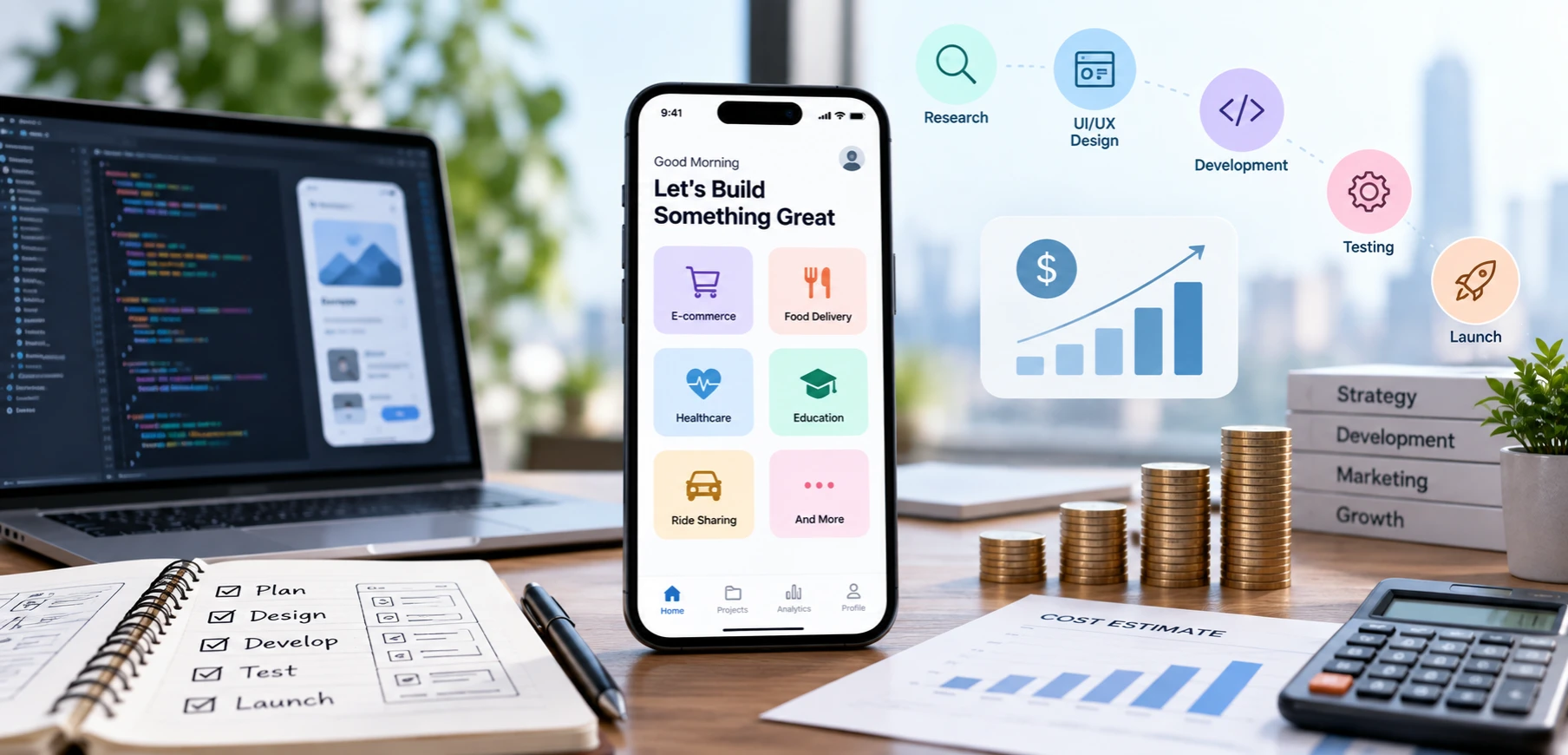

- Mobile app development cost with a US agency typically runs $25,000 to $70,000 for a simple app, $70,000 to $150,000 for a mid-complexity app, $150,000 to $300,000 for a complex app, and $300,000 to $500,000 or more for an enterprise platform.
- NewAgeSysIT's hybrid model, with US leadership and offshore development at $25 to $49 per hour, builds a simple app for about $10,000 to $44,000.
- The biggest cost drivers are app complexity, features, UI/UX design, backend infrastructure, platform choice, and the location of your development team.
- Budget for app store fees, cloud hosting, third-party services, compliance, and 15% to 25% of the build cost every year for maintenance.
- App store fees and rules changed in 2026, including new Google Play fees, stricter build requirements from Apple and Google, and a Texas age verification law now in effect.
- Start with an MVP, use pre-built tools, and choose cross-platform development, which usually costs about 30% to 40% less than two native apps.
How much does it cost to develop a mobile app in 2026? With a US agency, expect about $25,000 to $70,000 for a simple app, $70,000 to $150,000 for a mid-complexity app, $150,000 to $300,000 for a complex app, and $300,000 to $500,000 or more for an enterprise platform. At NewAgeSysIT's rates of $25 to $49 per hour, those tiers typically run about $10,000 to $44,000, $22,500 to $98,000, $50,000 to $196,000, and $100,000 or more.
Businesses of every size are reaching customers through custom mobile app development, and the app economy keeps growing. Consumers spent $167 billion on in-app purchases worldwide in 2025, up about 10% from the year before, and for the first time they spent more in non-game apps than in games.
Yet the first question almost every business asks, "How much does it cost to make an app?", rarely gets a straight answer. Online estimates range from a few thousand dollars to over a million, because mobile app development cost depends on what you build, which platforms you target, who builds it, and what it takes to keep the app running after launch.
This guide gives you realistic 2026 numbers for the US market. It covers:
- How much it costs to develop an app for your business, by complexity, app type, feature, and platform
- What your mobile app development budget actually pays for
- The hidden and ongoing costs, including 2026 app store fees and compliance
- How to estimate your budget and get the best possible return
Whether you want to improve your customer experience, reach new markets, or scale operations, these numbers will help you plan with confidence and sanity-check any quote you receive.
Cost OverviewAverage Mobile App Development Cost in 2026: Overview
Most businesses approach a development company with an idea but little exposure to how apps are built or priced. A clear list of requirements and must-have features is the foundation of any fair estimate.
Complexity is the best starting point. Here is what US agencies typically charge at each level, along with typical timelines:
| Complexity | What it usually includes | Typical US agency cost | Typical timeline |
|---|---|---|---|
| Simple app | A handful of screens, sign-in, basic backend, and push notifications | $25,000 to $70,000 | 2 to 4 months |
| Mid-complexity app | Payments, maps, search, integrations, and an admin panel | $70,000 to $150,000 | 4 to 7 months |
| Complex app | Real-time features, AI, multiple user roles, and compliance needs | $150,000 to $300,000 | 6 to 12 months |
| Enterprise platform | Several connected apps, single sign-on, offline sync, and heavy integrations | $300,000 to $500,000+ | 9 to 18+ months |
These estimates are approximate and change with your app's scope, features, integrations, and design requirements.
These prices reflect US labor costs. The median US software developer earned $135,980 in May 2025, or roughly $65 an hour before benefits, tools, and overhead, which is why US agencies commonly bill $100 to $200 or more per hour.
Here is the same set of tiers estimated at NewAgeSysIT's hybrid rates of $25 to $49 per hour:
| Complexity | Approximate effort | NewAgeSysIT estimate |
|---|---|---|
| Simple app | 400 to 900 hours | $10,000 to $44,100 |
| Mid-complexity app | 900 to 2,000 hours | $22,500 to $98,000 |
| Complex app | 2,000 to 4,000 hours | $50,000 to $196,000 |
| Enterprise platform | 4,000 to 8,000+ hours | $100,000 to $392,000+ |
The Basic Formula for App Development Cost
Every estimate comes down to hours multiplied by rates:
For example, an app that needs 600 hours of app development, 300 hours of backend work, and 200 hours of design, testing, and project management adds up to 1,100 hours. At $25 to $49 per hour, that comes to about $27,500 to $53,900.
Most apps also need a browser-based admin panel for managing users, content, and orders. That dashboard is a web application development project of its own, so make sure every quote you compare includes it.
Cost DriversFactors That Contribute to Your Mobile App Development Cost
Understanding what drives cost helps you make informed, budget-friendly decisions. Here is how much each factor typically moves the budget:
| Cost factor | Typical impact | Why it matters |
|---|---|---|
| App complexity and features | Major | Every screen, integration, and user role adds hours |
| App category | Moderate to major | Each category comes with its own must-have features |
| UI/UX design | Moderate to major | Custom design, animation, and accessibility take time |
| Platform choice | Major | Two native apps cost more than one shared codebase |
| Backend and integrations | Major | Servers, databases, APIs, and third-party services |
| Team size and location | Major | Hourly rates range from about $20 to over $200 |
| Security and compliance | Moderate to major | HIPAA, PCI DSS, children's privacy, and state laws add work |
| Maintenance | Ongoing | Updates and fixes continue after launch |
App Complexity
A simple app typically includes a login system, user profiles, a dashboard, and a few core functions, with limited admin capabilities. For example, NewAgeSysIT built Safety24Our, a focused safety app that delivers real-time alerts, live location sharing, and quick access to emergency help.
A mid-complexity app adds features that drive engagement and revenue, such as payment gateways, social media integrations, privacy controls, and audio or video streaming. Our team built SecurePosit, a fintech app that makes digital payments fast, simple, and secure.
A complex app costs the most because it combines advanced data handling, specialized interfaces, and integrations with outside systems. Auntie App, a childcare app we built to connect parents with babysitters, combines profile creation, real-time communication, secure scheduling, in-app payments, and background verification.
App Category
Your app's category shapes the features it needs, and therefore its cost:
- E-commerce apps let users browse, buy, and track orders. Cost depends on catalog size, checkout and payment options, integrations, and whether you run one store or a multi-vendor marketplace. Our e-commerce app development services page breaks down store and marketplace pricing in more detail.
- Social networking apps let people connect, share content, and message each other, and they tend to cost more than simpler apps because of feeds, media handling, and moderation. See our social networking app development services for examples.
- On-demand apps connect customers with service providers in real time, usually through separate apps for customers, providers, and administrators. Real-time tracking and dispatch make on-demand app development one of the pricier categories.
- Banking and fintech apps need strong security, identity checks, fraud controls, and regulatory compliance, which adds testing and documentation to every release.
- Hardware-connected (IoT) apps rely on devices and sensors to collect data or trigger actions, so cost depends on the hardware, connectivity, and data processing involved.
Here are typical ranges by app type:
| App type | What drives the cost | Typical US agency cost | NewAgeSysIT estimate |
|---|---|---|---|
| E-commerce | Catalog, cart, checkout, payments, and order tracking | $40,000 to $350,000 | $20,000 to $122,500 |
| Social media | Profiles, feeds, messaging, media uploads, and moderation | $50,000 to $250,000 | $30,000 to $122,500 |
| On-demand or food delivery (full launch) | Customer, driver, and vendor apps with real-time tracking | $80,000 to $200,000+ | $37,500 to $147,000 |
| Education | Courses, video, quizzes, and progress tracking | $60,000 to $250,000 | $22,500 to $107,800 |
| Dating | Profiles, matching, chat, and safety and verification tools | $50,000 to $350,000 | $35,000 to $147,000 |
| Healthcare or telehealth | Video visits, scheduling, secure messaging, and HIPAA safeguards | $60,000 to $300,000+ | $25,000 to $122,500 |
| Fintech | Accounts, payments, identity checks, fraud controls, and compliance | $80,000 to $350,000+ | $37,500 to $171,500 |
| Gaming | Gameplay, graphics, leaderboards, and in-app purchases | $50,000 to $300,000 | $45,000 to $171,500 |
These estimates are approximate and change with scope, timeline, design, and the complexity of features and integrations.
App Design, Animations, and Illustrations
App design usually costs $3,000 to $30,000 or more, depending on the number of screens, how custom the visuals are, and the designers' experience. Animations and illustrations can boost engagement, but they also add design and development time.
| Design task | Typical cost |
|---|---|
| UX research and wireframes | $500 to $5,000 |
| UI design (final visual screens) | $1,500 to $15,000 |
| Clickable prototype | $500 to $3,000 |
| Animations and illustrations (optional) | $500 to $10,000 |
| Branding, such as a logo and style guide (optional) | $1,000 to $10,000 |
A simple app may need only basic UX and UI work, while a brand-heavy app with custom motion design can pass $30,000. Planning for accessibility from the start also costs far less than adding it later.
Features and Functionalities
Every feature you add increases the budget, so focus on the core features first. That is exactly what a minimum viable product (MVP) does: it launches with a foundational feature set, keeps early costs down, and gathers real user feedback. Here are common features with typical effort at NewAgeSysIT's rates of $25 to $49 per hour:
| Feature | What it includes | Approximate hours | NewAgeSysIT cost |
|---|---|---|---|
| Sign-up and login | Email, phone, and social sign-in, plus password reset | 40 to 80 | $1,000 to $3,920 |
| User profiles and settings | Profile editing, preferences, and account deletion | 30 to 60 | $750 to $2,940 |
| Social media integration | Sharing, invites, and social feeds | 20 to 60 | $500 to $2,940 |
| Push notifications | Alerts, reminders, and segmented messages | 20 to 50 | $500 to $2,450 |
| In-app payments and subscriptions | Apple and Google billing, Stripe, and receipts | 60 to 140 | $1,500 to $6,860 |
| Cloud data storage | Secure storage for user data, files, and backups | 30 to 80 | $750 to $3,920 |
| Maps, GPS, and geofencing | Location tracking, directions, and location-based alerts | 60 to 160 | $1,500 to $7,840 |
| Photo and video capture | Camera access, uploads, and basic editing | 40 to 120 | $1,000 to $5,880 |
| Chat and messaging | Real-time chat, media sharing, and read receipts | 80 to 200 | $2,000 to $9,800 |
| Video calling | One-to-one or group calls | 100 to 240 | $2,500 to $11,760 |
| Search and filters | Keyword search, sorting, and saved filters | 40 to 100 | $1,000 to $4,900 |
| Admin panel | Web dashboard for users, content, and orders | 100 to 250 | $2,500 to $12,250 |
| Analytics and reporting | Usage tracking, dashboards, and exports | 40 to 120 | $1,000 to $5,880 |
| Offline mode | Local storage that syncs when the device reconnects | 80 to 200 | $2,000 to $9,800 |
| AI features | A chat assistant, recommendations, or smart search | 120 to 320 | $3,000 to $15,680 |
| AR features | Virtual try-ons, 3D product views, or AR navigation | 160 to 400 | $4,000 to $19,600 |
| Third-party integration (each) | CRM, ERP, EHR, shipping, or accounting systems | 40 to 160 | $1,000 to $7,840 |
Add design, testing, and project management on top of feature hours. These estimates are approximate and depend on your requirements.
What AI Features Add to Your Budget
AI is now one of the fastest-growing app categories: in-app spending on generative AI apps more than tripled in 2025 to top $5 billion. Adding AI usually means two costs, the build itself and usage-based fees for the AI service every time a user makes a request.
Building accurate, safe AI features, such as assistants that answer from your own content or models that predict what a user needs next, is specialized AI agent development work that should include testing for wrong answers and privacy risks.
If you already have an app, connecting it to an existing AI service is often faster and cheaper than building from scratch. Planning that rollout, including when a person should review AI output, is the focus of our AI integration and adoption services.
Platform Choice: iOS, Android, or Cross-Platform
Building for one platform costs less than building for two, and sharing code across platforms narrows the gap further. Using a web-only build as the baseline, here is how the options compare:
| Platform approach | Relative cost | Best for |
|---|---|---|
| Web app or progressive web app (PWA) | 1.0x (baseline) | Fast launches and tools that don't need app store distribution |
| Cross-platform (Flutter or React Native) | 1.1x to 1.2x | Most startups and business apps that need iOS and Android |
| One native app (iOS or Android) | 1.5x | Apps targeting a single audience or device-heavy features |
| Native iOS and native Android | 1.8x to 2.0x | Performance-critical apps, advanced device features, and large consumer brands |
A native iOS app is written in Swift for Apple devices and gives you the best access to features like Face ID, Apple Pay, and HealthKit. If your audience is mostly iPhone users, iOS app development is often the fastest path to a polished launch.
For iOS-specific pricing, see iOS App Development Cost: A Detailed Estimation of Everything You Should Consider.
Android reaches the widest range of devices, which means more screen sizes and hardware combinations to test. That extra testing is the main reason Android app development can take slightly longer for the same features.
For Android-specific pricing, see Android App Development Cost in the United States: Pricing & Outsourcing Factors.
Cross-platform frameworks let you reuse one codebase for iOS and Android, which simplifies both development and maintenance and usually saves about 30% to 40% compared with two native apps. Google's Flutter app development framework is a strong fit for custom, brand-heavy interfaces.
Meta's React Native is the other leading option, and React Native development works especially well when your team already uses JavaScript or React for the web.
Backend and Integrations
Most of the work users never see lives on the server: databases, business logic, notifications, and connections to payment, shipping, CRM, or EHR systems. Apps with real-time syncing, heavy data storage, or many integrations need more backend time.
Team Size and Location
Your team of developers, designers, testers, and project managers drives cost directly. Larger teams can finish sooner but cost more per month, and hourly rates vary widely by region, as the next section shows.
Security and Compliance
Apps that handle health data, payments, or children's information need extra safeguards, testing, and documentation, which can add weeks to the schedule. The compliance section below covers the main US requirements.
App Maintenance
Maintenance typically costs 15% to 25% of the original build every year, and the first year after launch can run higher. The total depends on app complexity, how often you release updates, bug fixes, design changes, and your support needs, which is why many businesses budget for ongoing maintenance and support services from day one.
Team & RatesHow Team Location and Hiring Model Affect Cost
The same app can cost very different amounts depending on where your team is based:
| Region | Typical agency hourly rate |
|---|---|
| USA | $100 to $200+ |
| UK | $60 to $100+ |
| Poland | $35 to $65 |
| Ukraine | $30 to $60 |
| Brazil | $30 to $55 |
| India | $20 to $40 |
| Vietnam | $20 to $45 |
| NewAgeSysIT (US company with its own offshore centers) | $25 to $49 |
How you hire matters too:
| Hiring model | Typical hourly rate | Best for | Watch out for |
|---|---|---|---|
| Freelancer | $25 to $80 | Small apps, prototypes, and quick fixes | Limited capacity and continuity |
| Outsourced agency | $40 to $150 | Full builds with design, development, and testing | Time zone gaps and communication overhead |
| In-house team | $60 to $120+ | Long-term core products | Salaries, benefits, recruiting, and management |
| US-managed hybrid team | $25 to $49 at NewAgeSysIT | Full builds on a tighter budget | Choose a partner with clear US accountability |
Many businesses choose offshore teams to save money, then struggle with slow feedback and unclear accountability. A US-managed hybrid team solves that by pairing US project leadership with offshore development rates.
If you want developers who work as an extension of your own team, you can hire mobile app developers on a dedicated basis instead of scoping a fixed project.
For a deeper look at hourly rates and hiring trade-offs, see Cost to Hire Mobile App Developers (2026; Important Factors).
Beyond the BuildHidden Costs You Should Consider
The build is only part of what an app costs. These expenses show up during development and after launch, and they are easy to miss in early budgets.
Third-party services. Most apps rely on outside services for push notifications, payments, maps, SMS, email, and analytics. Many charge subscription or usage fees that grow as your user base grows.
Backend infrastructure and servers. Real-time data syncing, large data storage, and user authentication all need solid backend infrastructure, which means ongoing hosting costs on providers like AWS, Google Cloud, or Microsoft Azure. Many businesses hand this work to cloud managed services so scaling and monitoring don't pull developers off new features.
App store fees. Apple charges $99 a year and Google Play charges a one-time $25 fee for developer accounts, and both stores take a share of in-app digital sales. The next section explains the 2026 fee changes.
Marketing and user acquisition. Launching an app is only the first step. Attracting and keeping users takes a marketing budget for advertising, influencer partnerships, app store optimization, and content, and the right amount depends on your category and audience.
Security and compliance. Protecting user data takes security audits, encryption, penetration testing, and compliance reviews, all of which add to the total cost.
Here is a quick summary of hidden and ongoing costs:
| Cost | What to expect |
|---|---|
| Apple Developer Program | $99 per year |
| Google Play developer account | $25 one-time registration |
| App store fees | Apple takes 15% to 30% of in-app digital sales, and Google Play's service fees start at 10% |
| Payment processing | Card processors charge per transaction, for example 2.9% plus 30 cents on Stripe's standard plan |
| Cloud hosting and backend services | Grows with your user base, from under $100 to several thousand dollars a month |
| Third-party services | Maps, SMS, email, analytics, and AI usage fees |
| Maintenance and updates | Commonly 15% to 25% of the build cost each year |
| Security testing and compliance | Penetration tests, privacy reviews, and legal documents |
| Marketing and user acquisition | Budget separately, since downloads rarely happen on their own |
Maintenance is the cost most often underestimated. Every year brings new iOS and Android versions, new store requirements, security patches, and feature requests. Our guide App Maintenance Cost: A Detailed Breakdown of the Costs Involved covers this in depth.
Here is a simple way to see the total cost of ownership. Suppose you build an app for $80,000, spend 20% of that on maintenance each year ($16,000), and pay $500 a month for hosting and services ($6,000 a year). Over three years, the app costs about $146,000, not $80,000.
App Store Fees and Rules in 2026
App store economics shifted significantly in 2025 and 2026. Here is where things stand for US apps:
| Item | Apple App Store | Google Play |
|---|---|---|
| Developer account | $99 per year | $25 one-time |
| Standard fees on in-app digital sales | 15% to 30% | Service fees start at 10% (on subscriptions and a developer's first $1 million in annual earnings) and run up to 20% to 25% on other in-app purchases, plus 5% when you use Google Play Billing |
| US purchases through outside payment links | No commission since April 2025, while a federal court decides what cost-based fee Apple may charge | Developers in Google's US external links and alternative billing programs must report sales and pay service fees starting October 1, 2026 |
| Physical goods and real-world services | No commission | No commission |
Other 2026 changes that affect your budget:
Apple build requirements. Since April 28, 2026, apps uploaded to App Store Connect must be built with Xcode 26 or later using the iOS 26 SDK, and Apple introduced a new age rating system that required developers to answer updated age rating questions.
Google Play target API level. Since August 31, 2026, new apps and updates must target Android 16 (API level 36), and existing apps must target at least Android 15 to stay available to new users on newer devices.
Apple's US commission case. The Supreme Court agreed to review Apple's contempt finding, with arguments expected in its October 2026 term, while a separate district court proceeding decides what link-out commission Apple may charge.
These yearly platform updates are a real budget line: every spring and summer, apps need updates just to keep shipping.
ComplianceCompliance Costs and Taxes
Depending on your audience and industry, compliance can be one of the larger items in your budget.
Taxes. Sales tax rules for software and digital products vary by state. New Jersey, for example, charges a 6.625% statewide sales tax with no additional local sales taxes, and Urban Enterprise Zones offer reduced rates in certain areas. Whether tax applies to software development itself depends on the state and on whether the software is custom or prewritten, so check with a tax advisor.
For purchases made through the App Store or Google Play billing, the stores generally act as marketplace facilitators and collect and remit sales tax for you, although you may still need to track where you have tax obligations. Sales you process through your own website checkout are usually your responsibility, which matters if you move purchases outside the stores to save on fees.
Key compliance requirements for US apps:
| Requirement | When it applies | What it requires |
|---|---|---|
| HIPAA | Apps that handle protected health information for healthcare providers, health plans, or their business associates | Technical, administrative, and physical safeguards, audit controls, and business associate agreements |
| CCPA and CPRA | Businesses serving California residents that exceed $26,625,000 in annual revenue, handle data on 100,000 or more California consumers or households, or earn half their revenue from selling or sharing personal data | Data access, deletion, and opt-out features plus privacy notices, with newer rules adding risk assessments and cybersecurity audits for larger data processors |
| COPPA | Apps directed to children under 13, or that knowingly collect their data | Verifiable parental consent, clear privacy notices, limited data retention, and a written security program under the amended rule in full effect since April 22, 2026 |
| App store age verification laws | Apps offered to users in Texas today, with Utah, Louisiana, and Alabama to follow | Using age and parental consent signals from the app stores to manage minors' access |
| FTC rules | All apps | Truthful marketing, honest privacy claims, and reasonable data security |
| ADA and accessibility | Apps that serve the public, including state and local government apps under a Department of Justice rule | Accessible design, typically to WCAG 2.1 Level AA, such as screen reader support and clear navigation |
| SOC 2 | B2B, SaaS, and enterprise apps that manage customer data | An independent audit of your security controls |
| PCI DSS | Apps that handle credit or debit card payments | Tokenization, encryption, and secure card handling, with a compliant payment processor reducing your scope |
| GDPR | Apps with users in the European Union, even if you are US-based | A lawful basis for processing, consent management, and data rights |
Compliance work varies widely by scope. As a rough guide, HIPAA compliance can add $20,000 to $100,000 or more to a healthcare app, and CCPA features can add $5,000 to $50,000 depending on how much personal data the app handles. Depending on your market, you may also align with ISO 27001, ISO 27701, or the NIST Cybersecurity Framework.
Texas's App Store Accountability Act became enforceable in late May 2026, after a federal appeals court paused the order blocking it while the legal challenge continues, and Utah's version is now set to take effect in May 2027. This section is general information, not legal or tax advice.
Step-by-Step Mobile App Development Process
Here is the process to follow when building an app for your business:
- Research the target market
- Select the right platform
- Choose a development partner
- Build a minimum viable product (MVP)
- Test the app
- Submit the app to the stores
- Launch the app and monitor its performance
Research the Target Market
Learn who your users are, how they interact with brands like yours, and what competitors offer. Reading user reviews of the top apps in your category is a quick way to find gaps your product can fill.
Select the Right Platform
Decide whether you need iOS, Android, or both. If your budget is limited, launch on the platform your audience uses most, or use cross-platform development to reach both at once, then expand later.
Choose a Development Partner
An experienced development company brings developers, UI/UX designers, testers, and project managers who can deliver advanced features on schedule, suggest better approaches, and give you access to current technology. Compare partners on transparency, relevant experience, and post-launch support, not just hourly rates.
Build a Minimum Viable Product (MVP)
An MVP validates your idea without spending too much. A good partner helps you identify the must-have features and your app's unique selling points, and our MVP development for startups follows exactly that approach.
Test the App
Test everything, from performance and security to user experience and content, across the devices your users own. Catching bugs before launch shortens development, lowers cost, and protects your reputation.
Submit the App to the Stores
After testing and bug fixes, submit your app to the App Store and Google Play. Make sure it follows Apple's and Google's guidelines, meets their current build requirements, and uses a monetization model the stores allow.
Launch the App and Monitor Its Performance
After launch, track performance with analytics tools, and keep releasing updates that improve engagement and respond to user feedback.
Here is how a typical budget splits across these stages, using a $100,000 app as an example:
| Phase | What happens | Typical share of budget | Example on a $100,000 app |
|---|---|---|---|
| Discovery and planning | Market research, feature list, architecture, and estimates | 10% | $10,000 |
| UI/UX design | Wireframes, clickable prototypes, and final screens | 15% | $15,000 |
| Development | Frontend, backend, and integrations | 50% | $50,000 |
| QA and testing | Functional, device, performance, and security testing | 15% | $15,000 |
| Launch and project management | App store submission, release setup, and coordination | 10% | $10,000 |
Skimping on discovery or testing rarely saves money. Unclear requirements lead to rework, and bugs found after launch cost far more to fix than bugs caught before it.
BudgetingHow to Estimate Your App Budget in 5 Steps
- List your must-have features. Separate what users need at launch from what can wait.
- Choose your platforms. Decide between cross-platform, one native app, or two native apps.
- Place your app in a complexity tier. Use the tables above to find your range.
- Apply your team's rates. Multiply estimated hours by the hourly rate of the team you're considering.
- Add ongoing costs. Include maintenance, hosting, store fees, and third-party services for at least three years.
For a quick first number, try our app cost calculator, then refine it with a team that can review your feature list.
If your budget is tight, start smaller. Our guide MVP Development Cost Explained: Factors, Estimates, and Cost Saving Strategies! shows how to launch a minimum viable product first and expand once real users confirm demand.
Get a quick first number with our interactive app cost calculator.
Start Cost Estimation →Tips and Tricks to Reduce Your Mobile App Development Cost
Planning where every dollar goes at each stage keeps your budget under control. These strategies help the most:
- Define the core functionality. Focus the app on the problem it solves and leave out the clutter. A focused app is easier to use, faster to build, and cheaper to maintain, so set clear goals and milestones before development starts.
- Use pre-built templates and libraries. Proven components for common screens and features save development time and money, so your budget goes into the features that make your app different.
- Consider low-code tools where they fit. Low-code and no-code platforms can speed up prototypes, internal tools, and simple apps. Custom development still makes more sense for complex logic, unique designs, and apps that need to scale.
- Choose cross-platform development when it fits. One codebase for iOS and Android cuts cost and time, which makes it a strong choice for startups, MVPs, and most business apps. Native development is still the better choice for heavy graphics, advanced device features, or the most demanding performance needs.
- Outsource smartly. Offshore and hybrid teams can lower costs significantly, but the lowest rate is not always the lowest total cost. Budget for time zone overlap, project oversight, and communication, and choose a partner with clear accountability.
- Use proven services and APIs. Services such as Firebase for sign-in and notifications, Stripe for payments, and Google Maps Platform for location features let you add capabilities without building them from scratch. Open-source libraries can save even more.
- Keep the design clean and intuitive. Simple designs are faster to build and easier to use. Every element should earn its place, and working with an experienced UI/UX design team keeps screens focused and consistent.
- Use cloud services to scale smoothly. Pay-as-you-go cloud platforms remove the need for your own servers and let costs grow in step with your user base.
- Use AI coding assistants wisely. Tools like ChatGPT and other AI coding assistants can speed up prototyping and routine coding, but every change still needs review by an experienced developer before it reaches users.
- Phase features and automate testing. Release features in stages based on user feedback, reuse a design system for new screens, and automate testing early to cut QA hours on every release.
Hacks to Boost ROI on Mobile App Development Costs
A smart budget is only half the story. These steps help your app earn back what you spend:
- Research before you build. Gather data on your target industry, competitors, and users so your feature roadmap reflects what people actually want. Apps built on solid research find their audience faster and keep users longer.
- Invest in user experience. User expectations and UI design trends keep changing as devices evolve, so treat UX as ongoing work rather than a one-time task. A better experience means higher retention and more revenue from the same investment.
- Optimize performance. Slow screens frustrate users and hurt reviews. Keep images compressed, code clean, and backend responses fast, and budget time in every release for performance and security checks.
- Release regular updates. Frequent updates keep users engaged, improve your store listing, and fix issues before they spread. They are also unavoidable: Apple and Google now require apps to be rebuilt with current tools every year to keep shipping updates.
Choose the right engagement model. How you pay your development team affects both cost and risk:
| Engagement model | How it works | Best for |
|---|---|---|
| Fixed price | One agreed price for a clearly defined scope | Small, well-defined projects |
| Time and materials | You pay for actual hours at agreed rates | Products with evolving requirements |
| Milestone-based | Payments are tied to reviewed deliverables | Most custom app projects |
| Dedicated team | A monthly fee for a team working only on your product | Long-term development |
| Revenue sharing | Lower upfront fees in exchange for a share of app revenue | Early-stage partnerships (less common) |
Separately, choose your monetization model early, whether freemium, subscriptions, in-app purchases, ads, or paid downloads, because it shapes which features you build and which store fees apply.
Case StudiesCase Studies: Apps Like Tinder, Toni & Guy, Shiprocket, and Sweepstakes.com
Building an app like Tinder. Tinder popularized swipe-based matching. NewAgeSysIT built Xplore Dating, a dating app for different relationship goals, from serious connections to casual dating and wider social circles, with smart matching, privacy controls, and secure messaging.
Building an app like Toni & Guy. Salon brands like Toni & Guy use apps for bookings, updates, and salon management. Following a similar model, we built ISRA, an on-demand beauty app that helps users discover and book stylists, makeup artists, and other beauty professionals.
Building an app like Shiprocket. Shiprocket helps e-commerce businesses ship orders with courier integrations and real-time tracking. In the same space, we built TownConnect, a shipment tracking app with real-time delivery status, package updates, and driver coordination.
Building an app like Sweepstakes.com. Sweepstakes.com lets users enter contests and giveaways. We built CliquePrize, a gamified lead generation platform that uses contests, user engagement, and prize management to help businesses grow their audience.
Working TogetherHow NewAgeSysIT Can Help You Estimate Your App Development Cost
The cost to develop an app depends on its complexity and features, as well as the expertise and location of your development team. Before you choose a partner, weigh all of the factors above, and look for a team that is flexible, works as an extension of your own, and genuinely cares about your app's success.
NewAgeSysIT is a US software company based in Princeton, New Jersey, with more than 30 years of experience and its own offshore development centers. We help businesses estimate, build, and grow apps at a cost that fits their plans:
- Discovery and estimation with a clear feature list, timeline, and line-item budget.
- UI/UX design with clickable prototypes you can test before development starts.
- Native and cross-platform development in Swift, Kotlin, Flutter, and React Native.
- Backend, integrations, and admin panels for payments, maps, CRMs, and more.
- Testing and app store launch for both Apple and Google.
- Maintenance and support for OS updates, store requirements, and new features.
If you're planning a new app or need a detailed cost estimate for your business, our experts are ready to help.
Turn your idea into a detailed, line-item estimate.
Talk to our experts →Final Thoughts
There is no single price for an app, but there is a reliable way to budget for one: define your must-have features, choose the right platform approach, pick a team whose rates and accountability fit your goals, and plan for the costs that continue after launch. Doing that work upfront keeps your mobile app development cost predictable and avoids the rework that sinks budgets.
If you're ready to turn your idea into a detailed estimate, talk to NewAgeSysIT for a free consultation. Learn more about digital transformation solutions from one of the leading AI software companies in the United States.
FAQsFrequently Asked Questions
How much does it cost to make an app for your business in 2026?
It depends on complexity, features, platforms, integrations, and your team's rates. US agencies typically charge $25,000 to $70,000 for a simple app, $70,000 to $150,000 for a mid-complexity app, $150,000 to $300,000 for a complex app, and $300,000 to $500,000 or more for an enterprise platform. NewAgeSysIT's hybrid rates bring a simple app down to about $10,000 to $44,000.
What is the average cost of mobile application development in the USA?
A typical business app with payments, notifications, and an admin panel falls in the mid-complexity range, about $70,000 to $150,000 with a US agency. Simple apps cost less, while apps with real-time features, AI, or strict compliance cost more.
Is it cheaper to build an iOS app or an Android app?
For a single platform, costs are similar. Android can need more device testing because of the wide range of phones, while iOS requires Apple hardware and a $99 yearly developer fee. Building both natively costs about 1.2 to 1.3 times as much as one native app, because the backend and much of the design are shared.
Is cross-platform development cheaper than native?
Usually, yes. One Flutter or React Native codebase for iOS and Android typically costs about 30% to 40% less than two native apps. Native development still makes sense for heavy graphics, advanced device features, or the most demanding performance needs.
How long does it take to build a mobile app?
About 2 to 4 months for a simple app, 4 to 7 months for a mid-complexity app, 6 to 12 months for a complex app, and 9 to 18 months or more for an enterprise platform. Longer timelines raise costs because they add hours and resources.
How do you estimate app development costs?
Consider your app category, complexity, platforms, features, and your team's hourly rates, then use this formula: total cost = (app development hours + backend development hours + design, testing, and project management hours) × hourly rate. Add ongoing costs such as maintenance, hosting, and store fees for a complete budget.
How much does it cost to maintain an app per year?
Plan for about 15% to 25% of the original build cost each year, and possibly more in the first year after launch. That covers bug fixes, OS and app store updates, security patches, hosting, and small improvements.
What hidden costs should I budget for?
Budget for developer accounts ($99 a year for Apple and $25 once for Google Play), app store fees, payment processing, cloud hosting, third-party services such as maps and SMS, yearly maintenance, compliance, security testing, and marketing.
How much do app developers charge per hour?
US agencies typically charge $100 to $200 or more per hour, UK teams $60 to $100 or more, teams in Poland, Ukraine, and Brazil about $30 to $65, and teams in India or Vietnam about $20 to $45. NewAgeSysIT, a US company with its own offshore centers, charges $25 to $49 per hour.
How much do Apple and Google take from app sales in 2026?
Apple charges 15% to 30% on in-app digital sales. Google Play's service fees now start at 10% and run up to 20% to 25% on some purchases, plus 5% if you use Google Play Billing. Neither store takes a cut of physical goods or real-world services, such as food orders or rides.
How much does it cost to add AI features to an app?
A focused AI feature, such as a chat assistant or recommendations, typically takes about 120 to 320 hours, or roughly $3,000 to $15,680 at NewAgeSysIT's rates, plus usage-based fees for the AI service once it's live.
How much does an e-commerce app cost?
About $40,000 to $350,000 with a US agency, depending on whether you need a single-brand store or a multi-vendor marketplace. NewAgeSysIT estimates run about $20,000 to $122,500.
How much does a food delivery app cost?
A full food delivery or other on-demand app usually costs $80,000 to $200,000 or more with a US agency, because it needs separate customer, driver, and restaurant apps plus real-time tracking. NewAgeSysIT estimates run about $37,500 to $147,000, and an MVP can cost less.
Can I create an app for free?
You can build a basic app with no-code app builders, many of which offer free plans or trials with drag-and-drop editors and templates. You'll still pay to publish ($99 a year for Apple and $25 once for Google Play), and free plans usually limit features, users, or branding, so most business apps outgrow them.
How can I reduce my mobile app development cost?
Start with an MVP, choose cross-platform development, use proven services for sign-in, payments, and hosting, keep the design simple, phase your features, automate testing, and work with a hybrid team that pairs US leadership with offshore rates. Together, these choices can lower your mobile app development cost without cutting quality.
Sources
- U.S. Bureau of Labor Statistics, Occupational Outlook Handbook, Software Developers (May 2025 wages): https://www.bls.gov/ooh/computer-and-information-technology/software-developers.htm
- Sensor Tower, State of Mobile 2026 press release: https://sensortower.com/press/press-release-boosted-by-gen-ai-services-consumers-spent-more-money-in-apps-than-games-for-first-time
- TechCrunch, "Consumers spent more on mobile apps than games in 2025, driven by AI app adoption" (January 2026): https://techcrunch.com/2026/01/21/consumers-spent-more-on-mobile-apps-than-games-in-2025-driven-by-ai-app-adoption/
- Apple Developer, Upcoming Requirements: https://developer.apple.com/news/upcoming-requirements/
- Google Play Console Help, Target API level requirements: https://support.google.com/googleplay/android-developer/answer/11926878
- Google Play Console Help, Policies for developers serving users in the US: https://support.google.com/googleplay/android-developer/answer/15582165
- iTech Post, "Google Play Store Fees Will be Lowered Thanks to Epic Games Lawsuit" (June 2026): https://www.itechpost.com/articles/236446/20260624/google-play-store-fees-will-lowered-thanks-epic-games-lawsuit-settlement.htm
- Tech Times, "Apple Must Now Justify App Store Commission to Judge" (August 2026): https://www.techtimes.com/articles/324312/20260813/apple-must-now-justify-app-store-commission-judge-who-called-it-contemptuous.htm
- MacDailyNews, "U.S. Supreme Court clears path for App Store commission showdown" (August 2026): https://macdailynews.com/2026/08/14/u-s-supreme-court-clears-path-for-app-store-commission-showdown-as-apple-must-defend-its-rates-in-lower-court/
- Davis Polk, "FTC prioritizes COPPA enforcement as new compliance obligations take effect": https://www.davispolk.com/insights/client-update/ftc-prioritizes-coppa-enforcement-new-compliance-obligations-take-effect
- Future of Privacy Forum, "Comparing Enacted App Store Accountability Acts": https://fpf.org/blog/comparing-enacted-app-store-accountability-acts/
- Recording Law, "App Store Age Verification Laws: All 4 States Compared (2026)": https://www.recordinglaw.com/us-laws/age-verification-laws/app-store-age-verification-laws/
- Freeman Mathis & Gary, "Key updates to CCPA fines and penalties for 2025": https://www.fmglaw.com/cyber-privacy-security/key-updates-to-ccpa-fines-and-penalties-for-2025/
- SWK Technologies, "How the CCPA Audit Rule Affects SMBs in 2026": https://www.swktech.com/how-ccpa-audit-rule-affects-smb-2026/
- Wipfli, "Marketplace facilitator tax: Rules, compliance requirements and considerations for businesses": https://www.wipfli.com/insights/articles/tax-marketplace-facilitators-and-sales-tax-what-you-need-to-know


