

Introduction: Monetization Is an Architecture Decision, Not a Marketing Decision
A founder who says “we’ll figure out monetization after launch” is making a database schema commitment without realizing it. Subscription management requires a recurring-billing backend, webhook listeners, and entitlement-check endpoints. Advertising requires ad-placement logic baked into the user flow from the first wireframe. Marketplace commission requires Stripe Connect split-payment architecture that cannot sit on top of a simple checkout.
Every app monetization strategy USA 2026 founders face comes down to one reality. The revenue model determines what gets built. It shapes the schema, the API layer, the UX, and the compliance surface. Deferring that decision until post-launch forces a rebuild of the app’s most sensitive, revenue-generating code. That rebuild typically costs two to three times what building it right would have cost originally.
Teams that scope custom mobile app development around a defined monetization model avoid this trap entirely, since the subscription entitlement backend, IAP product catalog, and ad placement logic each require different schema decisions that cannot be retrofitted without rebuilding the payment layer.
The Eight Monetization Models at a Glance
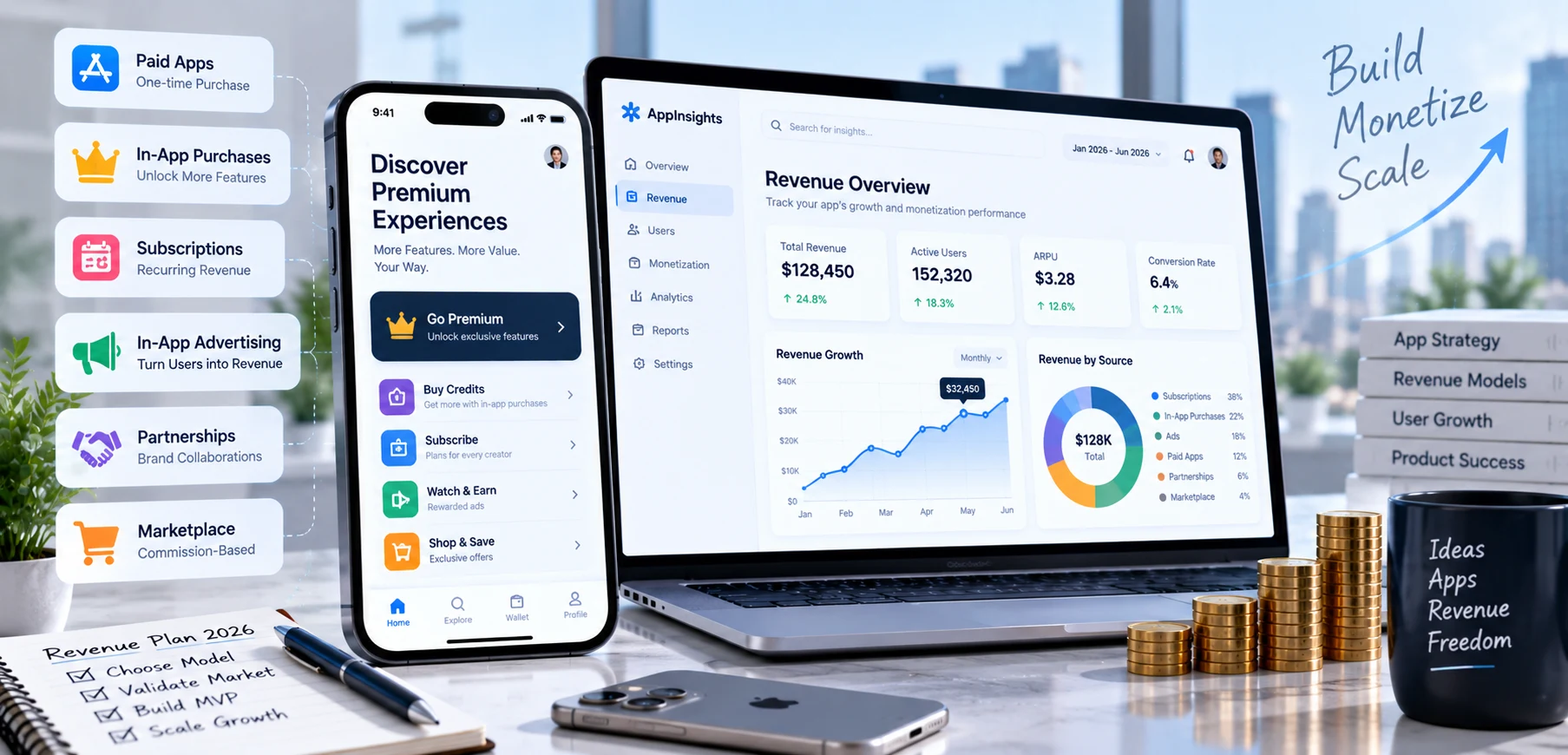
Not every app monetizes the same way. Eight primary models exist on a spectrum from consumer-facing to B2B and marketplace. The right choice depends on the app category, the audience, and the buyer relationship.
1. Subscription charges a recurring monthly or annual fee for continued access. It produces the most predictable revenue and, per investor benchmarks, commands the highest valuation multiples of any model. Content platforms, productivity tools, SaaS apps, and fitness apps fit this model naturally.
2. Freemium offers a free core product with a paid upgrade tier. Conversion rate from free to paid is the metric that makes or breaks the economics. Too generous a free tier kills the conversion incentive. Too limited a free tier kills retention before the upgrade prompt arrives.
3. In-app purchases (IAP) cover one-time virtual goods, content unlocks, or permanent feature upgrades. IAP remains the dominant model in mobile gaming. Industry reports from sources like Sensor Tower and data.ai consistently show IAP as a major share of total mobile earnings, though specific dollar figures shift year over year.
4. In-app advertising displays ads to free users in exchange for open access. Revenue depends heavily on daily active user volume, ad format, and platform. Rewarded video ads generally earn the highest eCPM. Banners earn the lowest. Below a meaningful DAU threshold, ad revenue often generates less than the retention it costs.
5. Hybrid models combine two or three streams. Industry estimates suggest a growing majority of top-grossing apps now run hybrid monetization rather than relying on a single stream. Common combinations include subscription plus IAP, freemium with ads on the free tier, and IAP plus rewarded ads.
6. B2B enterprise licensing makes the app free for end users while the business pays per seat or deployment. This model requires a sales process, not an app-store listing.
7. Marketplace commission takes a percentage of transactions between buyers and sellers. Service booking platforms, ride-sharing apps, and freelance marketplaces use this model. It carries distinct payment-architecture requirements covered in the technical cluster.
8. Data monetization licenses anonymized user data or audience segments. CCPA and platform privacy policies have made this the least viable standalone model for US apps in 2026. It is not recommended as a primary revenue strategy.
The full model-by-model comparison, current benchmarks for subscription conversion rates, IAP ARPU, advertising eCPM thresholds, and a five-question decision framework runs through App Monetization Models Compared: Subscription vs. Freemium vs. In-App Purchases vs. Advertising.
Choosing Your Model: The Decision Framework
No universal ranking of monetization models exists. A content streaming app, a B2B field-service tool, and a two-sided marketplace land on genuinely different answers. The decision requires asking five questions specific to the app being built.
1. What is the app category? User expectations vary enormously. Productivity tool users expect a subscription. Casual game players expect free-to-play with IAP. Marketplace users expect the platform to take a commission from sellers, not from them.
2. What is the target user’s willingness to pay? A professional tool serving accountants has different price tolerance than a social photo-editing app serving teenagers. Subscription vs freemium app model selection depends on this answer more than anything else.
3. What scale does unit economics require? Advertising below a meaningful DAU threshold generates less revenue than the retention cost of showing ads. A subscription app can reach profitability with a much smaller, higher-paying user base.
4. What does Apple and Google commission exposure look like? The platform commission applied to each model is genuinely different. IAP and subscriptions processed through native in-app purchase carry 15 to 30 percent commission under standard terms. External payment flows currently carry 0 percent in the US. B2B and physical-goods transactions are exempt entirely.
5. What monetization architecture is easiest to build now and iterate later? Some models allow layering over time. Adding rewarded ads to a freemium app is lighter than retrofitting subscription management into an app built without recurring billing infrastructure.
Technical Architecture: What Building It Actually Requires
Choosing a monetization model is a strategy decision. Translating that model into a development scope is an architecture decision. The two are connected, but they require different expertise.
RevenueCat and subscription management
RevenueCat abstracts the difference between Apple StoreKit 2 and Google Play Billing into one entitlement state. The app checks whether access is active or not, regardless of which platform processed the purchase. Purchase restoration, cross-platform entitlement syncing, and real-time subscription analytics (MRR, churn, LTV) all run through a single integration.
Webhook integrations push purchase events to the backend in real time. RevenueCat’s Paywalls product allows no-code paywall experimentation. Copy, pricing, and layout can change without requiring an app-store resubmission for every test. For most teams, this saves more development time than its licensing cost. But experienced teams building subscription features directly against StoreKit 2 and Play Billing can work natively with those SDKs if the timeline supports it.
Teams scoping the entitlement backend, receipt verification, and webhook listeners for RevenueCat or StoreKit integration often find this is where custom software development scope concentrates most heavily, since purchase event handling, cross-platform entitlement sync, and real-time subscription state management must be designed as a coherent backend system rather than individual webhook handlers wired together after the mobile apps are built.
Advertising and ad mediation
AdMob integrates through the Google Mobile Ads SDK on both iOS and Android. Ad mediation routes each ad request across competing networks to maximize eCPM. AppLovin MAX and Unity LevelPlay (the mediation product formerly marketed as ironSource) are the primary third-party mediation options alongside AdMob’s own mediation stack.
Rewarded ad units perform best when gated behind user-initiated triggers. A user watches an ad to earn currency or unlock content. This exchange works at a much smaller scale than interstitials or banners without the same retention drag passive ads create.
Stripe for B2B and marketplace payments
Stripe handles B2B per-seat billing and invoice-based payment through Stripe Subscriptions. Marketplace split payments run through Stripe Connect. Both are architecturally distinct from a simple Stripe Checkout integration. Adding split-payment architecture after the fact requires rebuilding the payment layer, not extending it. Building the billing dashboard where B2B administrators manage seats, invoices, and subscription status alongside marketplace commission configuration requires web payment flow and billing dashboard development that treats Stripe Connect split-payment logic and per-seat entitlement management as first-class architecture requirements rather than admin screens added after the payment layer is built.
Stripe’s stablecoin payment support is confirmed and currently available. It is worth considering for apps serving crypto-native users or international markets with high card-transaction costs.
Building the StoreKit 2 and external-link implementation on iOS or the Play Billing and alternative billing flow on Android each carry their own platform-specific scope, separate from the backend entitlement logic.
The in-app purchase advertising hybrid model 2026 approach, where subscription and IAP sit alongside rewarded ads in a single app, requires all three architecture layers working together from the first build. Retrofitting any one layer onto the others creates conflicts in the user flow, the database schema, and the analytics pipeline.
How RevenueCat entitlement state management, StoreKit 2 receipt verification, Play Billing alternative billing flows, AdMob mediation configuration, and Stripe Connect split-payment architecture each connect into one coherent monetization backend runs through Building App Monetization Into Your Architecture: RevenueCat, Stripe, AdMob, Apple StoreKit & Google Play Billing Integration for US App Founders.
The App Store Commission Bypass Decision: Current Reality
This section describes a fast-moving legal situation, not a fixed policy. All commission-bypass content applies to the US App Store and Play Store storefronts specifically. The EU, Japan, and Brazil each operate under separate frameworks. Verify current litigation status before making architecture decisions based on anything described here.
This is educational content, not legal advice. Consult qualified app-platform counsel given how quickly this area is moving.
Apple: $0 commission, under active Supreme Court review
Apple’s standard in-app purchase commission runs 15 to 30 percent. Large developers pay 30 percent on standard transactions and 15 percent on subscriptions after the first year. Developers earning under $1 million in prior-year revenue qualify for Apple’s Small Business Program at 15 percent. These tiers apply to purchases processed through Apple’s native in-app purchase system.
As of this writing, though, Apple charges $0 commission on qualifying external payment links in the US.
The backstory matters for the architecture decision. The 2021 Epic v. Apple injunction required Apple to allow external payment links. Apple complied by imposing a 27 percent fee on purchases made through those links. Courts later found this fee was designed to make the option commercially unviable. Not a single developer implemented external links during that compliance period.
In April 2025, Judge Yvonne Gonzalez Rogers found Apple in contempt. She barred Apple from charging any commission on external-link purchases. The Ninth Circuit upheld the contempt finding in December 2025 but modified the remedy. It ruled that a total commission ban was itself excessive. Apple should be allowed to charge “a commission based on costs that are genuinely and reasonably necessary” for coordinating external links. The appellate court did not set a rate.
Apple petitioned the Supreme Court. The Court denied Apple’s request to stay the mandate on May 6, 2026. Then on June 30, 2026, the Court granted certiorari on the underlying appeal. Oral argument is expected in the October 2026 term. A merits decision is not likely before late 2026 or early 2027. Apple has stated it will continue charging $0 on US external-link purchases while the petition is pending.
Apple can still impose design constraints on external links. The link cannot be more prominent than the native IAP option. Font and button sizing are restricted. A neutral third-party-site disclosure is required.
Google: A bigger remedy, also currently $0, and the settlement just fell apart
Google’s situation is structurally larger than Apple’s. A jury found Google maintained a full illegal monopoly over Android app distribution and billing in December 2023. This was not a narrow anti-steering violation like Apple’s case. It was a monopoly finding.
Judge James Donato’s October 2024 permanent injunction is broader than anything in the Apple case. It requires Google Play Billing. It bars anti-steering. And it requires Google to open Play Store distribution to rival app stores. Google lost its appeal in July 2025. The Supreme Court declined to review the case. This injunction is final and binding.
On July 15, 2026, Epic and Google jointly withdrew their proposed alternative settlement. That settlement would have introduced a 9 to 20 percent tiered “service fee” on external transactions. With the withdrawal, the original 2024 injunction is now the sole governing order. No settlement fees are pending.
Starting July 22, 2026, third-party app stores will begin appearing inside the Google Play Store in the US. Users will download rival stores just like any other app. Google is opening its full Play Store app catalog to those rival stores through the Play Catalog Access Program.
Google currently charges $0 on alternative billing and external-link purchases in the US under the injunction.
What this means for the web payment flow
The App Store commission bypass math currently favors web payment flows more strongly than a static 15-to-30-percent-versus-2.9-percent comparison suggests. Both platforms charge $0 right now. A compliant web payment flow (hosted sign-up page, purchase-verification backend, disclosure UI, cross-platform account linking) currently retains nearly all revenue that would otherwise go to platform commission.
But this is a live legal situation on the Apple side. The Supreme Court review could result in a “reasonable” commission being set. Any architecture decision built on $0 Apple commission should include a configurable commission calculation so the payment layer can adapt without a rebuild when the court rules.
Google’s injunction, by contrast, is final. The settlement that would have reintroduced fees was withdrawn. Google’s $0-commission posture is now governed by a permanent, non-appealable court order.
The full current-status breakdown, including Apple’s Supreme Court petition timeline, Google’s permanent injunction posture after the settlement withdrawal, and the ROSCA and state-law subscription transparency requirements that replace the vacated FTC rule, runs through Apple App Store, Google Play & FTC Compliance for App Monetization: What Every US App Founder Must Know Before Choosing a Revenue Model.
Compliance: FTC, Platform Policy, and Data Privacy
This is educational content, not legal advice on antitrust, FTC, or platform-policy compliance. Consult qualified counsel before building monetization features based on anything described here.
FTC subscription transparency: What’s binding now
The Eighth Circuit vacated the FTC’s 2024 “Click-to-Cancel” rule (the amended Negative Option Rule) in its entirety on July 8, 2025. The court found the FTC skipped a required cost-benefit analysis during the rulemaking process. It did not rule on the substance of the rule itself. That specific rule is not currently in effect.
The practical guidance is largely unchanged despite the vacuum.
ROSCA (the Restore Online Shoppers’ Confidence Act) remains fully in force. It independently requires clear disclosure of subscription terms before charging, informed consent, and a simple cancellation mechanism. The FTC continues to bring Section 5 unfairness and deception enforcement actions against subscription businesses that obscure cancellation. These enforcement actions function as a de facto cancellation-ease requirement even without the vacated rule behind them.
Roughly 30 states, including California, Colorado, and New York, have their own automatic-renewal statutes. These state laws independently require cancellation to be at least as easy as enrollment. California’s most recent amendments took effect on July 1, 2025. Massachusetts enacted a comparable regulation effective September 2, 2025.
The FTC filed a new Advance Notice of Proposed Rulemaking on January 30, 2026, with comments due April 13, 2026. The prior rule took roughly three years to finalize. A new binding federal rule is not imminent.
Build easy cancellation anyway. Cite ROSCA and state law as the basis, not the vacated rule.
CCPA, ATT, and advertising data collection
In-app advertising that relies on behavioral data for targeting falls under CCPA’s opt-out requirements. US apps serving California users need a “Do Not Sell or Share My Personal Information” option. Apple’s App Tracking Transparency (ATT) framework requires an explicit opt-in prompt before cross-app tracking on iOS. Opt-in rates affect targeting precision and eCPM directly.
COPPA
Apps that monetize through advertising and might attract users under 13 face specific COPPA restrictions on behavioral advertising. A COPPA violation creates FTC enforcement exposure that dwarfs the ad revenue an under-13-attracting app would ever generate.
Common app store rejection triggers
The most common monetization-related App Store rejections are avoidable. Obscured free-trial cancellation terms trigger rejection. IAP that does not function on first launch triggers rejection. Misleading subscription pricing displays trigger rejection. Each is an architecture and copy-review problem, not a policy ambiguity.
The five signs a monetization decision is being deferred dangerously late, and what a qualified consultant reviews before development scope is written, runs through Why US App Founders Must Decide Their Monetization Model Before Choosing a Development Partner
Cost and Unit Economics
All figures below are 2026 planning references. Verify current commission status and specific tooling costs before finalizing a budget.
Development cost by model
Subscription with RevenueCat integration runs roughly $15,000 to $30,000 in platform integration, webhook backend, and paywall implementation on top of the base app build. In-app purchases with server-side receipt verification run $10,000 to $25,000 for product catalog, purchase flow, restoration logic, and verification endpoints. Advertising with mediation runs $8,000 to $20,000 for AdMob integration, mediation stack configuration, rewarded-ad trigger design, and placement optimization.
B2B enterprise billing with Stripe runs $20,000 to $40,000 for subscription management, invoice generation, usage-based billing, and an admin portal. Marketplace commission with Stripe Connect runs $25,000 to $50,000 for split-payment architecture, seller onboarding, payout management, and commission configuration.
The commission-bypass development cost
Building a compliant web payment flow costs roughly $15,000 to $25,000. That covers a hosted sign-up page, a purchase-verification backend, a disclosure UI meeting Apple’s design constraints, and a cross-platform account-linking system.
Given the current $0-commission reality on both Apple and Google, this investment reaches break-even quickly for an app with a meaningful subscriber base. For an app generating $200,000 or more in annual recurring revenue, the savings from avoiding standard 15 to 30 percent commission on native IAP (once or if commission is reimposed by Apple) can recover the development cost within months.
On Google’s side, the commission bypass investment is now governed by a permanent injunction with no pending settlement fees. The ROI case on Android is even more stable than on iOS.
Hybrid revenue modeling
Apps combining subscription and IAP tend to show higher average revenue per user than single-model apps, per industry analyst reports. The app monetization architecture for a hybrid model requires all revenue streams instrumented from the first build. Adding a second stream after launch means rebuilding the analytics pipeline and the user flow, not just adding a new SDK.
The formula: subscription revenue (paying subscribers times ARPU) plus IAP revenue (conversion rate times IAP ARPU times total users), minus platform commission, RevenueCat fees, and payment processing fees.
The advertising scale threshold
Model daily ad revenue as DAU times eCPM divided by 1,000. Compare that figure honestly against churn cost before adding advertising to a freemium app. Rewarded ads are the exception. They work at a smaller scale because the user initiates the interaction and receives value in exchange.
The full cost breakdown by model, commission-bypass economics updated for the current $0-commission posture on both platforms, and the advertising scale threshold that determines when ad revenue justifies its retention cost runs through App Monetization Unit Economics: What It Actually Costs to Build Each Revenue Model and What Returns US Apps Can Expect in 2026.
Final Thoughts
US app founders who treat monetization as a first-conversation architecture decision avoid the expensive rebuild that comes from bolting revenue logic onto an app never designed for it. The model choice shapes the database schema, the API layer, and the UX flow from the first design pass.
The 2026 platform-commission and FTC compliance picture is genuinely in flux. Apple’s $0 external-link commission is under Supreme Court review. Google’s $0 alternative-billing posture is now governed by a permanent injunction after the proposed settlement was withdrawn. The FTC’s subscription-transparency requirements rest on ROSCA and state law, not the vacated 2024 rule. Each of these facts changes what gets built and what it costs.
A development team building app monetization architecture against the current, verified state of these rules, rather than assumptions from a year-old blog post, builds a payment layer designed to last. NewAgeSysIT approaches every app monetization strategy USA 2026 scoping conversation with that current picture in mind.
If you’re planning an app and haven’t settled on a monetization model, working through the model comparison, the RevenueCat StoreKit integration it implies, and the current platform-commission situation before your first development sprint is what determines whether monetization is built in from day one or retrofitted at two to three times the cost. To see how an AI software development company approaches monetization model selection, RevenueCat and StoreKit 2 entitlement backend architecture, Stripe Connect split-payment design, and commission-bypass web payment flow development for US app founders, explore our work with app development teams.
Frequently Asked Questions
Why does the monetization model have to be decided before development starts?
Because the revenue model determines what gets built. It shapes the database schema, the API layer, the UX, and the compliance surface. Subscription management needs a recurring-billing backend, webhook listeners, and entitlement-check endpoints; advertising needs ad-placement logic in the user flow from the first wireframe; marketplace commission needs Stripe Connect split-payment architecture that cannot sit on top of a simple checkout. Deferring the decision forces a rebuild of the app’s most sensitive, revenue-generating code, typically at two to three times what building it right would have cost originally.
What are the eight app monetization models?
Subscription, freemium, in-app purchases, in-app advertising, hybrid models, B2B enterprise licensing, marketplace commission, and data monetization. They sit on a spectrum from consumer-facing to B2B and marketplace, and the right choice depends on the app category, the audience, and the buyer relationship. Data monetization is the exception: CCPA and platform privacy policies have made it the least viable standalone model for US apps in 2026, and it is not recommended as a primary revenue strategy.
How do I choose the right monetization model for my app?
Five questions. What is the app category? What is the target user’s willingness to pay? What scale does unit economics require? What does Apple and Google commission exposure look like? And what monetization architecture is easiest to build now and iterate later? A content streaming app, a B2B field-service tool, and a two-sided marketplace land on genuinely different answers, so there is no universal ranking.
Does Apple still charge a commission on external payment links?
As of this writing, no. Apple charges $0 commission on qualifying external payment links in the US, and has stated it will keep doing so while its Supreme Court petition is pending. The Court granted certiorari on June 30, 2026, oral argument is expected in the October 2026 term, and a merits decision is not likely before late 2026 or early 2027. Apple’s standard in-app purchase commission is unchanged at 15 to 30 percent, and Apple can still impose design constraints on how prominently an external link is presented.
What does Google charge on alternative billing and external links now?
Google currently charges $0 on alternative billing and external-link purchases in the US under Judge Donato’s October 2024 permanent injunction. On July 15, 2026, Epic and Google jointly withdrew their proposed settlement, which would have introduced a 9 to 20 percent tiered service fee, so the original injunction is now the sole governing order and no settlement fees are pending. That injunction is final and binding, which makes Google’s posture more stable than Apple’s.
Is the FTC’s Click-to-Cancel rule still in force?
No. The Eighth Circuit vacated the 2024 amended Negative Option Rule in its entirety on July 8, 2025, on procedural grounds. But ROSCA remains fully in force and independently requires clear disclosure, informed consent, and a simple cancellation mechanism; the FTC continues to bring Section 5 enforcement actions against businesses that obscure cancellation; and roughly 30 states have their own automatic-renewal statutes. Build easy cancellation anyway, and cite ROSCA and state law as the basis rather than the vacated rule.
Should I use RevenueCat or build directly against StoreKit 2 and Play Billing?
RevenueCat abstracts the difference between Apple StoreKit 2 and Google Play Billing into one entitlement state, so the app checks whether access is active regardless of which platform processed the purchase. For most teams it saves more development time than its licensing cost. Experienced teams building subscription features directly against StoreKit 2 and Play Billing can work natively with those SDKs if the timeline supports it.
How much does each monetization model cost to build?
On top of the base app build: subscription with RevenueCat integration runs roughly $15,000 to $30,000; in-app purchases with server-side receipt verification $10,000 to $25,000; advertising with mediation $8,000 to $20,000; B2B enterprise billing with Stripe $20,000 to $40,000; and marketplace commission with Stripe Connect $25,000 to $50,000. These are 2026 planning references, so verify current commission status and tooling costs before finalizing a budget.
Is a commission-bypass web payment flow worth building?
Building a compliant web payment flow costs roughly $15,000 to $25,000, covering a hosted sign-up page, a purchase-verification backend, a disclosure UI meeting Apple’s design constraints, and a cross-platform account-linking system. With both platforms at $0 commission right now, it reaches break-even quickly for an app with a meaningful subscriber base. Because the Apple side is still live at the Supreme Court, any architecture built on $0 should include a configurable commission calculation so the payment layer can adapt without a rebuild.
What privacy rules apply to app monetization in the US?
In-app advertising that relies on behavioral data falls under CCPA’s opt-out requirements, so apps serving California users need a “Do Not Sell or Share My Personal Information” option. Apple’s App Tracking Transparency framework requires an explicit opt-in before cross-app tracking on iOS, and opt-in rates affect targeting precision and eCPM directly. Apps that might attract users under 13 also face COPPA restrictions on behavioral advertising, where enforcement exposure dwarfs the ad revenue involved.


