
Welcome to Blogs
Discover actionable insights, in-depth research, and expert perspectives, all in one place.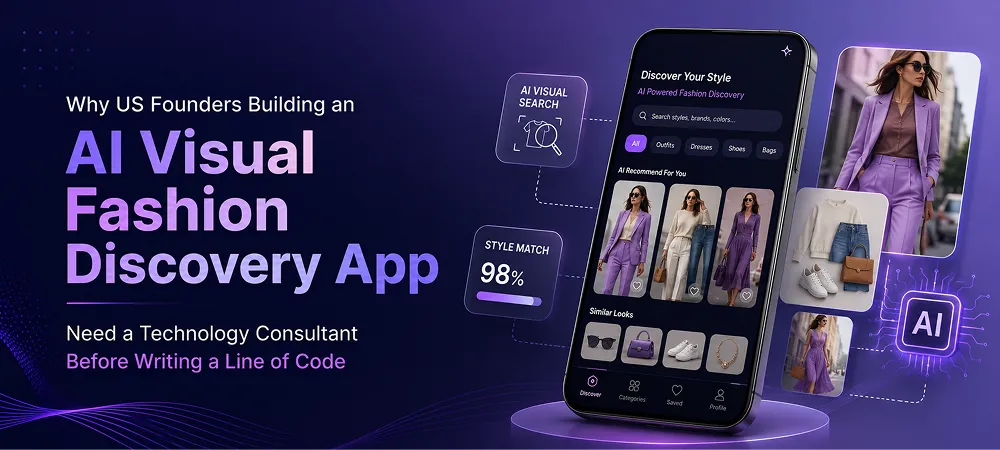
Fashion 7 min read
Why US Founders Building an AI Visual Fashion Discovery App Need a Technology Consultant Before Writing a Line of Code

AI visual fashion apps fail more often from poor infrastructure and design choices than from bad code. A founder who makes poor decisions about their design partner, infrastructure partner, or the economics of their per-query pricing APIs will have poor outcomes, no matter how good the code is. In AI fashion app development, these are problems of strategy and architecture, and they will need to be addressed before any code is written..
An AI Fashion App Technology Consultant USA is an absolute necessity. A good consultant will help avoid some of the crucial decisions which can kill this type of app. Some examples of these include, which Search Engine Result Page (SERP) API to use based on your app’s query volume, whether to use a managed vision service and build towards a self-hosted solution, how to rank results if you do not own the catalog, what your app’s unit economics will look like, and how to structure your app’s image data and biometric posture to comply with the App Store review.
This article identifies the five main pitfalls of first time founders, what the no catalog architecture really means, the risks and advantages of image preprocessing for 2026.
The Five Mistakes First-Time AI Fashion App Founders Make
Understanding these mistakes now saves enormous cost and time later. Each one is preventable with the right guidance upfront.
1- Building an Internal Catalog Before Validating SERP Results
The biggest mistake is building an entire product catalog infrastructure before verifying that results from SERP API fulfill user needs. Instead of relying on an external source, founders assume that owning their own inventory is critical, and spend a lot of time creating the infrastructure for catalog, management of products and SKUs, synchronization of inventory, and storage for images of products that might never get used.
What happens after all that effort, is that they find out that results from the SERP API, when they go through the right amount of preprocessing and are ranked, are good enough. They might find out that users of their product prefer to search a number of external retailers instead of a consolidated database of internal retailers. The internal catalog, therefore, becomes useless, and the infrastructure that was intended to be an advantage becomes a burden.
Before building a catalog, use the SERP-API method. The most important thing is to have users search, and from that, determine the quality of the results. The internal catalog should be built only when users of the product demand it and the cost makes sense.
2- Poor Match Accuracy Because Image Preprocessing is Skipped
Some founders think that preprocessing is an additional, trivial step. They take user-uploaded images in an unprocessed state and submit them directly to the visual search API and expect optimal results. What happens instead is that users upload images of themselves in their closets and receive random images that are completely irrelevant to clothing, such as furniture and backgrounds. This makes the application appear nonfunctional.
The problem is raw images. Unprocessed images contain backgrounds with multiple users, photos with poor lighting, and various other distractions. The visual search algorithm will not narrow its search without preprocessing as it will be exposed to all of the aforementioned distractions. Garment isolation and background removal eliminate the noise. Without preprocessing, the accuracy problem cannot be resolved.
3- Ignoring SERP API Rate Limits and Cost Curves
SERP API charges per query rather than per month, meaning each individual search costs money. 2000 searches lead to a larger bill than 200 searches. Founders that fail to account for search costs end up with a five figure bill and a realization that their app’s costs far outpace revenues.
If a search costs $0.30 and a user performs 5 searches, then a user session’s cost is $1.50. Repeat and account for costs for inactive users, and it doesn’t take long to realize the app’s cost is unsustainable with a large user base.
4 – Building Native iOS and Android Separately
Building native iOS and Android separately costs roughly 40% more than React Native, which covers both platforms at approximately 60% of native development cost. Having the separate Native frameworks for iOS and Android is almost never warranted.
5 – Launching Without an Admin or Monitoring Panel
Most things are unknown without a dashboard that tracks API usage, identifies patterns in queries, and monitors costs for API calls. API costs going up could mean a bug that results in duplicate queries, an API abuse, or a sudden spike in usage. Without visibility, you only find out about the issue when it’s too late.
An admin panel that tracks API usage, costs per user, the most queried searches, and API latency is not a feature. It is the operational infrastructure that keeps the business going.
Why No-Catalog Is Both the Biggest Advantage and the Biggest Risk
The absence of a catalog is the key to deciding which app development partner is best suited for visual search. This single characteristic is both your main strength and weakness in the discussion.
It is an undeniable strength. Lean code base and predictable operating costs dependent on the number of queries rather than on the growing database size. A team of a few developers has enough leverage to develop a product that is useful for its users without being burdened with technical responsibilities of a much bigger company.
But the danger is also clear. You have no control over the result set. Bad preprocessing, poor result ranking and inefficient filtering mean that the app looks like a bare API dumping ground. One bad query from a user, a bunch of irrelevant results and a user leaves forever. The whole experience of the product depends on your ability to work with the results that you do not own.
This is exactly why this architectural choice is a pre-build conversation. The no-catalog approach only works if you make excellent decisions about preprocessing accuracy, fashion-relevance filtering, result ranking, handling edge cases, and cost control. A technology consultant’s value lies in ensuring those choices are made right before they’re baked into your shipped product.
What AI Image Preprocessing Actually Means in 2026
Preprocessing is not a buzzword. It’s the technical building block that decides if your application will provide relevant fashion matches or will look like a broken search engine. It is crucial to understand the concept of preprocessing and how it works in practical use cases.
In case there is no preprocessing done before passing an image to a visual-search API, it will be matched based on all the elements of that image: background, pose, lighting, the person himself, and the clothes. This environment is dominating the matching and resulting in absolutely irrelevant matches.
In case preprocessing is implemented, the processing pipeline will extract the garment and remove any other elements from the picture. And the visual-search API will match on the actual piece of clothing. One step results in an absolute match quality boost.
There are two options for implementing preprocessing in 2026. The MVP option is the utilization of managed Vision API solutions such as Google Cloud Vision or AWS Rekognition. The paid per-image fee is applicable and the provider will take care of the infrastructure. The scaling option would be to implement a self-hosted segmentation model such as Segment Anything Model or SegFormer once your volume starts paying off.
Why this matters for consultant discussions: choosing the preprocessing approach and designing it to segment garments rather than identify faces has implications for accuracy, cost, and compliance. This is an architecture decision best made before development begins.
Final Thoughts
Decisions regarding how you preprocess your images, how you plan to use your SERP API service and handle results, whether you have a viable unit economic model, and your image data and biometrics approach for App Store compliance will determine your future app’s success or failure before you start development.
Discovery work of a technology consultant is the reason why the first attempts of building visual fashion discovery apps fail. American founders who do pre-development discovery significantly increase their chances to build a working app that provides correct results, is economically feasible, and complies with app stores’ terms of service.
When you are about to create your AI fashion app, the most important thing you can do is to have a discovery conversation with a partner who knows how this type of app works technically and from a perspective of economics and compliance. NewAgeSysIT is the right platform to take your first step. Learn more about digital transformation solutions from one of the leading AI software companies in the United States.
Core Development
Keep exploring the custom services.

AI Software Development
Custom AI Software Development
Build intelligent, production-ready software from machine-learning models to AI-driven automation designed around your business goals.
Learn more
Mobile App Development
Custom Mobile Application Development
Native and cross-platform mobile apps that are fast, secure, and built to scale across iOS and Android.
Learn more
Web App Development
Custom Web Application Development
Scalable, secure web applications, from customer portals to complex dashboards, tailored to how your business actually works.
Learn more



