
Welcome to Blogs
Discover actionable insights, in-depth research, and expert perspectives, all in one place.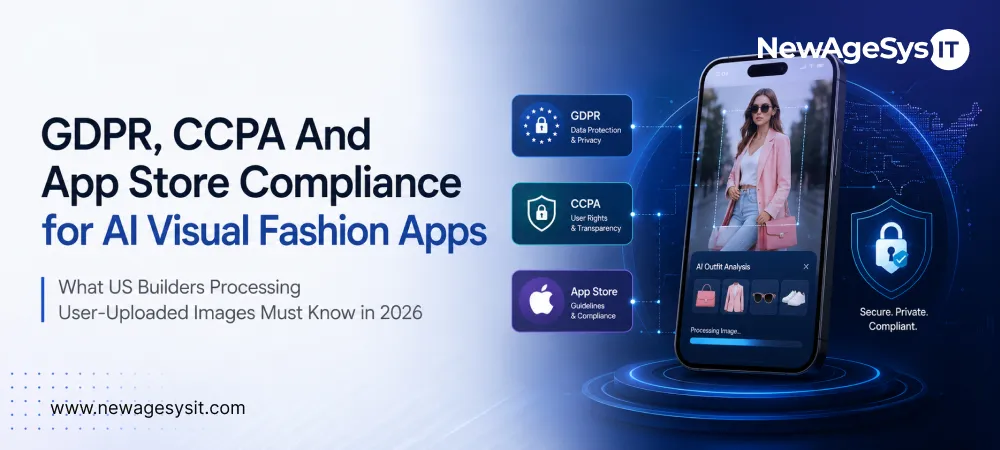
Fashion 10 min read
GDPR, CCPA And App Store Compliance for AI Visual Fashion Apps: What US Builders Processing User-Uploaded Images Must Know in 2026

Launching a fashion discovery app involves difficult decisions around product design and regulatory compliance.In AI fashion app development, founders often prioritize building out the app and considering data requirements later. This is a mistake
The core action used to facilitate engagement in your app is the uploading of images, and that same action is also the primary and most serious compliance exposure.Those images then have to be stored and managed somewhere, which pulls your super admin dashboard development into the same compliance scope from day one.
There is a lot of industry-specific guidance. The literature available for building a fashion discovery app will offer guidance on app compliance data dealing with standard app data like emails or preferences. The data your app will collect is images, and more concerning, images of people, which brings your app into the realm of a number of rapidly evolving image data privacy compliance frameworks, including, but not limited to, app biometric privacy frameworks.
This article covers the most important compliance frameworks for building a visual fashion app in the United States around AI fashion, image data, and privacy compliance.
Uploaded Image Data and CCPA, CPRA, and Compliance Frameworks
When talking about privacy compliance, especially concerning image data, things can get very complicated and very quickly. Let’s get you started by talking about compliance under California’s consumer privacy law. Simply put, an identifiable image of a user (or an image of a user that identifies someone) is considered personal data, and if a user submits an image (or uploads a photo) to your fashion app, you are collecting personal data under California law. When thinking about image uploads in fashion discovery apps, we should keep the privacy of the user who submitted the photo in mind, and we need to ask ourselves what compliance requirements are triggered when users upload images to our apps.
Consent Disclosures and Data Collection
First, describe the consent details. Users should know what photos you collect, the reason for the collection (search, history, features), and the retention time.
The privacy details will explain the upload and processing of the images. Users will know they can upload images and search for fashion items. The photos will go through the visual search. If images are used for model improvement or analytics, disclose this to users in the consent flow.
User Deletion Rights and Data Retention
Users also have deletion rights. Users can request deletion of their uploaded photos and search history. Users have to be able to request that their photos and search history be deleted on the app compliance.
You need a way to address deletion requests in your backend system. The request should trigger your system to find and delete all of the associated user account images and the linked search history. You cannot wait until deletion requests are made to build the required system for deletion. You need to build retention minimization systems before you make the service available.
Retention Minimization Systems
Retention minimization is important. Your system should only keep the uploaded images for as long as you need those images for the search and history functions. There is a cost and risk associated with holding onto unnecessary files. Some systems hold the uploaded images for only a short amount of time, just long enough to extract and store relevant features, and then delete the images.
Decide how long you want to keep the uploaded images and clearly define that in your privacy policy for your users. Some systems only keep the search results and the metadata. Some even delete the user upload images but keep a thumbnail version for history retrieval.
Understanding the Biometric Data Exposure: BIPA, CUBI, and MHMDA
This is when the discussion becomes applicable to image-processing applications. A visual fashion app will receive full body pictures with faces in them. This poses a biometric data fashion app risk that needs to be understood explicitly by founders.
Illinois BIPA Requirements
Illinois BIPA is the most restrictive and litigated biometric law. It requires the obtaining of opt-in consent prior to collecting biometric identifiers. It requires having a written retention and destruction policy for the biometric data. It bans the selling of biometric information. And importantly, it grants individuals a private right of action which allows them to sue for damages. More violations occurred due to BIPA than any other state biometric law.
Under BIPA biometric identifiers are fingerprints, voiceprint and facial geometry. If your application extracts facial geometry from photos uploaded by your users, you fall under BIPA. You need explicit written consent from users before collecting facial biometric data. You need a documented data-retention and destruction policy that users can access. You cannot sell the biometric data. A violation can result in damages plus statutory penalties, which makes BIPA enforcement expensive.
Texas CUBI Coverage and Enforcement
Texas HB 149 (effective Jan 1, 2026) exempts biometric data used to develop or train AI models from CUBI, unless the system is used to uniquely identify an individual. Texas CUBI (Bus. & Com. Code Ch. 503) pertains to the record of an individual’s facial geometry and is enforced by the Texas Attorney General, not through any private litigation. A violation of this law results in penalties of up to $25,000 per violation. This statute pertains to face geometry and not the face itself.
Under Texas law, the collection of face geometry requires express consent. However, the fines are significant and enforcement may occur through consumer complaints to the state.
Washington MHMDA
The My Health My Data Act of Washington has the most broad biometric definition. Under this act, facial imagery “from which an identifier template can be extracted” is covered. Notice the wording of the law; you do not need to actually extract the template. Merely the possibility that the template can be extracted is sufficient to cover under the statute. There is also a provision for private right of action.
This is particularly relevant for visual fashion apps because it creates liability even if you design your system to ignore facial data. The mere fact that facial templates could be extracted from user photos triggers regulatory obligations. Washington MHMDA requires explicit consent for collection and use of biometric data and prohibits certain uses without affirmative user authorization.
App Store and Play Store Image-Permission and Privacy-Label Requirements
iOS Usage Description Requirements
Apple requires apps to justify every permission they request and disclose every category of data they collect. For a visual fashion app, that means camera and photo-library access.
iOS requires a usage-description string. In your app’s info.plist file, you specify why the app needs camera or photo-library access. A vague description like “to provide features” gets rejected. Apple wants specificity: “to upload fashion photos for visual search.” The App Store image permission policy requires clear explanations that users understand before granting access.
Android Permission Rationale
Android also imposes such a requirement on permission rationale. When a dangerous permission, such as access to the camera or read-external-storage, is requested, Android displays a rationale explaining why the permission is required. The rationale must be relevant and understandable.
You should give a clear rationale before requesting permission in your app. In case the user denies the request, try giving additional context and explaining why that particular feature requires the permission. Sometimes people deny permission simply because it was asked, and an informed second-time request succeeds.
PCI Out of Scope and COPPA Considerations for Under-Thirteen Users
It’s another obvious advantage of compliance which should be stated separately. Since your app doesn’t process any payments, redirects users to external retailers for making purchases, you won’t ever have anything to do with credit cards and therefore, there is no need for PCI-DSS compliance. In particular, this implies a lack of need to secure card data, apply point-of-sale encryption, and perform annual security audits related to payment processing. Being PCI out of scope is a true cost saving as compared to creating a marketplace with built-in payments functionality.
COPPA stands for the Children’s Online Privacy Protection Act. If your app is available to children under the age of thirteen, then presence of image-upload features will result in additional COPPA image upload app requirements. Specifically, you cannot collect image data of such users without their parents’ verifiable consent which is rather hard to implement. As usual, most image processing apps deal with this requirement in a way of setting age restrictions prohibiting children under thirteen years old.
Final Thoughts
A mobile app that analyzes images uploaded by users requires a privacy obligation related to image data, a state biometric law, SERP API terms of services, App Store disclosure, and PCI scope requirements, all correct. These are image data and privacy obligations, not health-data and financial-data obligations and should be integrated in the product architecture and not fixed prior to release.
The compliance effort might seem overhead but it is actually a competitive advantage. Founders that are aware of these obligations and design their products accordingly are going to release products that work flawlessly and do not face any of the biometric claims, API terminations and store rejections that ruin image processing. Learn more about digital transformation solutions from one of the leading AI software companies in the United States.
FAQ
Are user-uploaded photos personal data in an AI fashion app?
They can be. An identifiable photograph can qualify as personal data or personal information when it relates to an identified or identifiable individual. An AI fashion app should therefore document why images are collected, what processing occurs, how long originals and derived data are retained, which service providers receive them, and how users can exercise applicable privacy rights.
Does GDPR apply to a US-based AI fashion app?
Yes, in some circumstances. GDPR can apply to a company outside the EU when its processing relates to offering goods or services to people in the EU or monitoring their behavior there. A US fashion app targeting EU users should therefore evaluate lawful processing, transparency, data minimization, processor agreements, user rights, retention, international transfers, and privacy-by-design requirements.
Is every photo containing a face considered biometric data under GDPR?
No. GDPR does not automatically treat ordinary photographs as special-category biometric data. Recital 51 states that photographs fall within that category when specific technical processing enables unique identification or authentication. A visual fashion app analyzing clothing, colors, or product similarity therefore presents a different biometric risk from an application creating facial templates to identify individual users.
When can facial imagery become biometric information under the CCPA?
California defines biometric information around physiological, biological, or behavioral characteristics used or intended to establish identity. Its definition includes facial imagery from which an identifier template, such as a faceprint, can be extracted. The key architectural question is therefore whether the fashion app merely processes visual content or performs identity-related biometric processing.
Does Illinois BIPA apply whenever users upload photos containing faces?
No. Illinois BIPA expressly excludes photographs from its definition of biometric identifiers but includes scans of face geometry. A fashion app should therefore determine what its computer-vision pipeline actually derives from the uploaded image. Processing an ordinary fashion photograph is legally different from generating or using facial geometry or other covered biometric identifiers for identification purposes.
Does Washington’s My Health My Data Act apply to every fashion photo containing a face?
Not automatically. Washington defines biometric data as information generated from measurement or technological processing of characteristics that identifies a consumer. The statute includes facial imagery from which an identifier template can be extracted, but biometric data sits within the law’s broader definition of consumer health data. Developers should evaluate the actual processing and whether the resulting information meets those statutory definitions.
How long should an AI fashion app retain uploaded images?
There is no universal retention period for every fashion application. The platform should define retention according to its actual product purpose and applicable law. For example, the original upload might be deleted after visual-search processing while necessary metadata or search history remains. Retention rules should cover originals, thumbnails, embeddings, cached copies, backups, analytics records, and third-party processors instead of addressing only primary image storage.
What privacy requirements should an iOS AI fashion app consider?
Apple requires an accessible privacy policy describing data collection, uses, third-party sharing, retention, deletion, and ways users can withdraw consent or request deletion. Apple also emphasizes data minimization and recommends limited-access mechanisms where possible instead of broad access to protected resources such as Photos. Permission-purpose strings should accurately explain why camera or photo access is required.
Core Development
Keep exploring the custom services.

AI Software Development
Custom AI Software Development
Build intelligent, production-ready software from machine-learning models to AI-driven automation designed around your business goals.
Learn more
Mobile App Development
Custom Mobile Application Development
Native and cross-platform mobile apps that are fast, secure, and built to scale across iOS and Android.
Learn more
Web App Development
Custom Web Application Development
Scalable, secure web applications, from customer portals to complex dashboards, tailored to how your business actually works.
Learn more



