
Welcome to Blogs
Discover actionable insights, in-depth research, and expert perspectives, all in one place.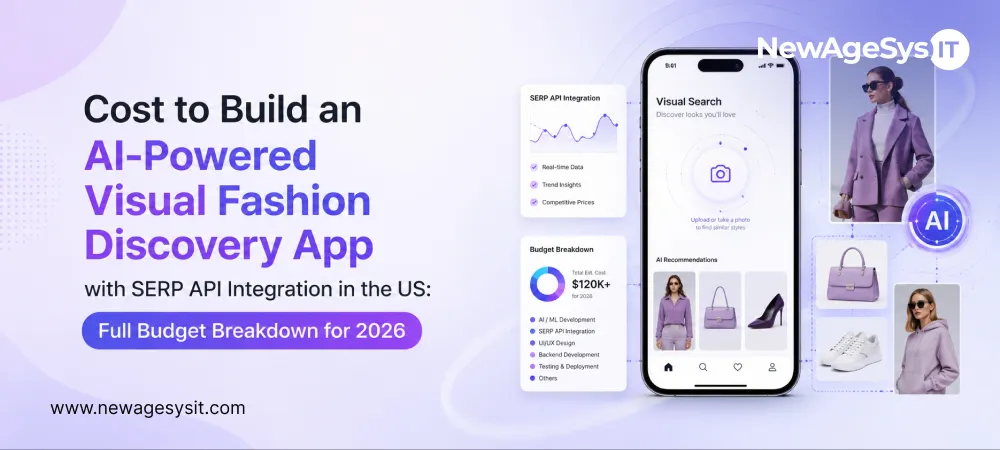
Fashion 10 min read
Cost to Build an AI-Powered Visual Fashion Discovery App with SERP API Integration in the US: Full Budget Breakdown for 2026

When a founder asks “what does a fashion app cost,” the answer they typically get is wrong. They receive pricing for a generic e-commerce platform with shopping cart, checkout, and inventory management. An AI-powered visual fashion discovery app with SERP API integration is fundamentally different. You’re developing a search interface that accepts user-uploaded images, runs them through an AI image-recognition preprocessing pipeline, performs image search via visual search endpoints, prepares and displays results to users, and does it all without carrying any of the items in the search results.
Most cost estimates are feature-focused, and not architecture-focused. Consequently, they tend to overlook the preprocessing pipeline, the costs associated with visual matches, and SERP API query costs at scale.
Here we will be talking about the costs of validated MVPs, fully functional products, and complex features, and are concerned with the real drivers of cost.
Scope-Based Cost Tiers for 2026
Each tier is a level of a validated operational application that is functional and complete. The tier of your choice is a reflection of your capital position.
Lightweight MVP: $30,000 to $60,000
The quickest way to see if SERP API results fulfill user needs is to create an MVP. The MVP consists of uploading an image, integrating a SERP API, displaying the results, and implementing a basic search history feature to allow users to view their previous searches. There is no personalization, admin panel, or advanced analytics.
The admin panel is omitted here. You initially need to monitor costs through the SERP API yourself. You also validate that users are engaging with the feature. If users are not interested and/or obtaining results, you will find this out before you commit resources to implement additional operational features.
This approach is practical for a founder using validation capital and the managed Vision API to preprocess images without the additional resources to build a custom segmentation pipeline. It will also be reasonable for founders without validation capital, taking a lot of the risk to validate the product and services quickly.
Full Fit-Fetch Scope: $65,000 to $120,000
The full fit fetch scope pricing is for the fully integrated and operational product. It contains everything the MVP has and a custom built AI image preprocessing pipeline. Integrating the AI image preprocessing pipeline also enables a custom built admin analytics panel.
The full scope build is what you deploy to production when you’re beyond validation. Users receive consistent high-quality visual matches. You can monitor for abnormal queries or abuse patterns that may signal technical issues. The full scope includes a user profile so users can manage their search history, view saved items, and set preferences.
Advanced: $120,000 to $250,000 or More
Advanced scope introduces features that distinguish an offering, and increase user loyalty and engagement. For instance, the app can perform multi-item outfit decomposition, which means it can identify and segment multiple articles of clothing from a single image. It has a personalization feature that adjusts the app’s level of assistance based on the user’s preferences and steers them toward items that contain their most searched clothing.
What Drives Cost Up
With a clear understanding of what drives cost, you can make reasonable choices when creating your budget.
The most sophisticated part of the app is the image preprocessing pipeline. If you choose to integrate a managed Vision API, such as the Google Cloud Vision, the cost is low and the integration is simple. However, if you plan to create a garment segmentation model or to host an open source model such as the Segment Anything Model, the costs can increase as you need to have ML engineers that are able to build and run the segmentation model.
The fashion relevance filtering and SERP API result parsing are also usually underestimated. The raw results from searches called the Search Engine Results Page API contain a lot of unstructured data. In order to create a fashion relevant, shoppable display, results must be filtered in order to remove non-fashion related results, segmentation must be done to extract product names, and results must be ranked by relevance before display. Additionally, fallback handling must be done for queries that return thin results.
Search history and image-storage architecture adds complexity when implemented correctly. You need to store user-uploaded image thumbnails efficiently in cloud storage. The super admin analytics dashboard typically adds fifteen to twenty-five thousand dollars to your scope.
The choice of mobile framework affects total cost. React Native allows you to write one codebase for both iOS and Android, keeping complexity and cost reasonable. Building native iOS and Android separately roughly doubles the mobile development cost for minimal benefit in this category of app.
Image Preprocessing Cost Options
The preprocessing approach significantly impacts both build cost and ongoing operating expense. There are two fundamental options.
Managed Vision API Approach
Services like Google Cloud Vision API, AWS Rekognition, etc., manage the heavy lifting involved with training and hosting machine-learning models for image processing. They simply require you to upload images, and they return the associated segmentation masks and detected objects, etc. Managed services take care of infrastructure, unlike self-hosted solutions.
As a rule of thumb, for a minimum viable product (MVP) or a service with low throughput, managed Vision services are more economical compared to self-hosted solutions. You also gain the added benefit of faster time to market. The flip side is that you incur costs for every processed image.
Self-Hosted Model
Getting started with self-hosted solutions is easier and more economical because you are not locked into a per-image fee. Models like Segment Anything Model and SegFormer are open-source segmentation models that can be self-hosted. You are in control of the hosting and serving of the model on your infrastructure or GPUs.
The increased control and cost savings come at the expense of increased complexity. You need to be able to support the model for serving, scaling, and monitoring. Furthermore, you need to have or obtain the budget and the technical skill to support machine learning. Managed Vision services will be more economical and easier to get started with.
Cost Crossover Point
There is a point where the costs of using a managed Vision API surpass the costs of self-hosting when considering your usage volume, the pricing of the managed API, the costs of hosting your own API, and the capabilities of your team. The more you plan to use the Vision API, the more you should consider self-hosting. A reasonable approach is to launch using the managed Vision API with your MVP and for early growth scenarios. Monitor the SERP API and Vision API costs as your platform grows. Once you reach a volume where self-hosting becomes cost-effective, plan a migration to a self-hosted model.
SERP API Operating Costs at Scale
The per-query SERP API cost is the single cost that almost all cost calculations leave out, and yet it is the only thing that matters when deciding whether your unit economics survive growing. The price illustration across various vendors is around $0.005-$0.015 per query. That means $5-$15 for 1,000 searches per month, $50-$150 for 10,000, $500-$1,500 for 100,000 and $5,000-$15,000 for 1 million.
There are two ways you can reduce the cost of SERP API queries right away: caching identical or similar image searches and deduplicating repeat queries from a single user session. Whether you cache or not is an architectural choice; you can cache cheaper, potentially stale results or query more expensive but always up-to-date results. You should think carefully about caching TTL.
Model the SERP API cost per active user against revenue per user from your monetization channel: affiliate redirects, subscriptions or ads on each volume level. When your cost per user grows faster than revenue per user, your business is broken, not just the scalability.
Preprocessing and SERP API are the primary cost drivers — detailed in Google Vision AI, SERP API & Image Preprocessing Integrations.
White-Label SDK Versus Custom SERP Build Plus Admin Panel
Some founders look for white-label visual search SDKs with companies like Visenze, Syte, and Snap. These search SDKs are search platforms for which you do not have to build and maintain the search infrastructure. These platforms take care of things like image processing and ranking. These platforms assume you have your own product catalog, and they have a usage license that you pay for per query.
The licensing model taken by white-label SDKs is different than a custom build of a SERP API. To put a hypothetical example, let’s say you have 10,000 queries. A white-label system would charge between $200 and $500 for that month. If you scaled that to 100,000 queries, the licensing would be somewhere between $2,000 – $10,000 for that month. Finally, for a half a million queries, that licensing would easily be over $50,000.
When you custom build using SERP API, you would pay for each query you made and would have a greater degree of control over ranking and have a branded experience. Additionally, you would pay a greater build cost for a search SDK that provides a basic admin dashboard that allows you to track usage and query costs.
Final Thoughts
The realistic cost to build an AI visual fashion discovery app in 2026 depends on your scope tier. An MVP for rapid validation costs thirty to sixty thousand dollars. A full, operationally mature product with preprocessing, search history, and an admin panel costs $65,000 to $120,000.
Founders who budget by scope tier and model SERP API and preprocessing costs as explicit line items at different volume levels build realistic budgets and gain clear visibility into whether unit economics work at ten thousand, one hundred thousand, and one million monthly searches. That level of cost modeling is what separates founders who build viable products from those who discover broken economics after launch.
If you’re preparing to build an AI visual fashion discovery app, budget your project by scope tier, and choose your preprocessing approach deliberately. Get more details and consultation at NewAgeSysIT. Learn more about digital transformation solutions from one of the leading AI software companies in the United States.
FAQ
How much does an AI-powered visual fashion discovery app cost?
An AI-powered visual fashion discovery app can cost approximately $30,000 to $250,000+, depending on product scope and AI complexity. Typical ranges are $30,000–$60,000 for a lightweight MVP, $65,000–$120,000 for a production-ready platform, and $120,000–$250,000+ for an advanced product with segmentation, personalization, recommendation engines, richer analytics, and scalable AI infrastructure.
What is included in a $30,000–$60,000 visual fashion app MVP?
A lightweight MVP can include image upload, managed image preprocessing, visual-search API integration, product-result display, and basic search history. Its purpose is to validate whether users receive useful fashion matches before the startup invests in personalization, custom garment segmentation, advanced analytics, or a large administrative dashboard. Limiting the first release reduces capital exposure while testing the product’s central value proposition.
What is included in a $65,000–$120,000 production-ready platform?
A production-ready platform can add a stronger preprocessing pipeline, user profiles, saved products, search history, preferences, result filtering, operational monitoring, and a super-admin analytics dashboard. This tier may also include more robust security, scalable backend services, abuse controls, and production deployment. The final budget depends on mobile scope, search providers, ranking logic, storage architecture, and how much AI functionality is custom-built.
What features can push visual fashion app development above $120,000?
Advanced costs usually come from functionality beyond basic image-to-product matching. Examples include detecting several garments in one image, generating pixel-level garment masks, personalized ranking, recommendation engines, advanced behavioral analytics, custom machine-learning models, GPU inference, retailer integrations, and more sophisticated moderation or administration tools. Each capability adds engineering, model evaluation, infrastructure, monitoring, and quality-assurance requirements.
What are the main cost components of a visual fashion application?
The budget should be divided into mobile development, backend services, image preprocessing, visual-search integration, search-result filtering, user accounts, administrative tools, analytics, security, QA, and deployment. Recurring expenses should be modeled separately and can include search requests, image-analysis calls, cloud storage, bandwidth, GPU inference, monitoring, maintenance, and third-party subscriptions. This separation gives founders a clearer total-cost-of-ownership model.
Why does image preprocessing increase AI fashion app costs?
Preprocessing determines what part of an uploaded image is sent into the visual-search workflow. A simple implementation may use labels, object localization, or crop suggestions. A more advanced product may need garment detection, background removal, segmentation, multi-item decomposition, or image-quality correction. Custom segmentation requires additional machine-learning development, model evaluation, serving infrastructure, performance monitoring, and ongoing tuning.
Is a managed computer-vision API cheaper than a self-hosted model?
A managed vision API is often easier and less expensive for an MVP because the provider manages model hosting, scaling, and availability. Self-hosting may become attractive when usage grows or the application requires specialized garment segmentation. The comparison should include API fees, GPU infrastructure, machine-learning engineering, monitoring, scaling, reliability, model updates, and operational support rather than comparing only per-image charges.
How much does SerpApi integration cost each month?
SerpApi costs depend on the selected plan, monthly search volume, and required throughput. This recurring expense should be modeled independently from the initial integration cost. Founders should calculate searches per active user, cost per completed search, and revenue per user at several volume levels. High-volume requirements may require custom enterprise pricing, so static per-query assumptions can become inaccurate as the platform scales.
Core Development
Keep exploring the custom services.

AI Software Development
Custom AI Software Development
Build intelligent, production-ready software from machine-learning models to AI-driven automation designed around your business goals.
Learn more
Mobile App Development
Custom Mobile Application Development
Native and cross-platform mobile apps that are fast, secure, and built to scale across iOS and Android.
Learn more
Web App Development
Custom Web Application Development
Scalable, secure web applications, from customer portals to complex dashboards, tailored to how your business actually works.
Learn more



