
Welcome to Blogs
Discover actionable insights, in-depth research, and expert perspectives, all in one place.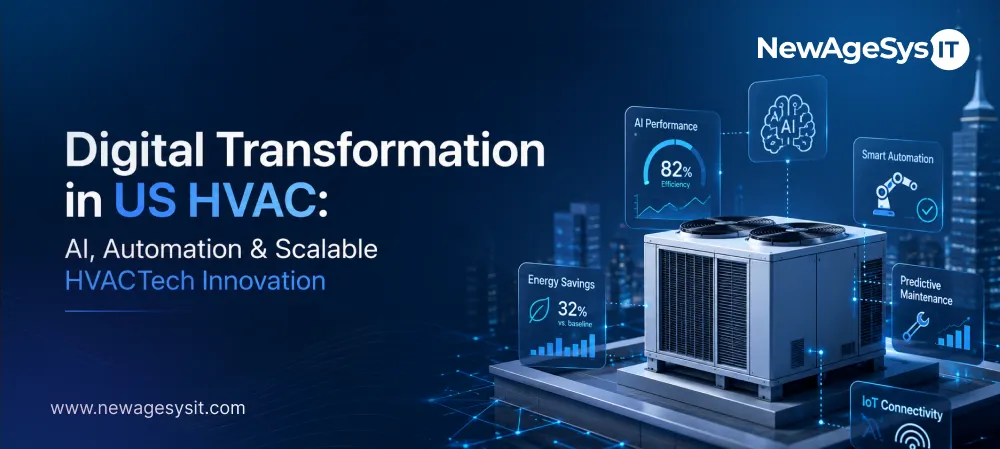
HVAC 8 min read
Digital Transformation in US HVAC: AI, Automation & Scalable HVACTech Innovation

Introduction: Why Digital Transformation is Now a Competitive Necessity for US HVAC Businesses
Digital transformation in US HVAC is now a competitive necessity. Contractors still dispatching by phone are falling behind. Logging EPA refrigerant records on paper costs you compliance confidence. Managing maintenance agreements in spreadsheets loses customers and technician efficiency. Digitally transformed competitors are winning that ground every day.
Several pressures are converging at once. IoT-connected equipment creates new predictive maintenance opportunities. AI dispatch optimization improves technician utilization across the board. Customers now expect digital booking and live service tracking. EPA compliance complexity creates real documentation risk for paper-based shops. Many owners add custom HVAC software and CRM development services to connect operational data with field execution and agreement management.
HVAC businesses that blend field excellence with digital tools win more. IoT monitoring, AI dispatch, and automated journeys lift agreement retention. Invoice collection speeds up, and emergency call rates drop. Digital transformation in HVAC spans four clear layers. The layers cover customer experience, operations, data intelligence, and technology strategy. Our guide maps the full landscape for you.
The US HVAC Technology Transformation Landscape
Four technology layers define modern US HVAC transformation. Each layer builds on the one before it. Together, they turn reactive shops into proactive operations.
• Customer experience layer: Digital booking with real-time availability and live technician tracking. Automated reminders, on-the-way alerts, and IoT-triggered service notifications round it out. The layer decides whether customers feel served or ignored.
• Operational efficiency layer: AI dispatch matching technician skill, GPS location, and van inventory. It adds automated agreement scheduling, field invoicing, and same-day payment collection. More revenue-generating jobs per technician follow naturally.
• Data intelligence layer: IoT monitoring, performance analytics, and agreement profitability tracking. Equipment replacement pipelines and seasonal demand forecasts also live here. Evidence replaces guesswork across the whole operation.
• Technology strategy layer: buy vs build choices, platform selection, and integration design. A clear HVACTech roadmap sits at the center. Smart sequencing keeps investments compounding rather than fragmenting.
Buy vs Build: The Technology Decision Every US HVAC Business Faces
Buy vs build is the foundational technology choice in HVAC. Owners face it for every major capability. The right answer protects both margin and compliance.
• Off-the-shelf platforms like ServiceTitan, Jobber, and Housecall Pro fit average workflows. They become obstacles when strategy demands differentiated customer experiences. Complex agreement structures and proprietary IoT integration expose their limits.
• Buy vs build carries an EPA compliance dimension in HVAC. A generic CRM may not support EPA Section 608 refrigerant logging. Custom or specialized software closes that gap by design.
• Custom HVAC software enables proprietary AI dispatch and branded customer portals. IoT monitoring gets configured for the exact equipment brands you service. Agreement structures match your business, not a vendor template.
• Most successful programs use a hybrid model. Owners buy commodity infrastructure like accounting and standard invoicing. They build differentiation, such as branded apps and custom EPA reporting.
The full buy vs build framework commodity infrastructure vs proprietary differentiation, EPA compliance gaps in generic CRMs, and hybrid model design runs through Buy vs Build in US HVAC Tech: Off-the-Shelf CRM vs Tailored HVAC Software.
AI and Automation: The Intelligence Layer of US HVAC Operations
AI and automation now define competitive advantage in US HVAC. Smart applications touch dispatch, maintenance, and customer communication. Each one moves measurable operational numbers.
• AI-optimized dispatch balances several constraints at once. It weighs technician GPS proximity, EPA 608 certification type, and customer time window. Job duration estimates and van parts inventory factor in, too. Manual dispatch consistently underperforms on technician utilization.
• Predictive maintenance runs on IoT equipment data. ML models spot failure patterns before customers feel an outage. Emergency calls convert into scheduled maintenance visits.
• Automated customer journeys respond to real events in real time. Examples include seasonal tune-up campaigns and lapsed customer re-engagement. Equipment age outreach and agreement renewal sequences also run automatically.
• AI revenue intelligence surfaces your highest-value opportunities. It flags customers near agreement renewal and the largest replacement pipelines. It also ranks technicians by revenue per job.
• EPA compliance automation removes the manual documentation burden. It manages refrigerant logs and technician certification expiry alerts. Compliance reports are generated without spreadsheet wrangling.
Each of those capabilities has a dedicated architecture breakdown in AI & Automation in US HVAC: Predictive Maintenance, Smart Dispatch & Automated Customer Journeys.
IoT and Smart Thermostat Integration: The Data Foundation of Modern HVAC
IoT and smart thermostat integration form the data foundation of modern HVAC. Connected equipment feeds every other transformation layer. Real-time performance data unlocks proactive service.
• Smart thermostat APIs open up rich system data. Ecobee, Nest/Google, Honeywell Home, and Lennox iComfort all provide access. Run time, temperature differential, error codes, filter life, and energy history flow through. Each platform requires a separate API integration.
• Predictive failure detection studies run time and temperature differential trends. Error code frequency adds another signal for ML models. Proactive service calls go out before the outage hits.
• Energy efficiency monitoring tracks performance over time. Alerts fire when equipment efficiency degrades. Tune-up conversations become valuable for homeowners and revenue-generating for contractors.
• Remote diagnostics let technicians review data before arrival. Crews show up with informed diagnoses, not blind guesses. Fewer return trips protect billable capacity.
• IoT-triggered upsell targets equipment showing degradation patterns. Outreach reaches non-agreement customers at the right moment. The data starts the sales conversation for you.
How those integrations connect into predictive service workflows is the subject of IoT & Smart Thermostat Integration in US HVAC Platforms.
HVACTech Product Development Cost in the USA
HVACTech development cost gets underestimated more often than not. Compliance, dispatch, and IoT scope drive the real number. Planning ranges help you budget with confidence.
• Compliance architecture drives HVACTech MVP cost. EPA Section 608 logging, ESIGN work authorization, and offline field capability add up. A compliant MVP costs 2 to 3 times as much as a non-compliant one.
• GPS dispatch optimization is the most underestimated cost. The multi-constraint routing engine adds $20,000 to $50,000. Generic software estimates routinely omit it.
• IoT integration adds meaningful scope to any platform. Ecobee, Nest/Google, Honeywell, and Lennox APIs each need separate work. Ongoing API maintenance continues after launch.
• A full-scale HVACTech platform carries a wide planning range. CRM, FSM, mobile app, AI dispatch, IoT monitoring, EPA compliance, and a customer portal combine. Initial development runs $350,000 to $1.2M and up.
Each cost driver has a dedicated breakdown in HVACTech Product Cost in the USA: MVP vs Full-Scale Platform.
Technology Roadmap Planning: The Strategic Foundation for US HVAC Transformation
US HVAC businesses without a roadmap repeat the same costly mistakes. A structured plan sequences every investment. Strategy beats reactive purchasing every time.
• A HVACTech roadmap is not a feature wish list. It is a multi-year strategic investment plan. Capabilities map against operational goals, EPA milestones, IoT data needs, and budget.
• Without a roadmap, HVAC owners make reactive decisions. Some buy scheduling tools that cannot generate EPA reports. Others pick CRMs with no agreement automation.
• Current state assessment is the required starting point. Map existing technology, EPA compliance approach, and IoT equipment penetration. Review agreement data quality and vendor contracts first.
• Consultant-led roadmaps add real value for HVAC organizations. The domain expertise is highly specialized. It spans EPA architecture, IoT APIs, dispatch optimization, and agreement data modeling.
That sequencing, buy vs build decisions, IoT data strategy, AI capabilities, and EPA compliance architecture runs through How to Plan an HVAC Tech Product Roadmap for the US Market: Consultant-Led Strategy.
Key Technology Pillars of US HVAC Transformation
Five technology pillars carry HVAC transformation forward. The pillars interact rather than stand alone. AI dispatch needs IoT data, and mobile apps surface AI recommendations. Process automation links every layer, and EPA compliance governs the records you capture.
AI and Dispatch Optimization
Multi-constraint AI dispatch weighs skill, GPS, time window, and parts inventory. Predictive routing, emergency job insertion, and seasonal capacity forecasting come together. High-utilization operations pull away from manual dispatch shops.
IoT and Equipment Intelligence
Smart thermostat API integration powers predictive failure detection. Energy efficiency monitoring, remote diagnostics, and performance dashboards follow. Proactive service delivery becomes the standard. Many teams build it through custom software development services that connect IoT telemetry, predictive failure detection, and energy efficiency monitoring into one operational layer.
Mobile-First Field Experience
Technician apps handle offline work orders, EPA refrigerant logging, and field invoicing. Customer apps add live tracking, service history, and agreement management. A strong custom mobile app development partner connects field work to customer experience, offline work orders, EPA logging, and live technician tracking as one connected workflow.
Process Automation
Automation covers agreement scheduling and seasonal campaigns. Lapsed customer re-engagement and replacement outreach run on their own. Renewal sequences and field-to-office data sync cut administrative overhead.
EPA Compliance Architecture
EPA Section 608 refrigerant logging works per job and per technician. Certification tracking and compliance report generation sit alongside. ESIGN-compliant authorization keeps digital operations defensible under scrutiny.
EPA compliance automation is operational guidance, not regulatory advice. Qualified environmental compliance counsel should review your specific obligations.
Challenges US HVAC Businesses Face in Digital Transformation
Transformation brings real challenges worth naming early. Honest planning beats surprise at every turn. Five hurdles show up most often.
• EPA compliance complexity meets mobile offline architecture. Records must capture correctly regardless of connectivity. The design challenge is specific to HVAC.
• IoT platform fragmentation slows integration work. Ecobee, Nest/Google, Honeywell, and Lennox use different API architectures. Comprehensive monitoring is harder than a single connection.
• Technician adoption needs deliberate investment. HVAC technicians train as tradespeople, not software users. Onboarding should match the change in daily workflow.
• Agreement data quality affects every migration. Moving paper or spreadsheet records into a CRM takes care. It runs deeper than importing a simple CSV.
• Budget sequencing protects your investment. HVACTech transformation needs phased spending. IoT monitoring before mobile infrastructure creates data with no use.
Final Thoughts
Digital transformation in the US HVAC spans five connected areas. It covers buy vs build, AI and automation, and IoT integration. Cost planning and roadmap development complete the picture.
Owners who plan with a clear strategy pull ahead. Sequenced investments, EPA-compliant data, and IoT predictive maintenance compound. Maintenance-call-response competitors cannot easily replicate the advantage.
Planning US digital transformation? Aligning technology decisions, IoT data strategy, and EPA compliance within a structured roadmap improves outcomes. Doing it before major investments strengthens long-term competitive positioning. Learn more about digital transformation solutions from one of the leading AI software companies in the United States.
Core Development
Keep exploring the custom services.

AI Software Development
Custom AI Software Development
Build intelligent, production-ready software from machine-learning models to AI-driven automation designed around your business goals.
Learn more
Mobile App Development
Custom Mobile Application Development
Native and cross-platform mobile apps that are fast, secure, and built to scale across iOS and Android.
Learn more
Web App Development
Custom Web Application Development
Scalable, secure web applications, from customer portals to complex dashboards, tailored to how your business actually works.
Learn more



