
Welcome to Blogs
Discover actionable insights, in-depth research, and expert perspectives, all in one place.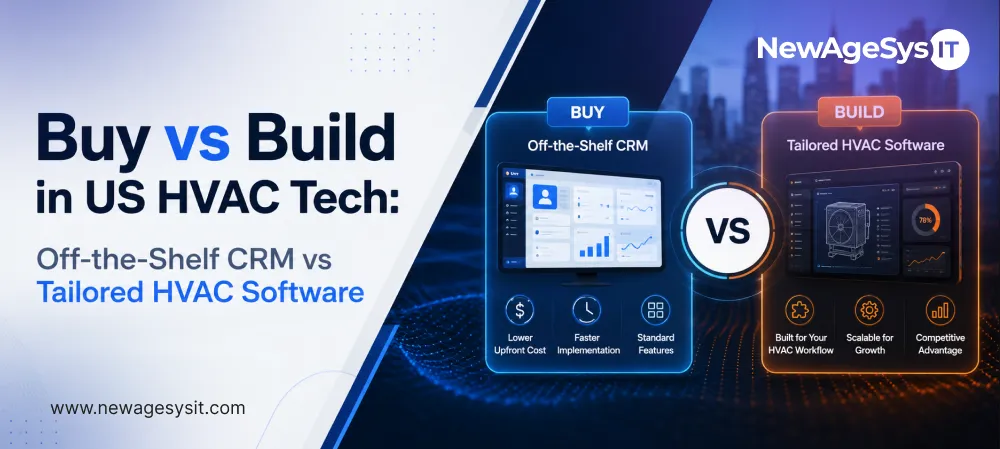
HVAC 4 min read
Buy vs Build in US HVAC Tech: Off-the-Shelf CRM vs Tailored HVAC Software in 2026

| This article is part of our series on Digital Transformation in US HVAC: AI, Automation & Scalable HVACTech Innovation |
Buying vs building HVAC software in the USA is a recurring choice. Owners face the decision for every major capability. It applies to CRM, dispatch, mobile field tools, and IoT monitoring. Customer portals and EPA compliance reporting raise the same question.
Every major HVAC technology investment needs a buy vs build review; the answer shifts by capability, not by habit. Buy vs build carries an EPA compliance dimension in HVAC. Generic CRM platforms often miss EPA Section 608 refrigerant logging. HVAC businesses carry a regulatory obligation to maintain those records. Many pair planning with custom HVAC software and CRM development services to scope EPA compliance architecture and IoT integration depth before any vendor contract is signed.
The Off-the-Shelf HVAC Software Landscape
Several purpose-built HVAC platforms serve the US market. Each fits standard workflows but shows real limits. Knowing the gaps protects your investment.
• Purpose-built platforms include ServiceTitan, Jobber, Housecall Pro, and FieldEdge. They handle standard HVAC workflows well. IoT integration depth, proprietary AI dispatch, and custom EPA reporting often fall short.
• ServiceTitan is the premium off-the-shelf option. Dispatch, invoicing, and reporting are strong. Per-seat cost scales steeply, often $400 to $2,000 and up, monthly.
• Jobber and Housecall Pro serve small and mid-size shops well. Pricing stays lower at that tier. Advanced IoT, custom agreements, and enterprise analytics remain limited.
• Generic CRMs like Salesforce and HubSpot need heavy customization. HVAC workflows do not come built in. EPA Section 608 records still require additional custom development.
• Data ownership is a real concern. Equipment history, agreement records, and EPA logs sit in third-party SaaS. Export complexity and vendor lock-in follow.
Businesses that outgrow SaaS configuration limits often start the transition through custom software development engagements that scope EPA compliance architecture, IoT integration, and proprietary dispatch logic before any product code is written.
What Custom HVAC Software Development Offers
Custom development answers needs SaaS cannot. It builds around your business, not the average user. The payoff is differentiation and control.
• A proprietary AI dispatch engine optimizes for your specific constraints. It weighs technician certifications, service area, and seasonal demand. A generic algorithm cannot match that fit.
• Deep IoT integration connects Ecobee, Nest/Google, Honeywell, and Lennox. Integrations target the exact brands you service. Proprietary alerting and energy reporting come with it.
• You own the EPA compliance architecture. Section 608 logging fits your services and certification types. A generic form gets replaced by purpose-built records.
• A branded customer portal reflects your HVAC identity. The experience positions premium brands above commodity competitors. Differentiation becomes visible to every customer.
• Custom builds end SaaS cost escalation. A 20-technician shop paying $1,500 monthly hits $90,000 over five years. Custom platforms can break even at that scale. How that break-even calculation maps against MVP compliance architecture, GPS dispatch engine scope, and full-scale platform investment ranges runs through HVACTech Product Cost in the USA: MVP vs Full-Scale Platform.
The HVAC Buy vs Build Decision Framework
A clear framework guides each capability choice. The most defensible model is hybrid. Buy commodity functions, and build differentiation.
EPA Compliance Requirements
Ask whether your work requires EPA Section 608 records. Check if the platform generates the specific records needed. Manual workarounds signal that compliance needs exceed SaaS.
Competitive Differentiation
Ask whether a capability sets your brand apart. Custom IoT dashboards, branded portals, and proprietary analytics create an advantage. Standard scheduling and invoicing are commodities enough for SaaS.
Scale Economics
Model five-year total SaaS cost at your technician count. ServiceTitan at $1,500 monthly for 15 technicians reaches $90,000. Custom development may break even and add differentiation. How those five-year cost models, IoT readiness assessments, and EPA compliance milestones sequence into a structured multi-year investment plan runs through How to Plan an HVAC Tech Product Roadmap for the US Market: Consultant-Led Strategy.
IoT Integration Requirements
Ask whether deep IoT monitoring drives predictive maintenance. Most SaaS platforms offer limited IoT connectivity. Custom development controls integration depth and alerting logic.
Mobile-heavy builds benefit from custom mobile app development that handles offline work order reliability, background GPS sync, and EPA refrigerant logging from the first sprint.
Common Buy vs Build Mistakes in US HVAC Technology
A few mistakes show up again and again. Each one costs time and money. Awareness prevents most of them.
• Choosing a CRM without EPA compliance support is common. A generic platform leaves refrigerant records unmanaged. Teams discover the gap only after deployment.
• Building commodity scheduling wastes custom resources. Standard booking adds no advantage. Invest instead in IoT, AI dispatch, and EPA architecture.
• Ignoring SaaS IoT limits creates surprises. Some platforms cannot connect to Ecobee or Nest data. Predictive maintenance then stalls before it starts.
• Ignoring five-year SaaS costs hurts scaling shops. Per-seat growth from 8 to 25 technicians compounds fast. Model the cost before you commit.
Final Thoughts
Buy vs build in the US HVAC needs more than a feature comparison. EPA compliance, five-year cost, and IoT depth all matter. A documented evaluation produces defensible architecture.
Owners who document EPA needs and cost models choose better. IoT integration assessment rounds out the decision. The result is cost-efficient, defensible technology. Learn more about digital transformation solutions from one of the leading AI software companies in the United States.
Making buy vs build decisions? A structured evaluation across EPA Section 608, IoT depth, and five-year cost improves long-term outcomes.
Core Development
Keep exploring the custom services.

AI Software Development
Custom AI Software Development
Build intelligent, production-ready software from machine-learning models to AI-driven automation designed around your business goals.
Learn more
Mobile App Development
Custom Mobile Application Development
Native and cross-platform mobile apps that are fast, secure, and built to scale across iOS and Android.
Learn more
Web App Development
Custom Web Application Development
Scalable, secure web applications, from customer portals to complex dashboards, tailored to how your business actually works.
Learn more



