
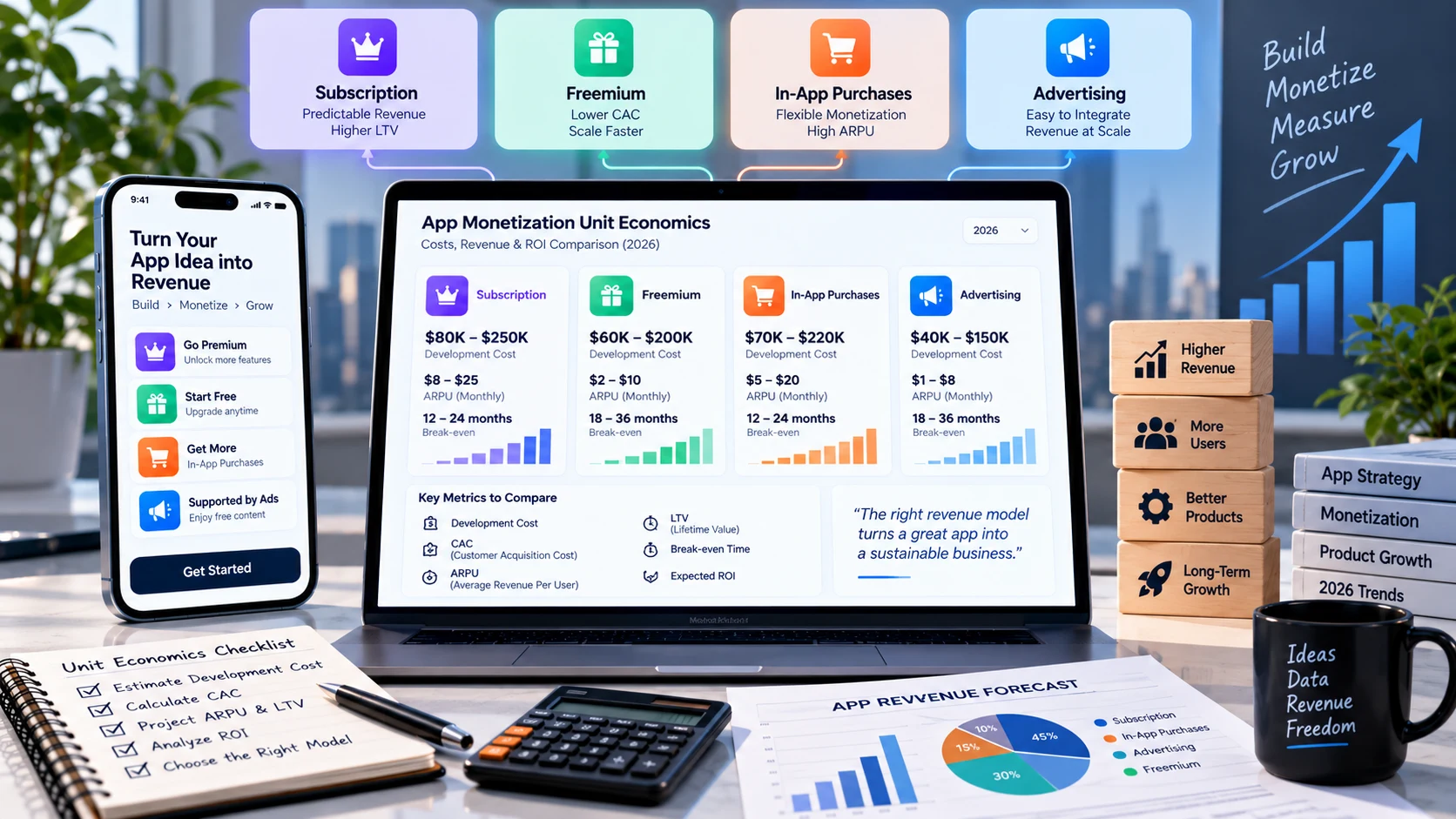

This article is part of our series on : App Monetization Strategies: The Best Practices for US App Founders to Choose the Right Revenue Model Before Writing a Line of Code in 2026
Model Revenue Before You Commit to a Budget
A founder budgeting “an app” without a specific monetization model is budgeting for the wrong thing. Subscription costs different money to build than advertising. B2B billing costs different money than marketplace commission. The model determines the budget. Not the other way around.
App monetization development cost 2026 varies by as much as 5x between the lightest and heaviest integrations. Advertising with AdMob sits at the low end. Marketplace commission with Stripe Connect sits at the high end. A founder who skips the model decision before budgeting either over-invests or under-invests. The under-investment is worse. It forces a rebuild.
This article covers development cost by model, subscription ARPU benchmarks 2026, the updated App Store commission bypass ROI, hybrid monetization revenue model math, and the advertising DAU eCPM threshold. All figures are 2026 planning references. The commission-bypass economics describe a temporary, litigation-dependent window. Not a permanent discount.
This is educational content, not financial or legal advice. Consult qualified counsel on the commission-bypass decision before committing the budget.
Founders scoping custom mobile app development need these cost inputs before the first sprint. B2B invoicing and web payment portal scope falls under web application development when those components are part of the deliverable.
Cost planning is the investment-decision layer of the full App Monetization Strategies: The Complete Guide for US App Founders.
Development Cost by Monetization Model
Every dollar amount below sits on top of the base app build cost. These ranges cover the monetization layer only. They include integration, backend, UX, and testing for each model.
Consumer models
| Model | Cost range | What it covers |
|---|---|---|
| Subscription (RevenueCat) | $15,000 to $30,000 | SDK integration, webhook backend, paywall screens with A/B test slots, entitlement-check endpoints, subscription-status management |
| In-App Purchases | $10,000 to $25,000 | Product catalog, purchase flow, restoration logic, server-side receipt verification, fraud detection for consumables |
| Advertising (AdMob + mediation) | $8,000 to $20,000 | AdMob SDK, mediation stack (AppLovin MAX, Unity LevelPlay, or AdMob Mediation), rewarded-ad triggers, placement optimization |
What drives the range within each model:
Subscription sits lower with a single paywall and two pricing tiers. Multiple paywalls with dynamic timing, localized pricing, and a free-trial conversion flow push toward $30,000.
IAP sits lower with non-consumable unlocks only. Adding consumable virtual goods with server-side balance tracking and fraud rules pushes toward $25,000.
Advertising sits lower with AdMob standalone and one ad format. Adding mediation across three networks and three ad formats pushes toward $20,000.
B2B and marketplace models
| Model | Cost range | What it covers |
|---|---|---|
| B2B Enterprise Billing (Stripe) | $20,000 to $40,000 | Stripe Subscriptions, invoice generation, usage-based metering, admin portal for enterprise buyer |
| Marketplace Commission (Stripe Connect) | $25,000 to $50,000 | Split-payment architecture, seller onboarding with identity verification, payout management, commission configuration, dispute handling |
The marketplace Stripe Connect development cost is the highest of any model here. Split-payment architecture is not an extension of Stripe Checkout. It is a different integration entirely. Adding it after a Checkout-only build means a payment-layer rebuild. Split-payment logic, payout scheduling, and commission configuration are the parts no processor ships ready-made, which is why this model carries the heaviest custom software development load.
B2B billing sits lower with simple per-seat pricing. Usage-based metering with tiered pricing and overage charges pushes toward $40,000.
The architecture behind these costs is detailed in Building App Monetization Into Your Architecture: RevenueCat, Stripe, AdMob, Apple StoreKit & Google Play Billing Integration for US App Founders.
Revenue Benchmarks to Model Against
Development cost tells half the story. The other half is what each model earns at a given scale. Pairing the two produces a break-even timeline. That timeline is what actually determines whether the monetization investment is worth making.
Verify and cite a current source for every specific figure below before using it in a budget model. These benchmarks shift by category and year.
Subscription ARPU benchmarks 2026
Consumer subscription ARPU generally runs in the high single digits to mid-teens per month. Category shapes the range:
- Fitness and health apps: typically $10 to $15 monthly.
- Productivity tools: typically $5 to $12 monthly.
- Entertainment and content: varies widely by content depth and exclusivity.
Annual subscription LTV is commonly modeled as:
Monthly revenue ÷ monthly churn rate = subscriber LTV
An app earning $10/month with 5 percent monthly churn has a modeled LTV of $200. That figure determines how much the app can spend acquiring each subscriber and still turn a profit.
Trial-to-paid conversion matters enormously here. Industry benchmarks commonly cite low single-digit conversion rates for cold paywalls. A well-designed free trial converts at a meaningfully higher rate. The gap between those numbers justifies the investment in paywall optimization and dynamic timing.
Advertising revenue per user
The advertising DAU eCPM threshold formula is straightforward:
DAU × eCPM ÷ 1,000 = daily ad revenue
An app with 50,000 DAU and a $10 eCPM generates roughly $500 per day. Whether that covers acquisition and retention cost depends on the app’s full economics.
eCPM varies enormously by category. Finance and healthcare apps command premium rates because advertisers bid higher for those audiences. Casual games sit at the low end. News and utility apps sit in the middle.
IAP ARPU
IAP revenue concentrates in a small percentage of users. Most free-to-play users never purchase anything. The ones who do spend at varying levels. Industry reports commonly cite low single-digit purchase rates for consumer apps. Games tend to convert slightly higher.
Modeling IAP revenue accurately means segmenting users by spending tier. Averaging across the full base produces misleading projections. The top 1 to 2 percent of spenders typically generate a disproportionate share of IAP revenue.
The App Store Commission Bypass — Updated Unit Economics
This is where the current legal reality reshapes the budget math. Both Apple and Google charge $0 commission on qualifying US external payment links right now. The App Store commission bypass ROI is stronger today than at any prior point in mobile app history. But one platform’s situation is temporary. The other is permanent.
The development cost
A compliant web payment flow costs roughly $15,000 to $25,000 to build. This is a one-time cost. It does not recur. Four components make up the scope:
- Hosted sign-up page: Stripe or a comparable processor handles the transaction on a web page the founder controls.
- Purchase-verification backend: A server confirms the web purchase and provisions entitlements in the app.
- Disclosure UI: Apple requires a neutral screen when the user taps an external link. Design constraints apply.
- Cross-platform account linking: Web purchases must unlock access in both iOS and Android apps through a bridged authentication system.
Apple: The math at $0 commission
Apple’s native IAP commission runs 15 to 30 percent under standard terms. The Small Business Program drops it to 15 percent for developers under $1 million in prior-year revenue. Year-two subscriptions also drop to 15 percent. Verify current thresholds before citing these figures in a budget model.
As of this writing, Apple charges $0 on qualifying US external payment links. Stripe charges roughly 3 percent.
Here is what the difference looks like at $20,000 monthly subscription revenue:
| Payment path | Commission | Monthly cost | Monthly retained |
|---|---|---|---|
| Native IAP (30%) | $6,000 | Apple commission | $14,000 |
| Native IAP (15% SBP) | $3,000 | Apple commission | $17,000 |
| Web flow ($0 Apple + 3% Stripe) | $600 | Processing only | $19,400 |
At 30 percent commission, the web flow saves $5,400 per month. The $15,000 to $25,000 development cost reaches break-even in three to five months.
At 15 percent commission (SBP or year-two rate), the web flow saves $2,400 per month. Break-even lands within six to ten months.
Both calculations assume the current $0 Apple commission holds. It may not. The Supreme Court granted certiorari on Apple’s appeal in June 2026. Oral argument is expected in the October 2026 term. A decision is not likely before late 2026 or early 2027. The Court could set a “reasonable” commission rate that changes this math.
Build the web flow now to capture the window. Include a configurable commission variable so the payment system adapts without a rebuild when the Court rules.
Google: Even more favorable, and permanent
Google charges $0 on alternative billing and external-link purchases in the US. The October 2024 permanent injunction governs this posture. Google lost its appeal. The Supreme Court declined further review.
On July 15, 2026, Epic and Google jointly withdrew their proposed settlement. That settlement would have introduced 9 to 20 percent tiered fees. With the withdrawal, the original injunction is the sole governing order. No fees are pending. No further appeals are possible.
The App Store commission bypass ROI on Android is not just favorable right now. It is stable. No Supreme Court review threatens it. The $0-commission posture rests on a final, non-appealable court order.
Build the Google-side web payment flow with confidence.
Hybrid Monetization Revenue Model and the Advertising Scale Threshold
Most top-grossing apps in 2026 run more than one revenue stream. The hybrid monetization revenue model is now standard, not exceptional. Modeling it correctly requires combining the individual revenue calculations and subtracting shared costs.
Hybrid Revenue Formula
The formula for a subscription-plus-IAP hybrid app:
Subscription revenue = paying subscribers × monthly ARPU
IAP revenue = IAP conversion rate × IAP ARPU × total users
Gross revenue = subscription + IAP
Net revenue = gross revenue minus platform commission, minus RevenueCat fees, minus payment processing fees
Given the current $0-commission reality on external payment links, the platform-commission line drops to near zero for web-routed transactions. That makes hybrid models more attractive right now than under standard commission terms.
One critical architecture note: a hybrid model requires all revenue streams instrumented from day one. Adding a second stream post-launch means rebuilding the analytics pipeline and the user flow. The app monetization development cost 2026 for a hybrid build is roughly the sum of the individual model costs, minus shared infrastructure (authentication, entitlements, analytics). Budget for both streams up front. Not one now and one later.
The advertising scale threshold
Adding ads to a freemium or hybrid app is not always a revenue-positive decision. Below a meaningful MAU count, the ad revenue generated is less than the retention it costs.
Interstitials and banners interrupt the user experience. That interruption drives churn. If the lifetime-value lost to churn exceeds the ad revenue generated, the ads subtract value. They do not add it.
The test before adding advertising to the architecture:
Daily ad revenue (DAU × eCPM ÷ 1,000) versus daily LTV lost to ad-driven churn
If the first number is smaller, do not add ads. Wait for scale.
Rewarded ads are the exception. The user initiates the interaction. The user receives in-app value in exchange. That opt-in exchange works at smaller DAU counts without the same retention cost. Rewarded ads are the only ad format worth considering before the app hits meaningful daily-active-user volume.
The advertising DAU eCPM threshold is category-specific. A casual game, a news app, and a fitness app each need different DAU counts to justify ads. Model it with real numbers before committing the architecture scope.
The scope decisions that prevent expensive rework across all of these models are in Why US App Founders Must Decide Their Monetization Model Before Choosing a Development Partner.
Final Thoughts
Development cost varies by model. Revenue timelines vary by model. Break-even math varies by model. The commission-bypass window is unusually favorable right now. On Apple’s side, it is temporary and pending Supreme Court review. On Google’s side, it is permanent and governed by a final court order.
A budget built on last year’s commission assumptions is a budget built on wrong numbers. The $0-commission reality on both platforms makes the web payment flow investment recover faster than most founders expect. Capture the window. Plan for it to change on Apple’s side.
NewAgeSysIT prices every app monetization development cost 2026 scope against the current, verified state of both platforms. Learn more about digital transformation solutions from one of the leading AI software companies in the United States.
If you are budgeting app monetization, price the commission-bypass decision against today’s $0-commission reality. Plan to revisit the Apple-side assumption when the Supreme Court rules. That approach captures the current window without treating it as permanent.
FAQ
How much does it cost to add monetization to a mobile app?
The cost depends heavily on the revenue model and its technical complexity. A basic advertising integration may require less development than subscriptions, enterprise billing, or marketplace payments. Costs increase when the app needs subscription management, payment verification, seller payouts, fraud controls, analytics, multiple pricing tiers, or cross-platform entitlements. Founders should budget for monetization separately from the core app-development cost.
Which app monetization model is most profitable?
There is no single most profitable app monetization model. Subscriptions can generate predictable recurring revenue, while in-app purchases can perform well when a smaller group of users spends heavily. Advertising generally requires substantial user activity, and marketplace commissions depend on transaction volume. The best model is the one where customer acquisition cost, retention, ARPU, churn, and operating costs produce sustainable unit economics.
What is app monetization unit economics?
App monetization unit economics measures how much revenue and profit an app generates relative to the cost of acquiring and serving users. Important metrics include customer acquisition cost, average revenue per user, lifetime value, churn, conversion rate, payment fees, and platform commissions. These numbers help founders estimate break-even timelines and determine whether a monetization strategy can become profitable as the app grows.
How do you calculate customer lifetime value for a subscription app?
A simple subscription LTV estimate divides average monthly revenue per subscriber by the monthly churn rate. For example, an app generating $10 per subscriber each month with 5% monthly churn would have a simplified modeled LTV of about $200. Actual lifetime value should also consider payment fees, refunds, discounts, servicing costs, upgrades, downgrades, and differences between customer segments.
How much does it cost to build a subscription model into an app?
A subscription monetization layer built on a platform such as RevenueCat typically runs roughly $15,000 to $30,000. Scope may include SDK integration, subscription webhooks, paywalls, entitlement management, subscription status, trials, and pricing tiers. Costs increase when an app requires localized pricing, multiple paywalls, advanced experimentation, cross-platform subscription access, or more complex subscription lifecycle management.
How much does marketplace payment integration cost?
Marketplace payments are typically more expensive than standard checkout because the platform must manage payments between buyers, sellers, and the marketplace itself. A Stripe Connect monetization layer typically runs approximately $25,000 to $50,000. Development can include seller onboarding, identity verification, split payments, commissions, payout scheduling, disputes, refunds, and marketplace-specific accounting or transaction-management requirements.
How many users does an app need before advertising becomes profitable?
There is no universal user threshold because advertising revenue depends on daily active users, impressions, ad format, geography, category, fill rate, and eCPM. A simple estimate is daily active users multiplied by eCPM, divided by 1,000. Founders should also measure whether ads increase churn or reduce engagement. Advertising becomes attractive only when incremental ad revenue exceeds the value lost through poorer retention.
Are subscriptions better than in-app purchases for mobile apps?
Subscriptions generally work well when an app provides continuous value, such as ongoing content, software features, services, or regular updates. In-app purchases are better suited to optional digital goods, upgrades, virtual items, or one-time unlocks. The right choice depends on user behavior and product value. Some apps combine both models when subscription access and optional purchases serve different customer needs.


