
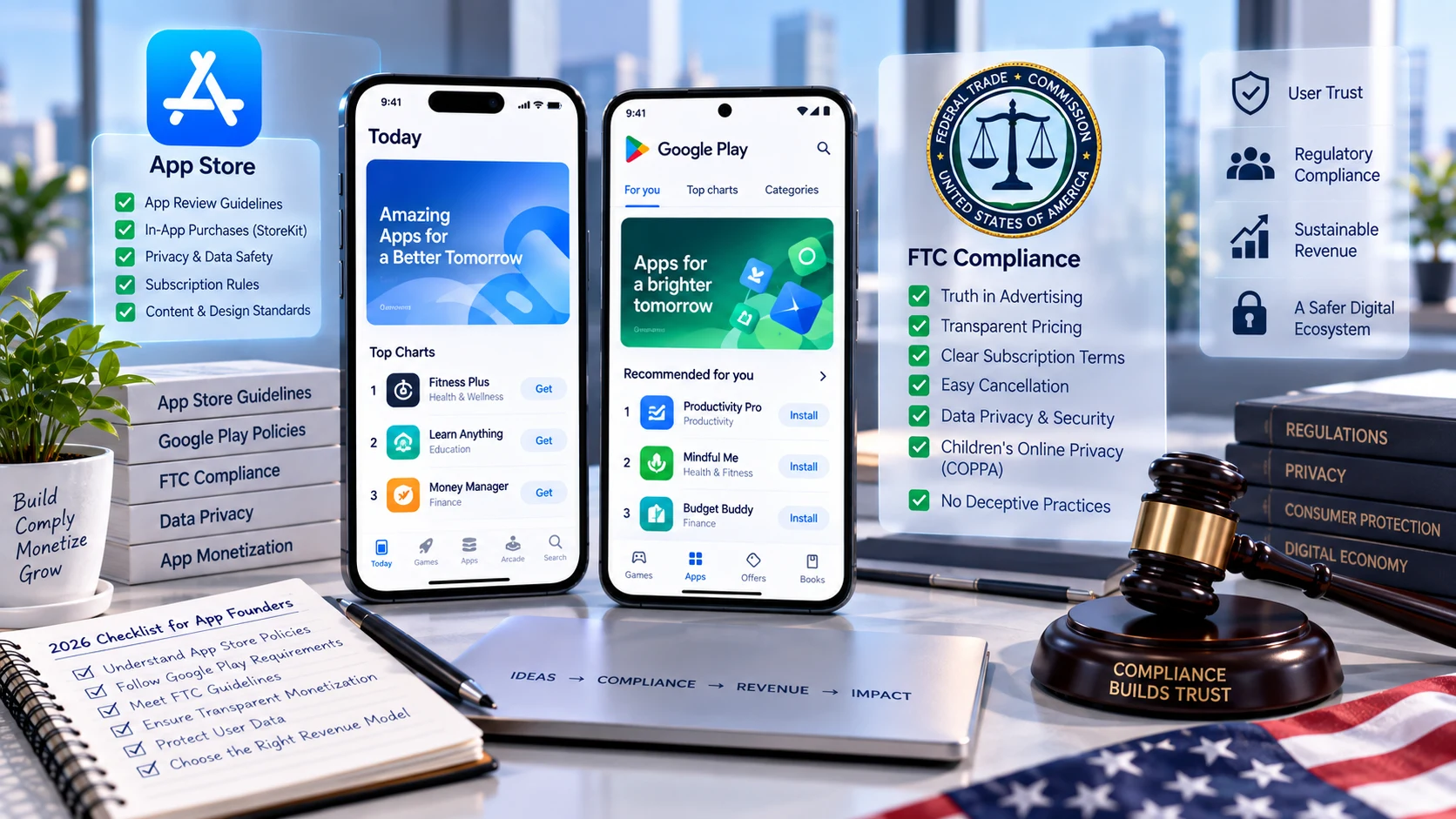

This article is part of our series on : App Monetization Strategies: The Best Practices for US App Founders to Choose the Right Revenue Model Before Writing a Line of Code in 2026
Introduction: Platform Policy and FTC Law, Both Moving Fast in 2026
Most existing app monetization compliance content is already outdated. Apple’s platform policies have been reshaped by active antitrust litigation. Google’s billing rules have been rewritten by a permanent federal injunction. The FTC’s own subscription-transparency rule was struck down by a federal court. All three shifts happened within the last 14 months.
App monetization compliance USA 2026 now spans two moving targets. Platform policies on one side. Federal and state subscription law on the other. A founder who builds against last year’s version of either one risks App Store rejection, FTC enforcement exposure, or both.
This article covers Apple’s in-app purchase mandate and its carve-outs. It covers Google Play’s billing policy under the current court order. It corrects the record on FTC subscription-transparency requirements. It addresses CCPA ATT in-app advertising obligations. It covers common App Store rejection triggers. And it addresses COPPA behavioral advertising children apps restrictions for ad-monetized products with younger users.
This is educational and strategic content, not legal advice. Apple and Google’s external-payment situations and FTC subscription law are all in active flux. Consult qualified app-platform and consumer-protection counsel before building monetization features based on anything described here. The speed at which this area is moving makes professional guidance more valuable right now than at any point in the last decade.
Founders scoping custom mobile app development around a monetization model need these compliance inputs defined before the first sprint. The subscription disclosure and cancellation flow that clears both App Store review and FTC scrutiny is part of the web application development scope when a web-based sign-up or billing portal is part of the deliverable.
Compliance is the risk-and-trust layer of the full App Monetization Strategies: The Complete Guide for US App Founders.
Apple’s In-App Purchase Mandate and Google’s Billing Policy — Current State
Two separate platform policies govern app monetization on iOS and Android. Both have been reshaped by litigation. Both carry carve-outs that did not exist two years ago. And the two are not parallel in scope.
Apple’s mandate and carve-outs
Apple requires digital goods and services consumed within an iOS app to be purchased through Apple’s in-app purchase system. Consumer digital subscriptions, premium feature unlocks, and virtual goods all fall under this mandate. There is no general opt-out for consumer digital content.
Specific carve-outs exist. Physical goods and real-world services are exempt. Reader apps (Netflix, Spotify, Kindle, and similar) hold a separate, longer-standing zero-commission entitlement. That entitlement stems from a 2021 Japan Fair Trade Commission settlement. It is distinct from the newer Epic-driven external-link allowance. Qualifying B2B enterprise apps also have a specific carve-out from the standard IAP requirement.
As of this writing, US-storefront apps can also use the newer external-link entitlement. Apple charges $0 commission on qualifying external payment links in the US right now. This stems from the April 2025 contempt finding against Apple in the Epic v. Apple case. The Supreme Court granted certiorari on Apple’s appeal in June 2026. Oral argument is expected in the October 2026 term. A decision is not likely before late 2026 or early 2027.
Most apps using the external-link entitlement must still also offer native IAP as an option. The Apple in-app purchase mandate reader app carve-out is the exception. Reader apps can link to their website for account management without offering IAP at all.
Apple can still impose design constraints on the external link. The link cannot be more prominent than the IAP button. Font and button sizing are restricted. A neutral third-party-site disclosure screen is required.
Google Play alternative billing policy
Google’s situation is structurally different from Apple’s and structurally bigger. A jury found Google maintained a full illegal monopoly over Android app distribution and billing in December 2023. Judge James Donato’s October 2024 permanent injunction goes beyond payment routing. It bars requiring Google Play Billing for digital goods. It bars anti-steering restrictions. And it requires Google to host rival app stores inside the Play Store.
Google lost its appeal in July 2025. The Supreme Court declined further review. This injunction is final and non-appealable.
The Google Play alternative billing policy under the current injunction allows US apps to offer alternative billing, external payment links, and direct-to-web purchase flows. No Play Billing enrollment is required. Google charges $0 on alternative billing and external-link transactions in the US right now.
On July 15, 2026, Epic and Google jointly withdrew their proposed alternative settlement. That settlement would have introduced 9 to 20 percent tiered fees. With its withdrawal, the original 2024 injunction is the sole governing order. No settlement fees are pending.
Starting July 22, 2026, rival app stores appear inside Google Play in the US. Google’s Play Catalog Access Program opens its full app catalog to enrolled rival stores by default.
Verify current enrollment and implementation requirements directly with Google Play Console documentation before publishing specific steps. The mechanics of compliance are changing frequently as Google implements the injunction.
Which monetization models trigger which compliance obligations is broken down in App Monetization Models Compared: Subscription vs. Freemium vs. In-App Purchases vs. Advertising.
FTC Subscription Transparency — ROSCA and the Click-to-Cancel Rule’s Current Status
This is the single most important correction in this cluster. Most app monetization compliance guides still cite the FTC’s “Click-to-Cancel” rule as binding federal law. It is not. Getting the legal citation right matters for the subscription disclosure and cancellation flow a founder builds.
This is educational content, not legal advice on FTC compliance. Consult qualified consumer-protection counsel before finalizing your subscription sign-up and cancellation architecture.
What’s currently binding
1. ROSCA: The Restore Online Shoppers’ Confidence Act is a federal statute, not an administrative rule. It remains fully in force. ROSCA requires clear disclosure of subscription terms before charging. It requires informed consent. It requires a simple cancellation mechanism. The FTC enforces ROSCA directly. Violations carry FTC enforcement action and potential civil penalties.
2. FTC Section 5 enforcement: The FTC continues to bring unfairness and deception enforcement actions against subscription businesses that obscure cancellation. These actions function as a de facto cancellation-ease requirement. The FTC does not need a specific rule to pursue companies that make cancellation deliberately difficult. Section 5 of the FTC Act covers it independently.
3. State automatic-renewal statutes: Roughly 30 states have their own laws. California, Colorado, and New York each require cancellation to be at least as easy as enrollment. California’s most recent amendments took effect on July 1, 2025. Massachusetts enacted a comparable regulation effective September 2, 2025. These state laws apply independently of any federal rule. An app serving users across multiple states faces a patchwork of requirements. Building to the strictest standard (California’s, typically) satisfies the rest.
The FTC ROSCA click-to-cancel rule status 2026 bottom line: the “easy cancellation” standard is effectively still required. The legal citation behind it has changed, but the practical obligation has not.
What’s not currently binding
The FTC’s 2024 amended Negative Option Rule is the rule commonly called “Click-to-Cancel.” It would have made the “cancellation as easy as enrollment” standard an explicit, uniform federal rule. The Eighth Circuit vacated it in its entirety on July 8, 2025.
The court’s reasoning was procedural, not substantive. The FTC skipped a required cost-benefit analysis during the rulemaking process. The court found this was a “fatal, prejudicial error.” It did not address whether the substance of the rule was sound. It struck the rule down because the process was defective.
That specific rule is not currently in effect. It cannot be enforced. Companies are not subject to its mandates.
The FTC filed a new Advance Notice of Proposed Rulemaking (ANPRM) on January 30, 2026. Comments were due April 13, 2026. The prior rule took roughly three years to finalize. A new binding federal rule is not imminent. The timeline is years, not months.
What this means for the build
The practical guidance is unchanged despite the vacatur. Build a subscription sign-up flow that clearly discloses pricing, renewal terms, and trial-to-paid conversion timing. Build a free-trial confirmation screen that obtains genuine informed consent. Build a cancellation flow that is at least as easy as the sign-up flow.
This standard remains effectively required through three separate channels. ROSCA as a federal statute. State automatic-renewal laws covering roughly 30 states. And continued FTC Section 5 enforcement risk that functions like a rule even without one. The specific federal rule citation has changed. The requirement to build easy cancellation has not.
CCPA and In-App Advertising Data Collection
Ad-monetized apps face a separate compliance layer that runs parallel to the platform policies and FTC subscription rules above. CCPA ATT in-app advertising obligations apply to any app that serves California users and relies on behavioral targeting.
CCPA requirements
In-app advertising that relies on behavioral data for targeting falls under CCPA’s opt-out requirements. US apps serving California users need a “Do Not Sell or Share My Personal Information” option. This applies to any sharing of user behavioral data with advertising networks for targeting purposes. CCPA defines “sharing” broadly enough to cover most ad-network data flows.
The practical requirement: a visible, functional opt-out mechanism in the app’s settings. The opt-out must apply to all ad-network data sharing, not just selected partners. Non-compliance exposes the app to California Attorney General enforcement action and private lawsuits under CCPA’s limited private right of action for data breaches.
Apple app tracking transparency
Apple’s ATT framework requires an explicit opt-in prompt before any cross-app tracking on iOS. This is separate from CCPA. It is a platform-level requirement, not a legal one. But the practical effect on ad revenue is significant.
ATT opt-in rates directly affect targeting precision and eCPM. Lower opt-in means less precise targeting. Less precise targeting means lower advertiser bids. The gap between opted-in and opted-out eCPM is material for most ad-supported apps.
The ATT permission prompt needs careful design. Apple prohibits incentivizing the opt-in. “Opt in and get 50 coins” is not allowed. The prompt must earn genuine consent through clear value communication. “We use this data to show you ads relevant to your interests” is the kind of framing Apple permits.
Apps that run advertising without the ATT prompt when it is required face App Store rejection. Apps that incentivize the prompt face App Store rejection. Both are avoidable with the right pre-submission review.
App Store Review Rejection Triggers
Most monetization-related App Store rejections are preventable. They follow predictable patterns. A pre-submission architecture and copy review catches nearly all of them.
- Obscured free-trial cancellation terms: If the paywall screen promotes a free trial but buries the cancellation method or the post-trial pricing, Apple rejects. The cancellation path must be visible and clear on the same screen that promotes the trial. This is the single most common monetization-related rejection.
- IAP that does not function on first launch: If a user purchases a subscription or consumable and the entitlement does not activate immediately, Apple rejects. This is an architecture problem. Receipt verification and entitlement provisioning must work on the first purchase attempt, not after a server sync delay.
- Missing free tier or trial in expected categories: Some app categories (fitness, productivity, content) carry an implicit Apple expectation that a free trial or free tier exists. A hard paywall at launch in these categories often triggers a rejection, even if the App Store guidelines do not explicitly require a trial. Apple’s review team applies category-specific judgment.
- Misleading subscription pricing displays: Showing a weekly price in large text and an annual price in small text, or displaying a per-day price without the total annual cost clearly visible, triggers rejection. Apple’s pricing-display rules require the full charge amount and billing frequency to be equally prominent.
Each of these is an architecture and copy-review problem. It is not a policy ambiguity. A structured pre-submission review catches all four before the app reaches Apple’s review queue. Catching them after a rejection adds one to two weeks of delay per resubmission cycle. Receipt verification and entitlement provisioning that work on the first attempt are a custom software development concern rather than a review-guideline question.
COPPA and Section 230 for Monetized Apps
Apps that monetize through advertising and also host user-generated content sit at an intersection of two federal laws. Section 230 governs content liability. COPPA governs data collection from children. The two interact in ways most founders do not expect.
Section 230
Section 230 of the Communications Decency Act provides immunity for third-party content. A platform is generally not liable for what its users post. This immunity applies to ad-monetized apps with user-generated content, reviews, comments, or social features.
COPPA behavioral advertising children apps
COPPA applies regardless of Section 230 protection. If the app is directed at children under 13, or if it has actual knowledge that it collects data from users under 13, COPPA’s restrictions apply. Behavioral advertising to children under 13 is prohibited under COPPA. This prohibition applies even if Section 230 protects the app from liability for the underlying user-generated content.
Getting this wrong creates FTC enforcement exposure that dwarfs the advertising revenue the app would generate. COPPA violations carry civil penalties per violation. The FTC has increased COPPA enforcement actions in recent years. Recent FTC amendments to the COPPA rule have expanded its scope. Verify current COPPA guidance directly before finalizing an advertising model for any app that might attract users under 13.
The practical standard: treat any app that could attract younger users as needing dedicated COPPA compliance review before the advertising model is finalized. “Our app is not for kids” is not a defense if the app’s content, design, or marketing would attract them.
A consultant’s compliance risk review maps to these obligations. The pre-build compliance assessment that prevents App Store rejection and FTC exposure is detailed in Why US App Founders Must Decide Their Monetization Model Before Choosing a Development Partner.
Final Thoughts
Apple’s and Google’s external-payment postures are different in scope and legal finality. Apple charges $0 under a pending Supreme Court review. Google charges $0 under a permanent, final injunction. The FTC’s subscription-transparency obligations rest on ROSCA and state law, not the vacated 2024 rule. CCPA and ATT shape the ad-revenue model. COPPA restricts behavioral advertising to younger users.
Each of these is an architecture input, not a post-launch audit item. Founders who treat the current compliance picture as a build requirement, with qualified counsel, clear App Store review on the first submission. They hold up under FTC scrutiny.
NewAgeSysIT treats app monetization compliance USA 2026 as a scoping input, not a post-launch checklist. Learn more about digital transformation solutions from one of the leading AI software companies in the United States.
If you are building app monetization, getting qualified app-platform and consumer-protection counsel to validate your commission-bypass approach and your subscription disclosure and cancellation flow before submission is the step that most reduces the risk of a rejection or an FTC complaint.
FAQ
What compliance rules affect app monetization in the US?
US app monetization can involve Apple App Review rules, Google Play policies, FTC consumer-protection law, ROSCA for online negative-option subscriptions, advertising and endorsement rules, COPPA for qualifying child-directed services, privacy laws, and payment requirements. The exact obligations depend on whether the app sells digital content, physical services, subscriptions, advertising, marketplace transactions, or access purchased outside the app.
When does Apple require In-App Purchase?
Apple generally requires In-App Purchase when users purchase digital content, functionality, subscriptions, virtual goods, or other features consumed inside the app. Physical goods and real-world services generally use other payment methods. Apple also maintains specific exceptions for reader apps, enterprise services, person-to-person services, multiplatform services, and other categories. US storefront apps currently receive broader external-link treatment.
Can US iOS apps link users to external payment methods?
Yes. Apple’s current App Review Guidelines state that apps on the United States storefront may include buttons, external links, or other calls to action directing users to alternative purchase mechanisms without the external-link entitlement required in some other regions. However, Apple’s litigation with Epic remains active, with Supreme Court review granted on June 30, 2026.
Can Android apps use alternative billing in the United States?
Yes. Google currently allows enrolled developers serving US users to offer an alternative billing system instead of or alongside Google Play Billing. The program requires enrollment, transaction reporting, subscription-management links, customer support, and other conditions. Google says applicable Play service fees for this program begin October 1, 2026.
Is Google’s US external-payment commission permanently 0%?
No. That description is now outdated. Google states that developers enrolled in its US alternative-billing and external-content-link programs must begin reporting qualifying activity and paying applicable Play service fees on October 1, 2026. For alternative billing, current published rates vary by transaction type, annual earnings, and whether the user is associated with a new or existing install.
Is the FTC Click-to-Cancel Rule currently in force?
No. The amended 2024 Negative Option Rule was vacated by the Eighth Circuit on July 8, 2025. The FTC began a new rulemaking process in 2026 and announced an Advance Notice of Proposed Rulemaking on March 11, 2026. The vacated 2024 rule should therefore not be cited as current binding federal law.
What federal subscription rules still apply after Click-to-Cancel was vacated?
ROSCA remains important for online negative-option subscriptions. It requires clear and conspicuous disclosure of material terms before obtaining billing information, express informed consent before charging, and a simple mechanism for stopping recurring charges. The FTC also continues bringing Section 5 and ROSCA cases involving allegedly deceptive billing or difficult cancellation.
What subscription disclosures do Apple and Google require?
Apple requires subscription apps to provide ongoing value and clearly explain what customers receive for the price. Google requires subscription offers to clearly communicate terms and provide an easy-to-use online cancellation method through the app’s account settings or an equivalent location. Trial duration, conversion to paid access, pricing, and cancellation should therefore be visible rather than buried in secondary text.


