Welcome to Blogs
Discover actionable insights, in-depth research, and expert perspectives, all in one place.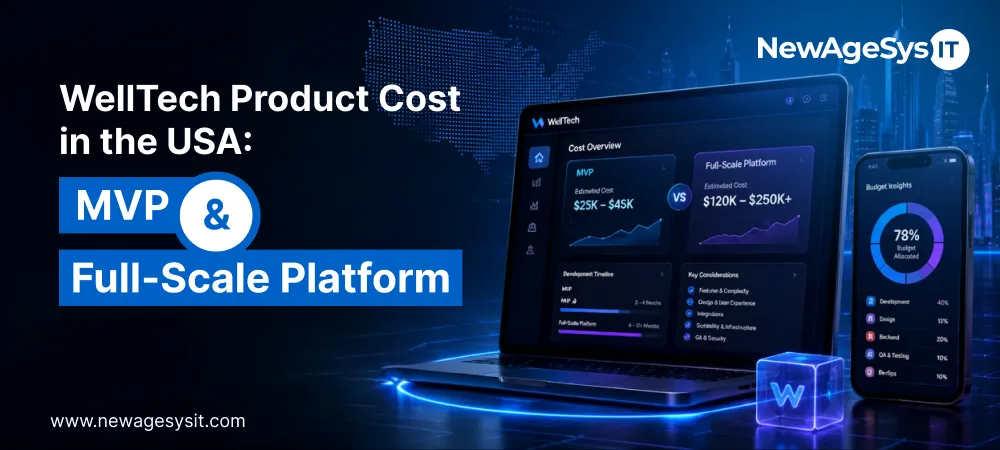
Wellness 5 min read
WellTech Product Cost in the United States: MVP vs Full-Scale Platform in 2026

| This article is part of our series on Digital Transformation in US Wellness: AI, Automation & Scalable WellTech Innovation. |
WellTech product development cost in the USA is one of the most underestimated line items in wellness startup planning. Startups that use generic software estimates without considering informed consent architecture, HIPAA compliance, and wellness-specific features overspend 40–70% mid-development.
The cost gap between a WellTech MVP and a full-scale platform is wider than most software categories. Wearable API complexity, compliance architecture, and mobile delivery requirements all drive costs beyond what standard dev quotes capture.
For teams investing in wellness mobile and web app development services, cost clarity is essential before finalizing scope or approaching vendors. It is equally critical for teams building wellness software and CRM development services, without it, funding gaps stall programs before they launch.
What Makes WellTech Development More Expensive Than Standard Software?
Six cost drivers consistently separate the cost of developing WellTech products from generic software estimates:
1. HIPAA Compliance Architecture: HIPAA compliance architecture includes encryption, role-based access with audit logging, and BAA management. Breach response protocols can increase the development cost of HIPAA-applicable wellness platforms by 15–25%.
2. Informed Consent & Digital Waiver Systems: ESIGN/UETA-compliant consent architecture, consent version management, and retrieval systems are the most consistently underestimated compliance cost in WellTech builds.
3. Wearable Integration:
Each platform requires separate API integration. This includes Apple HealthKit, Oura Ring, Whoop, and Google Health Connect. OAuth flows, data normalization, and privacy compliance are also required for each platform. These factors add $10,000 to $25,000 per platform.
4. AI Wellness Coaching Development: Behavior change-informed ML models, adaptive recommendation infrastructure, and clinical safety guardrails demand specialized engineering.
5. Mobile Delivery: Full iOS and Android deployment is non-negotiable for broad client reach in wellness.
6. Mental Health Content Safety: Clinical disclaimer infrastructure, crisis resource integration, and App Store mental health compliance documentation add scope that most generic estimates omit entirely.
WellTech MVP Development Cost
A WellTech MVP is the minimum product that delivers the core wellness value proposition, meets health data privacy requirements, and can be validated with real clients. Informed consent architecture and health data compliance are essential. They are non-negotiable from day one. These elements cannot be added after the launch, unlike general software MVPs.
The following are the US development cost ranges categorized by product type:
- Wellness CRM & Booking MVP: Client management, multi-provider scheduling, digital intake, package billing, no mobile app: $40,000–$100,000
- Consumer Wellness App MVP: Cross-platform, guided content, habit tracking, HealthKit + Health Connect, subscription billing: $60,000–$150,000
- Wellness Practitioner Platform MVP: Client management, program delivery, check-in forms, billing, and HIPAA-compliant messaging (if applicable): $50,000–$130,000
- Mindfulness & Content Platform MVP: On-demand audio, basic CMS, subscription billing, no AI or wearable integration: $80,000–$200,000
For any HIPAA-applicable platform, add 15–25% to account for full compliance architecture. Teams building custom mobile app development for wellness should factor compliance architecture costs in before finalizing MVP scope not after App Store submission
Full-Scale WellTech Platform Development Cost
The development of the Full-scale WellTech platform goes beyond just validating the MVP. It expands into a multi-feature and multi-audience infrastructure. The depth of AI, the breadth of wearables, and the scope of compliance influence the costs.
US development costs vary by platform type:
- Full Consumer Wellness Platform: AI coaching, wearable integration, content library, habit coaching, community features, and dual mobile apps: $350,000–$1,000,000
- Full Spa & Wellness Center Platform: CRM, booking, client app, AI retention, multi-location management, wearable integration, HIPAA if applicable: $280,000–$800,000
- Full Wellness Practitioner Platform: Multi-practitioner, AI program creation, wearable data access, branded client apps, billing, marketplace: $220,000–$600,000
- Full Mindfulness & Content Platform: Live and on-demand content, AI personalization, multi-category library, corporate wellness B2B, dual native Android and iOS apps: $600,000–$1,800,000+
Annual operational expenses include wearable API fees, content CDNs, AI model serving, and platform maintenance; typically 20 to 30% of initial build cost annually. These include wearable API fees, content CDNs, AI model serving, and platform maintenance. Typically, these expenses run 20–30% of the initial development cost each year.
Compliance Architecture Cost for WellTech
Compliance architecture is often missing from initial WellTech estimates. This absence is the budget category that tends to lead to funding gaps during mid-development.
US cost ranges by compliance component:
- HIPAA Applicability Legal Review: Healthcare attorney analysis of platform scope costs between $5,000 and $15,000. This is the most important pre-build investment for any wellness platform that offers health services.
- HIPAA Technical Safeguards (if applicable): Encryption architecture, role-based access with audit logging, breach response infrastructure: $20,000–$60,000.
- Informed Consent System: ESIGN/UETA-compliant consent architecture, version management, and retrieval: $10,000–$25,000.
- CCPA Consumer Rights Infrastructure: Data export, deletion pipeline, and consent management: $10,000–$30,000.
- Annual Compliance Maintenance: Ongoing HIPAA compliance, CCPA updates, and wearable API governance monitoring: $10,000–$30,000 per year.
Total Year 1 compliance costs for a mid-sized WellTech platform are usually between $45,000 and $130,000. This is a number that isn’t included in almost all software estimates. Teams building custom iOS wellness apps should include compliance architecture scope before finalizing any development budget.
How to Budget a US WellTech Development Program Realistically
Generic software budgeting frameworks fail WellTech founders. Here is a four-step approach built for wellness technology development cost realities:
Step 1: Define Your Product Category
Is it a Wellness CRM, a consumer wellness app, a mindfulness platform, a practitioner management platform, or a combination of these? Single or multi-location? This decision determines the cost tier before development begins.
Step 2: Assess Compliance Requirements
Determine HIPAA applicability with legal counsel. Identify CCPA obligations for California client data, and map informed consent architecture requirements for your specific wellness service types.
Step 3: Budget Operational Costs From Year One
Fees for wearable APIs, content CDNs, AI model serving, and platform maintenance are recurring budget items. These are predictable recurring costs, not post-launch surprises.
Step 4: Add 25–35% Contingency
WellTech projects consistently surface compliance requirement discoveries and wearable API changes that are not visible at project start. Budget for them upfront through planning.
Building a Realistic WellTech Development Budget
There are four things that affect how much it costs to make WellTech products, and general software estimates always miss them. Including wearable tech, compliance architecture, AI features that are hard to understand, and all the features that are available.
These four things are informed consent architecture, wearable API fees, HIPAA compliance where applicable, and ongoing operational costs.
If your organization is budgeting a US WellTech development program, mapping compliance requirements, wearable integration scope, and AI feature complexity to your specific product category before approaching any vendor gives you the most accurate financial foundation. To see how a US WellTech development company approaches cost modeling across compliance, wearable integration, and AI feature scope, explore our work with wellness founders and enterprise teams.
Core Development
Keep exploring the custom services.

AI Software Development
Custom AI Software Development
Build intelligent, production-ready software from machine-learning models to AI-driven automation designed around your business goals.
Learn more
Mobile App Development
Custom Mobile Application Development
Native and cross-platform mobile apps that are fast, secure, and built to scale across iOS and Android.
Learn more
Web App Development
Custom Web Application Development
Scalable, secure web applications, from customer portals to complex dashboards, tailored to how your business actually works.
Learn more