
Welcome to Blogs
Discover actionable insights, in-depth research, and expert perspectives, all in one place.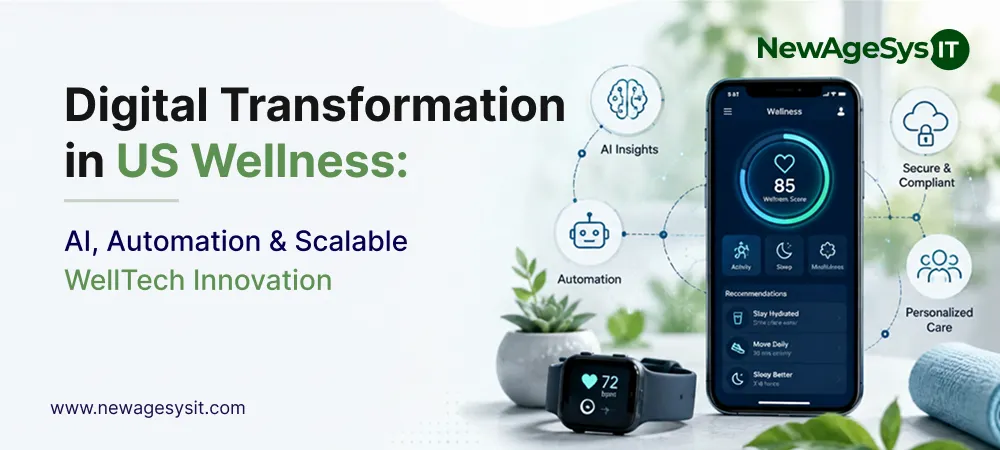
Digital Transformation 9 min read
Digital Transformation in US Wellness: AI, Automation & Scalable WellTech Innovation

Digital transformation in US wellness is not optional anymore. It has become a survival strategy. Spas, yoga studios, wellness centers, and holistic health businesses that lack compelling digital experiences are quietly losing clients to app-only platforms like Calm, Headspace, and Noom. These apps have permanently reset client expectations around personalization, convenience, and digital engagement.
Four forces are accelerating this shift. AI is now personalizing wellness experiences at scale. Wearable devices are generating real-time health data that businesses can actually act on. Automation is reducing the administrative load on practitioners. The mix of physical and digital wellness that started after the pandemic is now the standard in the industry, not just an experiment.
Wellness businesses that combine physical service excellence with strong digital engagement consistently retain clients longer. Transformation spans four layers: client experience, operations, data intelligence, and technology strategy. Businesses implementing this transformation through wellness mobile and web app development services build connected client experiences that generic platforms cannot replicate. It covers everything from buy vs build decisions and AI coaching to wearable integration, cost planning, and roadmap development.
The US Wellness Technology Transformation Landscape
US wellness technology transformation operates across four distinct but deeply connected layers. Understanding each one and how they work together is what makes a well-thought-out WellTech strategy different from spending on a bunch of different point solutions.
The client experience layer covers digital booking, mobile wellness apps, virtual coaching, and loyalty programs. This is what keeps clients engaged between physical visits.
The operational efficiency layer handles automated client communication, AI-driven retention prediction, billing automation, and practitioner scheduling. It determines whether a wellness business can grow without proportional overhead increases.
The data intelligence layer is where WellTech Innovation USA is accelerating fastest. Wearable technology like the Apple Watch, Oura Ring, and Whoop generates rich, real-time health data. When combined with predictive analytics and personalized recommendation engines, that data creates experiences no generic platform can replicate.
The technology strategy layer is the meta-layer. Buy vs build decisions, platform selection, integration architecture, and roadmap planning determine whether all other investments compound or fragment.
Most wellness businesses struggle not because they lack ambition, but because they invest in disconnected solutions across these layers. The result is fragmented client experiences, siloed data, and workflows that create more friction than they remove. Avoiding this requires custom software development that treats the four layers as an integrated architecture from the start, not as separate vendor decisions made in isolation.
Buy vs Build: The Technology Decision Every US Wellness Business Faces
The buy vs build decision is the most consequential technology choice a US wellness business makes. It must be made separately for each capability: CRM, booking system, client app, wellness content, AI coaching, and wearable integration.
Off-the-shelf platforms like Vagaro, Mindbody, and Jane App serve standard wellness workflows well. But they become obstacles when your competitive strategy requires differentiated client experiences, multi-modality workflows, or HIPAA-applicable compliance architecture. A platform built for the average wellness business will eventually work against you.
Wellness buy vs build decisions also carry a compliance dimension that general technology decisions don’t. HIPAA applicability is fact-specific. Informed consent architecture must meet ESIGN/UETA standards. CCPA health data obligations affect what you can collect and how. These factors directly influence whether SaaS or custom development is the lower-risk path.
Custom wellness software and CRM development services enable proprietary AI coaching, unique client journey design, and wearable integrations built for your specific client population, not the same feature set every competitor uses. SaaS platforms deliver the same features to every competitor using the same system.
The most successful US wellness technology programs use a hybrid model. Buy commodity infrastructure. Build your competitive differentiation.
The full decision framework is covered in Buy vs Build in US Wellness Tech: Off-the-Shelf CRM vs Tailored Wellness Software.
AI and automation are now defining competitive advantage in US wellness. The applications span four areas: virtual coaching, predictive health insights, automated client journey management, and AI-powered personalization.
AI virtual wellness coaching moves businesses away from generic programs. Clients receive personalized wellness protocols, adaptive habit recommendations, and real-time progress insights. This level of individualization is only commercially viable at scale because of AI.
Predictive health insights allow wellness businesses to act early. AI can identify clients approaching wellness plateaus and predict lapsed client risk 30 to 60 days before a cancellation happens. Outreach becomes proactive rather than reactive.
Automated client journey management replaces generic messaging with behavior-triggered communication. A rebooking reminder that references the client’s actual practitioner and last treatment performs significantly better than a standard automated message.
AI-powered personalization adapts continuously to each client’s history, preferences, and wellness data. Over time, the experience becomes genuinely individual.
One non-negotiable principle applies across all of these: AI wellness guidance is not medical advice. Every AI coaching interaction must carry appropriate clinical disclaimers. Mental health AI content requires additional safety guardrails beyond standard wellness applications.
Wearables and IoT: The Data Foundation of Modern US Wellness
Wearable devices and IoT technology have created an entirely new data foundation for US wellness personalization. Each major device contributes something distinct.
Apple Watch via HealthKit provides the richest health data ecosystem available. It delivers mindfulness minutes, sleep analysis, HRV, respiratory rate, active energy, blood oxygen, and resting heart rate. For iOS-first wellness platforms, this is the most powerful personalization data source available today. Building on this data layer requires custom iOS app development with HealthKit integration designed around the privacy constraints HealthKit prohibits advertising use and third-party sharing without explicit consent.
Oura Ring specializes in recovery-focused data. Sleep quality scores, readiness scores, HRV trends, body temperature deviation, and respiratory rate patterns make it particularly valuable for sleep-centered and stress management wellness programs.
Whoop contributes strain scores, recovery percentages, and HRV trends. This physiological readiness data allows wellness businesses to adapt coaching recommendations based on how a client is actually recovering day to day.
Connected wellness equipment adds another layer. Smart massage chairs, biofeedback devices, PEMF mats, and infrared sauna systems capture session data automatically. No manual client logging required.
Health data governance is non-negotiable across all of these integrations. HealthKit prohibits advertising use and third-party sharing without explicit consent. Wearable health data is sensitive personal information under CCPA. These requirements must be built into the architecture from day one.
WellTech Product Development Cost in the USA
WellTech product development costs in the US are higher than most wellness business owners expect. Three factors drive this consistently.
Compliance architecture inflates MVP cost. A wellness app that includes HIPAA safeguards, informed consent management, and CCPA compliance typically costs 2 to 3 times more than a comparable non-health MVP. Skipping compliance at the MVP stage creates far higher costs later when retrofitting becomes necessary.
SaaS platform pricing is deceptive at scale. Mindbody at $500 per month costs $18,000 over three years for a multi-location wellness center. That figure buys no customization, no proprietary features, and no data ownership. Custom development can reach cost parity at that point while delivering meaningful competitive differentiation.
Wearable API integration is the most underestimated line item. Apple Watch via HealthKit, Oura Ring via the Oura API, and Whoop via the Whoop API each require separate integration engineering. Each also requires ongoing API maintenance as platforms evolve.
Full-scale WellTech platforms include several components. These are a client app, AI coaching, wearable integration, wellness content, and spa management. The initial development cost typically ranges from $350,000 to $1.2 million or more. Phased planning is not optional at this scale.
Technology Roadmap Planning: The Strategic Foundation for US Wellness Transformation
US wellness businesses that invest in digital transformation without a structured technology roadmap consistently run into the same problems. Fragmented technology investments. Unintegrated wearable data. Compliance obligations discovered too late.
A wellness technology roadmap is not a feature backlog or a vendor shopping list. It is a multi-year strategic investment plan. It sequences technology capabilities against business objectives, wearable data requirements, compliance milestones, and budget constraints.
Without a roadmap, technology decisions become reactive. Wellness businesses purchase point solutions in response to immediate pain points. Those solutions create data silos instead of the connected, wearable-powered client experience that actually drives retention.
Every effective roadmap starts with a current state assessment. This means mapping existing technology, wearable data relationships, vendor contracts, and HIPAA compliance posture. HIPAA applicability is a fact-specific determination that requires qualified legal counsel, not a vendor checkbox.
Consultant-led roadmap development delivers real value here. The domain expertise required is highly specialized. HIPAA applicability for wellness business models, wearable SDK knowledge, wellness workflow design, and compliance architecture are not skills generalist technology consultants typically bring.
Key Technology Pillars of US Wellness Transformation
US wellness digital transformation is built on five technology pillars. They are deeply connected. AI requires wearable data. Mobile apps surface AI coaching outputs. Process automation integrates all layers. Compliance governs what data can be collected and how it can be used.
AI and Personalization
Virtual wellness coaching, predictive client analytics, adaptive habit recommendations, and AI-powered wellness plan generation form the intelligence layer of modern WellTech. One important principle applies here: AI wellness recommendations are not medical advice. Every AI coaching interaction must carry appropriate clinical disclaimers.
Wearable and Health Data Integration
Apple HealthKit, Google Health Connect, Oura Ring API, and Whoop API integration enable real-time health data to power coaching decisions and retention interventions. HealthKit data use restrictions, CCPA sensitive personal information protections, and potential HIPAA obligations must be designed into the architecture from the start.
Mobile-First Client Experience
Custom mobile app development for wellness delivers appointment booking, wellness program delivery, virtual content access, loyalty programs, and wearable data visualization in a single client-facing interface that reinforces the brand between physical visits.
Process Automation
Automated rebooking prompts, lapsed client re-engagement, milestone recognition, billing automation, and appointment management reduce administrative overhead significantly. Well-designed automation is invisible to clients but improves their experience at every touchpoint.
Data Security and Compliance
HIPAA safeguards, where applicable, ESIGN/UETA compliant informed consent architecture, CCPA consumer data rights, and wearable health data governance form the regulatory foundation. This layer defines what data can be collected, how it must be stored, and what obligations the business carries.
Challenges US Wellness Businesses Face in Digital Transformation
Digital transformation in US wellness comes with five challenges that require deliberate planning.
HIPAA compliance complexity creates real uncertainty. Medical spas, acupuncture clinics, and integrative health centers face different obligations than traditional day spas. Applicability is fact-specific and requires qualified legal guidance.
Informed consent architecture is consistently underbuilt. Digital consent systems must meet ESIGN/UETA standards to be legally enforceable. Many wellness technology vendors do not implement this correctly.
Wearable ecosystem fragmentation makes comprehensive integration demanding. Apple Watch, Oura Ring, and Whoop each have different data models, API requirements, and privacy policies. Building across all three is engineering-intensive.
Client habit change takes longer than most businesses plan for. Clients accustomed to paper forms and phone booking need structured onboarding support to adopt digital tools successfully.
Budget sequencing errors derail many programs. Building a great client app without investing in AI and wearable data layers produces a half-finished transformation.
Final Thoughts
Digital transformation in US wellness is a multi-year strategic program. It spans buy vs build decisions, AI and automation, wearable data integration, cost planning, and technology roadmap development. Each layer connects to the others.
Wellness businesses that approach transformation with a clear strategy build competitive advantages that app-only platforms cannot replicate. Calm and Headspace will never have the physical relationship layer that a skilled practitioner builds over time. That combination of human connection and digital excellence is what drives long-term retention. Wellness businesses that sequence technology decisions, compliance planning, and wearable integration before major investment tend to build more durable platforms working with a US wellness app development company that understands each layer reduces both the planning risk and the execution cost.
Core Development
Keep exploring the custom services.

AI Software Development
Custom AI Software Development
Build intelligent, production-ready software from machine-learning models to AI-driven automation designed around your business goals.
Learn more
Mobile App Development
Custom Mobile Application Development
Native and cross-platform mobile apps that are fast, secure, and built to scale across iOS and Android.
Learn more
Web App Development
Custom Web Application Development
Scalable, secure web applications, from customer portals to complex dashboards, tailored to how your business actually works.
Learn more



