
Welcome to Blogs
Discover actionable insights, in-depth research, and expert perspectives, all in one place.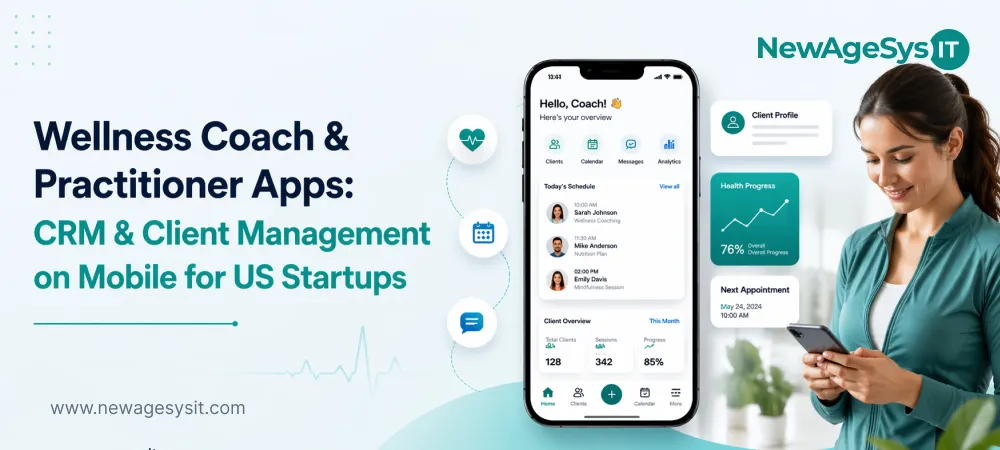
Wellness 6 min read
Wellness Coach & Practitioner Apps: CRM & Client Management on Mobile for US Startups

| This article is part of our series on Wellness Mobile Apps in the USA: Building Smarter Health & Self-Care Experiences |
US wellness coaches managing 20 to 60 online clients can no longer run their practices through scattered tools and manual workflows. Wellness program delivery, client check-ins, progress monitoring, session scheduling, and secure communication now demand dedicated mobile platforms built for practitioner workflows. A wellness coach app is becoming a practical foundation for managing client relationships at scale.
As wellness coaching expands across online and hybrid models, practitioners need more than generic software to support structured programs and growing client demands. Platforms supported by custom wellness app development is becoming essential.
Generic CRMs are not designed for structured wellness programs, intake forms, or ongoing progress tracking. For practitioners operating in health-adjacent contexts, HIPAA-compliant communication and data handling may also become necessary, depending on their services.
Practitioners building client-facing tools alongside their coaching platform are working within a broader US wellness app ecosystem where user expectations for mobile-first experiences, habit tracking, and seamless content delivery are increasingly set by consumer wellness apps
Client Management and CRM Features for US Wellness Practitioners
A well-designed wellness practitioner app becomes the central system for managing every client interaction. For US wellness businesses, effective wellness coach client management starts with a structured client profile that captures goals, health history, dietary preferences, intake responses, and ongoing progress notes. This gives practitioners the full context needed to design and adjust personalized programs.
Client data must be stored securely with role-based access and audit tracking, especially when services fall under healthcare and require HIPAA-aware handling. Digital intake forms completed before the first session ensure practitioners begin with accurate baseline information, while a unified communication history keeps messages, check-ins, and updates organized in one place.
Strong CRM capabilities also help identify at-risk clients by flagging missed check-ins or declining engagement. This allows practitioners to intervene early and improve retention. These capabilities are typically powered by dedicated wellness software and CRM systems. The wellness tracking elements within these systems also overlap with consumer-facing feature expectations, as explored in Must-Have Features in Modern US Wellness Mobile Apps.
Wellness Program Creation and Delivery
A modern health coach mobile app helps practitioners create and deliver structured programs with guided sessions and progress tracking. As a wellness coaching practice scales, the most effective platforms move beyond static programs toward AI-driven health plan personalisation and habit nudges that adapt to each client’s behaviour between sessions reducing the manual adjustment burden on the practitioner.
Wellness Protocol Builder
Practitioners can create structured multi week programs such as stress reduction or sleep improvement with clear daily and weekly tasks. They can also add guided meditations, breathwork, yoga, and educational content to deliver personalized and consistent client experiences.
Program Assignment and Scheduling
Practitioners can assign personalized programs to individual clients with clear start dates, daily routines, and regular check-ins. The same system also supports group program delivery, allowing coaches to manage cohorts efficiently while maintaining consistent structure and client engagement.
Client-Side Program Experience
Clients see daily practices with clear prompts, easy access to guided content, and space for reflections within the app. Practitioners can track completions, missed activities, and client notes in real time, creating stronger accountability and consistent engagement.
Check-In and Progress Monitoring Features
Effective progress tracking in a wellness CRM mobile system helps practitioners stay connected to each client’s progress between sessions. Automated weekly check-in forms collect inputs such as sleep quality, stress levels, mood, digestion, and program adherence. This allows practitioners to adjust protocols based on real client data.
Wellness apps track measurable changes like energy levels, symptom trends, and consistency of daily practices, helping practitioners identify what is working and what needs to change. Secure progress photo uploads support visual tracking when relevant, with proper client consent.
Connecting client Apple Health or Google Health Connect data to the practitioner view can provide deeper insights into sleep, activity, and recovery patterns, enabling more data-informed coaching adjustments between sessions. For iOS-first wellness coaching platforms, custom iOS app development with HealthKit integration brings this data directly into the practitioner dashboard without requiring clients to manually export records.
Session notes remain linked to each client profile, creating a continuous record that supports more accurate program adjustments and long term client outcomes.
Scheduling, Communication, and Business Management
A well-structured holistic health coach app allows practitioners to manage scheduling without manual coordination. Clients can check live availability and schedule sessions using preset time slots, whether for in-person visits or virtual appointments that include auto-generated meeting links. This reduces back-and-forth communication and minimizes missed or double bookings.
Secure messaging keeps client communication within a protected environment, supporting text, documents, and progress updates. For health-adjacent practitioners, this often means HIPAA-aware communication with end-to-end encryption, rather than relying on consumer messaging tools where sensitive health information may not be adequately protected. Building this correctly requires custom mobile app development with HIPAA-aware architecture, not a generic messaging module added to an off-the-shelf platform.
Billing systems are built to support how wellness businesses actually operate. Practitioners can offer monthly coaching subscriptions, bundled session packages, or one-time program purchases, with automated payment collection and alerts for failed transactions.
Digital consent forms and service agreements can also be delivered, signed, and stored within the platform, supported by ESIGN and UETA-compliant electronic signature architecture that helps ensure enforceability and proper documentation.
For a growing US wellness pro app, built-in reporting provides clear visibility into monthly recurring revenue, active client count, program completion rates, and session utilization. These metrics help practitioners adjust pricing, manage capacity, and identify which services are driving consistent revenue.
Build vs Buy for US Wellness Practitioner Apps
Wellness practitioners in the USA often begin with off-the-shelf platforms such as Practice Better ($25–$89/month), Healthie ($69–$199/month), and Nudge Coach ($79–$299/month). These tools work well for standard coaching workflows like session scheduling, basic program delivery, and managing a limited client base without upfront development costs.
Building a custom app becomes necessary when the business model is more complex. Multi-practitioner clinics, hybrid in-person and digital services, or structured multi-week programs often require workflows that generic platforms cannot support. Custom development allows full control over program delivery, client experience, and operational processes. This is where custom software development delivers the flexibility that subscription platforms fundamentally cannot full ownership of the product architecture, client data flows, and feature roadmap
White-label solutions provide a faster alternative with basic branding, but they still restrict deeper feature customization and long-term scalability. The core decision comes down to differentiation. A custom wellness practitioner app becomes a business asset that supports growth and brand identity, while a subscription platform remains a functional tool with predefined limits.
Final Thoughts
US wellness coaches running structured client programs increasingly need a single platform that connects program delivery, check-ins, scheduling, and billing. Practitioners investing in purpose-built mobile tools are often able to deliver more consistent programs, maintain stronger client accountability, and manage more clients without operational strain.
Practitioners using purpose-built solutions are able to track client progress more accurately, follow up on missed check-ins, and maintain structured program delivery. This leads to stronger client accountability, better program adherence, and the ability to manage a higher number of active clients without operational breakdowns.
If your wellness coaching practice or holistic health clinic is evaluating mobile tools, working with an ai software and app development company or emerging technology partner to build or select a platform designed specifically for wellness program delivery and client management will consistently outperform adapting generic business software.
Core Development
Keep exploring the custom services.

AI Software Development
Custom AI Software Development
Build intelligent, production-ready software from machine-learning models to AI-driven automation designed around your business goals.
Learn more
Mobile App Development
Custom Mobile Application Development
Native and cross-platform mobile apps that are fast, secure, and built to scale across iOS and Android.
Learn more
Web App Development
Custom Web Application Development
Scalable, secure web applications, from customer portals to complex dashboards, tailored to how your business actually works.
Learn more



