
Welcome to Blogs
Discover actionable insights, in-depth research, and expert perspectives, all in one place.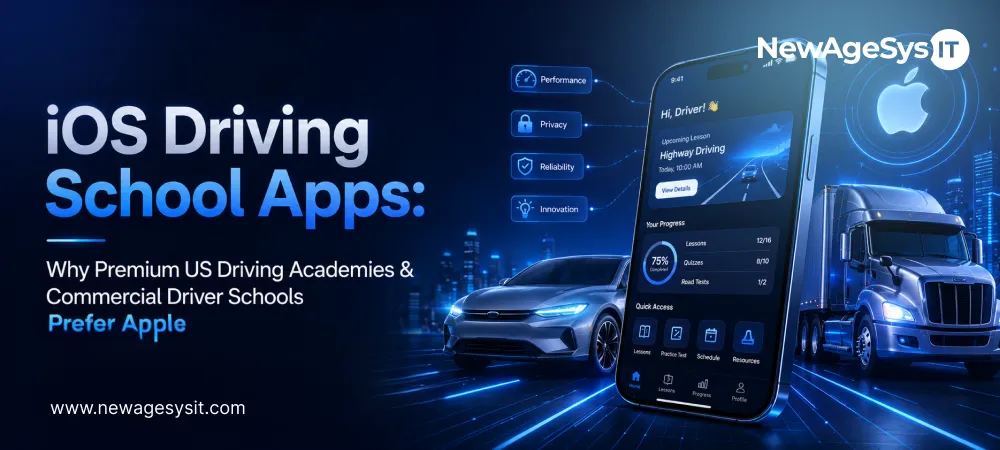
App Development 8 min read
iOS Driving School Apps: Why Premium US Driving Academies & Commercial Driver Schools Prefer Apple

| This article is part of our series on Android vs iOS for Driving School & CDL Apps in the USA: Choosing the Right Platform |
Building an iOS driving school app USA premium academies and teen-focused schools deploy starts with demographics. US teen driving students are predominantly iPhone users. This is the highest-volume customer segment for standard driving school enrollment. Premium driving academies serving affluent communities in major metros serve families that are overwhelmingly iOS.
App Store education app revenue data reinforces the platform case. iOS users show higher subscription conversion and longer retention in education categories. Premium driving school features like AI readiness scoring and personalized lesson plans monetize better on iOS than on Android.
Driving school mobile and web app development services built for iOS align with this demographic reality. Custom CDL software and CRM development services that include iOS instructor apps serve the premium commercial driver school segment, where career-transition candidates invest $5,000–$10,000+ in training.
An iPhone driving school app built for the right demographic converts more students and generates higher per-user revenue. This article covers the iOS demographic advantage, technical strengths, use cases, App Store compliance, and when iOS-first is the right platform strategy for US driving schools.
The iOS Demographic Advantage for Driving Schools
iOS dominance in the driving school market is not a general platform preference claim. It is specific to the demographics that driving schools actually serve.
1. Teen driver demographics: US students ages 15-18 pursuing first-time licenses are predominantly iOS users. The income correlation with iPhone ownership is strong among families paying for driving school enrollment. A driving school app that launches Android-only misses the majority of its teen student base. This is the segment that drives enrollment volume for standard driving schools.
2. Premium driving academy clients: Families paying $800-$2,000+ for a premium driving education package are overwhelmingly iOS users. In affluent metro communities where these academies operate, iPhone penetration exceeds 80% among the target demographic. The premium driving academy iOS app development experience must match the premium price point
3. Driving school app revenue: iOS users in the driving school category generate higher in-app purchase conversion. Subscription retention is longer on iOS for education apps. Premium BTW progress features and AI readiness tools produce more revenue per user on iOS than equivalent Android deployments.
4. Parent communications via app: Parents of teen driving students are typically the decision-makers for school selection. They are also predominantly iOS users. Through web application development, parent portal notifications and progress updates reach parents more reliably on iOS. Higher push notification open rates mean parents actually see the updates.
5. CDL commercial driver school premium tier: Commercial driving schools offering premium CDL training packages serve career-transition students. These candidates invest $5,000–$10,000+ in training. This demographic is more iOS-oriented than budget CDL programs serving working truckers. An iOS CDL training app captures the premium CDL segment effectively.
However, CDL programs must never launch iOS-only. CDL candidate demographics require both platforms including android app development for full enrollment coverage.
iOS Technical Advantages for Driving School Apps
iOS provides three technical advantages that matter specifically for driving school app functionality. Each advantage translates directly into better compliance logging, higher notification engagement, or stronger App Store visibility.
GPS precision for BTW route logging
The iOS CoreLocation framework provides high-precision GPS with reliable background operation. BTW route logging remains accurate throughout sessions, including in urban environments where signal quality affects compliance record quality.
iOS significant location changes keep background location updates active even when the app is not in the foreground. This is essential for BTW route logging across long training sessions. An iOS custom mobile app development driving instructor app does not lose GPS data when the instructor switches to another app briefly during a session
The GPS precision difference between iOS and Android is typically negligible for compliance purposes. But iOS consistency across device models is higher. Apple controls both hardware and software. Every iPhone running the same iOS version produces the same GPS behavior. Android’s hardware fragmentation creates more variability across device models.
Face ID for instructor sign-off
Face ID biometric authentication provides the device-level verification that makes a digital instructor’s sign-off legally defensible. The instructor completes a BTW session and confirms with Face ID. The record locks immediately. No post-session modification is possible.
iOS Keychain stores signed session records with hardware-backed protection. This supports BTW log immutability. The combination of Face ID sign-off and Keychain storage produces compliance records that hold up under legal scrutiny.
BTW session logs are legal compliance documents on all platforms. Immutability and instructor sign-off are required regardless of whether the app runs on iOS or Android. iOS Face ID provides one implementation path. Android biometric authentication provides an equivalent alternative.
App store education category
iOS App Store education category visibility benefits driving school and CDL test prep apps. The driving test prep search category receives significant organic traffic from students and parents actively searching for driving education resources.
App Store parental controls integration matters for minor student driving apps. iOS Screen Time and parental controls give parents additional oversight of their teens’ app usage. For driving schools serving students under 17, App Store compliance with minor user rules is a requirement, not an option.
Push notification open rates on iOS are consistently higher than Android in education categories. BTW reminder notifications and road test readiness alerts reach more students. For schools where no-shows cost instructor time and revenue, this engagement difference is operationally meaningful.
For a comparison with Android advantages, see Android Driving School Apps: Benefits for Large-Scale US CDL Training Centers & Budget-Friendly Programs.
iOS Driving School App Use Cases
Five use cases define where iOS-first delivers the strongest results for US driving schools. Each use case connects to a specific demographic or operational advantage.
- Teen driver student app: This is the core enrollment demographic. iOS-first maximizes reach for students ages 15–18. Lesson booking, progress tracking, knowledge test prep, and BTW session summaries all serve the teen user on their primary device.
- Premium driving academy mobile experience: A fully branded iOS app with AI readiness scoring, personalized lesson plan access, and premium content creates the experience that justifies $800–$2,000 package pricing. The Apple driving school platform experience reinforces the academy’s premium positioning.
- Instructor’s professional tools: An iOS-native instructor app delivering reliable GPS route logging, Face ID session sign-off, and push notification management. Instructors using iPhones get a purpose-built tool that integrates with the device’s native capabilities.
- Parent progress portal: iOS parent portal with push notification updates on teen student progress. The communication tool that reduces parental phone calls to the front desk. Parents see real-time lesson completion, BTW hour totals, and road test readiness scores.
- CDL premium test prep subscription: An iOS commercial driver app targeting career-transition CDL candidates investing in their commercial license. This segment shows a higher willingness to pay for premium content. iOS monetization aligns with that willingness.
A custom mobile app built for these use cases must account for both the student-facing and instructor-facing requirements. The student app and the instructor app may share a backend but require different iOS interfaces.
App Store Compliance for Driving School Apps on iOS
App Store review adds compliance requirements that driving school apps must address before submission. Five areas receive scrutiny during the review process.
1. Student data privacy: Driving school apps collecting student training records and personal information are reviewed for privacy policy completeness. Data handling disclosures must be accurate and specific. Vague privacy policies trigger review rejection.
2. FERPA disclosure: Apps for driving schools subject to FERPA should disclose student record handling in their privacy policy. App Store reviewers check privacy policy completeness for education apps. Missing FERPA disclosure for qualifying schools creates review risk.
3. Minor student apps: Driving school apps serving student users under 17 are reviewed under App Store rules for apps serving minors. Parental consent mechanisms and age-appropriate content are required. Apps that collect location data from minor users face additional scrutiny.
4. Location data usage: BTW GPS logging apps must clearly disclose the location data collection purpose and retention in the privacy policy. “We collect your location” is insufficient. The disclosure must explain why (BTW route logging), how long the data is retained, and who has access.
5. CDL test prep content accuracy: App Store review for educational apps includes checking that content claims are substantiated. CDL prep apps should not claim guaranteed pass rates without evidence. Custom software development teams building CDL test prep apps must ensure content accuracy claims are defensible.
When iOS-First Is the Right Driving School App Strategy
iOS-first is the right starting point for specific school types. But iOS-only is never appropriate for CDL programs.
- Choose iOS-first for standard teen driving schools with affluent metro demographics: The enrollment demographic is predominantly iOS. Starting on iOS captures the majority of prospective students immediately.
- Choose iOS-first for premium driving academies with $800-$2,000+ packages: A branded mobile experience is a differentiator at this price point. iOS design standards and App Store positioning reinforce premium perception.
- Plan Android within 12-18 months regardless of iOS-first launch: Even teen-focused driving schools need Android for full market reach. Adult students and lower-income demographics require Android coverage. An iOS-first launch captures the primary demographic. An Android follow-up captures the rest.
- Never iOS-only for CDL programs: CDL candidate demographics require Android coverage. An iOS-only CDL training app excludes a significant portion of the candidate population. This is a demographic reality, not a platform preference. CDL programs must support both platforms or lose enrollment.
Finding a development partner is covered in Choosing the Right Driving School & CDL App Partner in the United States.
Final Thoughts
iOS is the strategic first choice for premium US driving academies and standard teen-focused driving schools. Demographic match, GPS precision through CoreLocation, and Face ID instructor sign-off align with the primary customer profile. App Store education category visibility reinforces the advantage.
US driving schools and premium academies that build iOS-first with precise GPS logging, biometric instructor sign-off, and parent portal notifications create the platform experience their core demographic expects. The teen driver market is iOS-dominant. The premium academy market is iOS-dominant. Building for those demographics first is not a preference. It is a strategy.
If your driving academy or standard driving school targets teen drivers, premium family demographics, or branded mobile experience as a differentiator, iOS-first delivers the platform advantages your primary student demographic expects. NewAgeSysIT, an AI software company, builds iOS driving school apps with GPS compliance logging and instructor biometric sign-off engineered for the App Store from day one.
Core Development
Keep exploring the custom services.

AI Software Development
Custom AI Software Development
Build intelligent, production-ready software from machine-learning models to AI-driven automation designed around your business goals.
Learn more
Mobile App Development
Custom Mobile Application Development
Native and cross-platform mobile apps that are fast, secure, and built to scale across iOS and Android.
Learn more
Web App Development
Custom Web Application Development
Scalable, secure web applications, from customer portals to complex dashboards, tailored to how your business actually works.
Learn more



