
Welcome to Blogs
Discover actionable insights, in-depth research, and expert perspectives, all in one place.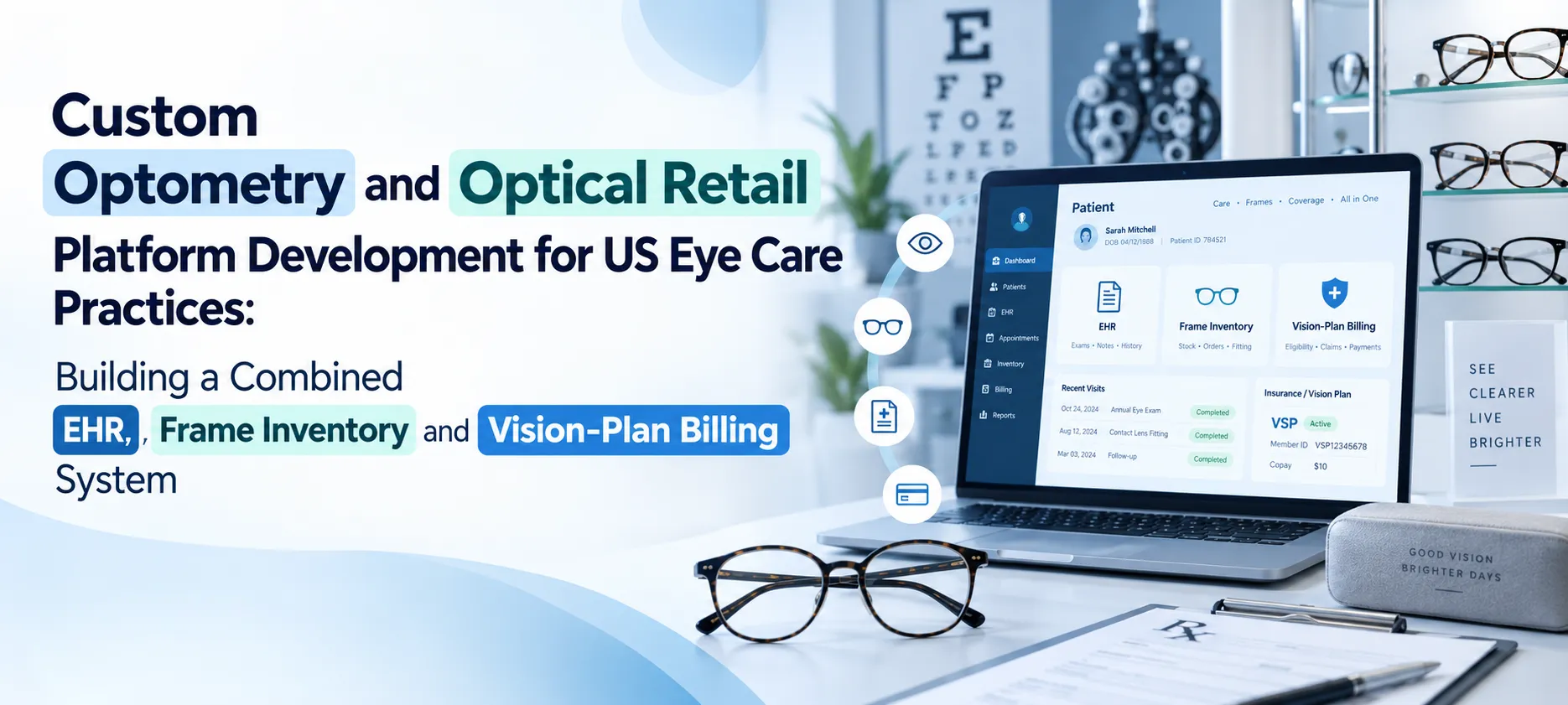
Custom Software Development 15 min read
Custom Optometry and Optical Retail Platform Development for US Eye Care Practices: Building a Combined EHR, Frame Inventory and Vision-Plan Billing System

An Optometry Practice Is Two Businesses Sharing One Patient
An optometry practice runs two businesses under one roof. One side is a healthcare clinic that includes a patient record, an exam workflow, diagnostic imaging, medical diagnoses, and medical claims. The other is a retail store and has a frame inventory, sales staff, suppliers, a point of sale, and a lab that makes the product.
These two units share a patient, a building, and almost nothing else. This is exactly why custom optometry practice management software has to serve both sides at once, instead of bolting one onto the other.
Software tends to fail right at that seam. Clinical systems handle the exam well and treat the optical as an afterthought. At the same time, retail systems track inventory well though they know nothing about a prescription or a payer.
As such, optometry practices and eye care groups end up running two products, trying to keep them in sync manually, and losing margin in the gap.
The gap costs real money in the form of exams billed as routine when they should have gone to medical insurance. Also, patient responsibility may be quoted wrong at the frame board, lab orders may come back as remakes, and some patients may never get recalled.
Closing this gap usually calls for optometry software development that treats the exam room and the dispensary as one system instead of two. Where patients need to see their own records and benefits, that means real patient portal development, not a login screen tagged onto the side.
This guide covers effective optometry platform development to make the job easier for eye care businesses. It covers the entire software structure, including the clinical side, the optical side, the billing seam, device integration, compliance, and cost by stage. Practices deciding which of those pieces belongs in a first release will find the shortlist in Optometry Software Features in 2026: What a US Eye Care Practice and Optical Dispensary Actually Needs in the First Release.
The Clinical Side: Scheduling, Exam Workflow, and the Prescription
The development starts with the clinical half. This is because everything downstream traces back to what happens in the exam room. These include the prescription, the billing code, and the recall.
Scheduling: For any eye care practice, deciding the routine for clinical tasks has many more constraints than it seems. Here are the various constraints for each task that practice owners and eye care group operators need to consider:
- Every type of appointment is of a different duration and needs different equipment
- Eye examination lanes and pretesting rooms are separate resources
- Availability times for technicians and doctors
- Wait times for dilation, during which patients occupy a chair without occupying a lane
- Series of visits for contact lens fittings and follow-ups
Exam Workflow: Once optometrists examine a patient, the records should include the following:
- Main complaint and patient history
- Findings of entrance testing sessions
- Refraction test reports
- Slit lamp and posterior segment findings
- Intraocular pressure
- Imaging
- An overall assessment
- A treatment plan
Also, the templates for these reports will differ based on the type of appointment. It may be a routine comprehensive test, a medical follow-up for diabetic retinopathy or glaucoma, or a contact lens fitting.
When patients are given the prescription, clinical work doubles up as a retail transaction and a legal obligation. Optometrists need to hand over an eyeglass prescription to the patient immediately after the examination is complete. As for the contact lens prescription, it needs to be released after the lens fitting.
Eye care organizations and clinics must release both these prescriptions as per the Federal Trade Commission (FTC) rules. This regulation applies regardless of whether the patient asks for the prescriptions.
These multiple functions that are part of the clinical side make prescription release a critical platform feature rather than just a plain front-desk activity.
The prescriptions are generated automatically, given to the patient in a documented way, and the organization keeps a record of them. In case of a contact lens, the rule is stricter, as the practice needs to obtain and retain confirmation that the patient received the prescription.
Coding for the platform runs parallel to this clinical procedure. The decision about whether a patient has arrived for a routine checkup or a medical visit for an issue is made during examination and at the billing desk.
The Optical Side: Frame Inventory, Dispensing, and the Lab Order
Once the exam ends, the prescription makes its way through the exam room door and into a completely different set of problems. The focus shifts to frames, pricing, and a lab order that should come back right the first time.
Frame inventory: This is the retail inventory for an optometry clinic or eye care organization that is maintained with optical specifics.
Every frame has a UPC, a brand and model, a color, and eye-bridge-temple measurements. Also, The Frames Data catalog service is a service under subscription that’s part of the inventory. These are designed so that dispensaries don’t need to record the technical information manually. Over time, the frame selection on the display boards may change, and some models may be discontinued.
Added to this, a large share of stock may sit on consignment or memo from the vendor rather than being owned outright. Most general retail systems cannot represent such updates.
Configuration rather than stocking: On digital optometry platforms, lens types are divided into categories based on their price.
Notably, the price for each type is the result of combining its different features. These include material, design, index, tints, coatings, and add-ons. Thus, this pricing engine is very different from that of a product catalog that simply lists the lens stock.
Dispensing: This function fetches the measurements that the lab needs to produce spectacles and lenses. These include the pupillary distance, vertex distance, segment or optical center heights, and pantoscopic tilt.
Many dispensaries pull a frame and lens details onto a tablet right at the frame board. The store staff then scans a UPC using tools built through custom mobile app development rather than typing the details of the specs by hand.
A wrong or missing measurement is one of the most common reasons behind a remake. The practice has to pay for such issues both in terms of the cost and the confidence of patients.
The lab order: The lab order has the details of the frame, the lens configuration, a frame trace, and the measurements of the spectacles. In this stage, an optometry organization has to work with the OMA interchange standard for the data it receives, and the supported fields vary by lab and device. The OMA data communication format by the Vision Council is how data is exchanged between practice systems, labs, and tracers and edgers.
Finally, the optical side of the operations has to be tracked for all stages. These include sending the order, production, receipt, inspection, notifying the patient, and dispensing. Without proper tracking, a pair of glasses that wasn’t called for by the practice is a service failure that the practice has to pay for twice.
The Seam: Where the Exam Becomes a Sale
An optical floor is not far in distance from the eye examination room, but a lot can go wrong in this short gap. Each of these failure modes is absorbed as a write-off, a remake, or a patient who does not return.
Optometrists may find something medically significant during an eye examination but it might get billed as a visit for a vision-plan. In such cases, the practice loses out on the cost and the visit is recorded wrongly.
When a prescription is released without the patient being walked to the optical it amounts to a loss in the capture rate.
A frame chosen before checking a patient’s remaining plan benefit can cause the patient-responsibility quote to change after the fact. This is one of the most reliable ways to turn a satisfied patient into a complainant.
When optical retail business owners submit a lab order without the required measurement, a remake order often follows. Also, a lens job that is received but isn’t inspected results in an unhappy patient.
An eye examination that ends without any advice on follow-up visits may lead to patients not returning for the next two years. These possibilities are neither retail nor clinical failures. These are failures in keeping the two sections of an eye care organization in sync. As such, software that sees just one side of the business can’t detect them.
In a platform that combines both these components, the findings from an eye exam drive the billing route. This route refers to whether the encounter goes to medical or to the vision plan.
Prescriptions flow into dispensing screens, the system checks and considers benefits before the frame choice, and measurements are verified before lab orders. The follow-up visit is set right at the time of the eye examination.
Vision Plans and Medical Insurance: The Dual Billing Problem
This part is unique to optometry software among all medical practice verticals. Two separate systems of payment apply to the same patient for a single visit.
Medical insurance covers the cost of medical treatments, such as glaucoma management, dry eye, diabetic retinopathy, and removal of foreign bodies. It is billed based on the standard machinery for US healthcare. The billing mechanisms included in the standard machinery are X12 270/271 eligibility, clearinghouses, 837P claims, denial management and remittance.
On the other hand, vision plans include routine materials and exams, and work on an entirely different model. These plans include:
- Benefit allowances instead of fee schedules
- Exam frequency rules that reset at regular intervals
- Allowances on frames with a discount percentage on the coverage
- Lens coverage by type
- Separate lens allowances
Many vision plans work through their own portals and exclusive interfaces rather than standard EDI, though some plans accept standard claims. Hence, the integration of a vision plan into an optometry software will depend on the specific plan rather than following a universal method of connection.
The routing decision, that is, whether it will be a routine or will be based on the medical examination, is a coding and clinical judgement. It is decided in the exam room, and is the largest variable that decides the revenue for most eye care practices.
At the optical counter, the calculation of real-time benefit pays for itself. It is important to determine the total amount that a patient owes, which includes their remaining benefits and the lens and frame configuration. When this number is available before the sale of the eyewear, it keeps away disputes and write-offs.
The feature that pays for itself is real-time benefit calculation at the optical counter. Given this plan, it calculates what the patient owes given the patient’s remaining benefit, the frame and the lens configuration. Getting that number right before the sale is what prevents the write-offs and disputes that follow getting it wrong.
Eyefinity, a major optometry practice management and EHR provider, owned by the vision plan VSP.
Device Integration: Refraction Lanes, Imaging, and DICOM
An eye examination room is full of equipment that needs to have support for data storage. Without the integration, results generated by lane equipment get retyped by hand. The instruments used in the exam room include autorefractors, digital phoropters, tonometers, lensmeters, corneal topographers, OCT systems, visual field analyzers, and fundus cameras.
Device integration for the software has two aspects to it. While one side is standardized, the other is not. Stating this difference clearly makes a build plan for the software credible.
Imaging equipment: Integrating such equipment follows a shared standard. DICOM is the accepted format for ophthalmic imaging, including OCT and fundus photos. A platform that understands DICOM can pull in the studies automatically. It can then link each study to the correct patient and eye care visit. It can then display the study alongside the rest of the exam findings.
Refraction equipment: Integration doesn’t have a common standard in this case. Autorefractors, lensmeters, and phoropters often use network or serial protocols by specific manufacturers. These manufacturers have their own data management layer instead of an open interface. Thus, the connectivity for each device needs to be evaluated individually, by the model and manufacturer.
This split has a direct impact on planning: Optometry practice and eye care group owners should budget imaging integration as standards-based work. Refraction lane integration should be budgeted on a per-device basis. Also, someone must audit the actual equipment on the floor before estimating the project. That device layer, alongside lab ordering, eligibility checks and frame catalog sync, is examined connection by connection in VisionWeb Lab Ordering, Vision Plan Eligibility Checks, Frame UPC Inventory Sync and Digital Refraction Device Integration for a Custom US Optometry Platform.
A practice that runs three lanes of equipment from a single manufacturer is a simpler build. A practice with mixed equipment accumulated over fifteen years needs a different integration approach.
Compliance: FTC Prescription Rules, HIPAA, and State Boards
Optometry has more compliance requirements than most practice software discussions admit. Two of these rules are unusual. They require handing something directly to the patient.
The FTC Eyeglass Rule: It requires practices to give patients a copy of their eyeglass prescription right after the exam. This is free and automatic, and no request is needed. Practices should not make it a must for patients to buy eyewear there.
The latest amendment to the Eyeglass Rule came into effect on September 24, 2024. It states that prescribers with a financial interest in eyewear sales must also obtain the patient’s signed or digital confirmation of prescription receipt. They must also retain that record for at least three years. An additional binding as per this rule is that practices cannot require the patient to sign a waiver or release as a condition of getting the prescription.
Contact Lens Rule and FCLCA: As per these rules, practice owners and eye care groups need to release the prescription at the end of a lens fitting. Practices must obtain and retain confirmation that the patient received the prescription for at least three years. They must also respond to verification requests from sellers. If no response arrives within eight business hours, sellers may proceed under passive verification.
These are platform requirements and not policies that are merely posted on a wall. The system must automatically generate prescriptions and document delivery. It is also essential to retain confirmation and handle verification requests without manual checking. Each of those obligations, and the record-keeping the software has to perform to satisfy it, is detailed in FTC Eyeglass Rule, Contact Lens Rule and FCLCA Prescription Release, HIPAA and State Optometry Board Rules Compliance for US Optical Retail Software.
HIPAA: This regulation applies fully to an optometry practice since it is a covered entity under the law. A hosted platform vendor is generally a business associate requiring a signed BAA.
State optometry boards regulate scope of practice, testing, dispensing, and record retention. They also govern prescription expiration and remote refraction rules. These vary by state, so build them as adjustable settings, not fixed assumptions.
The above content is educational and strategic and must not be taken as legal or regulatory advice. The advice of a qualified healthcare regulatory counsel and the relevant state optometry board is recommended.
The Certification Question: Do You Actually Need to Build an EHR?
One question decides the true size of an optometry software development project before any estimate is made. The availability of an ONCT/ASP certification determines whether the build stays a lean optical and billing system or expands into a multi-year regulated software program.
Practices in Medicare quality programs may need an ONCT/ASP certification. Information blocking rules also apply broadly to health care providers. Certification is not a simple feature. It is a separate program with its own criteria, testing, and ongoing oversight. Its cost can rival the rest of the build.
Many practices overlook one option, though it is often the right answer. Keep a certified EHR for clinical records. Build a custom system for optical, dispensing, inventory, and vision-plan benefits. Connect both through integration.
The clinical record is the most regulated and most standardized part of the system. Mature, certified products already exist for it. The optical and benefits side is where practices differ most. Existing products are weakest there, so custom development adds real value.
A practice that builds only the underserved optical and benefits half gains most of the value. It does so at a fraction of the cost and regulatory exposure.
Cost and the Staged Build Sequence
After settling the certification questions, optometry practice owners and eye care groups need to focus on the cost figures. The four stages build on each other, which is why sequencing affects both the budget and how soon the practice sees a return. The team size and timeline behind each of those stages is broken out in Budgeting a Custom Optometry and Optical Retail Platform: Team Size, Timeline and Total Build Cost for US Eye Care Practices.
Stage 1 is the clinical core. It covers patient records, scheduling with lane and resource limits, exam documentation, and compliant prescription release. The cost at this stage is roughly $100K–$185K over 5–7 months.
Stage 2, which involves the optical retail side, works through the frame and lens inventory, catalog sync, point of sale, and dispensing measurements. It also covers lab ordering and job tracking. This stage adds roughly $70K–$135K over 4–6 months.
The third stage includes the dual billing part, with vision-plan eligibility and real-time benefit calculation. It also covers medical eligibility, claims, and remittance through a clearinghouse. The costs involved are roughly $65K–$125K over 4–5 months. Most estimates underprice this stage.
The last stage has device integration, the patient portal, and the recall engine. It adds roughly $50K–$100K over 3–5 months. A full four-stage platform costs about $285K–$545K over 16–23 months.
Certified health IT, if required, needs to be counted outside these figures. It carries its own cost, timeline, and ongoing obligations. It is best to settle the certification question before building a budget. The numbers discussed above are rough planning estimates for 2026 and not official price quotes.
Final Thoughts
US practices that treat their software as one platform spanning two businesses close the seam where most eye care organizations tend to lose margin. That means routing the billing decision from the exam room, calculating patient responsibility before the frame is chosen, and validating the lab order before it goes out. Also, prescription releases are automatic and documented, and certification questions are settled before scoping anything.
None of this happens by accident, and it rarely happens inside off-the-shelf software built for one side of the business. It takes a platform designed around the seam. If you’re evaluating a custom optometry platform, settle certification first, then map the seam, billing routes, and lane equipment as one plan. Practices weighing a packaged product against a custom build should start with Off the Shelf vs Custom for US Optometry Practice Owners and Optical Retailers: Where a Technology Consultant Protects the Budget. Learn more about digital transformation solutions from one of the leading AI software companies in the United States.
Core Development
Keep exploring the custom services.

AI Software Development
Custom AI Software Development
Build intelligent, production-ready software from machine-learning models to AI-driven automation designed around your business goals.
Learn more
Mobile App Development
Custom Mobile Application Development
Native and cross-platform mobile apps that are fast, secure, and built to scale across iOS and Android.
Learn more
Web App Development
Custom Web Application Development
Scalable, secure web applications, from customer portals to complex dashboards, tailored to how your business actually works.
Learn more



