
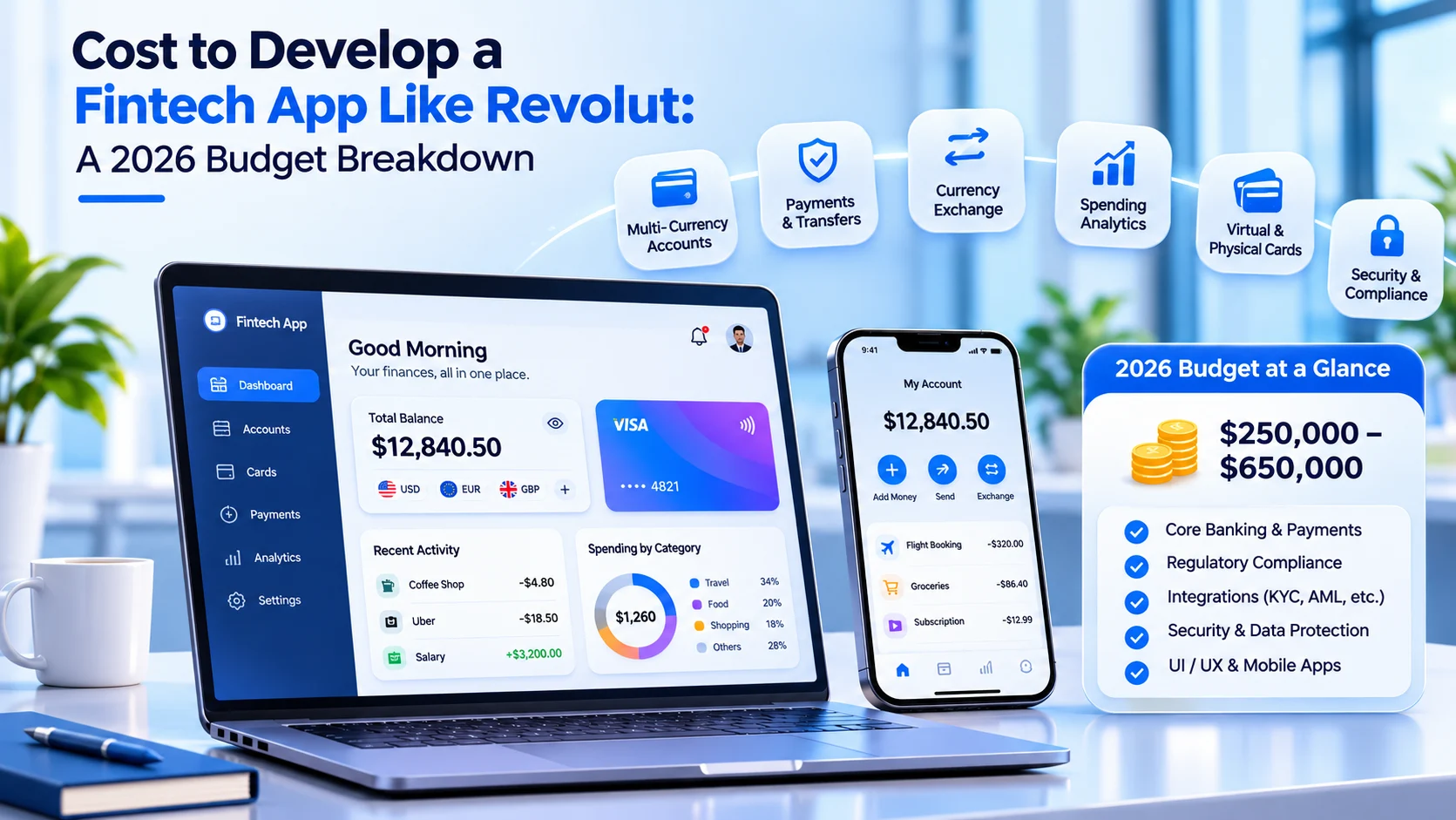

- A fintech app like Revolut starts with a first version: accounts, a card, and transfers for about $50,000 to $150,000 with a US agency, or $20,000 to $73,500 at NewAgeSysIT rates, shipping in 3 to 6 months.
- A full multi-product neobank app runs $150,000 to $350,000, and a true Revolut-style super app is $350,000 to $1 million or more spread across years, not a single project.
- Engineering is often the smaller half of the budget. Licensing, partner banks, card programs, identity checks, and compliance staff can match or exceed the build.
- Money transmitter licensing alone runs roughly $250,000 to $350,000 in fixed fees and bonds for nationwide coverage, before legal costs, and takes 3 to 18 months per state.
- Revolut itself is the reason to be realistic: more than 70 million customers, around $6 billion in 2025 revenue, a $75 billion valuation, and a US national bank charter application filed in March 2026.
- The cheapest route to market is partner-first: launch one core flow through a sponsor bank or banking-as-a-service provider, prove demand, then buy independence later.
Quick answer: How much does it cost to develop a fintech app like Revolut? Budget $50,000 to $150,000 for an MVP with onboarding, a card, and transfers, $150,000 to $350,000 for a multi-feature neobank app, and $350,000 or more for a multi-product platform across several markets. At NewAgeSysIT's rates of $25 to $49 per hour, those tiers run about $20,000 to $73,500, $37,500 to $171,500, and $87,500 or more. Licensing, partner fees, and compliance costs sit on top of all of them.
"Build me something like Revolut" is one of the most common briefs in fintech, and one of the most misunderstood. The app you see on a phone is the visible part of a company holding licenses in dozens of markets, running its own ledger, and employing hundreds of people in compliance.
This guide separates the two. It covers what the software actually costs, feature by feature, what the non-engineering costs look like in the US, and how to sequence a build so the first version is affordable. It reflects how we scope custom mobile app development for fintech clients, where the first conversation is always about which single money flow to launch with.
What You Would Actually Be Copying
Revolut passed 70 million retail customers in January 2026, reported about $6 billion in revenue for 2025 (up 46% year over year), and was valued at $75 billion in a secondary share sale in November 2025. It received a full UK banking licence and, in March 2026, filed with the OCC and FDIC for a US national bank charter under the name Revolut Bank US, N.A., with $500 million earmarked for the US push and more than a million US customers already on the platform.
That scale matters for budgeting in two ways. First, the product you see today is the result of a decade of layered releases, not one build. Second, the expensive parts are the parts users never see: the ledger, the risk engine, the compliance operation, and the licenses.
So the honest version of the question is not "what does a Revolut clone cost?" It is "what is the smallest version of this that can launch legally, earn trust, and grow?" Every realistic budget starts there.
The Short Answer: Three Budget Tiers
| Product stage | What it includes | Typical US agency cost | NewAgeSysIT effort | NewAgeSysIT estimate | Timeline |
|---|---|---|---|---|---|
| Fintech MVP | Onboarding with identity checks, one account type, a card through a partner, transfers, basic support | $50,000 to $150,000 | 800 to 1,500 hours | $20,000 to $73,500 | 3 to 6 months |
| Multi-feature neobank app | Multiple payment rails, multi-currency, savings, budgeting, admin console, fraud controls | $150,000 to $350,000 | 1,500 to 3,500 hours | $37,500 to $171,500 | 6 to 12 months |
| Revolut-style platform | Several product lines, business accounts, investing, multiple markets, deep risk and reporting | $350,000 to $1,000,000+ | 3,500 to 7,000+ hours | $87,500 to $343,000+ | 12 to 24 months, then continuous |
These ranges cover software only. Licensing, partner fees, and ongoing operations are separate, and the next section covers them.
The back-office side belongs in the budget too. Operations, support, risk review, and reconciliation all run in a browser, so custom web application development for the admin console is usually 15% to 25% of the engineering effort on a fintech build and is the piece founders most often forget to scope.
Cost by Feature
Here is where the hours go, estimated at NewAgeSysIT's rates of $25 to $49 per hour. Add design, testing, and project management on top.
| Feature | Approximate hours | NewAgeSysIT cost |
|---|---|---|
| Onboarding with identity verification and document checks | 120 to 280 | $3,000 to $13,720 |
| Core accounts and ledger | 200 to 500 | $5,000 to $24,500 |
| Card issuing integration, virtual and physical | 120 to 300 | $3,000 to $14,700 |
| Peer-to-peer transfers between users | 80 to 180 | $2,000 to $8,820 |
| Bank transfers (ACH, wires, instant rails) | 140 to 320 | $3,500 to $15,680 |
| Multi-currency accounts and currency exchange | 160 to 400 | $4,000 to $19,600 |
| Bill pay and scheduled payments | 80 to 200 | $2,000 to $9,800 |
| Savings goals or vaults | 80 to 180 | $2,000 to $8,820 |
| Spending analytics and budgeting | 100 to 240 | $2,500 to $11,760 |
| Notifications and activity feed | 60 to 140 | $1,500 to $6,860 |
| In-app support and dispute handling | 100 to 240 | $2,500 to $11,760 |
| Fraud and risk engine | 160 to 400 | $4,000 to $19,600 |
| Admin and operations console | 200 to 450 | $5,000 to $22,050 |
| Compliance reporting and audit logs | 100 to 240 | $2,500 to $11,760 |
Two line items deserve special attention. The ledger is the heart of the product: every balance, hold, fee, and reversal has to be provably correct, which means double-entry accounting, idempotent payment handling so a retried request never charges twice, and reconciliation against your partner bank every day. The fraud and risk engine is the one that grows forever, because attackers adapt.
Scoring transactions for risk is model work rather than rules once volume grows, and that sits with our AI agent development team, with the rule that a person reviews anything that freezes an account or declines a customer.
The Costs That Are Not Engineering
This is the section most "app like Revolut" articles skip, and it is where budgets break.
| Cost area | What to expect |
|---|---|
| Money transmitter licensing | Roughly $250,000 to $350,000 in fixed application fees, surety bonds, and agent costs for nationwide coverage, before legal fees. Per-state application fees run about $500 to $5,000, bonds range from $25,000 to over $1 million, and approvals take 3 to 18 months per state |
| Sponsor bank or banking-as-a-service partner | Setup fees, monthly platform fees, and per-account or per-transaction pricing, plus the partner's own compliance review before launch |
| Card program | BIN sponsorship, card manufacturing and shipping, processor fees, and network fees, offset later by interchange revenue |
| Identity verification and screening | Per-check fees for identity, document, sanctions, and watchlist screening, which scale directly with signups |
| Payment processing | Per-transaction costs on each rail you support |
| Security and audits | Penetration testing, SOC 2 readiness and audit, and annual reviews that enterprise and bank partners will ask for |
| Compliance staffing | A compliance officer, BSA or AML responsibilities, transaction monitoring reviews, and reporting. This is a payroll line, not a software line |
| Support operations | Disputes, chargebacks, and account recovery, which arrive the week after launch |
| Cloud and monitoring | Infrastructure that holds up during payroll days and holiday peaks |
A practical way to read this: for a US launch, assume your non-engineering first-year costs land in the same range as your build, and often higher if you pursue your own licenses rather than launching through a partner. Our guide Cost to Develop US FinTech Software: Key Factors & Budget Ranges breaks the software side down by product type.
The Four Decisions That Move the Budget Most
1. Partner bank versus your own license. Launching through a sponsor bank or a banking-as-a-service provider gets you to market in months and keeps the licensing burden with the partner, at the cost of per-account fees and less control. Pursuing your own money transmitter licenses or a charter costs more upfront and takes far longer, but removes the fee layer and the partner's veto. Revolut spent a decade as a partner-dependent business in the US before filing for its own charter.
2. Cross-platform versus native. One React Native or Flutter codebase for both platforms typically costs 30% to 40% less than two native apps. Native becomes worth it when you lean on platform-specific security and hardware features.
On Apple devices that usually means secure enclave storage, biometric authentication, and wallet provisioning, which is where iOS app development specifics shape the build.
Either way, budget for app store review cycles and a real device test matrix, because financial apps draw extra scrutiny during review and more support tickets from older hardware.
Most US fintech audiences split roughly evenly across platforms, so Android app development is rarely optional, and the wide device range on that side adds testing time rather than feature work.
3. Build the ledger or buy one. Ledger-as-a-service providers shorten the build and give you reconciliation tooling. Building your own gives you control over products you cannot buy, and costs 200 to 500 hours before any product feature exists.
4. Who builds it. Rates vary more than scope does.
| Region | Typical agency hourly rate |
|---|---|
| USA | $100 to $200+ |
| UK | $60 to $100+ |
| Poland | $35 to $65 |
| Ukraine | $30 to $60 |
| Brazil | $30 to $55 |
| India | $20 to $40 |
| Vietnam | $20 to $45 |
| NewAgeSysIT (US company with its own offshore centers) | $25 to $49 |
For fintech specifically, the cheapest hourly rate is rarely the cheapest project. Rework after a failed partner bank security review costs more than the savings, which is why most founders weigh accountability alongside rate. Our post Buy vs Build in US FinTech: Off-the-Shelf vs Custom Development in 2026 covers the same trade-off at the platform level.
US Compliance Requirements That Shape the Build
| Requirement | What it means for the product |
|---|---|
| Bank Secrecy Act and AML rules | Transaction monitoring, suspicious activity workflows, record keeping, and a named compliance officer |
| KYC and customer identification | Identity verification at signup, document checks, risk scoring, and re-verification triggers |
| OFAC sanctions screening | Real-time screening of customers and counterparties, with a review queue for hits |
| State money transmitter licensing | Either your own licenses or a partner whose licenses cover your activity, plus the reporting each state expects |
| Regulation E | Error resolution timelines, provisional credits, and disclosures for consumer electronic transfers |
| Gramm-Leach-Bliley Act | A written security program, privacy notices, and breach response |
| PCI DSS | Card data handled by a compliant processor so raw card numbers never touch your systems |
| SOC 2 | Documented controls and audit evidence, which sponsor banks and enterprise partners ask for |
| Open banking data access | The CFPB's data-sharing rule is blocked by a federal court while the agency reconsiders it, so build data connections that can adapt |
| Stablecoin features | The GENIUS Act sets federal rules for payment stablecoins, taking effect no later than January 18, 2027 |
This table is general information, not legal advice. Your obligations depend on your products, your partners, and the states you operate in.
Compliance also drives engineering choices that cost money later if they are missed: immutable audit logs, data retention rules, role-based access, and the ability to export everything a regulator or partner asks for. Regular penetration testing and security reviews through IT security and cybersecurity services are part of the annual cost, not a one-time launch item.
Tech Stack and Architecture
| Layer | Common choices |
|---|---|
| Mobile | React Native or Flutter for both platforms, Swift and Kotlin where device security features matter |
| Web and admin | React or Next.js with TypeScript |
| Backend | Node.js, Java, Go, or Python, usually service-based so payments can scale separately |
| Ledger and data | PostgreSQL with strict consistency, Redis for caching, an event log for every balance change |
| Payments | Partner bank APIs, card issuing processor, ACH and instant payment rails |
| Identity and risk | Identity verification vendor, sanctions screening, device fingerprinting, fraud scoring |
| Messaging | Push notifications, SMS for alerts, email for statements and receipts |
| Infrastructure | AWS or Google Cloud with multi-zone redundancy, infrastructure as code, and automated deployments |
| Observability | Transaction tracing, reconciliation dashboards, alerting on failed payments |
Payment traffic is spiky and unforgiving: payday, the first of the month, and holidays all produce peaks where a queue backing up turns into customer-visible failures. Autoscaling, retries with idempotency keys, and a rehearsal before launch are the fix, and teams without a platform group usually hand that layer to cloud managed services.
A Realistic Timeline
| Phase | What happens | Duration |
|---|---|---|
| Discovery and partner selection | Product scope, compliance mapping, sponsor bank or BaaS selection, architecture | 3 to 6 weeks |
| Design | Onboarding, account, card, and transfer flows, plus the admin console | 3 to 5 weeks |
| Core build | Ledger, onboarding, accounts, card, transfers, admin | 10 to 16 weeks |
| Integration and testing | Partner APIs, payment rails, screening vendors, reconciliation, security testing | 4 to 8 weeks |
| Partner and compliance review | Sponsor bank review, penetration test, policy documentation | 3 to 8 weeks, often in parallel |
| Launch and stabilization | Limited release, monitoring, dispute and support workflows | 4 to 6 weeks |
Partner reviews are the most commonly underestimated phase. A sponsor bank will ask for security documentation, policies, and evidence before approving a launch date, and that queue does not move faster because your build is finished.
How the Money Comes Back
Budgets are easier to defend when the revenue model is explicit. Revolut reported eleven product lines each generating over about £100 million a year, which is the end state of a layered strategy rather than a launch plan.
| Revenue source | How it works |
|---|---|
| Interchange | A share of card transaction fees, which scales with card spend |
| Subscriptions | Paid tiers with higher limits, better rates, or added features |
| Currency exchange | A margin on conversions, plus fees above free allowances |
| Transfer and payment fees | Charges on faster or international transfers |
| Business accounts | Higher-value customers with per-feature pricing |
| Interest income | Earned on balances, subject to your banking structure |
| Investing and other products | Trading, savings, and partner products, each with its own licensing requirements |
Most early neobanks live on interchange and subscriptions, which is why the card program matters as much as the app.
How to Cut the Cost Without Cutting Trust
Every item below trades breadth for speed, and each one is reversible later. If you want a rough number before any of this, the app cost calculator gives you a first figure in a couple of minutes.
- Launch one money flow. Pick the single flow your audience would switch for, and ship that. Everything else is phase two.
- Start with a partner. Sponsor bank or banking-as-a-service first, your own licenses later, once volume justifies them.
- Buy compliance tooling. Identity, screening, and monitoring vendors are cheaper than building and already have the integrations auditors expect.
- One country, one currency to start. Multi-currency adds engineering, treasury, and licensing all at once.
- Use a cross-platform codebase unless a specific device feature forces native.
- Design the admin console early. Operations staff working in spreadsheets is how small issues become incidents.
- Phase the risk engine. Start with rules and vendor scores, add models when you have enough data to train them.
Our MVP cost guide explains how to scope a first release that proves demand without committing the full budget.
Mistakes That Blow Up Fintech Budgets
- Treating the ledger as a database table. Balances, holds, reversals, and fees need accounting discipline from day one.
- Ignoring reconciliation. If your numbers and your partner bank's numbers disagree, everything else stops.
- Scoping compliance at the end. Partner reviews and audits set launch dates, so they belong in the plan from week one.
- Underestimating support and disputes. Chargebacks and account recovery are product work, not just staffing.
- Copying features instead of a wedge. Competing with a 70 million customer app on breadth is a losing strategy for a startup; competing on one underserved audience is not.
- Skipping idempotency. Retried requests that double-charge customers are the fastest way to lose trust you cannot rebuy.
For the architecture decisions behind scaling past the first release, see Why Fintech Startups Choose Tailored Software Solutions for Scalable Growth.
How NewAgeSysIT Helps
NewAgeSysIT is a US software company based in Princeton, New Jersey, with more than 30 years of experience and its own offshore development centers, which is how we deliver at $25 to $49 per hour with US-based project leadership.
- Scoping and compliance mapping before a line of code, including partner and licensing routes.
- Ledger and payments engineering with reconciliation, idempotent processing, and audit trails.
- Integrations with sponsor banks, card processors, payment rails, identity vendors, and screening services.
- Mobile and web apps for customers, operations teams, and partners.
- Security and audit support covering penetration testing, SOC 2 readiness, and partner reviews.
- Ongoing engineering for new products, rule changes, and scale.
This work sits inside our custom fintech app development services, which cover banking, payments, lending, and investment products for US companies.
Conclusion
An app like Revolut is not one budget, it is a sequence of them. The first release, with onboarding, an account, a card, and transfers, is achievable for $50,000 to $150,000 with a US agency or $20,000 to $73,500 with us, and it is the only number that matters until real customers are moving money. After that, the costs that decide whether you survive are licensing, partners, risk, and support, and they deserve the same planning as the app.
If you want a costed plan for your version, talk to one of the leading AI software companies in the United States for a free consultation.
Frequently Asked Questions
How much does it cost to develop a fintech app like Revolut?
A first version with onboarding, an account, a card, and transfers costs about $50,000 to $150,000 with a US agency, or $20,000 to $73,500 at NewAgeSysIT rates. A multi-feature neobank app runs $150,000 to $350,000, and a multi-product platform across markets starts around $350,000 and keeps going.
Why do estimates for a Revolut clone vary so much?
Because "like Revolut" can mean a single wallet or eleven product lines across 40 markets. The variables that move the number most are how many payment rails you support, whether you build or buy the ledger, whether you launch through a partner bank or your own licenses, and how many countries you serve.
How long does it take to build?
Roughly 3 to 6 months for an MVP, 6 to 12 months for a multi-feature app, and 12 to 24 months before a platform resembles a mature neobank. Sponsor bank reviews and security audits often add weeks that have nothing to do with engineering speed.
Do I need a banking license?
Usually not at the start. Most US fintech apps launch through a sponsor bank or a banking-as-a-service provider whose licenses cover the activity, then pursue their own money transmitter licenses or a charter as volume grows. Revolut itself only filed for a US national bank charter in March 2026, long after launching here.
How much does money transmitter licensing cost?
Industry guides put nationwide coverage at roughly $250,000 to $350,000 in application fees, surety bonds, and agent costs, before legal fees. Individual state application fees run about $500 to $5,000, bonds range from $25,000 to over $1 million depending on volume, and approvals take 3 to 18 months per state.
What is the cheapest way to launch a fintech app?
One country, one currency, one core money flow, delivered through a partner bank with bought-in identity and screening tools, on a cross-platform codebase. That combination gets a defensible product live in months rather than years.
Should I build native iOS and Android apps or use a cross-platform framework?
Cross-platform usually saves 30% to 40% against two native builds and is the default for early fintech products. Go native when you need deep platform security features, advanced wallet integration, or performance that a shared codebase cannot deliver.
What features should the MVP include?
Onboarding with identity verification, one account type, a card issued through a partner, transfers in and out, transaction history, notifications, support, and an admin console. Everything else, including multi-currency, investing, savings, and business accounts, belongs in later phases.
How much does it cost to maintain a fintech app?
Plan for 15% to 25% of the build cost each year for engineering maintenance, plus running costs that grow with volume: per-check identity fees, payment processing, partner platform fees, cloud, monitoring, security testing, and compliance staffing.
What compliance rules apply to a US fintech app?
Commonly the Bank Secrecy Act and AML rules, KYC and customer identification, OFAC sanctions screening, state money transmitter requirements or a partner's licenses, Regulation E for consumer transfers, the Gramm-Leach-Bliley Act, PCI DSS for card data, and SOC 2 expectations from partners.
Can AI reduce fintech development or operating costs?
It helps most in fraud scoring, support deflection, and document review, where it reduces manual work. It does not reduce licensing, partner, or audit costs, and any model that affects a customer's money or account status needs a person reviewing the decision.
How do apps like this make money?
Mainly interchange on card spend and paid subscription tiers, then currency exchange margins, transfer fees, business accounts, interest income, and investment products. Early-stage neobanks usually depend on interchange and subscriptions, which is why card program economics matter from day one.
What is the biggest hidden cost?
Operations. Disputes, chargebacks, account recovery, reconciliation breaks, and compliance reviews all need people and internal tools. Founders budget for the app and discover the back office three weeks after launch.
Where should I start if I have a fixed budget?
Start with a two to three week scoping exercise covering your product wedge, your partner route, compliance obligations, and the single money flow you will launch with. That produces a costed plan and tells you whether your budget buys a product or only a prototype, before you commit to a full build of a fintech app like Revolut.
Sources
- Revolut Annual Report 2025 and 2026 updates (customer growth, revenue, UK licence, US charter filing): https://www.revolut.com/en-US/annual-report-2025/
- Sacra company profile on Revolut (68.3 million retail customers at end of FY2025, $75 billion valuation from the November 2025 secondary sale, March 2026 OCC and FDIC filing): https://sacra.com/c/revolut/
- Revolut user and revenue statistics summary (70 million customers in January 2026, about $6 billion 2025 revenue, up 46%): https://bankstatementconverter.us.com/blog/revolut-user-statistics/
- Fortune on Revolut's $75 billion valuation and US expansion: https://fortune.com/2026/07/03/75-billion-valuation-london-america-ipo-francesca-carlesi/
- Brico, money transmitter license cost guide for founders (about $250,000 to $350,000 in fixed costs for nationwide coverage): https://www.brico.ai/post/how-much-do-mtls-cost
- Money transmitter licensing requirements, state fees, bonds, and timelines: https://www.digipay.guru/blog/money-transmitter-license-usa-compliance-guide/
- Cozen O'Connor on the CFPB's open banking rule being enjoined and reconsidered: https://www.cozen.com/news-resources/publications/2026/section-1033-compliance-date-open-banking-rule-enjoined-and-under-reconsideration
- Mayer Brown on GENIUS Act implementation and its effective date: https://www.mayerbrown.com/en/insights/publications/2026/03/occ-proposes-comprehensive-rulemaking-to-implement-the-genius-act


