
Welcome to Blogs
Discover actionable insights, in-depth research, and expert perspectives, all in one place.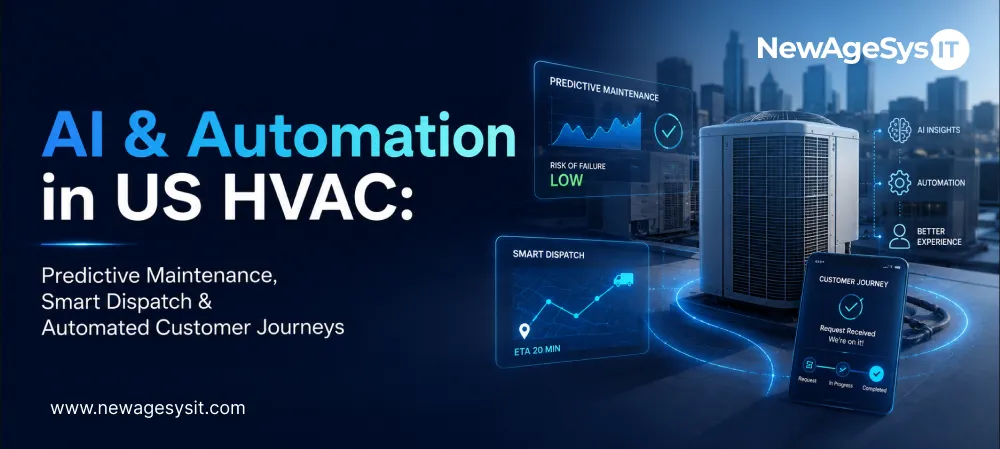
HVAC 5 min read
AI Automation in US HVAC: Predictive Maintenance, Smart Dispatch And Automated Customer Journeys in 2026

AI automation in US HVAC has crossed a clear threshold. It moved from differentiator to operational expectation. Shops using AI dispatch, predictive alerts, and automated journeys win. Technician utilization rises, and emergency calls drop. Maintenance agreement retention strengthens, too.
Connected equipment has proven that AI-analyzed data improves outcomes. Fleet telematics offers the same evidence base. AI HVAC dispatch and predictive maintenance follow that logic. Dispatch optimization delivers the highest ROI in HVAC. It matches the right technician, parts, and location at once. Teams often add custom HVAC software and CRM development services to connect AI dispatch output, agreement renewal automation, and EPA compliance records into one operational data layer.
AI-Powered Dispatch Optimization
AI dispatch is the highest-value automation in HVAC. It solves constraints, but manual dispatch handles poorly. Daily routing improves across the board.
• Multi-constraint dispatch resolves several factors at once. It weighs technician GPS proximity and EPA 608 certification type. Type I, II, III, or Universal must match the job refrigerant. Customer time window, job duration, and van parts inventory factor in.
• Predictive job duration uses historical job data. ML models estimate completion time by equipment and technician. Realistic routes and accurate customer ETAs result.
• Emergency call insertion finds the nearest certified technician. AI recalculates the affected route with updated ETAs. Summer AC demand stops becoming reactive chaos.
• Seasonal capacity optimization forecasts job volume by week. Weather and historical patterns drive the forecast. Hiring and overtime decisions happen before peak demand.
• Parts-aware dispatch checks likely job parts against van inventory. Assignment happens with the right stock on board. Return trips that waste billing capacity fall sharply.
Mobile builds that surface AI dispatch recommendations to technicians benefit from custom mobile app development that handles background GPS sync, offline reliability, and real-time route updates in low-connectivity field environments.
Predictive Maintenance and Equipment Intelligence
Predictive maintenance turns IoT data into revenue. Equipment signals reveal failures before they happen. Proactive service replaces emergency response.
• IoT equipment data feeds failure prediction. Ecobee, Nest/Google, Honeywell, and Lennox APIs supply the signals. Run time trends, temperature differential, and error code history flow in.
• System degradation detection spots impending failure. Algorithms flag efficiency and run time patterns. A reactive emergency call becomes a scheduled service call.
• Proactive service calls generate planned revenue. An alert triggers automated outreach and booking. The revenue model shifts from emergency to planned delivery.
• Equipment lifetime modeling predicts remaining useful life. Age, service history, run time, and failure patterns combine. Replacement-ready units surface before the customer feels a failure.
• A multi-equipment dashboard supports premium agreement tiers. Connected monitoring becomes a paid feature. Owners view the customer equipment fleet in one place.
Automated Customer Journey Management
Automated journeys respond to customer events in real time. Personalized messages beat generic outreach. Relevance drives conversion.
Personalization sets the standard. A message noting a Carrier unit serviced 14 months ago performs well. Generic “we miss your business” notes fall flat.
Seasonal Campaign Automation
• Spring cooling tune-up campaigns reach the full base in March and April. Digital competitors run them without manual effort. Seasonal revenue arrives on schedule.
• Fall heating tune-up campaigns run in September and October. The second annual conversion window opens. Reactive customers convert into agreement holders.
Lapsed Customer and Equipment Re-Engagement
• Lapsed customers who went quiet for 12 months get outreach. Messages reference equipment age and service history. Revenue recovery happens before they switch.
• Equipment age triggers replacement conversations. Residential HVAC often turns failure-prone at 12 to 15 years. Proactive outreach starts the upgrade discussion.
Maintenance Agreement Automation
• Renewal sequences run at 60, 30, and 7 days before expiration. Multi-step outreach keeps agreements active. Revenue leakage from lapses drops.
• Upgrade outreach targets, single-unit agreement holders. Multi-unit offers match their equipment inventory. Agreement value grows over time.
Performance Analytics and Revenue Intelligence
Analytics turn raw activity into decisions. The right KPIs guide management. Revenue intelligence drives growth.
• A technician scorecard tracks jobs per day and revenue per technician. First-call resolution and agreement conversion add depth. Customer satisfaction completes the picture.
• Agreement intelligence tracks count by type and renewal rate. Lapsed agreement revenue at risk stays visible. Revenue per agreement guides program management.
• The replacement pipeline filters customers by aging equipment. Service history and IoT performance refine the list. Sales intelligence drives revenue before failures.
• Seasonal forecasting blends weather with historical volume. Peak periods become predictable. Staffing, inventory, and marketing timing improve.
• EPA compliance analytics track refrigerant usage by technicians. Certification expiry and record completeness are monitored. A regulatory intelligence dashboard results.
Performance analytics dashboards that connect technician scorecards, agreement intelligence, and EPA compliance reporting into one operational view benefit from custom software development that models the full HVAC data layer from day one.
EPA Compliance Automation
EPA compliance automation removes manual documentation work. Records stay accurate and audit-ready. Risk drops across the operation.
• Automated refrigerant log management runs per job. Per-technician summaries and inventory reconciliation are generated automatically. Manual data compilation disappears.
• Certification expiry alerts reach management early. Notifications fire 60 and 30 days before EPA 608 renewal. Lapsed technicians never get refrigerant work.
• Compliance report generation assembles Section 608 documentation. Inspection responses come together fast. Manual record compilation for audits ends.
• Data integrity verification checks every refrigerant entry. Incomplete or inconsistent records get flagged. Gaps close before they become compliance problems.
EPA Section 608 automation is operational guidance, not legal advice. Qualified environmental compliance counsel should review your record-keeping obligations.
Final Thoughts
AI and automation deliver real operational ROI in HVAC. Dispatch efficiency and predictive revenue lead the way. Automated journeys and EPA management round it out.
Shops deploying AI dispatch and IoT predictive maintenance gain ground. Automated customer journeys lift retention. Utilization rises while emergency calls fall.
AI is the intelligence layer of the US HVAC digital transformation, covered in our pillar guide. Learn more about digital transformation solutions from one of the leading AI software companies in the United States.
Planning AI investments? Connecting IoT data to predictive triggers and multi-constraint dispatch from the start produces measurable ROI.
Core Development
Keep exploring the custom services.

AI Software Development
Custom AI Software Development
Build intelligent, production-ready software from machine-learning models to AI-driven automation designed around your business goals.
Learn more
Mobile App Development
Custom Mobile Application Development
Native and cross-platform mobile apps that are fast, secure, and built to scale across iOS and Android.
Learn more
Web App Development
Custom Web Application Development
Scalable, secure web applications, from customer portals to complex dashboards, tailored to how your business actually works.
Learn more



