
Welcome to Blogs
Discover actionable insights, in-depth research, and expert perspectives, all in one place.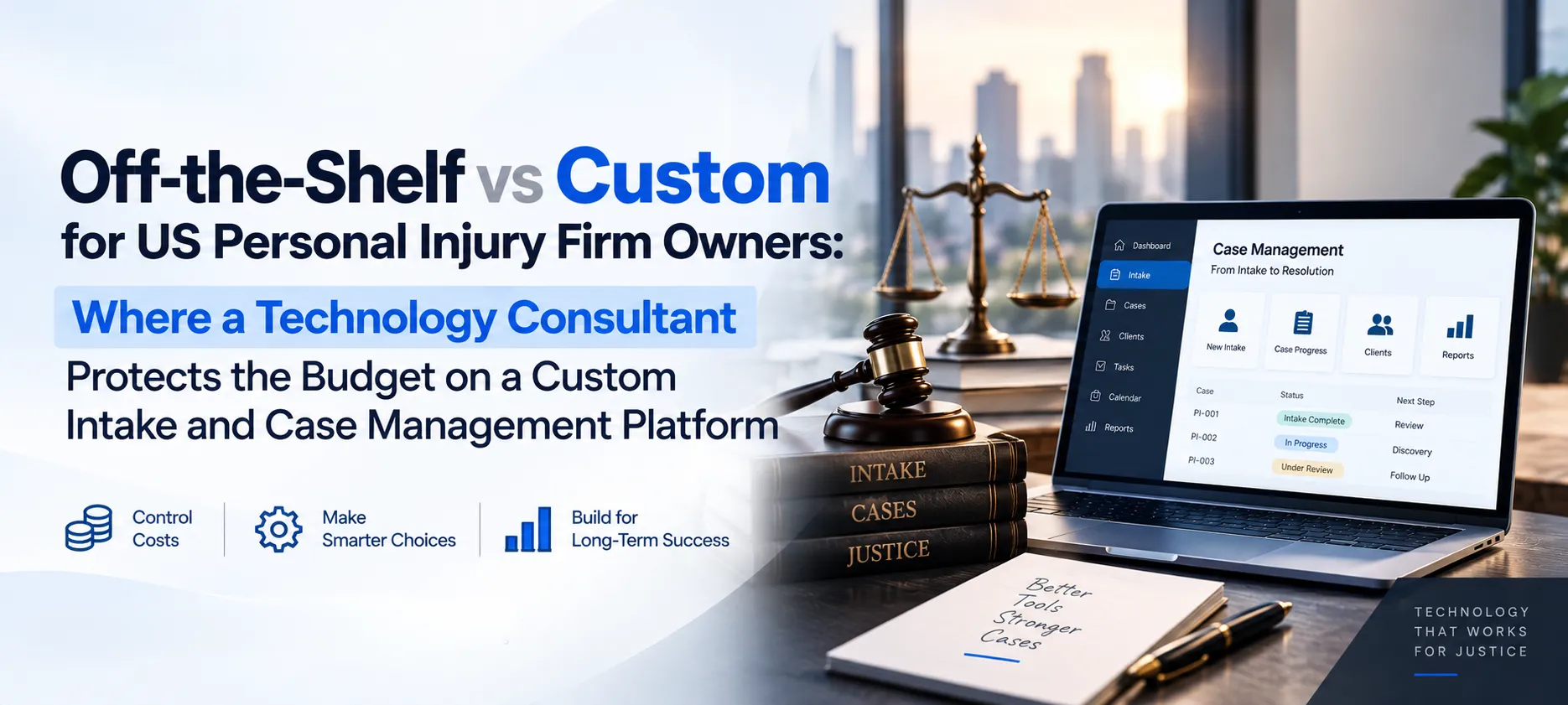
Custom Software Development 7 min read
Off-the-Shelf vs Custom for US Personal Injury Firm Owners: Where a Technology Consultant Protects the Budget on a Custom Intake and Case Management Platform

The Budget Is Protected Before Development Starts
Personal injury platform projects rarely overrun because engineering went slowly. They overrun for other reasons entirely.
They overrun because the firm decided to rebuild everything when its problem was in one stage. They overrun because the disbursement calculator was built against one fee agreement, and the firm actually has four. They overrun because consent handling was left to a later phase, or because nobody established what the current system would export.
Each of those is a scoping decision, visible before money is committed. That’s where an advisor earns their fee, not in choosing technology, but in preventing the four or five decisions that turn a defined project into an open-ended one.
This article on off-the-shelf vs custom personal injury software covers what established platforms genuinely do well, where they break for a firm with a specific problem, the option most owners never seriously price, the decisions that destroy budgets, and what a scoping engagement should produce. This connects to the fuller custom software development approach and the web application development work behind a complete platform.
What Established Personal Injury Platforms Genuinely Do Well
This is a mature software category, and it deserves an honest account. An advisor who can’t give one is selling rather than advising.
Established platforms arrive with the whole lifecycle already built: intake, case management, treatment tracking, lien records, settlement calculation, and trust integration. They carry connections to the call tracking, e-signature, and records vendors most firms already use. They track the regulatory changes that affect intake, which is a standing job on its own. They’re supported, and they’re running within weeks rather than within two years.
For a firm of modest size running conventional auto and premises work, that combination is usually decisive. A firm in that position should be told so directly, rather than encouraged toward a build it will struggle to complete.
The honest question isn’t whether these platforms are good. It’s whether the specific thing costing your firm money is something the platform holds rigidly.
Where They Break for a Firm With a Specific Problem
Intake is the most common pressure point. A firm treating conversion as an engineering problem, routing, response, scripting, testing, attribution down to cost per signed case by keyword, usually finds that platform intake modules are designed to be adequate rather than optimized. The data needed to run that analysis often isn’t exported in a usable form either.
The records chase is the second pressure point. Most platforms record requests fine. Fewer drive an escalation workflow that treats an unanswered request as an event requiring action.
Fee and disbursement handling is the third and the least visible. A firm with several fee structures, or a cost treatment that differs from the platform’s built-in assumption, often ends up computing settlements outside the system entirely. That’s precisely the situation the software was bought to prevent in the first place.
Multi-office and multi-state configuration is the fourth pressure point.
The test worth applying here is narrow: what does this constraint cost per month, and is any of it configurable? Frustration that’s configurable isn’t a reason to build.
The Option Most Owners Never Price: Replace One Stage
Between keeping everything and replacing everything sits an option most firms never consider. It’s frequently the right answer: keep the established platform for the lifecycle and build custom only where the constraint actually is.
There are two common shapes this takes.
The first is a custom intake and attribution layer feeding the existing case management system, which is where firms with a conversion problem get most of their return, at a fraction of a full build’s cost. Where that layer also has to reach staff taking intake at a hospital or a client’s home, custom mobile app development is scoped alongside it.
The second is a custom lien and disbursement layer sitting alongside the platform for firms whose settlement complexity exceeds what the product handles.
The economics here are genuinely favorable. It removes the largest and least differentiating engineering from the project entirely. It shortens the timeline substantially and reduces the regulatory maintenance burden, all while still addressing the thing that actually costs money.
It does require clean integration between the built and bought layers, plus a clear decision about which system holds the matter record.
Any advisor proposing a full replacement without costing this option alongside it isn’t protecting the budget. Ask for it explicitly.
The compliance scope behind these decisions is set out in State Bar Advertising and Solicitation Rules, TCPA Lead Contact Limits, HIPAA Medical Records Handling and IOLTA Trust Accounting Compliance for US Legal Software.
The Five Decisions That Destroy Personal Injury Platform Budgets
- Rebuilding Everything When One Stage Is the Problem
This is the highest avoidable cost in this whole category. Identify where the firm actually loses money, and price replacing only that before pricing a full lifecycle platform.
- Building the Disbursement Calculator Against One Fee Agreement
Firms accumulate fee structures over time: tiered by stage, different cost treatments, referral divisions, and matters signed under older terms. A calculator built against only the current standard agreement will produce wrong numbers on older matters. And those numbers are client funds.
- Deferring Consent Architecture
Consent capture with provenance, do-not-contact handling, revocation, and retention are expensive to retrofit later. They also carry per-contact statutory exposure in the meantime. This is the one thing that should be in release one, regardless of which stage gets built first.
- Treating Lien Tracking as a Notes Field
Different claim types have different identification, documentation, and resolution paths. A single lien record with a type label attached tends to produce missed claims. A claim discovered after funds have already moved has no clean remedy left.
- Not Establishing What the Current System Will Release
Matters, documents, case costs, and trust balances all have to migrate cleanly, and trust balances must reconcile exactly. Confirm export capability and terms with the incumbent vendor before agreeing to any timeline.
What a Good Scoping Engagement Produces
A constraint analysis grounded in the firm’s own numbers: conversion by source, cycle time by stage, records turnaround, and where matters actually sit still. This establishes which stage to build, rather than simply assuming.
A costed comparison of at least three options: configure what you have, replace one stage, and full custom, rather than a single proposal for whatever option the advisor would prefer to deliver.
An inventory of every fee structure currently in circulation across open matters, since that’s exactly what the disbursement calculator has to handle correctly.
A lien profile pulled from the firm’s own closed files: which claim types actually appear, how often, and how they’re resolved today in practice.
A compliance scope covering consent architecture, state variation across the firm’s advertising footprint, and trust design, reviewed with ethics counsel directly.
A migration feasibility check on what the incumbent system will actually release, with particular attention to trust balances and open case costs.
And a first-release definition, with the exclusions written down explicitly rather than left implied.
The staged budget these decisions shape is detailed further in Budgeting a Custom Personal Injury Intake and Case Management Platform: Team Size, Timeline and Total Build Cost for US Plaintiff Law Firms.
Red Flags in the Conversation
A fixed price offered before any real discovery work. A full replacement proposal with no partial option costed alongside it. Consent handling that goes unmentioned until you raise it yourself. No question asked about how many fee structures the firm has in circulation. Lien tracking presented as a single record type. Migration priced without any contact made with your current vendor.
And one red flag that should end the conversation rather than just raise a question: any proposal involving crash report or motor vehicle data to identify and contact potential clients. That’s exposure under federal law, state law, and the professional conduct rules all at once. A vendor offering it is telling you exactly what they don’t know.
The strongest positive signal, by contrast, is an advisor who asks for your conversion and cycle-time numbers before proposing anything at all.
Final Thoughts
Owners who establish where the firm actually loses money tend to make better decisions from that point forward. Pricing configuration and partial replacement alongside a full build matters too. So does inventorying real fee structures and the firm’s actual lien profile, and settling consent architecture before committing any money.
Doing this either de-risks a build genuinely worth doing, or reveals that a much smaller project delivers most of the value anyway. Both outcomes are worth considerably more than what the assessment itself costs.
If you’re weighing custom against the platform you run today, a structured assessment is what protects the budget before development begins. That means constraint analysis from your own numbers, a fee structure inventory, a lien profile, consent scoping, and a costed comparison of configuring, replacing one stage, and building from scratch. Learn more about digital transformation solutions from one of the leading AI software companies in the United States.
Core Development
Keep exploring the custom services.

AI Software Development
Custom AI Software Development
Build intelligent, production-ready software from machine-learning models to AI-driven automation designed around your business goals.
Learn more
Mobile App Development
Custom Mobile Application Development
Native and cross-platform mobile apps that are fast, secure, and built to scale across iOS and Android.
Learn more
Web App Development
Custom Web Application Development
Scalable, secure web applications, from customer portals to complex dashboards, tailored to how your business actually works.
Learn more



