
Welcome to Blogs
Discover actionable insights, in-depth research, and expert perspectives, all in one place.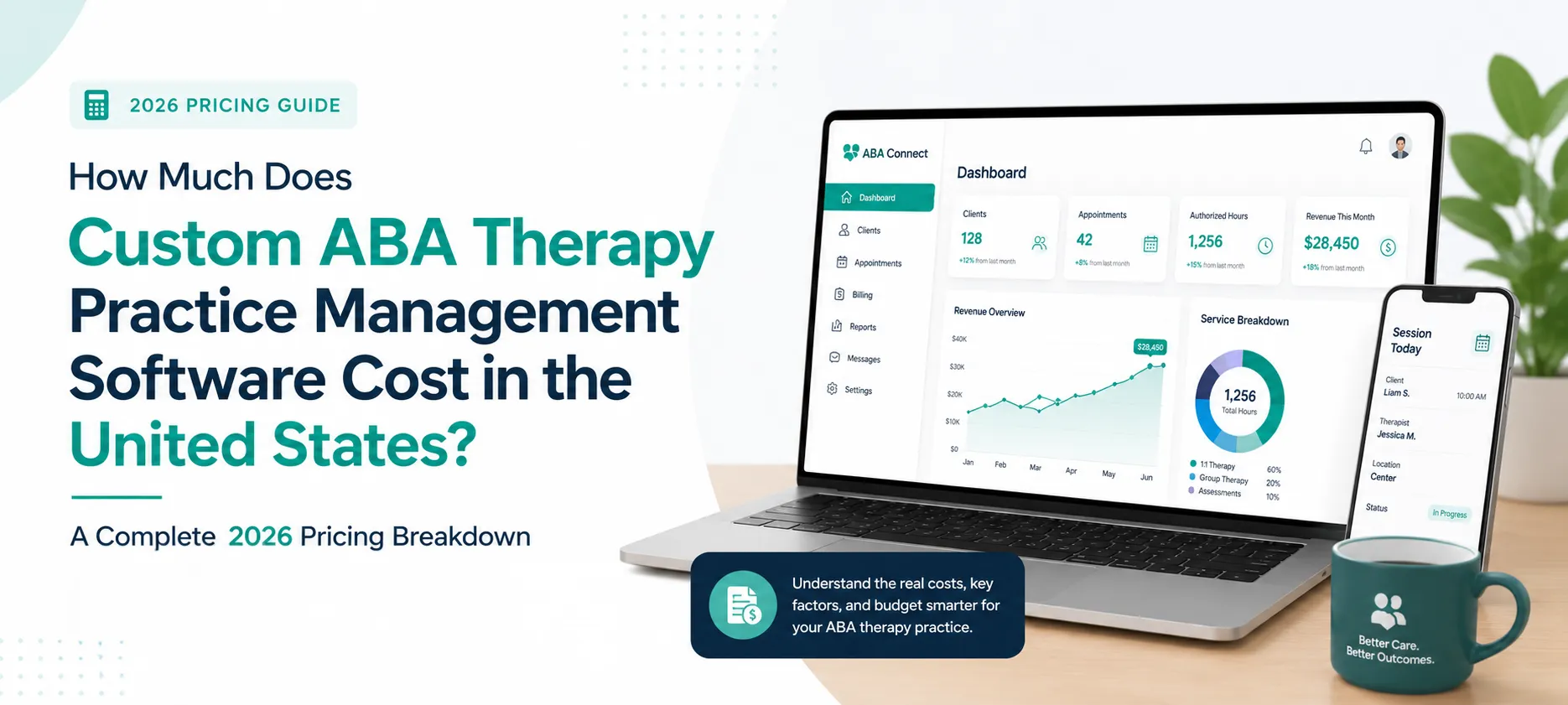
Custom Software Development 7 min read
How Much Does Custom ABA Therapy Practice Management Software Cost in the United States? A Complete 2026 Pricing Breakdown

Why ABA Software Estimates Come in Low
Provider owners researching ABA software development cost often receive a number for a different product. Generic estimates price a scheduling and notes application. They skip offline data capture, graphing layer, the authorization engine, and payer-specific billing.
A real platform needs the same engineering rigor as any specialized healthcare system. The scope resembles custom software development more than a simple configuration project. The technician-facing data collection app demands genuine custom mobile app development discipline, since it runs offline during live sessions.
Pricing below breaks the ABA software development cost into build stages. It covers what drives cost up, which lien items get missed, and what keeps a first release manageable. Every figure below is a 2026 planning range, not a fixed quote.
Stage-by-Stage Cost and Timeline for 2026
Custom ABA practice management software pricing breaks into four build stages. Each stage ships independently, so the budget grows alongside proven value.
Stage 1: Clinical Core: $110K–$200K (6–8 months)
Stage 1 covers client records, program libraries, and offline-capable session data capture. Graphing lives inside the data model rather than sitting on top of it. This stage costs the most, since session capture relies on genuine custom mobile app development, not a simple front end.
Stage 2: Scheduling & Workforce: +$70K–$130K (4–5 months)
Stage 2 adds constraint-aware scheduling, cancellation management, and travel time tracking. It also covers supervision tracking, credential expiry enforcement, and payroll-relevant time capture. These workflows prevent the scheduling gaps that cause missed sessions and lost revenue.
Stage 3: Authorization & Revenue Cycle: +$80K–$150K (5–6 months)
Stage 3 builds the authorization engine, eligibility verification, and 837P claim submission. The billing and admin console relies on solid web application development, since staff live inside it daily. Denial scrubbing and remittance posting close the loop, catching errors before they reach a payer.
Stage 4: Compliance & External Integrations: +$55K–$110K (4–5 months)
Stage 4 covers EVV transmission where a state requires it, telehealth video, and the caregiver portal. Consent tracking, incident documentation, and reporting close out this stage. Configurable eligibility rules keep telehealth access aligned with payer and state policy.
Full Platform
All four stages together run roughly $315K to $590K across 19 to 24 months. Licensed assessment instrument integration sits outside these figures, since it depends on publisher agreements rather than on development effort. A provider planning a full build should treat that range as the realistic ceiling, not the starting quote.
What You Are Actually Paying For in Stage 1
Stage 1 looks expensive next to a scheduling-and-notes product, and the reason is concrete. Measurement types are not variations on one form. Trial-by-trial capture with prompt levels, interval recording, and duration-latency timing each need distinct interaction design.
Task analysis and ABC records add two more distinct capture experiences. Each measurement type also carries its own validation rules and summary math. That adds up to real ABA data collection app cost, bundled into one app rather than a single screen.
Offline-first design is genuine distributed systems work. Data lives locally first, then syncs once connectivity returns. Conflict handling must never silently overwrite clinical notes, and staff need visibility into what has synced.
Interface speed is a requirement here, not a nice-to-have. The app gets used while a technician works directly with a child. Meeting that bar takes design and optimization effort a back-office system never needs.
Graphing shapes the underlying schema from day one. Phase changes, cross-session aggregation, and technician comparison views all need designing into the data model early. Retrofitting them later means revisiting how every data point gets stored.
What Drives Cost Up
Several factors push ABA software development cost higher.
Payer mix drives ABA billing software cost first. Each Medicaid managed care organization and commercial payer brings its own authorization rules, documentation expectations, and modifier requirements. Payer count pushes configuration and testing effort up close to linearly.
State count matters even more. Multi-state operation multiplies EVV determinations, licensure rules, mandate variation, and Medicaid program differences. It is the single largest structural cost multiplier in this vertical.
EVV scope adds its own cycle to EVV integration cost. Whether in-home ABA falls under EVV depends on the state, not on federal law. Where a closed-model state applies, integration with its designated aggregator brings separate specification and testing work.
Delivery settings multiply scheduling logic. Supporting center-based, in-home, school, and telehealth delivery means four distinct scheduling and documentation contexts.
Assessment licensing runs on its own clock. Publisher agreements for tools like VB-MAPP or ABLLS-R carry separate cost and timeline, apart from development.
Migration is often underestimated. Client records, historical session data, active authorizations, and open receivables all need to transfer accurately. Historical session data is especially high-volume and specific to whatever system produced it.
Payer mix and EVV scope remain the dominant cost variables here, tied to a wider integration layer. That layer is covered in depth in Session Data Capture, Authorization Unit Tracking, X12 837P Medicaid Claim Submission and Telehealth Video Integration for a Custom US ABA Platform.
The lien Items Providers Forget
Clearinghouse enrollment and payer setup often get missed. Each payer connection carries its own enrollment process and timeline, sitting on the critical path for billing go-live. Delays here push back the entire billing timeline, not just one payer.
EVV aggregator onboarding is another gap, where a closed-model state applies. Testing and certification with the aggregator takes real time before go-live. Skipping this step risks costly rework after launch.
Assessment instrument licensing gets negotiated separately with publishers, on their own schedule. A platform cannot embed or score licensed instruments without that written agreement.
Device fleet costs add up fast. Tablets, mobile device management, replacement cycles, and connectivity form a real ongoing lien, not a one-time purchase.
Training and rollout continue past launch, given workforce turnover in this field. New hires need the same onboarding path as day-one staff, indefinitely. In-product guidance becomes a cost-saving investment rather than a nicety.
Parallel running through cutover adds double licensing and reduced productivity temporarily. Migration of historical session data is high-volume and rarely as extractable as expected.
What Keeps the First Release Manageable
Shipping Stage 1 first keeps early cost contained. Proving data capture in live sessions before Stage 2 confirms technicians actually prefer it. Everything else gets built on that foundation, so it is worth confirming early.
Starting with one state and the payers that carry the most volume narrows a custom autism provider platform budget. Multi-state configuration and long-tail payers can follow once the core works. Supporting only the delivery settings run today, rather than the growth plan, avoids paying for unused paths.
Deferring assessment integration until licensing talks conclude avoids wasted engineering effort. Externally conducted assessments can be referenced in the meantime.
Deferring algorithmic scheduling optimization also helps. Constraint-aware manual assignment with good visibility works well as a starting point.
Running the incumbent system in parallel through cutover protects against failure. A failed morning means technicians arriving at family homes without a schedule or program. A hard switchover is rarely worth the licensing savings.
Ongoing Costs and the Comparison with Per-Seat ABA Platforms
Ongoing ABA software development cost doesn’t stop at launch. Hosting, storage growth, backup, disaster recovery, and monitoring typically run 15 to 25 percent of build cost yearly. Regulatory maintenance is genuinely recurring, since payer rules and state EVV positions keep moving.
Clearinghouse fees, telehealth licensing, messaging costs, and any aggregator fees continue as well. None of these lien items disappear once the platform is live.
The honest comparison favors established ABA platforms for some providers. Near-zero capital cost, per-user pricing, existing payer and EVV connections, and built-in support win outright for smaller, single-state providers. That combination removes most of the technical risk during a fast rollout.
Custom development starts making sense at scale. It suits organizations with a large technician workforce, multi-state operations, or delivery models existing products cannot express.
The sprint that turns these ranges into a defensible number is covered in Why US ABA Therapy Providers Should Run a Technology Discovery Sprint Before Committing to Custom Practice Management Software.
Final Thoughts
Providers that budget by stage arrive at a number they can defend. Clinical core comes first, then scheduling, then authorization, then compliance integrations. That sequence puts working software in technicians’ hands before the budget runs out.
Naming payer enrollment, EVV onboarding, licensing, devices, and migration as lien items prevents mid-build budget gaps. Treating payer count, state count, and EVV scope as explicit multipliers keeps that number realistic.
That discipline is what separates a workable budget from a rough guess.
These figures are educational planning ranges, not legal or regulatory advice. NewAgeSysIT works with US autism service providers on stage-based platform builds like this one. Learn more about digital transformation solutions from one of the leading AI software companies in the United States.
FAQ
How much does custom ABA therapy practice management software cost?
A complete custom ABA therapy practice management platform can cost approximately $315,000 to $590,000 as a 2026 planning range. The total depends on clinical data collection, scheduling, authorization management, Medicaid billing, EVV integrations, telehealth, caregiver portals, and multi-state requirements. Providers building only a clinical core or first release can start with a smaller staged investment.
What is included in the cost of custom ABA therapy software?
Custom ABA software development can include client records, treatment programs, offline session data capture, clinical graphing, scheduling, staff credentialing, supervision tracking, authorization management, eligibility verification, claims, remittance posting, caregiver portals, EVV, telehealth, and reporting. Costs also cover architecture, UX design, testing, security, integrations, deployment, and workflow configuration rather than only the screens staff see.
How much does an ABA therapy software MVP cost?
The clinical core typically runs approximately $110,000 to $200,000 and can function as a practical first-stage ABA software release. This stage includes client records, treatment programs, offline-capable session data collection, and clinical graphing. Providers can then add workforce management, authorization, billing, compliance, and external integrations after validating the core platform with technicians and clinicians.
Why is ABA data collection software expensive to develop?
ABA data collection requires more than a generic digital form. Software may need separate workflows for trial-by-trial responses, prompts, frequency, duration, latency, interval recording, task analysis, and ABC data. Offline operation adds synchronization and conflict-resolution requirements. Clinical graphing also affects the underlying data model, so measurement, storage, calculations, and visualization must be designed together from the beginning.
What factors increase ABA practice management software development cost?
The biggest cost drivers include the number of states, payer mix, EVV requirements, delivery settings, offline mobile functionality, billing complexity, data migration, and external integrations. Supporting multiple Medicaid programs and commercial payers increases configuration and testing. Multi-state providers may also need different authorization, credentialing, EVV, and compliance workflows, making state and payer diversity major structural cost multipliers.
How much does ABA scheduling and workforce management software cost?
The scheduling and workforce stage typically runs approximately $70,000 to $130,000. This can include constraint-aware scheduling, cancellation management, travel-time tracking, supervision monitoring, credential-expiration controls, and payroll-relevant time capture. Costs increase when scheduling must accommodate multiple service settings, geographic travel, complex staff qualifications, client-specific requirements, and authorization limits simultaneously.
How much does EVV integration add to ABA software cost?
EVV integration cost depends on whether specific ABA services require EVV in the states where the provider operates and how those states implement their programs. Some implementations may require integration with a designated EVV system or aggregator, onboarding, testing, and certification. Multi-state providers should budget EVV separately because integration specifications, required data, approval processes, and implementation models can differ by state.
Core Development
Keep exploring the custom services.

AI Software Development
Custom AI Software Development
Build intelligent, production-ready software from machine-learning models to AI-driven automation designed around your business goals.
Learn more
Mobile App Development
Custom Mobile Application Development
Native and cross-platform mobile apps that are fast, secure, and built to scale across iOS and Android.
Learn more
Web App Development
Custom Web Application Development
Scalable, secure web applications, from customer portals to complex dashboards, tailored to how your business actually works.
Learn more



