
Welcome to Blogs
Discover actionable insights, in-depth research, and expert perspectives, all in one place.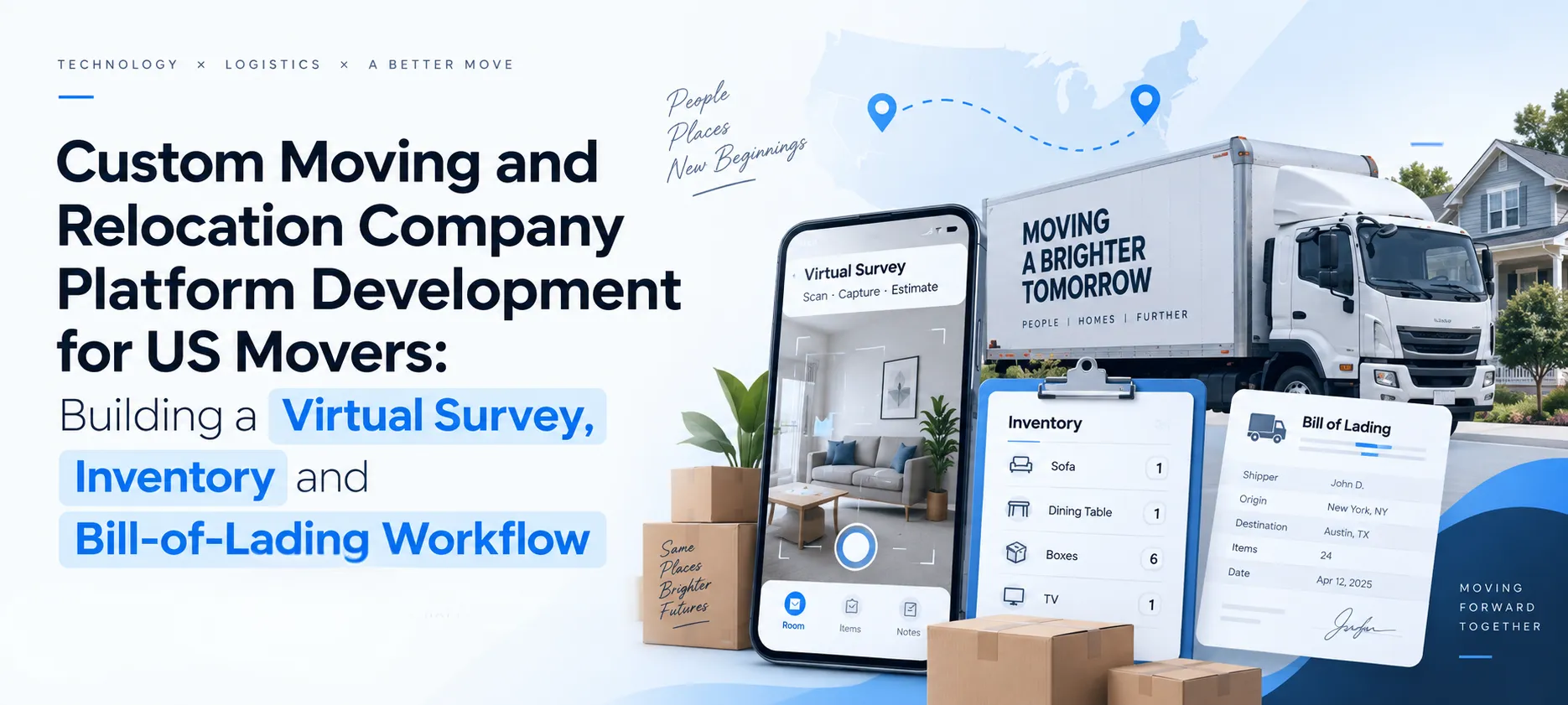
Custom Software Development 12 min read
Custom Moving and Relocation Company Platform Development for US Movers: Building a Virtual Survey, Inventory and Bill-of-Lading Workflow

In This Business, the Estimate Is a Regulated Document
Most sales platforms treat an estimate as a proposal. In interstate household goods moving, it is a regulated document with prescribed contents.
Those rules shape what a customer may be asked to pay at delivery. They also shape what happens when the final charge differs from the estimate.
That is why moving company software development has to start with the document chain. The survey creates the basis for the estimate. The inventory supports the estimate and, at load, records the goods against which loss and damage is measured. The bill of lading is the contract of carriage with required contents.
One scoping question has to come early. Is the mover a van line agent or an independent operating under its own authority? Agents may need the custom platform to work beside van line systems, not replace them. What the van line permits should be confirmed before architecture is scoped.
Teams usually need custom software development when those records drive daily operations. Companies often need custom mobile app development for survey capture, crew photos, field signatures, and offline move-day work.
The industry has a trust problem worth naming. Some operators have built businesses around estimates designed to rise after loading. Others have used payment demands the rules do not permit. Undisclosed brokering creates another risk, because customers may not know who will perform the move.
Legitimate movers compete against that reputation. Accurate estimating and complete disclosure become commercial advantages, not compliance drag.
Software can make the record visible: surveyed inventory, required disclosures, signed documents, retained evidence, and traceable revisions. That record becomes both a defense and a differentiator.
This guide covers virtual surveys, cube inventory, booking, deposits, dispatch, and digital bills of lading. It also covers storage-in-transit, billing, claims, compliance, cost, and consultant-led scoping.
The Survey: In-Home, Video, and Self-Survey
The survey sets the move’s inventory, pricing risk, and service plan. Inventory, access conditions, service needs, crew planning, and estimate risk all start here.
How movers run surveys has changed more in recent years than any other workflow area. The platform should support three paths:
- In-home survey for large or complex jobs
An estimator walks the home, builds inventory, notes access constraints, and judges what the move will take. It gives the estimator strong context, but it consumes travel hours.
- Live or recorded video survey
Video has replaced much of that field volume. A customer walks the home on a live call while an estimator builds the inventory. Another customer may record a walkthrough for later review.
The workflow can compress a two-hour visit into thirty minutes without removing professional review. Survey video needs deliberate data handling. It can show the inside of a customer’s home, possessions, and moving date. The platform should define who can access it, how long it stays, and when disposal occurs.
- Self-survey through a customer application
The customer records each room, and item recognition assists with inventory and cube data. That assistance has a hard boundary.
Artificial Intelligence (AI)-assisted recognition can assemble a first inventory pass quickly. The output remains a draft, not an estimate.
A qualified person reviews it before any estimate is issued. That review is not optional.
Estimate accuracy carries regulatory and consumer consequences. An automated figure that proves wrong at load is exactly the failure pattern this industry needs to leave behind.
The survey-to-document integration path is mapped in AI Video Survey Estimation, Cube Sheet Inventory, Digital Bill of Lading Signing and Deposit Payment Integration for a Custom US Moving Platform.
Whatever the method, three records must survive. The inventory the customer saw, the access and service conditions noted, and the time-stamped record of what was surveyed.
Inventory, Cube, and the Estimate
The inventory is the estimate’s foundation. The chain from survey to estimate is where accuracy is built or lost. Items need room-by-room capture, with quantities and handling notes. Condition can matter for fragile, high-value, or pre-damaged items.
The record should flag items requiring crating, disassembly, or special handling. Those details change labor, materials, equipment, and customer expectations.
Each item should carry a cube value from the company’s maintained estimating table. The platform can total estimated volume and convert it to estimated weight by the operation’s conventions.
That estimated weight, distance, and required services produce the estimate under the applicable tariff. The software should not hard-code public conversion factors, tariff rates, or rate figures.
For interstate moves, the final charge ultimately rests on actual weight. The customer may also have rights around weighing and reweighing. That makes the gap between estimated and actual charges a regulated concern with commercial consequences.
The estimate must be generated in the required form. It also needs the required contents and a clear binding or non-binding status. That status matters. It affects customer exposure and what the mover may require at delivery.
Two product rules follow.
- First, accessorial and additional services should be captured during survey whenever possible. When they appear only at load, disputes become more likely.
- Second, every estimate should be reproducible. Given the inventory, services, and tariff applied, the platform should explain the figure to the customer.
Operators can use Moving Company Software Features: Must-Haves for a US Local, Long Distance and Storage-in-Transit Mover in 2026 to map the full checklist across local, long-distance, and storage-in-transit workflows.
Booking, Deposits, and the Required Disclosures
Booking converts an estimate into a move commitment, and interstate jobs trigger documents and disclosures the mover must provide. The software mistake is treating those requirements as files to attach after booking. A better platform makes disclosure part of the booking path, so the job cannot move forward without the right record.
That sequence starts with consumer information publications given to the shipper, with acknowledgment captured and retained. It then issues the order for service with specified contents verified against current rules. Valuation options should appear before commitment, so the customer makes an informed choice. The mover’s arbitration program also needs to be disclosed and logged against the job.
Each step should be shown, acknowledged, timestamped, versioned, and retained. That evidence matters when a customer questions what was provided. A mover that can show the document, version, recipient, and time has answered much of a complaint before escalation.
Deposits sit beside the disclosure record. They are ordinary commercial practice, but they are also where consumer complaints cluster. The booking flow should show clear terms, issue clear receipts, and capture cancellation-policy acknowledgment. Those records matter more than payment mechanics.
For a legitimate operator, this record has business value. It can keep a dispute on evidence instead of turning it into a regulatory matter. It also creates an advantage over operators that cannot produce the same proof.
Dispatch, Crews, and the Day of the Move
Between booking and load day, the operating problem becomes coordination across jobs, crews, trucks, and field changes. That pressure is strongest during summer peaks and month-end volume.
Dispatch cannot stop at open slots on a calendar. The board has to weigh:
- crew size against job size
- truck capacity against estimated cube
- driver qualification and equipment needs
- travel time between jobs
- crew fit for long-distance loads, packing days, and short apartment moves
Those choices change with the work type. A long-distance load, packing day, and two-hour apartment move are different jobs. Storage handling and material deliveries may also sit on separate days, so they need schedule logic too.
Operations teams may use web application development for dispatch boards, scheduling consoles, and exception views. The office needs visibility when jobs move, crews change, or access conditions shift.
The crew day-of app turns that plan into field execution. It should show job details, access notes, inventory, materials used, photographs, and required signatures. Time capture should also flow back into the job record.
Time capture needs care beyond operations. Crews are often paid hourly, and the record can affect wage calculations. Federal overtime rules and the motor carrier exemption are fact-specific, so employment counsel should review those questions.
Dispatch rarely stays fixed. The crew view has to update when access, timing, truck assignment, or staffing changes in the field.
The Bill of Lading and the Descriptive Inventory
Load day produces the two documents that matter most: the bill of lading and the descriptive inventory. Both have often been built from carbon paper, handwriting, and truck-ramp data entry.
The bill of lading is the contract of carriage and receipt for the goods. For interstate moves, it has required contents and the shipper must receive a copy. A digital workflow should generate it from the job record. That removes transcription errors that often surface weeks later in disputes.
The descriptive inventory is the second core document. It is the baseline against which every loss and damage claim is measured.
Traditional inventories often rely on numbered lists and condition symbols. They are signed by the customer at origin and checked against at destination.
Digitizing the descriptive inventory is one of the largest quality improvements available to movers. Photographs attached to items at origin can settle a dispute over existing damage.
Condition notes also become clearer when the image sits beside the item. The customer should review and sign the inventory with those images visible.
Destination check-off should work from the same origin inventory. Exceptions can then be noted while the customer is present.
Signature capture matters at both ends of the job. Origin and destination signatures should be retained exactly as signed. The inventory protects both parties. The software should make facts easier to prove, not claims harder to bring.
Teams can use FMCSA Household Goods Rules Under 49 CFR 375 for the regulated document layer. It maps document requirements, disclosures, and authority obligations.
Storage-in-Transit, Delivery, and Payment
Storage-in-Transit (SIT) is common in long-distance moving, but it is not a loose warehouse status. Goods held between origin and final delivery sit under regulated time limits and notice requirements.
The platform should track SIT as a workflow with dates, status, alerts, and customer notices. A note on the job is not enough. Conversion to permanent storage can change the legal position and carrier liability, so the system needs a clear handoff point. Current SIT time limits, notice duties, and conversion requirements should be verified before workflow design.
Warehouse operations sit underneath that compliance layer. The platform should support vault or lot assignment, location tracking, shipment staging, and release planning. When delivery is scheduled, the office should know where the shipment is and what must move.
Delivery brings the payment question. This is where moving software carries real consumer-protection responsibility. For interstate moves, rules limit what a carrier may require before relinquishing goods. That matters especially when the estimate was non-binding.
Any remaining balance should follow the verified billing rule after delivery. The platform should implement those limits correctly. It must never support holding goods for payment beyond what is permitted.
Teams should verify current requirements and thresholds against the regulation before configuring payment logic.
Delivery documentation closes the move file. The destination inventory check, noted exceptions, customer presence, and signed records should all remain connected to the job.
Claims, Valuation, and the Compliance Surface
Loss and damage claims test the quality of every earlier record. A weak survey, unclear inventory, missing photo, or unsigned document becomes harder to fix after delivery.
Valuation should be handled before the claim stage. Interstate movers must offer valuation options, and full value protection applies unless the shipper elects another option in writing. The platform should record that election during booking, with the signed documents retained.
Current valuation details and claim periods should be verified against regulation. The software should not hard-code figures or deadlines from memory.
A claims workflow needs evidence and timeliness. The origin inventory, condition photographs, destination exceptions, signed documents, and customer communications should stay connected to the claim.
The workflow should also track filing, acknowledgment, and resolution steps. Those periods are regulated and should be verified before configuration.
The goal is fair handling of legitimate claims. The platform should make the record clear enough to resolve loss and damage issues on evidence.
The compliance surface extends beyond claims. Interstate household goods carriers need appropriate operating authority, identifiers, insurance filings, and process agent designation. Household goods authority is specific, so general freight or broker authority should not be assumed.
Intrastate moving depends on state rules. Some states license movers and regulate tariffs, while others do not regulate intrastate moving at all. No platform should assume one national intrastate workflow.
The van line question also shapes architecture. Agents may run interstate work through van line systems for registration, tariffs, documentation, and settlement. Independent movers operating under their own authority face a different scoping problem.
Some duties come from federal rules, state rules, or van line requirements. FMCSA Household Goods Rules Under CFR, Required Rights and Responsibilities Disclosures, DOT and MC Authority and State Intrastate Mover Licensing Compliance for US Moving Software goes deeper into that regulatory split.
This is educational content, not legal advice. Confirm requirements with transportation regulatory counsel, the relevant state regulator, and the van line where applicable.
Cost and the Staged Build Sequence
A moving platform should be budgeted along the job path, not as one large feature list. The practical sequence is sales, operations, move documents, then billing and compliance.
- Sales and survey
This stage covers lead capture, pipeline management, survey scheduling, and survey capture. It also includes inventory, cube building, estimate generation, booking, deposits, and disclosures. For 2026 planning, this stage typically lands around $95K–$180K over five to seven months.
- Operations and dispatch
This stage adds crew scheduling, truck scheduling, dispatch boards, day-of crew workflows, time capture, materials capture, and job costing. It typically adds $90K–$170K over five to seven months.
- Move execution documents
This stage covers the digital bill of lading, order for service, descriptive inventory, condition photographs, signatures, and storage-in-transit tracking. It typically adds $85K–$160K over five to six months.
- Billing, claims, and compliance
This stage covers final billing, delivery payment rules, claims workflow, valuation handling, document retention, disclosure records, and reporting. It typically adds $75K–$140K over four to six months.
A full four-stage platform usually lands around $345K–$650K across 19–26 months. AI survey licensing sits outside these figures.
The staged budget, timeline, team model, and platform tradeoffs are detailed in Budgeting a Custom Moving and Relocation Platform: Team Size, Timeline and Total Build Cost for US Moving Companies.
Final Thoughts
A custom moving platform should follow the documents the job already produces. The survey creates inventory, the estimate uses that inventory, and required disclosures travel with the booking.
Move-day records then carry the bill of lading, descriptive inventory, photographs, signatures, and delivery exceptions.
That chain matters because accuracy is an operating advantage. Movers can resolve many disputes from the record. That record shows what was surveyed, quoted, disclosed, signed, stored, delivered, and billed.
The van line question should be settled before architecture work starts. Agents may need to work alongside national systems, while independents may own more of the interstate workflow. Where that question, and the scope around it, protects the budget before a build starts is examined in Off the Shelf vs Custom for US Moving Company Owners: Where a Technology Consultant Protects the Budget on a Custom Survey and Dispatch Platform.
Teams choosing a custom software development partner should start with that operating reality. The platform should fit the mover’s survey model, service mix, authority position, and first release scope. In an industry where the reputation problem is real, showing what happened matters as much as doing it faster.
FAQ
What is moving company management software?
Moving company management software is a platform that manages the moving workflow from lead intake through delivery. It can combine virtual surveys, inventory creation, estimating, booking, dispatch, crew scheduling, bills of lading, storage tracking, billing, and claims. Custom platforms can also provide mobile tools for estimators and crews, customer portals, digital signatures, job costing, and integrations with accounting or van line systems.
What features should custom moving company software include?
Custom moving company software should include CRM and lead management, survey scheduling, household inventory, estimate generation, booking, disclosures, dispatch, crew and truck scheduling, digital bills of lading, descriptive inventories, photographs, signatures, storage-in-transit tracking, billing, and claims. Operators may also need customer portals, mobile crew applications, payment integration, job costing, reporting, warehouse management, and integrations with existing van line or accounting systems.
Can interstate moving estimates be based on virtual surveys?
Yes. FMCSA guidance allows the required survey for interstate household goods estimates to be performed on-site or virtually. A virtual survey can use live or prerecorded video that clearly shows the household goods being transported. Moving software can support video surveys and self-survey workflows, but inventory and estimate information should still be reviewed before a regulated estimate is issued.
What is the difference between a binding and non-binding moving estimate?
A binding estimate establishes an agreed price based on the listed shipment and services. A non-binding estimate is an expected cost rather than a guaranteed final amount. For interstate moves, FMCSA says a mover generally cannot require more than 110 percent of a non-binding estimate at delivery. Software should clearly identify estimate type and preserve every signed version and approved change.
How should moving software manage household inventory?
Moving inventory software should capture household goods room by room, including quantities, cube values, handling requirements, condition notes, photographs, and special-service needs. The inventory should remain connected to the estimate, descriptive inventory, bill of lading, and claims workflow. Keeping one traceable inventory record reduces duplicate entry and helps movers explain what was surveyed, transported, delivered, damaged, or missing.
What should digital bill of lading software for movers include?
For interstate household goods moves, the bill of lading functions as the transportation contract and receipt. Moving software should generate it from the approved job information and preserve the required supporting documents. FMCSA states that the bill of lading accompanies the shipment and may include the estimate, order for service, and inventory as integral attachments when not otherwise provided.
How can moving company software improve dispatch and crew scheduling?
Moving software can help dispatchers match jobs with crews, trucks, equipment, estimated shipment size, travel time, and required skills. The system can display changes to pickup times, access conditions, staffing, or truck assignments in one operating view. Mobile crew workflows can then provide job instructions, inventory, photos, materials, time capture, customer signatures, and delivery exceptions directly from the field.
How should moving software track storage-in-transit?
Storage-in-transit should be managed as a dedicated workflow rather than a simple job status. The platform should track storage dates, warehouse locations, vault or lot assignments, customer notices, shipment status, release planning, and conversion events. Interstate storage requirements include specific notification and responsibility rules, so configurable alerts help operators manage deadlines while keeping warehouse information connected to the original shipment record.
Core Development
Keep exploring the custom services.

AI Software Development
Custom AI Software Development
Build intelligent, production-ready software from machine-learning models to AI-driven automation designed around your business goals.
Learn more
Mobile App Development
Custom Mobile Application Development
Native and cross-platform mobile apps that are fast, secure, and built to scale across iOS and Android.
Learn more
Web App Development
Custom Web Application Development
Scalable, secure web applications, from customer portals to complex dashboards, tailored to how your business actually works.
Learn more



