
Welcome to Blogs
Discover actionable insights, in-depth research, and expert perspectives, all in one place.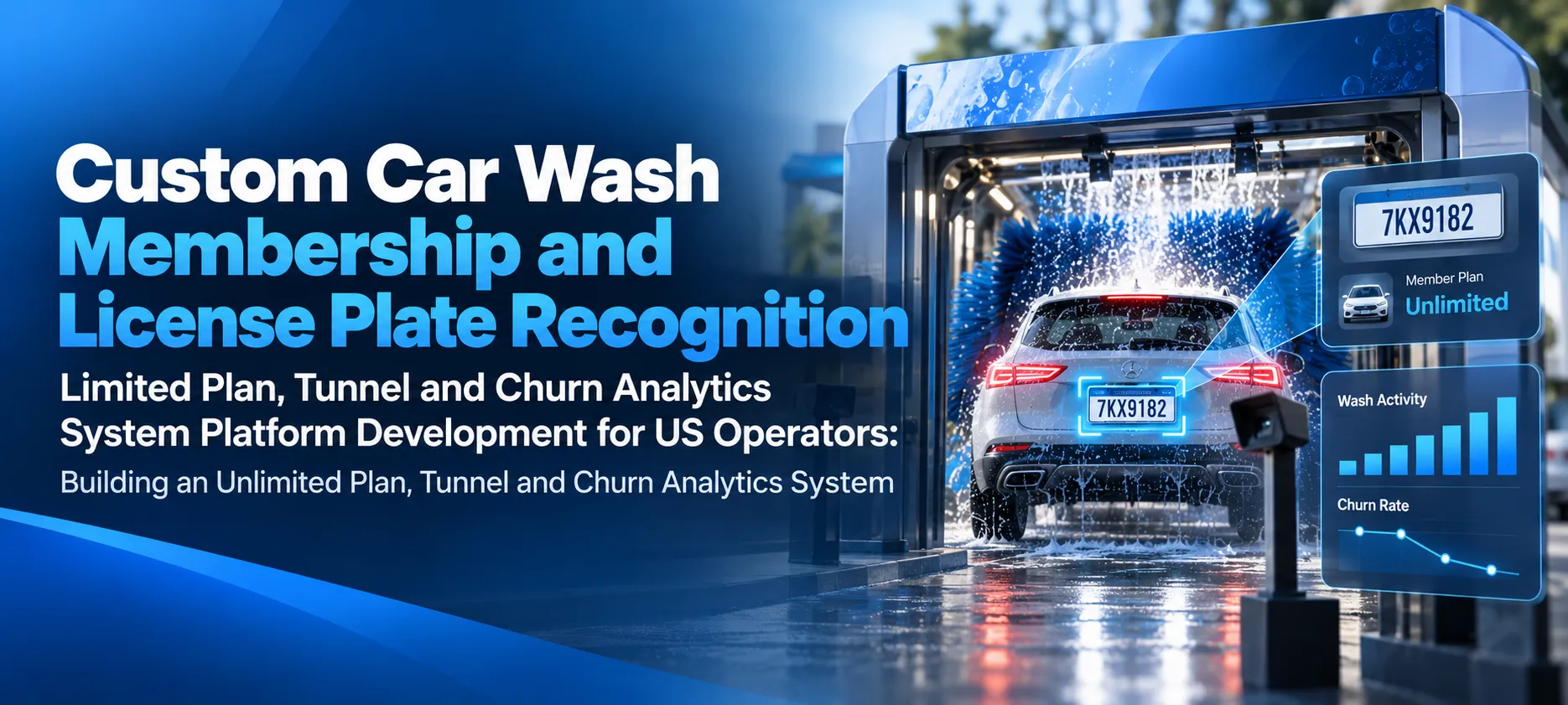
Custom Software Development 12 min read
Custom Car Wash Membership and License Plate Recognition Limited Plan, Tunnel and Churn Analytics System Platform Development for US Operators: Building an Unlimited Plan, Tunnel and Churn Analytics System

You Are Not Selling Washes Any More
A modern express car wash sells subscriptions. The tunnel is how it fulfills them. That reframing decides what car wash software development has to deliver. The economics of the format changed completely when unlimited plans arrived.
Recurring revenue smooths the weather and the seasons. It turns a business dependent on sunny Saturdays into one with predictable monthly income. That predictability explains the capital and consolidation of the last decade. Members per site and the rate at which they leave determine what a location is worth. Retail wash counts matter far less.
The software follows from that. A car wash platform is subscription management with a physical delivery mechanism attached. That means plans, billing, recognition at the lane, self-service, and the analytics that explain why members stay or go. Operators scope that layer as custom software development rather than a point-of-sale upgrade. Signup, self-service, and cancellation run through the browser, making web application development the compliance-critical half of the build.
Two things deserve to be stated at the outset. First, a substantial share of membership loss is involuntary. Cards expire, are reissued, or are declined for reasons unrelated to the member’s intention. It is the most solvable problem in the business and the one most often ignored.
Second, cancellation must be genuinely easy. It is a legal requirement in a growing number of states. It is also where this industry has attracted the most complaints. Operators who treat cancellation as a right rather than a leak protect their reputation.
This guide covers the features, lane and billing integrations, compliance surface, cost, and consultant questions.
The Membership Is the Business
The membership model looks simple and carries more structure than it appears. Plans map to the wash tiers, from a basic exterior to the site’s premium package. Each is priced monthly and sold on the promise of unlimited use.
Where a plan carries restrictions, they need to be clearly disclosed at signup. A limit of one wash per day, with certain vehicle types excluded, or use restricted to certain locations, all qualify. A plan described as unlimited that is not is a consumer protection problem before it is a marketing one.
Membership binds to a vehicle rather than to a person. That is unusual among subscriptions, and it creates most of the operational complexity. One plate per membership is the common model, with family plans covering several vehicles. Members also need to change a plate when they change cars, which happens more often than operators expect.
That binding creates a sharing problem. A membership passed between vehicles is revenue the operator has sold once and delivers several times over. Detection matters, handled proportionately. Most anomalies are a member who bought a new car and forgot to update the account.
Plan changes, upgrades, seasonal holds, and winbacks complete the lifecycle. Retail washes continue alongside all of it. The non-member transaction still accounts for a meaningful share of volume and is a primary source of membership conversion.
The complete feature checklist for an express tunnel and membership operation is covered in Car Wash Software Features: Must-Haves for a US Express Tunnel and Unlimited Membership Operator in 2026.
Recognition at the Lane
The moment that defines the member experience lasts about three seconds. A car approaches the lane, and the gate either opens or it does not.
Two technologies handle it. Radio frequency tags on the windshield were the original method and remain widely installed. They read reliably, but they require a tag per vehicle, plus distribution, replacement, and a member who remembers to move the tag when the car changes. Plate recognition replaced the tag with a camera. There is nothing to fit and nothing to lose, and a new member drives away, unable to use the membership immediately.
The operational reality is that recognition is not perfect. Plates get dirty, obscured, damaged, or replaced with temporary tags. Some states use plate designs that are hard to read. Weather and light affect performance, and a queue at a busy site amplifies every failure.
Exception handling is therefore the feature, not the edge case. A read that comes back uncertain needs a path that keeps the lane moving. That might be an attendant who can look the member up in seconds, a code, or the member’s own phone. A member sitting at a closed gate with cars behind them is having the single worst experience the business can produce.
Many operators run both technologies, with tags as the fallback for members whose plates read poorly. And every read is data, which the sections below take up in more detail.
Churn: The Voluntary Half and the Solvable Half
Churn is the number that determines what the business is worth. Most operators track it as a single figure, which hides the most actionable thing in it.
Voluntary churn is a member deciding to leave. They moved, sold the car, were disappointed with the wash quality, or were not using the plan enough to justify the cost. Reducing it means service quality, plan flexibility, and knowing which members are drifting before they act.
Involuntary churn is a payment that failed. A card expired, was reissued following a fraud event, or was declined for a reason unrelated to the member’s intent to continue. In many subscription businesses, this accounts for a substantial share of total loss. The member is frequently unaware it happened until they arrive at a closed gate.
That distinction matters because the two have entirely different solutions. Only one of them requires persuading anybody.
Involuntary churn is addressed by infrastructure. Account updater services automatically refresh reissued cards. Retry schedules attempt at sensible intervals rather than all at once. Notifications reach members through multiple channels, and a self-service path lets them update their payment in seconds.
Voluntary churn is addressed by understanding behavior. Declining wash frequency, a long gap since the last visit, or a downgrade are all signals worth acting on. The right response is service or a genuine offer.
What those signals must never be used for is treating likely cancellers differently when they try to cancel. That is covered in the next section.
Cancellation, and Why It Must Be Easy
This section exists because the industry has a problem with cancellation, and because software is how that problem is either created or solved.
The pattern is familiar to anyone who has read consumer complaints about subscription businesses. Signing up takes thirty seconds in a lane. Cancelling requires a phone call during business hours, a visit to the site, or a hard-to-find page. Some operators even make a retention call a required step before a cancellation can be processed.
Two things are true about that approach.
First, it creates legal risk. Automatic renewal laws in a growing number of states require cancellation to be at least as easy as signup. Federal law adds to that. ROSCA requires covered online negative option sellers to offer a simple way to stop recurring charges. The FTC has also continued active enforcement around difficult cancellation practices, and its broader negative option rulemaking remains subject to ongoing developments.
Second, it does not work commercially. A member who eventually cancels after an obstructive process is unlikely to come back. They tell other people and may leave a review that costs more than the two months of retained revenue.
The design position is straightforward. Cancellation should be available through the same channel as signup, findable without searching, processed immediately, and confirmed in writing. Any retention offer should be an option, never a gate.
Build it that way and it is both more defensible and better business.
The Plate Data You Are Accumulating
A plate read at a lane is an operational event. This vehicle, this site, this moment, membership valid. Individually it is unremarkable.
In aggregate it is something else. A multi-site operator reads plates at every entrance, year after year. The result is a record of where identifiable vehicles have been and when. That record includes vehicles belonging to people who are not members and simply drove through once.
That deserves deliberate handling rather than default retention. Several states now regulate automated plate recognition. Their statutes cover who may operate a system and the purposes for which the data may be used. They also address how long reads may be kept and whether they may be shared.
The positions worth adopting are the same regardless of what any particular state currently requires. Retain reads for as long as the operational purpose needs and no longer. Retention should be a configured policy rather than an accumulating default. Use the data to operate the membership program and nothing else. Control and log access to it. And never share or sell it to third parties, or provide access outside a lawful process.
One clarification prevents a common error. A plate is not a biometric identifier, and plate recognition does not trigger biometric privacy statutes. Facial recognition would, and it has no place in this application.
What You Should Not Build: The Tunnel Controller
One boundary is worth stating clearly before any scoping conversation, because crossing it is both unwise and unnecessary.
The tunnel controller is the system that drives the physical equipment. It runs the conveyor, arches, applicators, and dryers. It also carries the safety interlocks that stop everything when something is wrong. Specialist vendors supply it as part of an integrated point-of-sale and control system, with safety engineering behind it, because there is a vehicle and frequently a person inside the tunnel.
A custom platform does not replace that and should never be described as doing so.
What a custom platform is, in this category, is the layer above. Membership management, billing, the member relationship, self-service, marketing, and analytics that explain the business. That layer integrates with the controller rather than replacing it. It receives wash events, validates members, and passes plan entitlements. The member application and the lane attendant tool are on the same layer, which is why custom mobile app development is in scope alongside the web surfaces.
That makes the practical question a commercial one. What does the controller vendor permit, what data do they expose, and on what terms? The answer varies by vendor and by contract. Establish it in writing before anything is scoped, because it determines what a custom platform can actually do. That controller connection, alongside plate and tag recognition, recurring billing and the churn models, is examined in License Plate and RFID Recognition, Tunnel Controller Integration, Stripe Recurring Membership Billing and Churn Prediction Models for a Custom US Car Wash Platform.
Compliance: Renewal Law, Payments, Plate Privacy, and Water
Compliance: Renewal Law, Payments, Plate Privacy, and Water
Four compliance surfaces shape a car wash platform. The last one surprises people who came to this from software rather than operations.
Automatic renewal law is the most consequential. Federal requirements govern disclosure, consent, and cancellation for recurring charges. The federal rulemaking behind them has been through litigation and remains unsettled.
State statutes are the operative layer, and they typically require five things. Renewal terms must be disclosed clearly before the transaction. Affirmative consent to the recurring charge must be captured specifically. A post-purchase acknowledgment should be provided for the member to keep. Some states require renewal reminders. Cancellation must be at least as easy as signup, with online cancellation where signup was online.
Payment card obligations follow from operating recurring billing at scale. A chain holds stored credentials for every member indefinitely. That makes tokenization the architectural answer rather than an option.
Plate data is regulated in an increasing number of states, covering its use, retention, and sharing.
Water is the one that belongs to the physical business. Wash water discharged to a sanitary sewer is typically regulated by the local treatment authority under a pretreatment program. That can require a permit, sampling, and periodic reporting. Discharge to storm drains is generally prohibited. Separators and interceptors require maintenance, with waste disposal documented. Some jurisdictions require or incentivize reclamation, and water-stressed areas may set requirements on reclaim or per-vehicle use.
That produces records and reports a platform can usefully hold. It also produces requirements that vary enormously by jurisdiction. Each of those four surfaces, and the specific design decisions each one forces, is set out in ROSCA and State Automatic Renewal Laws, PCI DSS, ALPR Privacy Statutes and Water Reclamation Reporting Compliance for US Car Wash Software.
This is educational content, not legal advice. Confirm renewal and cancellation practice with consumer protection counsel. Take discharge questions to the local treatment authority and environmental counsel.
Cost and the Staged Build Sequence
Assuming the controller vendor permits it, the build stages by the member’s own lifecycle.
Stage 1 is membership and billing. It covers plans with accurate restriction disclosure, multi-channel signup, and tokenized recurring billing. Plate binding, dunning with account updater, and cancellation built to the standard the law now sets belong here too. Roughly $85K–$160K over 5–7 months.
Stage 2 is lane integration and recognition. It covers the point-of-sale and controller connection, plate and tag recognition with confidence handling, and member validation at the gate. Exception paths and retail transaction handling complete it. Add roughly $80K–$150K over 4–6 months.
Stage 3 is the member application and customer relationship layer. It covers plan management, wash history, payment updates, and referrals. Marketing with consent handling and winback finishes the stage. Add roughly $80K–$150K over 4–6 months.
Stage 4 is analytics and multi-site operations. It covers churn analysis split between voluntary and involuntary, cohort reporting, and site performance. Labor, throughput, and the water and maintenance records the physical operation generates also land here. Add roughly $85K–$160K over 5–7 months.
A full four-stage platform lands broadly in the $330K–$620K range across 18–26 months. All figures are 2026 planning ranges, not quotes.
The feature-by-feature pricing, the items operators forget, and the comparison with established platforms are covered in Custom Car Wash Membership and LPR Platform Development Cost in the United States: Feature by Feature Pricing for US Operators.
Final Thoughts
The business has become a subscription with a tunnel attached. Operators should build around what actually moves enterprise value.
That means recovering members lost to failed cards rather than to dissatisfaction. It means keeping lanes moving when a plate reads badly. It also means making cancellation genuinely easy, because cancellation is both a customer right and better business practice.
The tunnel controller stays with the people who build the equipment. Everything above it is where a custom platform earns its cost.
If you are evaluating a custom membership platform, start with two questions. What does your controller vendor permit? How much of your churn is involuntary? Answering them before mapping features determines whether the project targets the money actually available. Those two sit among the five an operator should put to any prospective partner, set out in The Five Questions US Car Wash Operators Should Ask a Technology Consultant Before Funding a Custom Membership and LPR Platform.
NewAgeSysIT helps operators frame both questions before scoping begins. Learn more about digital transformation solutions from one of the leading AI software companies in the United States.
FAQ
What is car wash membership management software?
Car wash membership management software is a platform that manages recurring wash plans, member vehicles, payments, plan changes, cancellations, lane access, and customer communication. For express tunnel operators, it can connect membership status with license plate recognition or RFID systems so eligible vehicles are identified when they arrive. More advanced platforms also provide churn analytics, multi-site management, dunning, marketing automation, and operational reporting.
What features should custom car wash membership software include?
Custom car wash membership software should include unlimited plan management, recurring billing, vehicle and license plate management, LPR or RFID integration, lane validation, payment recovery, self-service cancellation, plan upgrades, holds, and multi-site access. Operators may also need member apps, referral programs, wash history, churn analytics, site performance dashboards, customer notifications, staff tools, and integrations with existing POS and tunnel-management systems.
How does license plate recognition work for car wash memberships?
License plate recognition uses cameras and software to read a vehicle’s plate as it approaches the wash lane. The platform compares the plate with active membership records and determines whether the vehicle is eligible for the selected wash plan. Because plate reads are not always perfect, the system should also support confidence thresholds and fast exception workflows such as attendant lookup, RFID fallback, or another member-verification method.
Is license plate recognition better than RFID for car wash memberships?
LPR and RFID solve the same identification problem differently. License plate recognition requires no windshield tag and can make enrollment easier because the vehicle itself becomes the identifier. RFID can provide reliable recognition but requires distributing and maintaining physical tags. Many operators may benefit from supporting both technologies, using LPR as the primary method and RFID or attendant verification when plates cannot be read reliably.
How should car wash software handle failed membership payments?
Car wash software should separate failed-payment churn from customers who intentionally cancel. When recurring payments fail, the platform can use payment retry schedules, account updater services, customer notifications, and a simple self-service payment-update workflow. The objective is to recover memberships from customers who still want the service without creating unnecessary lane problems. Payment recovery should also be measured separately from voluntary membership cancellations.
What is churn analytics in car wash membership software?
Churn analytics helps operators understand why recurring members leave and identify patterns that may signal cancellation risk. Useful metrics include declining wash frequency, days since the last visit, failed payments, plan downgrades, site usage, tenure, and cancellation reasons. The platform should distinguish voluntary churn from involuntary churn because a member choosing to leave requires a different response from a member lost because a stored payment method failed.
Can car wash software predict which unlimited-plan members may cancel?
Yes. A custom analytics platform can identify behavioral signals associated with higher cancellation risk, such as declining visit frequency, unusually long gaps between washes, repeated payment failures, or plan downgrades. These signals can help operators improve service, communicate appropriately, or offer relevant plan options. Churn scores should not be used to make cancellation harder for customers who have already decided to end their membership.
Should custom car wash software control the tunnel equipment?
Generally, no. Custom membership software should operate above the specialized tunnel-control system rather than replace the controller responsible for conveyors, arches, applicators, dryers, and safety interlocks. The custom platform can integrate with approved POS or controller interfaces to validate memberships, exchange wash events, and pass plan entitlements. Integration capabilities should be confirmed with the tunnel or POS vendor before the custom platform is scoped.
Core Development
Keep exploring the custom services.

AI Software Development
Custom AI Software Development
Build intelligent, production-ready software from machine-learning models to AI-driven automation designed around your business goals.
Learn more
Mobile App Development
Custom Mobile Application Development
Native and cross-platform mobile apps that are fast, secure, and built to scale across iOS and Android.
Learn more
Web App Development
Custom Web Application Development
Scalable, secure web applications, from customer portals to complex dashboards, tailored to how your business actually works.
Learn more



