
Welcome to Blogs
Discover actionable insights, in-depth research, and expert perspectives, all in one place.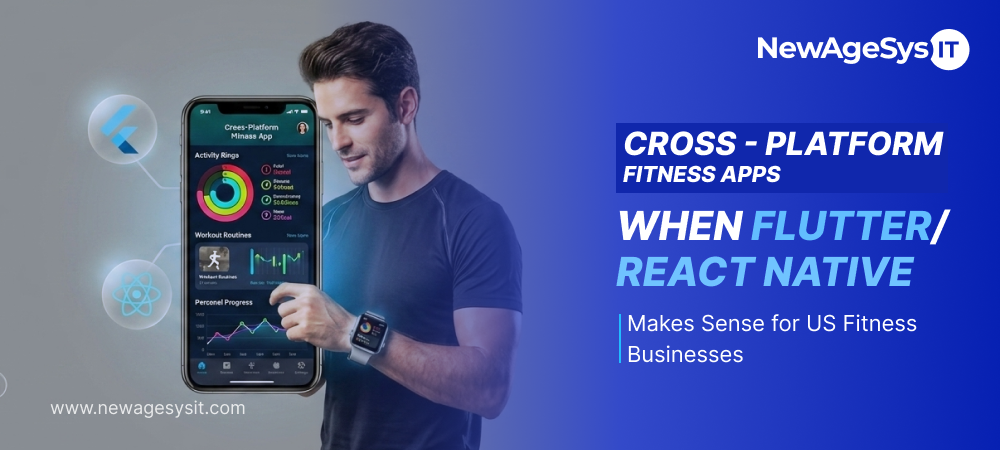
App Development 8 min read
Cross-Platform Fitness Apps: When Flutter/React Native Makes Sense for US Fitness Businesses

For US fitness businesses, building separate iOS and Android apps in 2026 means doubling development costs without doubling business impact.
A cross-platform fitness app in the USA strategy is now the smarter default for consumer fitness brands. Flutter and React Native help teams launch faster, manage one shared codebase, and reduce development costs by nearly 30–50%.
And honestly, most fitness apps do not need separate native builds. Class bookings, memberships, workout tracking, nutrition logging, push notifications, and community features work smoothly across both frameworks. That is why many brands choose cross-platform development early. Especially those investing in fitness mobile and web app development services and scalable fitness software and CRM development services.
But where does cross-platform work well in fitness apps, and where does it start falling apart? Let’s break it down.
US Fitness App Features That Cross-Platform Handles Well
Most fitness apps are not pushing mobile hardware to its limits. They are managing users, workouts, schedules, payments, and engagement. That is exactly where a cross-platform gym app performs extremely well.
Another major advantage? Compliance updates become easier to manage. Teams can roll out HIPAA workflow changes across both mobile and web application development platforms together.
The same applies to HealthKit governance updates and CCPA consumer rights requests. This removes the need for maintaining two separate implementations.
This removes the need for maintaining two separate custom software development implementations.
Class Scheduling and Booking
Real-time class calendars, bookings, cancellations, waitlists, and reminder notifications are mostly API-driven features. Flutter fitness app and React Native workout app frameworks handle these experiences smoothly, even for multi-location gym chains.
Workout Tracking and Nutrition
Workout logging, rep tracking, progress charts, macro tracking, barcode scanning, and food database search are UI-heavy experiences. Both frameworks support these features reliably through native camera and networking capabilities.
Member Management and Communication
Membership updates, billing management, loyalty programs, leaderboards, automated notifications, and in-app messaging are standard SaaS development engagement features. Most modern Android fitness app developmentteams already build these efficiently with cross-platform architecture.
When Cross-Platform Is Not the Right Choice for Fitness
Cross-platform custom mobile app development works for most fitness apps. But some experiences still demand native development.
The biggest limitation is Apple Watch workout apps. watchOS fitness tracking still depends heavily on native Swift development. Flutter and React Native cannot fully replicate that experience yet. This is where many premium iOS fitness app development projects stay native from day one.
Advanced health sensor access is a challenge as well. Real-time ECG streaming, continuous blood oxygen tracking, and deeper HealthKit integrations may require native APIs beyond standard cross-platform bridges.
Hardware-heavy fitness products also run into limitations. ANT+ sensors and proprietary gym equipment often need native Bluetooth implementation for stable communication.
And honestly, real-time performance experiences are where cross-platform starts struggling. Live workout overlays with heart rate or cadence tracking need low-latency sensor access. The same applies to AI-powered form correction using real-time pose estimation and platform-specific ML frameworks.
Flutter vs React Native for US Fitness Apps
| Feature | Flutter | React Native |
|---|---|---|
| UI Feel | Smoother animations and fitness dashboards | Flexible and familiar |
| Workout Streaming | Catching up fast | Better video ecosystem |
| Wearables | Works through native modules | Works through native modules |
| Notifications | Strong support | Strong support |
| Developer Pool | Growing quickly | Bigger talent pool |
| Best For | Performance heavy fitness apps | Content and community driven apps |
Flutter works better for fitness apps built around highly interactive experiences. Workout timers, live dashboards, progress rings, and animated tracking interfaces benefit from Flutter’s rendering performance.
React Native remains the stronger choice for video-first fitness products. Live classes, on-demand workout libraries, and community-driven platforms benefit from its larger JavaScript ecosystem and mature streaming support.
For wearable-focused fitness apps, both frameworks still depend heavily on native bridge modules for HealthKit and Google Health Connect integrations. In these cases, the development team’s real production experience matters more than the framework itself.
For most US fitness businesses, the choice becomes pretty straightforward:
- Choose Flutter for performance-heavy workout experiences and advanced fitness tracking
- Choose React Native for content-driven fitness platforms and faster hiring scalability
- Choose fully native development only when wearable performance or device-level integrations become the core product experience
Wearable Integration Architecture in Cross-Platform Fitness Apps
This is where cross-platform fitness apps stop looking “simple” behind the scenes.
HealthKit on iOS and Health Connect on Android still require platform specific native code. Flutter and React Native mainly act as the shared UI layer above it. The actual health data access still happens through native engineering.
Thankfully, packages like health for Flutter and react-native-health reduce a lot of manual integration work. That makes wearable syncing far more manageable for teams building custom mobile app development services, and scalable custom software development services.
But wearable syncing is not just about pulling step counts. iOS and Android structure workout and health data differently. Cross-platform apps must normalize everything into one consistent system.
Permissions are different too. HealthKit and Health Connect follow separate approval flows inside the same app experience. And wearable testing on simulators is rarely enough. Real devices and actual wearables are necessary for proper validation.
Cross-Platform Fitness App Development Timeline
| App Type | Timeline | Team Size |
|---|---|---|
| Basic fitness tracker | 3 to 4 months | 3 to 4 engineers |
| Mid scale fitness app | 5 to 7 months | 4 to 6 engineers |
| Full fitness platform | 10 to 16 months | 6 to 10 engineers |
A basic cross-platform fitness app USA project usually includes workout logging, push notifications, and member management.
Mid scale hybrid fitness app projects add wearable syncing, nutrition tracking, and class booking features.
Large scale cross-platform health app platforms often include AI coaching, workout streaming, trainer dashboards, and advanced wearable integrations.
Many fitness startups underestimate how fast scope expands. Wearable syncing, streaming, and AI features quickly add integration and testing complexity. That is why the team structure matters as much as the framework choice.
Most successful hybrid fitness app projects use Flutter or React Native engineers. Native iOS and Android specialists handle HealthKit and Health Connect integrations. QA becomes equally important once real devices enter the picture. Fitness apps behave very differently across wearables, operating systems, and Bluetooth connected hardware.
Final Thoughts
For most consumer fitness platforms, cross-platform development is now the smarter starting point. Flutter and React Native help businesses launch on iOS and Android faster while keeping development costs lower. Wearable integrations are also achievable through native HealthKit and Health Connect modules.
What matters more is understanding your actual product requirements before choosing a framework. Businesses that evaluate Apple Watch dependencies, advanced HealthKit access, and hardware integrations early usually avoid overbuilding and platform limitations later.
If your organization is exploring a cross-platform fitness app USA strategy, the right technical direction matters early. Cross-platform fitness app development experts can help assess whether Flutter or React Native fits your scalability, wearable integration, and long term cost goals. Learn more about digital transformation solutions from a leading AI software company in the United States.
FAQ
Is cross-platform development a good choice for a fitness app?
Yes, for many fitness applications. Flutter and React Native are suitable for workout logging, class booking, nutrition tracking, memberships, payments, push notifications, community features, and progress dashboards. Cross-platform development becomes less straightforward when the product depends heavily on continuous sensor processing, specialized Bluetooth hardware, watchOS features, or platform-specific health capabilities that require significant native engineering.
Should a fitness business choose Flutter or React Native?
The choice should depend on product requirements and available engineering skills rather than a simple framework ranking. Flutter provides its own rendering system and supports extensive custom interfaces. React Native integrates JavaScript and React with native platform capabilities through its current architecture. Both support native extensions when required. Existing team experience, libraries, wearable requirements, hiring availability, and maintenance strategy should influence the decision.
What fitness app features work well with Flutter and React Native?
Common fitness workflows work well with both frameworks. These include account management, memberships, class schedules, bookings, workout logs, progress charts, nutrition tracking, barcode scanning, push notifications, leaderboards, messaging, and subscription management. Most of these capabilities depend primarily on APIs, application logic, and standard mobile interfaces rather than continuous access to specialized device hardware.
Can Flutter and React Native integrate with Apple HealthKit?
Yes. HealthKit itself is an Apple platform framework that requires the appropriate HealthKit capability and user authorization. Flutter applications can access platform-specific functionality through plugins and platform channels. React Native can expose native iOS APIs through Native Modules. Existing packages may cover common health data requirements, while advanced features may require custom Swift integration.
Can cross-platform fitness apps use Google Health Connect?
Yes. Health Connect allows Android applications to read and write supported health and fitness records with user permission. Cross-platform applications can connect to it through compatible libraries or native Android modules. Google requires developers to declare the health data types they access and provide valid use cases for those permissions. Health Connect 1.1.0 is a stable production release in 2026.
Do wearable integrations require native development?
Not always. Common HealthKit or Health Connect workflows may be handled through existing Flutter plugins or React Native libraries. Native Swift or Kotlin development becomes more important when the application requires functionality that available libraries do not expose. Examples can include specialized sensor behavior, custom Bluetooth protocols, proprietary gym equipment, advanced watch functionality, or deeply platform-specific health workflows.
When should a fitness app use native iOS and Android development?
Native development becomes more attractive when device-level functionality is central to the product. Examples include sophisticated Apple Watch experiences, intensive Bluetooth communication, specialized sensors, real-time hardware processing, or platform-specific machine learning. Native development may also make sense when separate iOS and Android experiences are intentional product requirements rather than duplicated implementations of the same workflow.
Can Flutter or React Native support Apple Watch fitness features?
The mobile application can be cross-platform while the Apple Watch component uses native Apple technologies. Flutter’s officially documented target platforms include iOS and Android but not watchOS as a primary Flutter target. Cross-platform teams can therefore use a hybrid architecture where shared mobile functionality remains in Flutter or React Native while watch-specific workout functionality is implemented natively when required.
Core Development
Keep exploring the custom services.

AI Software Development
Custom AI Software Development
Build intelligent, production-ready software from machine-learning models to AI-driven automation designed around your business goals.
Learn more
Mobile App Development
Custom Mobile Application Development
Native and cross-platform mobile apps that are fast, secure, and built to scale across iOS and Android.
Learn more
Web App Development
Custom Web Application Development
Scalable, secure web applications, from customer portals to complex dashboards, tailored to how your business actually works.
Learn more



