
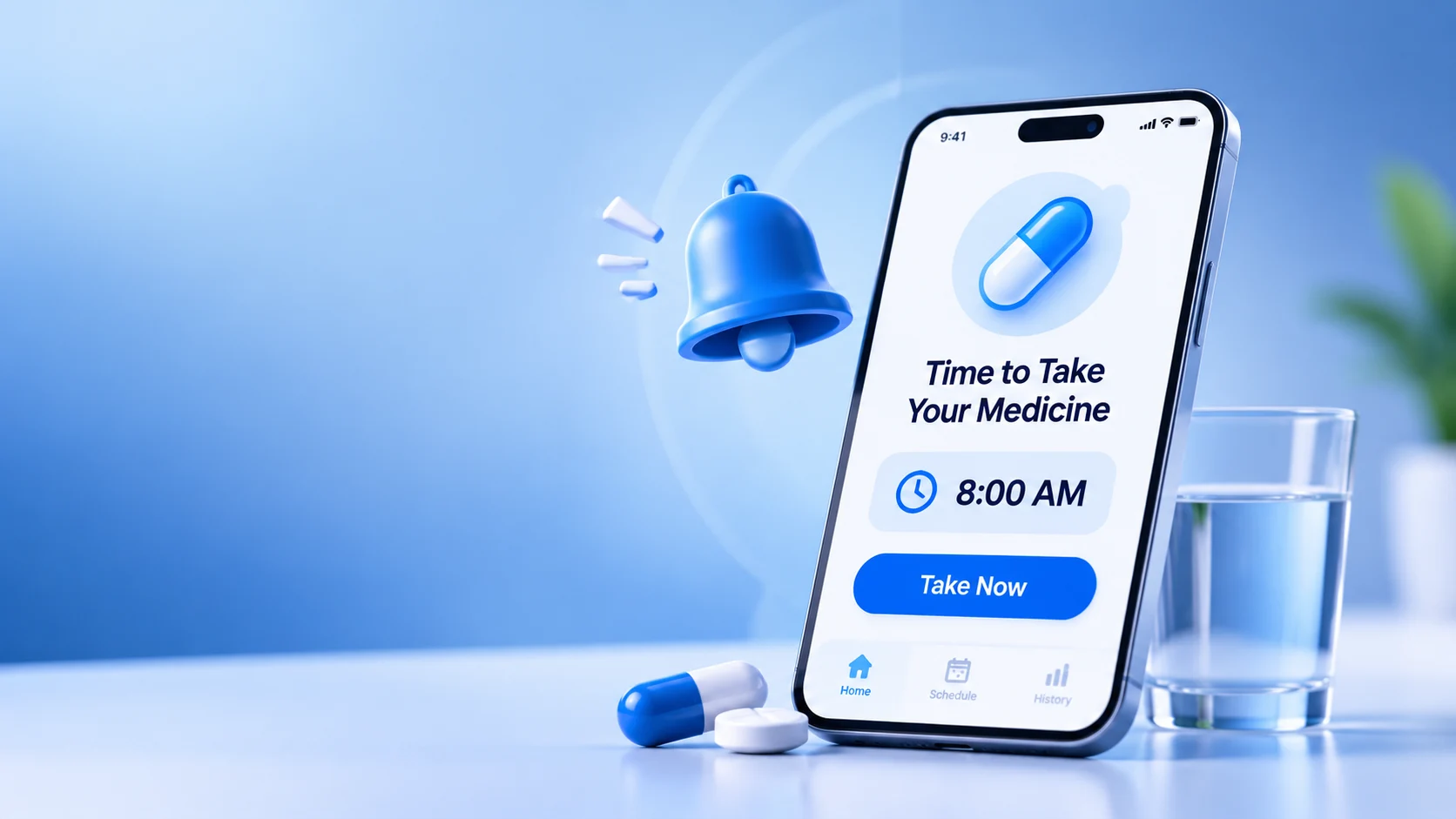

- Around half of people with a chronic condition do not take their medication as prescribed, and roughly 60% of US adults have at least one chronic condition. That is the market.
- Be careful with the money figure everyone quotes. The research says nonadherence costs the US health system somewhere between $100 billion and $289 billion a year. The larger $528 billion number covers all non-optimized medication therapy, not nonadherence alone.
- Reminders alone rarely change behavior for long. The apps that work reduce friction: refill prompts, caregiver visibility, simple schedules, and honest logging.
- Four rule sets decide your build: HIPAA if you work for a provider or plan, the FTC Health Breach Notification Rule if you are a consumer app, FDA policy if your features cross from tracking into advice, and text message consent rules for reminders.
- A consumer MVP costs about $7,500 to $34,300 at our rates. A clinical or pharmacy platform with provider dashboards and record integration starts around $40,000.
- The hardest technical work is not the reminder. It is the medication data, the schedule engine, and the integrations.
Quick answer: How do you build a pill reminder app? Start with the medication list, a schedule engine that handles real-world regimens, reliable notifications, and simple dose logging. Add caregiver access, refill tracking, and a drug database, then integrate with pharmacy or clinical systems if you serve providers. A consumer MVP takes 6 to 10 weeks and costs about $7,500 to $34,300 at NewAgeSysIT rates, while a clinical platform runs 6 to 12 months.
A pill reminder app looks like a to-do list with a clock. Then the requirements arrive: a medication taken every other day, one taken only with food, one tapering by half a tablet a week, a caregiver 200 miles away who needs to know it was taken, and a refill that runs out on a Sunday.
This guide covers what these apps need, which rules apply in the US, how they integrate with pharmacies and clinical systems, what they cost, and which features actually change behavior. It reflects how we scope custom mobile app development for health and care clients.
Who Builds Medication Reminder Apps, and Why
| Who | What they want from it | How it pays for itself |
|---|---|---|
| Consumer app companies | Daily engagement and subscriptions | Subscriptions, premium family plans |
| Pharmacies and pharmacy chains | Refills on time and prescriptions kept in-house | Prescription volume and retention |
| Health systems and clinics | Better outcomes, fewer avoidable admissions, quality scores | Value-based contracts, readmission penalties avoided |
| Pharma patient support programs | Patients staying on therapy through the first 90 days | Persistence on a specific drug |
| Home health and senior care | Fewer missed doses and incidents, family reassurance | Service differentiation, staff time saved |
| Health plans | Adherence measures that affect quality ratings | Star ratings and medical cost reduction |
The feature list changes completely depending on which of these you are. A consumer app lives or dies on daily engagement. A health system app lives or dies on whether it fits the clinical workflow and reports into the record, which is the same pattern we cover in our post on remote patient monitoring app features. Pick one before writing requirements.
The Adherence Problem, Stated Accurately
Roughly 50% of patients with a chronic condition do not take their medication as prescribed, and about 60% of US adults have at least one chronic condition, with 40% having more than one. Nonadherence is linked to avoidable hospitalizations and deaths, which is why payers and providers fund these programs.
On cost, be precise, because buyers in this market have heard the inflated version. The commonly repeated "$300 billion a year" traces back to a review that actually estimated $100 billion to $289 billion. A separate and larger figure, about $528 billion in 2016 dollars, covers the cost of all non-optimized medication therapy, which is a much wider category than people forgetting doses. Quote the narrower range and you will sound more credible, not less.
Evidence that apps can help does exist. A 2026 analysis of Medicaid claims covering 6,716 adults managing chronic conditions found that an adherence app increased medication adherence and reduced unnecessary healthcare use and costs over nine months. The useful detail for product teams is that the apps with results do more than buzz at 9 a.m.: they remove friction, involve someone else, and make the next refill easy.
Core Features
Patient app
| Feature | What it has to handle |
|---|---|
| Medication list | Name, strength, form, prescriber, purpose, and a photo of the actual pill or package |
| Schedule engine | Daily, multiple times a day, every other day, weekly, cyclical, as-needed, tapers, and "with food" rules |
| Reminders | Push and optional SMS, snooze, reschedule, quiet hours, and escalation when a dose is missed |
| Dose logging | Taken, skipped, or taken late, with one tap and no judgment in the copy |
| Refill tracking | Days of supply remaining, refill reminders, and a link to order or call the pharmacy |
| History and reports | A view a patient can show a clinician, exportable as PDF |
| Multiple profiles | One account managing medications for a partner, parent, or child |
| Accessibility | Large text, high contrast, voice entry, and screen reader support, since many users are older |
Caregiver features
| Feature | Why it matters |
|---|---|
| Invited access | A family member or aide sees the schedule without taking over the account |
| Missed dose alerts | Notification after a configurable delay, not immediately |
| Shared notes | Observations a clinician might need at the next visit |
| Permission levels | View only, log on behalf, or full management, chosen by the patient |
Provider, pharmacy, and admin side
| Feature | Why it matters |
|---|---|
| Patient roster and adherence view | Who is falling behind, sorted by risk rather than alphabetically |
| Outreach tools | Secure message, call task, or refill nudge, with a record of what was sent |
| Program reporting | Adherence rates by cohort, drug, or clinic for the people funding the program |
| Audit logs | Who accessed what and when, which is required once protected health information is involved |
| Consent management | What the patient agreed to, when, and for which data sharing |
That staff-facing side runs in a browser, so it is a custom web application development project alongside the mobile app, sharing one backend.
Features That Actually Change Behavior
Reminder fatigue is real: notifications that arrive at the wrong moment get dismissed, and dismissal becomes a habit within weeks. These design choices separate apps that hold adherence from apps that get deleted:
- Make logging one tap, from the notification. Every extra screen loses users.
- Let people reschedule, not just snooze. Real life moves doses, and an app that cannot follow reality gets ignored.
- Reduce refill friction. Most "forgetting" is actually running out. Days-of-supply tracking plus a refill link does more than another alarm.
- Involve one other person. Caregiver visibility is consistently the strongest retention feature in this category.
- Use photos of the actual medication. It helps with identification, especially where generics change appearance between refills.
- Be careful with streaks. Rewarding a perfect run can push people to log doses they did not take, which makes your data worse than useless for clinical use.
- Never guess on missed doses. "Take it as soon as you remember" is wrong for some drugs. Point people to their pharmacist or provider instead.
Integrations
| Integration | What it enables | Difficulty |
|---|---|---|
| Drug database | Accurate names, strengths, forms, and pill images, plus interaction data if licensed | Medium, usually a paid data license |
| Pharmacy systems | Refill status, order placement, and pickup notifications | Medium to high, varies by chain |
| EHR through FHIR | Medication lists pulled from the clinical record and adherence data written back | High, and the main cost driver in clinical builds |
| Apple Health and Health Connect | Medication and health data shared with the platform health apps users already have | Low to medium |
| Wearables | Reminder delivery on a watch, which materially improves response rates | Low |
| Smart dispensers and caps | Objective dose evidence rather than self-report | Medium, device dependent |
| Messaging | Push, SMS, and voice reminders for users who do not open apps | Low, with consent tracking required |
| Telehealth | A route from a missed-dose pattern to an actual conversation | Medium |
Two notes that save months. Medication data is licensed, not free, so budget for it early. And clinical integration is where timelines slip, because access to a health system's interfaces is an organizational process as much as a technical one.
On the platform side, Apple's Health app has handled medications since iOS 16, so iOS app development for this category means deciding where you complement the built-in feature rather than duplicating it.
Whichever platform you start on, test reminder delivery against battery optimization settings, do-not-disturb modes, and locked screens. A reminder that arrives silently is the same as no reminder.
The Android equivalent runs through Health Connect, and because this audience skews older and more price-sensitive, Android app development here has to work well on mid-range and older devices rather than only current flagships.
The Four Rule Sets That Shape the Build
| Rule set | When it applies | What it means in the product |
|---|---|---|
| HIPAA | Your app is built for or on behalf of a provider, plan, or their business associate | Access controls, audit logs, encryption, a business associate agreement, and breach notification workflows |
| FTC Health Breach Notification Rule | You are a consumer health app outside HIPAA | Breach notification to users, the FTC, and sometimes the media. Amendments effective July 29, 2024 made clear the rule covers most health apps, and penalties run to about $53,088 per violation |
| FDA policy on device software | Your features move from tracking into interpretation | Simple reminder and logging apps are treated as low risk. Features that calculate doses, interpret readings, or direct treatment can make the app a regulated device. Confirm your classification using FDA's digital health policy guidance before you build them |
| Text message rules | You send reminders or any marketing by SMS | Documented consent per user, a working opt-out, and records you can produce later |
Three more that apply to most builds: state health privacy laws such as Washington's My Health My Data Act, which reaches consumer health data outside HIPAA; accessibility to WCAG 2.1 Level AA, which matters more here than in most categories because of who uses these apps; and app store privacy disclosures for both platforms. Our healthcare app development guide covers how these rules play out across healthcare products generally.
The FTC's enforcement record is worth knowing when you set data sharing policy. Its first action under the health breach rule was against a prescription discount app, which paid a $1.5 million civil penalty for sharing user health information with advertising platforms without authorization. Analytics and advertising SDKs are the usual route to that outcome, so audit every SDK that can see medication data.
Security here is ordinary engineering done properly: encryption in transit and at rest, access control by role, audit logs, secrets in a vault, and penetration testing before launch and on a schedule after it, which is what our IT security and cybersecurity services cover. This section is general information, not legal advice.
AI Features, and Where the Line Sits
AI earns its place in this category in three safe places:
Adherence risk scoring. A model trained on logging patterns, refill timing, and engagement can flag who is likely to fall off therapy in the next 30 days, so a pharmacist or care manager can call. The output goes to a person, not to the patient as a warning.
Smarter reminder timing. Learning when each user actually responds and shifting the nudge accordingly, within the clinical constraints of the prescription.
Label and prescription capture. Reading a pharmacy label with the camera to populate a medication entry, with the user confirming every field before it saves.
Two things to avoid. Do not use image recognition to tell someone what a pill is as a standalone answer, because misidentification has direct safety consequences. And never generate advice about missed doses, interactions, or dosage changes. Build the handoff to a pharmacist instead. Models that score risk for staff review belong in our AI agent development work, with a human making every clinical decision.
What a Pill Reminder App Costs
| Product | What it includes | Approximate effort | NewAgeSysIT estimate | Timeline |
|---|---|---|---|---|
| Consumer MVP | Medication list, schedule engine, reminders, logging, history, one platform or cross-platform | 300 to 700 hours | $7,500 to $34,300 | 6 to 10 weeks |
| Full consumer app | Caregiver access, refill tracking, drug database, health platform sync, reports, subscriptions | 700 to 1,600 hours | $17,500 to $78,400 | 3 to 6 months |
| Clinical or pharmacy platform | Provider dashboard, EHR or pharmacy integration, outreach tools, audit and consent, compliance work | 1,600 to 3,500+ hours | $40,000 to $171,500+ | 6 to 12 months |
Here is how the work splits, at NewAgeSysIT's rates of $25 to $49 per hour.
| Feature | Approximate hours | NewAgeSysIT cost |
|---|---|---|
| Medication list and schedule builder | 80 to 180 | $2,000 to $8,820 |
| Reminder and notification engine | 80 to 200 | $2,000 to $9,800 |
| Dose logging and history | 60 to 140 | $1,500 to $6,860 |
| Caregiver accounts and alerts | 80 to 180 | $2,000 to $8,820 |
| Refill tracking and pharmacy links | 60 to 160 | $1,500 to $7,840 |
| Drug database integration | 60 to 160 | $1,500 to $7,840 |
| Label or barcode scanning | 60 to 160 | $1,500 to $7,840 |
| Apple Health and Health Connect sync | 40 to 120 | $1,000 to $5,880 |
| Provider or pharmacy dashboard | 120 to 300 | $3,000 to $14,700 |
| EHR integration through FHIR | 120 to 320 | $3,000 to $15,680 |
| Adherence reporting and analytics | 80 to 200 | $2,000 to $9,800 |
| Accessibility work to WCAG 2.1 AA | 60 to 160 | $1,500 to $7,840 |
| Security, audit logs, and consent management | 80 to 180 | $2,000 to $8,820 |
Running costs include hosting, push and SMS fees per message, the drug database license, monitoring, store fees, and maintenance at roughly 15% to 25% of the build cost each year. SMS is the line that surprises teams, because a daily reminder to 10,000 users is 300,000 messages a month.
For a first figure on your own scope, try our app cost calculator.
Build Timeline
| Phase | What happens | Duration |
|---|---|---|
| Discovery | Audience, regimen complexity, compliance path, integration targets | 1 to 2 weeks |
| Design | Medication entry, reminder, logging, and caregiver flows, with accessibility built in | 2 to 4 weeks |
| Core build | Schedule engine, notifications, logging, history, accounts | 6 to 10 weeks |
| Integrations | Drug data, pharmacy, health platforms, and clinical systems where in scope | 3 to 8 weeks |
| Compliance and testing | Security review, consent flows, accessibility testing, store privacy disclosures | 2 to 4 weeks |
| Pilot and launch | A small cohort, then a staged rollout with real adherence measurement | 3 to 6 weeks |
The schedule engine is the piece teams underestimate. Every-other-day regimens, tapers, time zones, daylight saving changes, and "take with food" rules each produce their own edge cases, and getting them wrong is both a trust problem and a safety problem.
How These Apps Make Money
| Model | How it works | Fits |
|---|---|---|
| Freemium subscription | Free for one or two medications, paid for family profiles, reports, and caregiver access | Consumer apps |
| Family plan | One subscription covering multiple profiles | Caregiver-focused products |
| B2B licensing | Health systems, pharmacies, or home care agencies pay per patient or per site | Clinical products |
| Pharma program funding | A manufacturer funds the app for patients on a specific therapy | Patient support programs |
| Plan contracts | Health plans fund adherence programs tied to quality measures | Payer-facing products |
| Pharmacy pull-through | The app is free, and refills keep prescriptions at that pharmacy | Pharmacy chains |
Advertising is the one model to avoid here. Ad and analytics SDKs with access to medication data are exactly what triggered the FTC's enforcement in this category.
Notes for Philadelphia and the Region
- Large health systems concentrate the B2B opportunity. Philadelphia has several major systems and academic medical centers, so clinical pilots usually start as a single-department project rather than a region-wide deal.
- Pharmacy density matters. Independent pharmacies in the region are a realistic first customer for a white-label app, since they compete with chains on service rather than price.
- The age mix favors caregiver features. Pennsylvania has one of the older populations in the country, which pushes accessibility, large text, and family access from "nice to have" to core.
- Medicaid managed care is a funding path. Adherence programs tied to quality measures are easier to fund through plans than through consumer subscriptions.
- Pilot locally, design nationally. Build for US-wide rules and integrations even if your first ten customers are within an hour's drive, because the second ten rarely are.
Mistakes to Avoid
- Building the reminder first. The schedule engine and medication data model are the real product.
- Assuming HIPAA applies, or assuming it does not. The answer depends on who you build for, and the FTC rule fills the gap for consumer apps.
- Letting analytics SDKs see medication data. This is the single most expensive mistake in this category.
- Designing for a 30-year-old. The heaviest users are older, often with vision or dexterity constraints.
- Gamifying accuracy away. Streaks that punish honesty corrupt the adherence data you want to sell to clinical buyers.
- Giving clinical advice in copy. "Take it as soon as you remember" is not safe for every medication.
- Ignoring SMS costs and consent. Both scale with your user base, in opposite directions.
How NewAgeSysIT Helps
NewAgeSysIT is a US software company based in Princeton, New Jersey, with more than 30 years of experience and its own offshore development centers, which is how we deliver at $25 to $49 per hour with US-based project leadership.
- Scoping by audience, so a consumer app and a clinical program are not scoped the same way.
- Schedule and reminder engineering that handles real regimens, time zones, and edge cases.
- Integrations with drug databases, pharmacy systems, health platforms, and clinical records through FHIR.
- Compliance work covering HIPAA where it applies, the FTC health breach rule where it does, consent, and accessibility.
- Security testing and audit readiness before launch and on a schedule after it.
- Measurement, because adherence programs are bought on evidence and renewed on reporting.
This work sits inside our healthcare mobile app development services, which cover patient apps, provider tools, and connected care products.
Conclusion
A pill reminder app is a behavior product wearing a software interface. The engineering that matters is the schedule engine, the medication data, and the integrations. The design that matters removes friction and brings one other person into the loop. And the compliance that matters depends on who you build for, not on what you call the app.
Get those three right and the rest is ordinary delivery. If you want that scoped against your own audience and budget, talk to one of the leading AI software companies in the United States for a free consultation.
Frequently Asked Questions
How much does it cost to build a pill reminder app?
A consumer MVP runs about $7,500 to $34,300 at our rates, a full consumer app with caregiver features and integrations $17,500 to $78,400, and a clinical or pharmacy platform $40,000 or more. US agencies typically quote several times those figures for the same scope.
How long does it take to build?
About 6 to 10 weeks for an MVP, 3 to 6 months for a full consumer app, and 6 to 12 months for a clinical platform. Clinical system integration is the phase most likely to extend a schedule, usually for organizational reasons rather than technical ones.
What features does a medication reminder app need?
A medication list with photos, a schedule engine that handles real regimens, reliable reminders with snooze and reschedule, one-tap dose logging, history and reports, refill tracking, and caregiver access. Accessibility belongs in that list, not after it.
Does my app need to be HIPAA compliant?
Only if you build it for or on behalf of a covered entity such as a provider or health plan, or as their business associate. A direct-to-consumer app usually falls outside HIPAA and under the FTC Health Breach Notification Rule instead, which has its own breach notification duties and penalties.
What is the FTC Health Breach Notification Rule?
It requires consumer health apps that are not covered by HIPAA to notify users, the FTC, and sometimes the media after a breach of identifiable health information, including unauthorized sharing with third parties. Amendments effective July 29, 2024 made its application to health apps explicit, and penalties reach about $53,088 per violation.
Is a pill reminder app a regulated medical device?
Usually not. Simple reminder, logging, and tracking functions are treated as low risk. An app moves toward device territory when it interprets clinical data, calculates doses, or directs treatment. Confirm your classification against FDA's digital health policy guidance before building those features.
Can the app tell users what to do if they miss a dose?
No. Missed-dose guidance differs by drug and can be unsafe as generic advice. Provide the prescriber's or pharmacist's instructions if you have them, otherwise route the user to their pharmacy.
Can AI identify pills from a photo?
It can suggest a match, and that is where it should stop. Misidentification has direct safety consequences, so use image recognition to help populate a medication entry that the user confirms, not to answer "what is this pill?" on its own.
How do we connect to pharmacies or a patient's medication list?
Pharmacy refill integrations are negotiated chain by chain. Clinical medication lists come through FHIR-based interfaces at the health system, which are increasingly standard but still require a formal access process. Budget 120 to 320 hours for a first FHIR integration.
Do we need a drug database?
For anything beyond a simple personal list, yes. Licensed drug data gives you correct names, strengths, forms, pill images, and interaction data. It is a recurring license cost, so include it in the business model from the start.
How do reminders reach users who do not open apps?
Push first, SMS second, and voice calls for some older cohorts. SMS needs documented consent and an opt-out, and it carries a per-message cost that scales with your user base, so model it against daily dose counts rather than user counts.
How do we measure whether the app works?
Track logged adherence rate, refill timeliness, caregiver engagement, 30 and 90 day retention, and, for clinical programs, the measures your buyer cares about such as proportion of days covered. Build the measurement before the pilot, not after it.
Can we make money from a free consumer app?
Through subscriptions, family plans, or a business customer paying for it. Not through advertising. Ad and analytics SDKs with access to medication data are what triggered the FTC's first enforcement action in this category.
What should the first version include?
Medication list, schedule engine, reminders, one-tap logging, history, and refill tracking, with accessibility designed in. That is enough to test whether people keep using it, which is the only question worth answering before you build a pill reminder app with every feature in this guide.
Sources
- American Journal of Managed Care, cost savings from an mHealth adherence tool (Medicaid claims analysis of 6,716 adults, roughly 50% nonadherence in chronic conditions, 60% of US adults with a chronic condition): https://www.ajmc.com/view/cost-savings-from-an-mhealth-tool-for-improving-medication-adherence
- Pharmacy Times, "Does Nonadherence Really Cost the Health Care System $300 Billion Annually?" (the $100 billion to $289 billion range, and what the $528.4 billion figure actually measures): https://www.pharmacytimes.com/view/does-nonadherence-really-cost-the-health-care-system-300-billion-annually
- FTC, Health Breach Notification Rule: The Basics for Business (amendments effective July 29, 2024, application to health apps): https://www.ftc.gov/business-guidance/resources/health-breach-notification-rule-basics-business
- FTC, Complying with the Health Breach Notification Rule (civil penalty of up to $53,088 per violation): https://www.ftc.gov/business-guidance/resources/complying-ftcs-health-breach-notification-rule-0
- FTC business blog on the updated Health Breach Notification Rule and what it covers: https://www.ftc.gov/business-guidance/blog/2024/04/updated-ftc-health-breach-notification-rule-puts-new-provisions-place-protect-users-health-apps


