
Welcome to Blogs
Discover actionable insights, in-depth research, and expert perspectives, all in one place.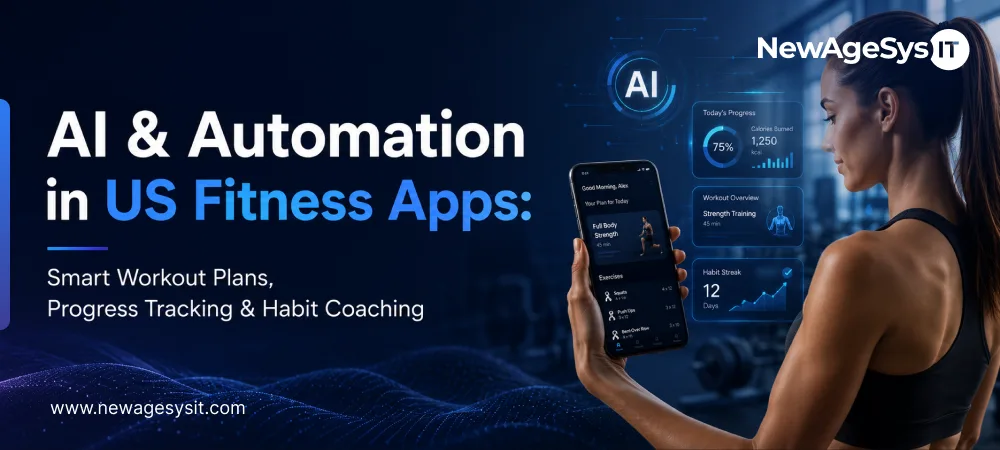
App Development 7 min read
AI & Automation in US Fitness Apps: Smart Workout Plans, Progress Tracking & Habit Coaching

| This article is part of our series on Fitness Mobile Apps in the USA: Building Smarter Workout Experiences in 2026 |
In the US market, AI and automation have officially crossed from early-adopter differentiators to an essential competitive baseline. Industry leaders like Future, Whoop Coach, and Apple Fitness+ have established intelligent coaching as a standard consumer expectation. Today, apps lacking an intelligent layer risk being dismissed as mere data loggers rather than true coaching tools.
However, succeeding in this landscape requires specialized custom fitness app development. Fitness AI operates uniquely at the intersection of exercise science, behavioral psychology, and machine learning. Without deep domain expertise, teams often build technically impressive features that fail to drive real fitness outcomes.
These applications must remain privacy-compliant and scientifically grounded. Ultimately, the highest-ROI implementations focus on retention and habit formation. By leveraging robust fitness software and CRM development services, brands can build vital behavioral intelligence.
This lets them turn sophisticated data into lasting compliance, keeping users engaged and fostering long-term loyalty.
AI-Powered Personalized Workout Planning
The modern US market demands a complete departure from rigid, one-size-fits-all training templates. Advanced machine learning models now build highly individualized programs from the ground up.
- Personalized program generation: Machine learning models build highly individualized training programs from the ground up. The software analyzes user goals, fitness levels, available equipment, schedules, and injury histories to replace rigid templates.
- Adaptive progression logic: Algorithms automatically increase or decrease workout difficulty based on performance data powered by custom mobile app development services. The system prescribes more weight when targets are exceeded, or schedules vital deload weeks when fatigue signals accumulate.
- Exercise substitution intelligence: Recommending alternative exercises when a user lacks equipment or has a limitation. This automated adjustment maintains training intent while accommodating real-world constraints.
- Wearable recovery integration: Ingesting HRV, sleep quality, and resting heart rate from wearable devices to adjust intensity recommendations. Whoop popularized this data-driven recovery model, which consumers now widely expect.
- Exercise science accuracy requirement: AI workout plans must respect fundamental principles like progressive overload, recovery timing, and muscle group sequencing. Violating these principles creates immediate injury risks and destroys user trust.
Compliance & Accuracy Note
AI-generated plans carry safety responsibilities. Apps must include medical disclaimers, PAR-Q prompts, and ‘consult your physician’ guidance. Fitness apps should not provide medical advice.
AI Progress Tracking and Performance Analytics
Gathering data is just the first step. True value lies in the intelligence layer that makes complex fitness metrics meaningful via web application development services.
- Strength progression modeling: ML models predict a user’s strength progress based on training history, program design, and recovery patterns. They accurately identify exactly when and why progress stalls.
- Body composition prediction: AI estimates body composition trajectories by analyzing nutrition data, workout volume, and historical response patterns. This approach sets realistic expectations for user goals.
- Performance anomaly detection: The system identifies when performance drops significantly below trend. This flags potential illness, overtraining, or life stress that warrants immediate program adjustment.
- Training load management: Platforms calculate aggregate training load by balancing recent workout volume with measured recovery capacity. This replicates the fitness readiness score concept popularized by Whoop and Garmin.
- Long-term fitness age modeling: The software projects fitness trajectories and physiological age based on cardiorespiratory metrics and wearable VO2max data. This offers a highly motivating future-state visualization.
These deep analytical insights require exceptional technical execution. For iOS development, utilize specialized mobile app development services. For Android apps, ensure your team integrates native health APIs effectively through custom android app development services
AI Habit Coaching and Behavioral Science Features
The fundamental challenge of fitness app abandonment occurs when users download an app but fail to build lasting daily habits. Behavioral AI directly addresses this massive attrition problem by integrating advanced habit formation science into the user experience enabled via custom ios app development services.
- Habit formation science: The initial 30 days represent the highest-churn window for digital wellness and fitness platforms. AI habit coaching focuses intensely on building workout consistency during this critical first month to prevent early abandonment.
- Optimal notification timing: Instead of generic, pre-scheduled reminders, advanced machine learning models track and learn each user’s unique responsive patterns. The system delivers tailored push notifications precisely when the user is most likely to act.
- Implementation intention prompts: Behavioral science shows that specific commitment questions significantly increase real-world follow-through. AI chatbots present personalized prompts, directly asking users what time and where they will complete tomorrow’s workout.
- Friction reduction AI: Custom algorithms actively identify individual friction points that cause users to skip scheduled sessions. Whether workouts are too long or poorly timed, the personalization layer adapts to eliminate these barriers.
- Loss aversion mechanisms: The interface leverages powerful psychological triggers to drive consistent, long-term application engagement. It incorporates automated streak maintenance notifications, visual “don’t break the chain” displays, and strategic near-miss re-engagement messaging.
AI Nutrition Coaching Features
Modern US fitness apps require automated nutrition support built directly into mobile platforms. Advanced apps leverage AI to deliver hyper-personalized coaching through five key features:
- Personalized macro targets: AI calculates individualized protein, carbohydrate, and fat targets using body composition, goals, and training schedules, outperforming generic TDEE calculators.
- Meal recommendation engine: The system translates data into daily food choices by suggesting specific database recipes that match a user’s remaining daily macros.
- Eating pattern analysis: Algorithms analyze logged meals to identify behavioral trends like weekend overeating, training-day protein deficits, or poor pre-workout timing.
- AI food recognition: Smartphone cameras identify food and estimate portion sizes, drastically reducing logging friction and overcoming manual entry barriers.
- Nutrition-workout correlation: Apps connect cross-domain data, showing users how specific eating patterns directly impact and correlate with their workout performance.
Implementing these multi-domain systems requires reliable corporate software architecture using custom software development services. Working with established partners during custom software development services ensures your nutrition databases sync flawlessly.
Conversational AI and Virtual Coach Features
The user interface is rapidly evolving away from static buttons and complex nested menus. Natural language processing introduces an intuitive interface layer via conversational AI.
- Natural language workout queries: Users can input requests like, “What should I do for a 20-minute leg workout with no equipment?” The conversational search translates user intent into customized workout recommendations.
- In-session coaching cues: The system delivers real-time form and tempo reminders during active workout sets. This digital coaching layer extends trainer guidance beyond scheduled sessions.
- Goal and habit check-in conversation: Weekly AI-facilitated check-in conversations collect subjective wellbeing data. The virtual coach celebrates wins and adjusts plans based on reported challenges.
- Nutrition question answering: Users can ask questions like, “Is Greek yogurt a good pre-workout snack?” Evidence-based nutrition Q&A keeps users in the app rather than searching externally.
- Fitness AI safety guardrails: LLM-based fitness coaching must include strict guardrails. These prevent medical diagnosis, advice on prescription drug interactions, or extreme restriction advice. Guardrails are critical for user safety and legal liability.
Privacy and Safety Considerations for Fitness AI
Deploying artificial intelligence in US fitness apps requires strict compliance with privacy and user safety frameworks implemented securely through saas development services. Developers must balance powerful machine learning features with robust regulatory safeguards.
- Health data privacy for AI training: Using user health and workout data to train ML models requires careful compliance. Systems must adhere strictly to Apple HealthKit terms and Google Health Connect policies. Furthermore, data collection must satisfy CCPA data use limitations.
- Model bias in fitness AI: Workout recommendations trained primarily on narrow demographic groups may be less effective for other user populations. Ensuring deep diversity in training data is a core equity concern.
- Medical disclaimer requirements: AI-generated workout and nutrition recommendations must include appropriate medical disclaimers. The system must prompt users to consult a physician, particularly those with underlying health conditions.
- Safety guardrails for adaptive AI: Adaptive training algorithms must feature strict maximum progression limits. These hard boundaries prevent the system from accelerating volume or intensity too quickly. Unconstrained AI-driven progression creates immense overtraining hazards and severe injury risks.
Final Thoughts
AI and automation deliver massive competitive differentiation in the crowded US fitness mobile application landscape. Platforms achieve superior market positioning through several key features:
- Smart workout planning and advanced performance analytics.
- Automated habit coaching and intelligent nutrition features.
- Exercise science accuracy and behavioral psychology grounding.
- Strict health data compliance and medical guardrails.
Apps utilizing these architectures achieve higher daily active use and stronger long-term subscription retention. Treating AI as a simple checkbox is no longer enough for sophisticated US consumers.
If your organization is adding AI features to a US fitness app, you must ground workout personalization in exercise science principles. It is equally essential to implement behavioral habit coaching to keep users engaged. Maintaining health data privacy compliance from the design stage ensures the experience is effective and legally defensible.
Learn more about digital transformation solutions from a leading AI software company in the United States.
Core Development
Keep exploring the custom services.

AI Software Development
Custom AI Software Development
Build intelligent, production-ready software from machine-learning models to AI-driven automation designed around your business goals.
Learn more
Mobile App Development
Custom Mobile Application Development
Native and cross-platform mobile apps that are fast, secure, and built to scale across iOS and Android.
Learn more
Web App Development
Custom Web Application Development
Scalable, secure web applications, from customer portals to complex dashboards, tailored to how your business actually works.
Learn more



