
Welcome to Blogs
Discover actionable insights, in-depth research, and expert perspectives, all in one place.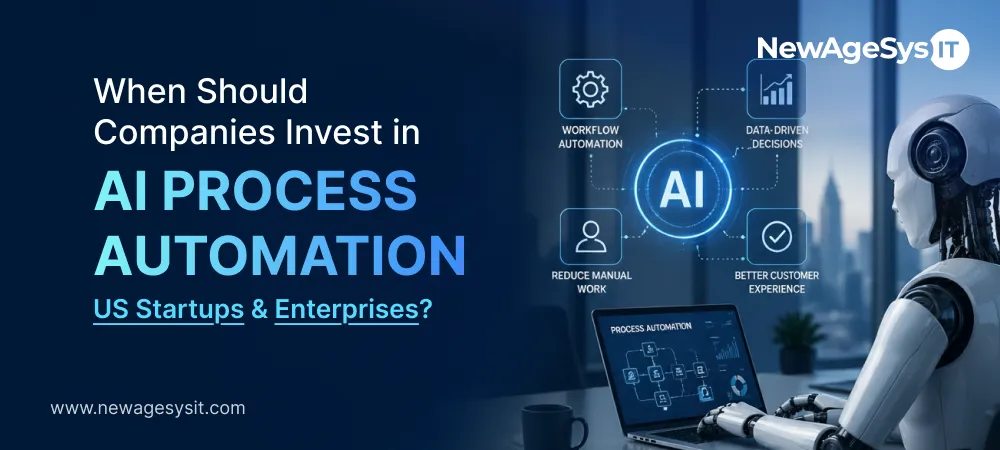
Artificial Intelligence 8 min read
When Should Companies Invest in AI Process Automation For US Startups and Enterprises?

The Investment Timing Question Most Businesses Get Wrong
Most companies approach AI automation investment from one of two positions: they wait too long, holding out for perfect conditions that never arrive, or they move too fast without the operational foundation that makes automation work. Both errors are expensive. The first allows competitors to compound operational advantages that become increasingly difficult to close. The second produces failed implementations, wasted budget, and organizational resistance that makes the next attempt harder.
When to invest in AI process automation is not a calendar question. It is a readiness question, one that depends on specific operational, financial, and data conditions that can be assessed before any investment decision is made. This article provides a practical framework for evaluating readiness, building the business case, and identifying where to start.
Organizations designing this architecture typically engage custom software development services or custom mobile app development suited to their operational environment.
The decision to invest in AI process automation requires understanding the full landscape, covered in [AI for Business Process Automation: How Intelligent Systems Replace Manual Work](Link to Pillar Blog: AI for Business Process Automation: How Intelligent Systems Replace Manual Work).
Signs Your Business Is Ready for AI Process Automation
Is your business ready for AI automation? These five signals indicate that the conditions for a successful implementation are in place.
You Have High-Volume Repetitive Processes
If your team performs the same multi-step task hundreds of times per week, processing invoices, routing support tickets, or collecting onboarding documents, that volume is a clear automation target. High-volume repetitive processes deliver the fastest ROI because every transaction automated produces an immediate cost saving.
Manual Processes Are Creating Bottlenecks
Delayed approvals, slow reporting cycles, and backlogged queues are symptoms of processes that have outgrown the manual capacity supporting them. When a process regularly causes downstream delays in finance, compliance, or customer service, automation removes the constraint rather than adding headcount to manage around it.
Your Error Rates Are Affecting Business Outcomes
Manual data entry errors that produce incorrect invoices, compliance gaps, or customer service failures are structural, not random. A process that generates consistent errors at scale will continue to do so regardless of who performs it. AI automation eliminates the error source rather than managing its consequences.
You Have Accessible, Reasonably Clean Data
AI automation requires data to learn from and operate on. If your core business data is structured, accessible, and reasonably consistent across systems, the foundational requirement for reliable automation is in place.
Your Team Has Capacity Constraints
If scaling operations requires hiring proportionally, automation is the structural answer. The right time for AI automation is when the cost of adding headcount to sustain growth exceeds the cost of building automation to absorb it.
Signs Your Business Is NOT Ready Yet
These four indicators mean investment should be preceded by foundation-building work. None are permanent blockers. Each has a specific fix.
Processes Are Not Documented
If no one can describe a workflow step-by-step, including every decision point, exception type, and system involved, that workflow cannot be automated reliably. The fix is formal process mapping before automation design begins. Documentation is a prerequisite, not a project deliverable.
Data Is Fragmented or Unreliable
AI automation built on inconsistent, siloed, or incomplete data produces unreliable outputs at scale. The fix is a data readiness assessment identifying gaps in structure, completeness, and accessibility across every system the target workflow touches, before implementation begins.
Organizational Buy-In Is Absent
Automation projects without alignment from affected teams consistently underperform. The fix is building internal alignment before deployment: communicating role impacts, involving affected teams in process design, and defining how freed capacity will be redeployed.
Success Metrics Are Undefined
Without clear KPIs, cycle time, error rate, and cost per transaction, there is no way to measure whether automation is working. The fix is defining measurable success criteria before implementation begins, not after the first deployment cycle completes.
How to Build the Business Case for AI Automation Investment
A credible business case for AI process automation rests on four components a CTO or Operations Director can structure before any vendor conversation takes place.
Problem quantification establishes the current cost of the process. Calculate staff hours per transaction, multiply by fully-loaded hourly labor cost, multiply by monthly volume, and add the downstream cost of error rates including rework time and compliance exposure. This produces the annual cost baseline the investment must beat.
ROI estimation compares build and deployment cost against annual savings. As a planning reference, a mid-scale departmental automation project typically falls in the range of $60,000 to $200,000 depending on integration complexity, data readiness, and process scope, with final figures determined during the discovery and scoping phase. AI automation ROI accrues faster in higher-volume processes because every additional transaction processed increases the return against a fixed implementation cost. Most mid-scale projects reach payback within 12 to 18 months.
Risk assessment documents data quality, integration complexity, and change management risks with ownership assigned to each. A risk assessment that names these factors upfront and assigns accountability gives stakeholders confidence that implementation has been planned rather than assumed.
Implementation roadmap defines a phased approach: start with one high-volume process, prove measurable ROI, then scale. A single successful deployment provides the internal evidence base for expanding scope.
Which Processes to Automate First
Prioritizing automation candidates starts with scoring each process across three dimensions: transaction volume, error rate, and strategic impact on downstream operations. The process scoring highest across all three is the strongest first-wave candidate.
Four process categories consistently score at the top of this assessment for US businesses.
Invoice processing and accounts payable combines high volume, measurable error rates with direct financial consequences, and clear downstream impact on cash flow. For companies where document handling is a primary bottleneck, [AI document processing](Link to Cluster Blog 3: AI Document Processing: Automating Data Extraction and Analysis) is often the highest-ROI starting point.
Customer support tier-1 query handling is high-volume, highly repetitive, and directly affects customer satisfaction. Customer support automation [often delivers the fastest payback period](Link to Cluster Blog 4: How AI Improves Customer Support Automation) of any first-wave automation investment.
Employee onboarding document collection carries lower complexity than finance or support automation, making it a manageable first implementation with immediate quality and speed improvements for HR teams.
Sales CRM data entry and lead scoring frees selling capacity without adding headcount, producing measurable revenue impact alongside operational cost savings.
Typical ROI Timeline for AI Process Automation
The planning phase, typically four to six weeks, is the most consistently underestimated stage in AI automation investment timing projects, and the one most likely to determine whether the implementation succeeds or stalls. Process documentation, data auditing, and integration scoping cannot be compressed without increasing downstream risk. Organizations that rush this phase spend significantly more time resolving problems during build and testing.
The build and integration phase runs between eight and sixteen weeks depending on integration complexity and data readiness. Projects connecting to modern API-enabled systems deploy faster. Projects requiring middleware layers for legacy ERP integration run toward the longer end of this range.
Deployment and testing typically requires four to six weeks. Operational savings become visible in months two to three post-deployment. Full payback on mid-scale projects typically falls within twelve to eighteen months, after which the ongoing cost saving accrues without the implementation cost offset.
The first ninety days of steady-state operation are critical. Active monitoring, model performance tracking, and rapid iteration on exception patterns in this period determine whether the system improves or plateaus.
Internal Build vs External Development Partner
Should my company automate with AI using internal resources or an external development partner? For most mid-market businesses, the answer depends on available AI talent depth.
A full internal build requires AI engineers, data engineers, integration specialists, and a project manager with automation implementation experience. For organizations without this team in place, the hiring timeline can add several months to the project before implementation begins.
External development partners bring proven automation architecture, existing integration frameworks, and deployment experience across multiple business environments. Time-to-deployment is faster, initial risk is lower, and implementation cost is predictable rather than scaling with talent acquisition.
The most practical model for mid-market businesses is a hybrid approach: an external partner designs, builds, and deploys the automation system while the internal team is trained to manage, monitor, and iterate post-launch. This delivers speed and expertise during implementation while building internal capability for ongoing ownership.
Questions to Ask Before Signing Off on AI Automation Investment in The United States
What separates automation investments that deliver on projected returns from those that underperform is the quality of pre-investment questions answered before approval is given. Use this checklist before committing to any AI automation investment:
- Which specific process will be automated first, and what is the quantified annual cost of running it manually today?
- What data does this process rely on, and has a readiness assessment confirmed it is structured, accessible, and consistent across all connected systems?
- What are the integration requirements, and which enterprise systems must be connected for the automation to function end-to-end?
- Who owns this project internally, and which stakeholders need to be aligned before deployment begins?
- What are the defined success metrics, and at what point will the organization evaluate whether to expand scope?
- What is the risk tolerance for phased versus full deployment, and what triggers the decision to scale?
- Is there an internal team capable of managing the system post-launch, or does the plan include a managed services arrangement?
- What is the fallback plan if data quality or integration complexity extends the build timeline beyond the original estimate?
Final Thoughts
The right time for AI automation is when readiness indicators align: high-volume processes with measurable inefficiency, accessible and reasonably clean data, organizational buy-in across affected teams, and a defined ROI target the implementation must achieve.
Organizations that invest in process and data readiness before deploying AI automation consistently achieve faster ROI and fewer project setbacks.
Core Development
Keep exploring the custom services.

AI Software Development
Custom AI Software Development
Build intelligent, production-ready software from machine-learning models to AI-driven automation designed around your business goals.
Learn more
Mobile App Development
Custom Mobile Application Development
Native and cross-platform mobile apps that are fast, secure, and built to scale across iOS and Android.
Learn more
Web App Development
Custom Web Application Development
Scalable, secure web applications, from customer portals to complex dashboards, tailored to how your business actually works.
Learn more



