
Welcome to Blogs
Discover actionable insights, in-depth research, and expert perspectives, all in one place.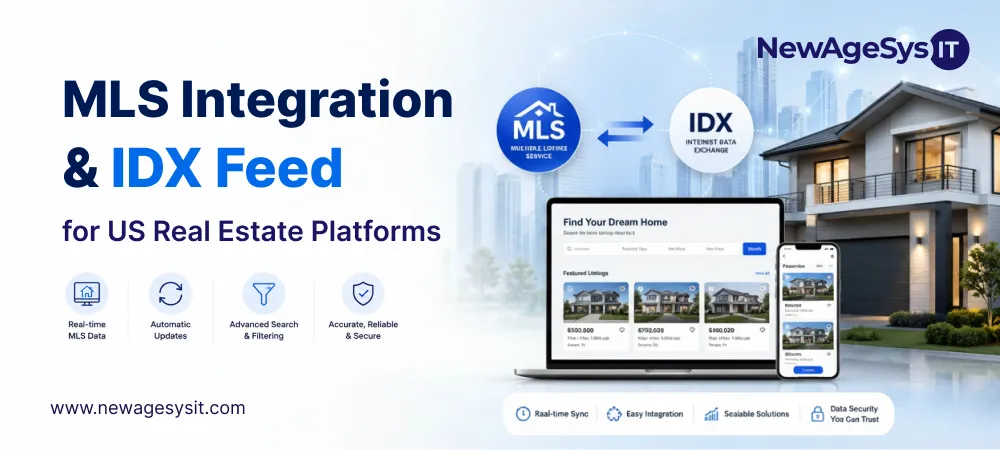
Real Estate 8 min read
MLS Integration & IDX Feed for US Real Estate Platforms

MLS integration and IDX feed implementation are the most technically demanding features of real-estate CRM development. Any compromise made in these features won’t just result in a technical problem but a business obstacle. It directly affects listing accuracy, user trust, and MLS membership footing.
Over 600 MLS systems operate across the United States. Each has its own data structure, field mappings, display rules, and data use agreement requirements. No single standard software connects all these 600 plus systems. This fragmentation also impacts how platforms access MLS data. The shift from RETS to RESO Web API is still an ongoing process. Meanwhile, maintenance costs for legacy RETS-based platforms keep rising. Migration to RESO Web API is now the need of the hour.
Migration urgency extends beyond the technical side. IDX compliance is not just about how listings look on screen. It is about maintaining a legally secured relationship with the MLS data providers. Teams building real estate mobile and web app development services need to integrate compliance into the architecture from day one. It is also a non-negotiable for teams investing in custom real estate software and CRM development services.
Understanding the US MLS Ecosystem
MLSs are cooperative databases run by local real estate associations. Agent membership gives professionals the right to list properties and access other members’ listings. Each MLS sets its own rules, even when following national policy.
NAR (National Association of Realtors) provides the Multiple Listing Policy as a national framework. But local MLS implementation has notable variations. These variations mean working patterns differ from market to market.
Platforms like CARETS, Bright MLS, and Stellar MLS have unified data access across large regions. Hundreds of smaller MLSs still operate independently with their own rules. Regional consolidation has been of help, but it has not solved the fragmentation problem.
Agent membership is what actually unlocks data access for a platform. Without a current broker membership and a signed IDX agreement, the platform cannot display MLS’s listings. For multi-market builds, this per-market compliance requirement has real architectural consequences.
Data reciprocity adds another layer that catches teams off guard. Many MLSs only permit IDX display of listings where the listing agent belongs to the displaying broker’s MLS. For brokerages spanning multiple markets, this rule directly influences how the data architecture is built.
RESO Web API: The Modern Standard for MLS Data Access
RESO Web API is not just a protocol upgrade. It represents a fundamental shift in how MLS data is structured, accessed, and maintained across the technology stack.
Before the RESO Web API, platforms relied on RETS, a protocol introduced in the early 2000s. RETS worked well for the requirements back then, but it was never designed for multi-MLS environments. Field naming varied from one MLS to the next, queries were inefficient, and maintenance costs kept rising with new integrations.
In 2020, NAR mandated RESO Web API compliance for all NAR-affiliated MLSs. This mandate changed the baseline expectation for every other platform developer in the US real estate market.
The RESO Data Dictionary standardizes property data field names across MLSs. Before this, every new MLS integration meant custom mapping work from scratch. This standardization significantly reduces the amount of rework.
On the query side, RESO Web API’s OData capabilities allow server-side filtering, sorting, and pagination. This means platforms retrieve only the data they need.
Efficient data retrieval, however, is only a part of the process. Authentication runs on OAuth 2.0 client credentials for server-to-server access. Weak authentication implementation is one of the most common causes of data feed instability in production environments.
Before committing to any data feed or integration partner, RESO certification is worth verifying. It is an independently documented benchmark that confirms the feed meets the standard specification. For technology teams evaluating vendors, this helps with avoiding guesswork.
IDX Compliance: Data Display Rules Every Platform Must Follow
IDX compliance requirements are not optional guidelines. They are terms and conditions tied to each MLS’s data use agreement. Violating them results in real consequences.
- Listing attribution is a universal requirement. Every listing must display the listing broker and agent name and brokerage. The exact format varies by MLS, but no MLS waives this requirement entirely.
- Listing freshness rules are equally important. IDX data must be updated within defined timeframes, typically 12 to 24 hours for residential listings. Showing a sold property as available is a compliance violation, not just a UX problem.
- Confidential field restrictions apply to specific data points. Seller concessions, certain financial fields, and some days-on-market methodologies may be restricted from public display. Each MLS’s data use agreement specifies what can and cannot be shown.
- Equal display requirements prohibit systematic suppression of competitor listings. Platforms cannot promote the displaying broker’s listings above others without clear, explicit labeling. The data must be treated neutrally in search results.
- Some MLSs also restrict framing their listing data inside third-party interfaces. This requires authorization before implementation. Check each MLS’s data use agreement before implementation.
- Non-compliance consequences are real and need immediate attention. They include MLS membership termination, removal of data access, and potential legal action from the MLS organization. Teams building IDX platforms should treat compliance as a core development requirement, not a post-launch review item.
Compliance Note: IDX compliance requirements vary by local MLS and are updated periodically. Always review the current data use agreement for each MLS integration. Consult qualified real estate legal counsel for compliance guidance.
Multi-MLS Integration Architecture
Platforms serving brokerages across multiple markets cannot rely on a single MLS feed. Multi-MLS integration requires deliberate architectural inclusions from the beginning.
Data normalization is the primary architectural decision that matters. Each MLS uses different field naming conventions. A mapping layer that converts all of that into one internal schema makes consistent querying possible.
Display rules are equally fragmented. Every MLS enforces its own requirements, and a generalized interpretation is not effective. The platform needs a compliance rule engine that stores and enforces each MLS’s rules independently.
Border market properties add another layer to this. The same property often appears in multiple MLS databases with slightly different data. Without aggregation and deduplication logic, users end up seeing duplicate listings, with a direct impact on client trust.
Not every MLS field needs to be synchronized either. Selective synchronization keeps storage and processing overhead in check. Syncing only required fields pays off at scale. Change detection and delta syncing are critical for data freshness. Extracting listings that changed since the last sync is far more efficient than full database refreshes. For large MLS databases, this distinction has a direct impact on system performance.
Third-Party Listing Aggregators: Zillow, Realtor.com, and Homes.com
Not every US real estate platform integrates directly with each MLS. Third-party aggregators offer an alternative path that comes with its own agreements. Zillow, Realtor.com, and Homes.com hold their own data agreements with MLS organizations. Brokerages syndicate listings to these portals and receive leads back. But syndication means handing over the display experience entirely. Brokerages have little control over how their listings appear.
Bridge Interactive and similar MLS data providers offer aggregated access across multiple MLSs through a single API. This reduces the per-MLS integration burden for multi-market platforms. For teams that need broad coverage quickly, this can be a starting point.
Direct MLS integration provides fresher data, better field coverage, and stronger compliance control. It requires individual MLS agreements, which takes time and negotiation. Aggregators are faster to implement but come with coverage limitations and less granular control.
Listing syndication management is a separate operational consideration. US brokerages need to control which listings go to which portals. Some sellers actively choose not to syndicate their listings. The platform must support these preferences at the individual listing level.
IDX Website Design and Search Experience Best Practices
User experience determines whether the platform will perform in the market or not.
Map-based search is the dominant UX pattern for US property search. Polygon drawing, pin clustering, and map-list toggle are expected features on consumer real estate platforms. Users who encounter a text-only list search often leave without converting.
Saved search and alert registration helps turn one-time visitors into return users. Allowing users to save criteria and receive automatic alerts creates both return traffic and a natural lead capture opportunity.
Listing detail pages need to have everything a buyer is looking for. Good photos, a mortgage calculator, school ratings, walk score, and neighborhood information. A clear contact agent button must be present to convert property views into agent inquiries.
More than 60% of US property searches happen on mobile devices. Map-based search that loads slowly or responds poorly on a smaller screen costs platforms’ real users. Mobile performance is not a nice-to-have, it is an essential product requirement.
Mobile interface performance of the CRM directly impacts how well lead capture works. Requiring registration to view full listing details, contact agents, or schedule showings is standard practice on IDX platforms. This implementation needs to balance conversion intent with user experience to avoid drop-off. For teams building on Android or iOS, platform-specific performance tuning is worth the investment.
Final Thoughts
MLS integration and IDX compliance are the most technically and legally demanding aspects of US real estate platform development. Neither of them can be treated as a configuration task. Both require expertise in RESO Web API, local MLS data use agreements, and real estate display rules.
Platforms that implement RESO Web API correctly and maintain IDX compliance with each local MLS build a stable technical foundation. A high-quality listing search experience along with this stable foundation creates a visible competitive advantage in US property markets.
If you are building a custom US real estate platform, architecture decisions are the hardest to alter later. Getting MLS integration and IDX compliance right from the start saves significant time, cost, and rework.
The platforms that get this right early are the ones that scale without rebuilding from scratch.
Core Development
Keep exploring the custom services.

AI Software Development
Custom AI Software Development
Build intelligent, production-ready software from machine-learning models to AI-driven automation designed around your business goals.
Learn more
Mobile App Development
Custom Mobile Application Development
Native and cross-platform mobile apps that are fast, secure, and built to scale across iOS and Android.
Learn more
Web App Development
Custom Web Application Development
Scalable, secure web applications, from customer portals to complex dashboards, tailored to how your business actually works.
Learn more



