
Welcome to Blogs
Discover actionable insights, in-depth research, and expert perspectives, all in one place.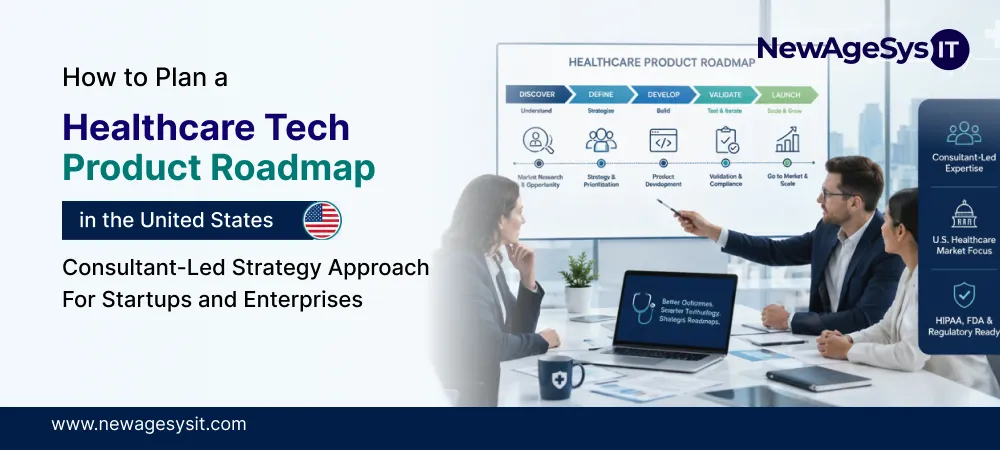
Healthcare 10 min read
How to Plan a Healthcare Tech Product Roadmap in the United States: Consultant-Led Strategy Approach For Startups and Enterprises

Healthcare organizations investing in digital transformation without a structured healthcare technology product roadmap consistently face fragmented investments, vendor lock-in, and missed clinical priorities. Organizations building or modernising clinical systems benefit most from a structured roadmap when they engage healthcare software development services with domain expertise, as the compliance obligations, integration standards, and clinical workflow requirements are too specialised for general IT planning frameworks. Organizations with documented technology roadmaps achieve better IT investment outcomes, lower cost overruns, higher clinical adoption, and clearer ROI measurement. Without a framework, buying “point solutions” often results in massive integration debt. These systems cannot talk to each other, leaving clinicians to bear the burden.
Roadmap vs. Project Plan: The Key Difference
While a general IT project plan focuses on “how” to install software, a healthcare technology roadmap is a multi-year strategic vision. It aligns clinical workflows, HIPAA compliance, and financial constraints to ensure every dollar spent improves patient outcomes.
- Strategic Resource Allocation: Roadmap planning must resolve buy vs build decisions for each technology investment, as explored in Buy vs Build in Healthcare IT: Off-the-Shelf vs Custom Software.
- Financial Forecasting: Realistic cost planning is an integral part of roadmap development is explored in Healthcare Product Development Cost: MVP vs Full-Scale Platform.
The Consultant-Led Advantage
Building a solid roadmap requires a high-level perspective that internal teams often miss because they are stuck in the weeds of daily support tickets. Bringing in an outside consultant changes the game by offering:
- Vendor-Neutrality: Vendor-neutral consultants evaluate platforms against clinical and operational requirements rather than convenience or existing vendor relationships. This prevents the soft lock-in that occurs when procurement defaults to familiar tools rather than fit-for-purpose ones.
- Specialized Expertise: Consultants with healthcare domain expertise assess integration architecture, compliance obligations, and clinical workflow fit at a depth that general IT advisors cannot match.
- De-risked Execution: Applying deep domain expertise in medical app architecture strips the guesswork out of the development cycle. This approach prioritizes high-impact patient features that are technically feasible and secure, preventing the costly architectural pivots that derail long-term roadmaps.
Healthcare administrators use specialized expertise and vendor-neutral insights to guide their strategy. This helps them implement secure, high-adoption mobile solutions that drive engagement and ROI.
What is a Healthcare Technology Product Roadmap?
A healthcare technology product roadmap is a strategic, multi-year plan that aligns technology investments with clinical priorities, compliance milestones, and organizational capacity. Unlike a narrow IT budget or a vendor feature list, this roadmap serves as a high-level vision focused on human outcomes. It delivers measurable value to both patients and providers.
To be effective, the roadmap must bridge the gap between today’s infrastructure and tomorrow’s goals by answering three core questions:
- Where are we now? A current state assessment is the non-negotiable starting point. Transformation remains impossible without a detailed map, including legacy systems and integration gaps.
- Where do we need to be? The target state vision defines the “North Star,” grounded in clinical excellence rather than just technical specs.
- How do we get there? This involves priority sequencing, which determines the order of initiatives based on clinical impact, buy/build decisions, and integration architecture.
By incorporating budget phasing and a compliance timeline, the roadmap prevents the all-or-nothing investment cycles that lead to abandoned programs. This ensures a sustainable path toward digital maturity.
Phase 1: Current State Assessment
Transforming healthcare IT isn’t about adding new layers; it’s about understanding the foundation upon which the entire system rests. Treating the current state assessment as a strategic discovery investment instead of a mere cost ensures that the roadmap rests upon reality rather than assumptions.
- System Inventory: An exhaustive cataloging of every billing platform, scheduling tool, and “shadow IT” application currently in play, looking well beyond the primary EHR.
- Integration Mapping: A comprehensive diagramming of data flows to pinpoint exactly where connections are fragile, manual, or completely severed.
- Clinical Workflow Analysis: An observation of actual clinical practice that moves past official manuals. This helps identify where digital tools provide genuine relief versus where they create friction.
- Compliance Gap Assessment: A rigorous check against HIPAA, ONC, and CMS standards to find vulnerabilities in data access and interoperability. It’s about understanding the foundation upon which the entire system rests
- Stakeholder Interviews: Bridging the gap between IT and the bedside by aligning technology with staff and leader perspectives.
Phase 2: Defining Clinical and Operational Priorities
To build a roadmap that actually sticks, organizations must move beyond “gut feelings” and use a structured Prioritization Framework. This ensures every IT dollar is spent where it matters most.
Ranking initiatives requires balancing four critical factors:
- Clinical Impact: This is the North Star. High-priority projects must directly improve clinical outcome targets, such as reducing readmissions or expanding telehealth access. If it doesn’t improve care, why do it?
- Implementation Feasibility: Even a high-potential concept can fail if execution is overly complex. Success requires an evaluation of technical readiness and resource availability to ensure the project remains viable for completion.
- Compliance Urgency: Regulatory deadlines (FHIR mandates) constitute the highest priority in a strategic roadmap. These requirements take precedence over discretionary projects to ensure the organization remains insulated from significant legal and financial penalties.
- Estimated ROI: Financial sustainability fuels growth. Projects that offer a faster, larger ROI are prioritized to generate the capital needed for subsequent phases.
Clinical leadership alignment is the most critical and most frequently skipped step in healthcare IT. Technology that doesn’t reflect the daily reality of providers creates adoption resistance. By aligning IT goals with clinical workflows from day one, healthcare organizations ensure tools are embraced rather than bypassed. This turns a technical update into a genuine healthcare improvement.
Phase 3: Technology Decision Architecture
Building a sustainable digital ecosystem requires more than just buying software. It requires a technical rules of engagement layer that stops integration spaghetti before it starts. Shift buy vs. build decisions to the roadmap level. This avoids reactive procurement and ensures every investment fits a cohesive architectural puzzle.
To prevent siloed decisions that lead to massive integration debt, every initiative must meet strict platform selection criteria:
- Interoperability: Mandatory FHIR/HL7 compliance and high-quality API documentation.
- Unified Governance: Establishing an integration hub and API framework before acquiring new systems.
- The Compliance Stack: Centralizing security, audit logging, and consent management across the full platform to avoid fragmented data silos.
Whether scaling clinical tools or investing in healthcare mobile app development, this top-down architecture ensures stability and clinical workflow fit. Decisions made today prevent millions spent tomorrow untangling fractured systems. This keeps the primary focus where it belongs: on the patient.
Phase 4: Budget Phasing and Investment Sequencing
To ensure the digital transformation doesn’t become an “open-ended IT spend,” the budget is structured around a phased investment model. This approach moves beyond simple financial adjustments; it requires earning the right to scale by hitting specific phase gate criteria.
- Year 1 (Foundation): Priority is given to essential requirements, including compliance baselines, robust integration infrastructure, and the resolution of high-urgency clinical workflows.
- Years 2–3 (Advancement): Following the establishment of foundational infrastructure, the strategy scales into clinical AI, advanced analytics, and patient engagement platforms.
Financial Governance
Build vs. Buy cost comparisons are embedded directly into the roadmap. Instead of ad-hoc procurement, every initiative is weighed against its long-term value. Most importantly, ROI milestones are defined at each phase. Funding is tied to measurable clinical and technical outcomes. This maintains executive confidence and ensures every dollar improves the provider and patient experience.
The Value of Consultant-Led Roadmap Development
Healthcare leaders don’t hire consultants just for “extra hands”; they hire them for unbiased speed.
The core value lies in vendor neutrality. Unlike internal teams who may be tethered to legacy vendor ties or office politics, external experts provide an objective lens. Combined with healthcare-specific mastery of clinical workflows and integration standards, they offer a depth generalists simply can’t match.
- Accelerated Delivery: Consultants finalize in 8–12 weeks what takes internal teams up to a year.
- Expert Guidance: This is vital during high-stakes shifts like EHR replacements, AI adoption, or system consolidations.
- Risk Mitigation: The cost of a structured roadmap is a fraction of the price of a failed, poorly sequenced technology rollout.
For organizations lacking dedicated strategy capacity, this isn’t just “consulting”; it’s a strategic safeguard. Professionalizing the roadmap process transforms technology from a cost center into a measurable driver of clinical and financial ROI.
Final Thoughts
A structured, consultant-led healthcare technology roadmap is the foundation that transforms reactive IT spending into a coherent, clinically-aligned investment strategy. By prioritizing clinical needs, enforcing architectural standards, and phasing budgets, healthcare organizations achieve lower total cost of ownership. These actions also lead to significantly higher adoption rates among providers.
If your organization is planning significant healthcare technology investments, developing a structured roadmap before vendor selection or product development begins significantly improves investment outcomes and reduces long-term technology risk. Strategic planning at this level is what ensures digital transformation actually serves the ultimate goal: better patient care. NewAgeSysIT partners with US healthcare startups and enterprises to develop consultant-led technology roadmaps covering compliance architecture, integration sequencing, and clinical workflow alignment before development investment begins.
FAQ
What’s the actual difference between a healthcare technology roadmap and a regular IT project plan?
A project plan is focused on the “how,” the steps to install and configure software. A roadmap is a multi-year strategic vision that aligns clinical workflows, HIPAA compliance, and financial constraints together, so the underlying question isn’t just “how do we deploy this system” but “does every dollar we spend actually improve patient outcomes.”
Why does buying “point solutions” without a roadmap create problems down the line?
Because each point solution gets chosen to solve its own immediate problem, without any shared architecture connecting it to what’s already in place. The result is systems that can’t talk to each other, described as massive integration debt, and it’s clinicians who end up bearing the burden of manually bridging gaps that a coordinated roadmap would have prevented.
What three questions does an effective healthcare technology roadmap need to answer?
Where are we now, which means a current state assessment covering legacy systems and integration gaps. Where do we need to be, which is the target state vision, described as the organization’s “North Star,” grounded in clinical excellence rather than just technical specs. And how do we get there, which is the priority sequencing that orders initiatives by clinical impact, buy or build decisions, and integration architecture.
What does a “current state assessment” actually involve?
Five components: a system inventory that catalogs every billing platform, scheduling tool, and shadow IT application, not just the primary EHR; integration mapping that diagrams where data connections are fragile, manual, or completely severed; clinical workflow analysis based on observing actual practice rather than official manuals; a compliance gap assessment checked against HIPAA, ONC, and CMS standards; and stakeholder interviews that connect IT decisions to what’s actually happening at the bedside.
How should healthcare organizations decide which technology initiatives to prioritize first?
Through a structured framework balancing four factors: clinical impact as the top priority (does it actually improve outcomes like reducing readmissions or expanding telehealth access), implementation feasibility (is it technically achievable with the resources available), compliance urgency (regulatory deadlines like FHIR mandates take precedence over discretionary projects), and estimated ROI to fund later phases. Clinical leadership alignment is called out separately as the step most likely to get skipped, even though it’s what determines whether providers actually adopt the tool instead of working around it.
Why should buy vs. build decisions happen at the roadmap level instead of per-project?
Because making that decision project by project, in reaction to whatever need comes up next, is exactly what leads to integration debt: a collection of tools that were each individually reasonable choices but don’t fit together. Shifting buy vs build decisions up to the roadmap level means every investment gets weighed against the same architectural picture instead of being decided in isolation.
What platform selection criteria should every new healthcare technology initiative meet?
Three: interoperability, meaning mandatory FHIR and HL7 compliance along with genuinely usable API documentation, not just a checkbox; unified governance, meaning an integration hub and API framework needs to already exist before new systems get acquired, not built retroactively around them; and a centralized compliance stack covering security, audit logging, and consent management across the whole platform instead of separately per system.
How should healthcare technology budgets be phased over multiple years?
Year one is treated as the foundation phase, focused on compliance baselines, integration infrastructure, and resolving the most urgent clinical workflow gaps. Years two and three are the advancement phase, where investment shifts toward clinical AI, advanced analytics, and patient engagement platforms, but only once specific phase gate criteria have been met, not automatically on a calendar schedule.
What’s the actual advantage of bringing in an outside consultant instead of using an internal team?
Two things internal teams generally can’t offer: vendor neutrality, since consultants aren’t tied to existing vendor relationships or internal politics, and specialized healthcare domain expertise in integration architecture and compliance that general IT advisors don’t have. Practically, that shows up as speed, consultants are described as finalizing a roadmap in 8 to 12 weeks versus up to a year for an internal team, and the cost of that structured process is framed as a fraction of what a poorly sequenced technology rollout ends up costing.
Core Development
Keep exploring the custom services.

AI Software Development
Custom AI Software Development
Build intelligent, production-ready software from machine-learning models to AI-driven automation designed around your business goals.
Learn more
Mobile App Development
Custom Mobile Application Development
Native and cross-platform mobile apps that are fast, secure, and built to scale across iOS and Android.
Learn more
Web App Development
Custom Web Application Development
Scalable, secure web applications, from customer portals to complex dashboards, tailored to how your business actually works.
Learn more



