
Welcome to Blogs
Discover actionable insights, in-depth research, and expert perspectives, all in one place.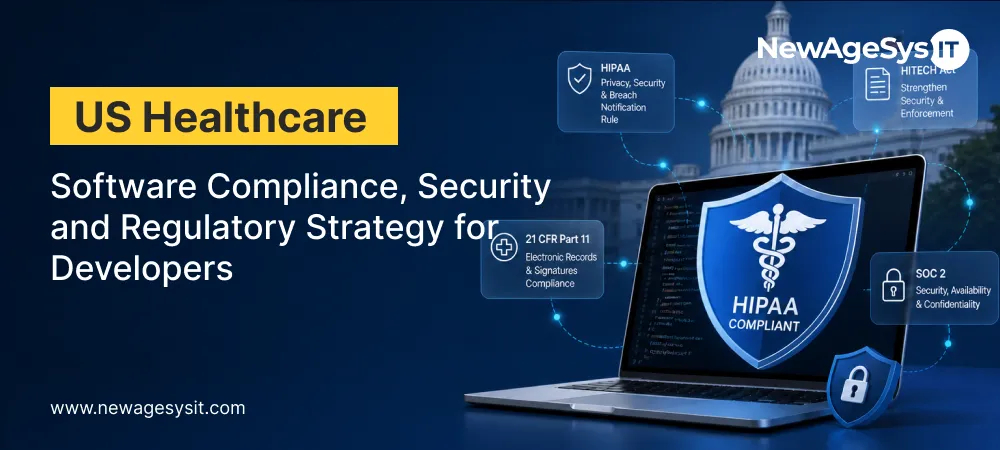
Healthcare 19 min read
US Healthcare Software Compliance, Security, and Regulatory Strategy for Developers

Most healthcare software teams don’t fail because they built the wrong product. They fail because they built the right product the wrong way and discovered that, mid-launch or worse, post-launch.
Healthcare software compliance in the United States is not a documentation exercise you hand off to legal before go-live. It is a foundational engineering and strategic requirement that determines whether your product can legally operate at all.
And the landscape you’re navigating is not simple: HIPAA, HITECH, GDPR for international users, FDA Software as a Medical Device (SaMD) classification, ONC interoperability mandates, CMS regulations, and a growing body of state-level privacy laws, all of which interact, overlap, and occasionally conflict with each other.
The core risk is this: healthcare software built without a compliance-first architecture typically requires a complete rebuild to meet regulatory standards. That process delays market entry by anywhere from 12 to 24 months and costs significantly more than getting the architecture right at the start. Our healthcare software development services team has spotted this pattern a lot, in startups and in established development shops alike.
HIPAA fundamentals, FDA SaMD pathways, cybersecurity requirements, compliance costs, and the regulatory strategy decisions that determine whether a product survives its first year in market. Whether you’re building healthcare mobile app development solutions or enterprise clinical platforms, getting these right before architecture begins is what separates products that scale from products that stall.
The US Healthcare Regulatory Landscape: All you need to know
The first thing most healthcare software developers need to understand is that US healthcare regulation is not a single framework; it is a layered topology of overlapping obligations with different enforcement mechanisms, penalties, and technical requirements.
At the federal level, HIPAA is the baseline for protected health information (PHI), but HITECH significantly strengthened its enforcement teeth and extended direct liability to business associates. GDPR enters the picture the moment your platform processes data from EU residents, which is increasingly common for telemedicine, wellness, and remote monitoring applications.
FDA SaMD guidance applies when software meets the definition of a medical device, a threshold that more products cross than most founders anticipate. ONC’s 21st Century Cures Act mandates FHIR API interoperability and prohibits information blocking, creating both compliance requirements and real technical obligations. CMS regulations apply across reimbursement and clinical workflows for platforms serving Medicare and Medicaid populations.
And layered on top of all of this: state privacy laws. California’s CCPA/CPRA, the New York SHIELD Act, and an expanding roster of state-level frameworks add jurisdiction-specific requirements that federal compliance does not automatically satisfy.
The critical point here is that these frameworks are not sequential. Compliance with HIPAA does not guarantee compliance with GDPR. FDA clearance does not resolve your ONC interoperability obligations. They must all be evaluated simultaneously, and they must be evaluated during architecture design, not after the product ships.
What HIPAA Actually Requires You to Build into Your Software
HIPAA’s Security Rule establishes three categories of safeguards that covered entities and business associates must implement: administrative, physical, and technical. For software developers, the technical safeguards are where the engineering decisions live, and they are legal requirements, not optional features.
The technical safeguard requirements include: unique user identification for every person accessing electronic protected health information (ePHI), emergency access procedures, automatic logoff, and encryption and decryption capabilities.
Access controls must ensure that users can only reach the PHI required for their clinical or operational role. Multi-factor authentication is required for all ePHI access. These controls must be built into the application architecture; they cannot be patched in at the infrastructure layer and considered complete.
Audit logging is one of the most frequently underfunded requirements in healthcare software development. HIPAA requires that every PHI access event, read, write, modify, or delete be logged with user identity, timestamp, IP address, and action taken. Those logs must be tamper-evident and retained for a minimum of six years. They are not application logs. They are a specific regulatory artefact with specific data requirements.
Encryption of ePHI in transit (TLS 1.2 minimum) and at rest (AES-256 minimum) is required, and must be implemented correctly at the application layer, not assumed from infrastructure defaults.
The Business Associate Agreement (BAA) requirement is where many software vendors create liability without realizing it. Any vendor that accesses or processes PHI on behalf of a covered entity must execute a BAA before technical integration begins. There is no grace period. The legal framework must exist before the data connection is made.
HITECH’s breach notification requirements mean your software must be capable of generating breach impact assessments, which requires the detailed audit logging infrastructure described above. A breach discovered without adequate audit logs creates a compliance crisis on top of a security incident.
Hackers Have Picked Their Favourite Target, and It Is Healthcare
In 2024, healthcare reported more cyber threats than any other critical infrastructure sector, with hundreds of ransomware attacks and data breach incidents documented by federal agencies, including the FBI and HHS Office for Civil Rights.
The same year, healthcare organizations filed 592 regulatory reports of protected health information hacks with the HHS Office for Civil Rights, exposing a record 259 million Americans, largely driven by the Change Healthcare ransomware attack.
This is not a background risk. This is the operating environment your software will launch into.
The IBM Cost of a Data Breach Report 2024 put the average healthcare breach cost at USD 9.77 million, the highest of any industry, for the 14th consecutive year. Ransomware attacks cause more than financial damage. The Ascension Health ransomware attack in May 2024 took down electronic health records across 142 hospitals for nearly four weeks.
Delayed surgeries, diverted patients, and disrupted care are documented consequences of healthcare software security failures. Cybersecurity is not just a compliance requirement; it is a patient safety issue.
Building cybersecurity for healthcare software requires going beyond HIPAA’s minimum requirements. Zero-trust architecture, “never trust, always verify”, is becoming the baseline security model, replacing perimeter-based assumptions.
Every access request must be authenticated, every connection verified, regardless of whether it originates inside or outside the network perimeter.
Penetration testing must be scheduled and recurring, not reactive. Annual third-party penetration tests are standard practice for HIPAA-compliant healthcare software. Vulnerability management, continuous scanning, patch management, and remediation tracking must be built into operational infrastructure from launch.
And incident response planning, which HIPAA requires, needs to be written, tested, and accessible before going live, not drafted after the first security incident forces the conversation.
Is Your App a Medical Device? The FDA Might Think So
One of the most expensive compliance surprises in healthcare software development is discovering mid-build that your product qualifies as a Software as a Medical Device under FDA regulation.
The FDA defines SaMD as software intended to be used for a medical purpose without being part of a hardware medical device. That definition captures a wide range of products that founders often categorize as wellness tools, administrative platforms, or clinical decision support, AI diagnostic tools, remote monitoring applications, symptom assessment software, and many patient-facing mobile apps that cross the line from information to clinical recommendation.
FDA classification follows a risk-based framework. Class I devices are the lowest risk and are often exempt from premarket notification. Class II devices, moderate risk, are the most common regulatory pathway for health-tech startups and require a 510(k) premarket submission demonstrating substantial equivalence to a legally marketed predicate device. Class III devices, the highest risk category, require full Premarket Approval (PMA).
For AI-enabled products specifically, the 510(k) pathway is by far the most common route to FDA clearance, one that does not require new clinical trials but does require comprehensive documentation, testing, and preparation of regulatory submissions.
The FDA’s Pre-Submission (Q-Sub) program is one of the most underutilized tools available to health-tech startups. It allows companies to get regulatory pathway guidance before investing in clinical studies or 510(k) submissions.
At an early stage, this engagement can prevent the most expensive possible outcome: discovering your product is Class II or Class III after significant development investment and redesigning the product, or the company’s strategy, from scratch.
AI and ML-based SaMD face additional scrutiny. The FDA’s final guidance on Predetermined Change Control Plans (PCCPs), published in December 2024, allows manufacturers to pre-specify how algorithms will be updated post-market without requiring a full resubmission for each change, but requires that planned model updates be documented before deployment.
Here’s What Compliance Actually Costs
Healthcare software compliance has a real cost, and the number that most founders quote when they resist investing in compliance architecture is almost always lower than the cost of not investing.
Proactive HIPAA compliance architecture typically adds 15–25% to healthcare software development cost. Retrofitting it to an existing product after launch typically adds 40–80% of the original development cost, on top of potential OCR penalties for any compliance gaps that existed in the interim.
Annual compliance maintenance is a recurring operational line item. Security audits, penetration testing, BAA management, HIPAA training, and policy updates typically cost between $50,000 and $200,000 annually, depending on platform complexity. This is not an exceptional cost; it is the cost of operating in a regulated industry.
A single HIPAA breach changes the math entirely. OCR civil monetary penalties range widely based on culpability and harm, and breach-related costs, legal fees, breach notification, remediation, and reputational damage can reach into the millions.
The average HIPAA enforcement penalty in 2024 topped $554,000. The total cost of a breach, factoring in all downstream impacts, consistently exceeds what a comprehensive proactive compliance program would have cost over several years.
FDA 510(k) clearance for a Class II SaMD product typically requires $150,000–$500,000, including clinical data collection, regulatory and legal consulting, and submission preparation. This is a known cost with a defined process, and it is far more manageable when planned for at the start than when discovered as a compliance obligation mid-development.
Compliance cost is also a market access cost. Enterprise healthcare buyers will not sign vendor contracts without HIPAA compliance attestation. SOC 2 Type II certification, while not legally required, has become a de facto requirement for healthcare software targeting hospital and health system procurement.
The Architecture Decisions Made Early Are the Ones That Hurt Later
The most expensive healthcare software compliance mistakes happen in the first 90 days of a project, when architecture decisions are being made without regulatory input.
Architecture decisions made without a compliance context create problems that compound. A data model that doesn’t segregate PHI at the layer level requires restructuring. Authentication built without HIPAA-required controls requires rebuilding. An application designed without audit logging baked into every data access pathway requires retrofitting across every module that touches patient data.
These are not small fixes; they are foundational rearchitecting exercises that require stopping development, assessing scope, and restarting from a compliance-informed baseline.
Regulatory strategy defines the compliance requirements that must be embedded in the technical architecture. It answers the questions that architecture cannot answer on its own: What regulatory frameworks apply? Does this product qualify as SaMD? What data classification requirements govern the PHI we’re handling? What third-party vendors require BAAs? What interoperability obligations does our API layer carry?
FDA classification determination must happen before product design, not after launch, when regulatory reclassification can require product withdrawal, reformulation of the product’s intended use, or complete regulatory remediation.
Consultant-led regulatory strategy engagements for health-tech typically cost $15,000-$60,000. They identify classification determinations, define the compliance architecture requirements, establish the BAA framework, and map the market access pathway that enterprise buyers require.
The cost of not having this information early and discovering it mid-development or post-launch consistently exceeds the engagement cost by 10x to 100x.
Building a Compliance-First Healthcare Software Architecture
Compliance-first architecture is not more expensive than standard architecture. It is a starkly different architecture, one that addresses a broader set of non-functional requirements from the start, rather than retrofitting them after the fact.
Every architectural decision should trace back to a compliance rationale. The regulatory requirements document should inform the architecture document, not follow it.
HIPAA-Compliant Data Layer
PHI must be encrypted at rest (AES-256 minimum) and in transit (TLS 1.2+). PHI storage must be segregated from non-PHI data with access controls enforced at the data layer, not just at the application layer. Data retention and deletion capabilities must be built in, supporting both HIPAA’s six-year minimum retention requirement and patient rights requests under state privacy laws.
Identity and Access Management
Role-based access control (RBAC) must ensure that users can only access PHI required for their clinical or operational role. Multi-factor authentication is required for all PHI access. Unique user identification must be implemented and auditable across all access events. Shared credentials and service accounts with PHI access are not compliant configurations.
Audit Logging Infrastructure
Every PHI access event must be logged with the user identity, timestamp, IP address, and action taken. Audit logs must be tamper-evident, retained for six years minimum, and accessible for OCR investigations and breach impact assessments.
Application logs and audit logs are different artefacts with different requirements; building one does not satisfy the obligation for the other.
Security Infrastructure
Vulnerability management, patch management, penetration testing cadence, and intrusion detection must be built into operational infrastructure from launch. Incident response runbooks, defining escalation paths, breach notification timelines, and forensic preservation procedures, must be defined and tested before go-live.
This is relevant whether your team is building custom software development solutions for healthcare clients or developing proprietary platforms, as the architecture obligations apply regardless of delivery model.
Interoperability and API Security
FHIR APIs must be secured with SMART on FHIR authorization: OAuth 2.0 plus OpenID Connect, enforcing consent-based data access. API rate limiting, input validation, and output sanitization are essential controls for healthcare APIs handling PHI.
These requirements apply to both internal APIs and any third-party integrations that touch patient data. For teams delivering custom mobile app development in healthcare, the same FHIR and SMART on FHIR requirements apply at the mobile API layer.
The Five Compliance Mistakes That Keep Costing Healthcare Teams the Most
These are not hypothetical risks. They are the most consistently documented compliance failures in healthcare software development, and they are all preventable.
· Treating HIPAA as a checklist, not an architecture requirement: Completing a risk assessment document without actually building the required technical safeguards is the most common and most costly mistake. A completed risk assessment does not create compliance. The safeguards it identifies must be implemented in working software.
· Skipping FDA classification analysis: Founders assume their software is a wellness tool or administrative application, then discover it qualifies as SaMD after months of development investment. The determination of whether software is a medical device must happen before product design, not after go-live.
· Inadequate BAA management: Using cloud services, analytics platforms, or third-party APIs that access PHI without executing BAAs creates direct HIPAA liability. Every vendor in the data chain that touches PHI is a potential business associate, and every business associate requires a BAA before the data connection is established.
· Insufficient audit logging: Building standard application logs rather than HIPAA-compliant PHI access audit trails is a gap that only becomes visible during a breach investigation or OCR audit, at the worst possible moment.
· Underestimating third-party vendor compliance obligations: HIPAA requires covered entities and business associates to manage the compliance posture of all subprocessors who access PHI. Most startups underestimate the scope of this requirement until a vendor audit reveals a compliance chain with significant gaps.
The Compliance-to-Market-Access Connection
Healthcare software compliance is not just a legal requirement; it is a commercial prerequisite for enterprise market access.
Hospital procurement processes require vendor HIPAA compliance attestation as a baseline. Without it, the vendor evaluation process does not advance. SOC 2 Type II certification, while not legally mandated, has become a de facto market access requirement for healthcare software vendors targeting health systems and large group practices.
Penetration test reports from reputable third-party firms are increasingly required during vendor security due diligence. For products that qualify as SaMD, FDA clearance is a market access requirement for clinical deployment, not a regulatory formality that can be deferred.
The commercial logic here is straightforward: healthcare enterprise buyers carry regulatory liability for every vendor in their technology stack. They will not assume vendor compliance risk on the basis of self-attestation. They require documentation, and the vendors who can produce it close faster, command better pricing, and build longer-term enterprise relationships.
Healthcare software companies with a strong compliance posture consistently outperform on enterprise sales cycle length and contract value. Compliance is not a cost centre, it is a revenue accelerator for any team serious about the enterprise market.
Get the Foundation Right, and Everything Else Gets Easier
US healthcare software compliance is not a problem to be minimised or deferred. It is the foundation that determines whether a product can operate legally, whether it can enter the enterprise market, and whether it can survive the security threats that define the healthcare operating environment.
The organizations that get this right treat compliance architecture, regulatory strategy, and cybersecurity infrastructure as design requirements, not afterthoughts. They invest in regulatory clarity before writing architecture documents. They build audit logging, access controls, and encryption into their data layer from day one. They execute BAAs before establishing vendor integrations. And they know their FDA classification status before they commit to a product design.
The cost of getting this right from the start is predictable, manageable, and well-documented. The cost of discovering compliance gaps mid-development or post-launch, in OCR penalties, rearchitecting costs, delayed market access, and lost enterprise contracts, is far higher and far less predictable.
Working with a development partner that treats compliance architecture as a design requirement, not a post-launch concern, is what separates healthcare software that scales from software that stalls.
This article reflects the general regulatory context for US healthcare software development and does not constitute legal advice. Consult qualified healthcare legal counsel for guidance specific to your product, business model, and regulatory situation. Organizations building US healthcare software can explore NewAgeSysIT‘s healthcare software development capabilities as a starting point for evaluating compliance-first development partners.
FAQ
The answers below reflect general regulatory context and are not legal advice. Consult qualified healthcare legal counsel for guidance specific to your product and situation.
Why can’t healthcare software compliance be handled by legal after the product is built?
Because compliance in this context isn’t a documentation exercise, it’s a foundational engineering requirement, and software built without a compliance-first architecture typically needs a complete rebuild to meet regulatory standards. That rebuild process delays market entry by 12 to 24 months and costs significantly more than getting the architecture right from the start.
What’s the difference between HIPAA, HITECH, and GDPR for a healthcare software product?
HIPAA is the federal baseline for protecting health information (PHI). HITECH strengthened HIPAA’s enforcement and extended direct liability to business associates, not just covered entities. GDPR enters the picture separately, the moment your platform processes data from EU residents, which comes up more often than founders expect in telemedicine, wellness, and remote monitoring apps. Compliance with one of these does not guarantee compliance with the others, they have to be evaluated simultaneously during architecture design.
What are HIPAA’s required technical safeguards, specifically?
The core technical safeguards are unique user identification for everyone accessing electronic PHI, emergency access procedures, automatic logoff, and encryption and decryption capabilities, alongside role-based access controls and multi-factor authentication for all ePHI access. These have to be built into the application architecture itself. They can’t be patched in at the infrastructure layer and treated as handled.
What does HIPAA-compliant audit logging actually require?
Every PHI access event, whether it’s a read, write, modify, or delete, needs to be logged with the user’s identity, a timestamp, IP address, and the action taken. Those logs must be tamper-evident and retained for a minimum of six years. This is a distinct regulatory artifact from a standard application log, and building normal app logs does not satisfy this requirement on its own.
When does a Business Associate Agreement (BAA) need to be in place?
Before technical integration begins, with no grace period. Any vendor that will access or process PHI on behalf of a covered entity needs a signed BAA in place first, since the legal framework has to exist before the data connection is made, not after.
How costly are healthcare data breaches, and why does that matter for compliance investment?
The IBM Cost of a Data Breach Report 2024 put the average healthcare breach at $9.77 million, the highest of any industry for the 14th year running. In 2024 alone, healthcare organizations filed 592 regulatory reports of PHI hacks, exposing a record 259 million Americans, driven largely by the Change Healthcare ransomware attack, and the Ascension Health ransomware attack that same May took down electronic health records across 142 hospitals for nearly four weeks. Those numbers are the reason compliance and cybersecurity investment gets framed as cheaper than the alternative, not as an optional cost center.
How do I know if my healthcare app qualifies as a medical device (SaMD) under FDA rules?
The FDA defines Software as a Medical Device as software intended for a medical purpose without being part of a hardware device, and that definition catches more products than most founders expect, including AI diagnostic tools, remote monitoring apps, symptom assessment software, and patient-facing apps that cross the line from information into clinical recommendation. Founders who assume their product is “just a wellness tool” are one of the most common sources of expensive mid-development surprises here.
What’s the difference between FDA Class I, II, and III medical device classifications?
Class I devices are the lowest risk and are often exempt from premarket notification entirely. Class II devices are moderate risk and are the most common pathway for health-tech startups, requiring a 510(k) premarket submission that demonstrates substantial equivalence to an already-marketed device. Class III devices are the highest risk category and require full Premarket Approval, a significantly heavier process than a 510(k).
What is the FDA’s Pre-Submission (Q-Sub) program, and why is it underused?
It’s a program that lets companies get FDA guidance on their regulatory pathway before investing in clinical studies or a 510(k) submission. It’s described as one of the most underutilized tools available to health-tech startups, because engaging early can prevent the most expensive outcome in this space: discovering your product is Class II or Class III only after significant development investment, which can force redesigning the product or the company’s strategy from scratch.
What are Predetermined Change Control Plans (PCCPs), and why do they matter for AI-based healthcare software?
PCCPs come from FDA final guidance published in December 2024, and they let manufacturers pre-specify how an AI or ML algorithm will be updated after it’s on the market, without needing a full resubmission for every change. The tradeoff is that planned model updates have to be documented before deployment, so this is a planning requirement, not a way to skip documentation.
How much does proactive HIPAA compliance add to development cost, versus retrofitting it later?
Proactive HIPAA compliance architecture typically adds 15 to 25 percent to development cost. Retrofitting it into an already-built product typically adds 40 to 80 percent of the original development cost, and that’s before factoring in any OCR penalties for compliance gaps that existed while the product was live in the meantime.
What ongoing compliance costs should I budget for after launch?
Annual compliance maintenance, covering security audits, penetration testing, BAA management, HIPAA training, and policy updates, typically runs $50,000 to $200,000 a year depending on platform complexity, and that’s framed as a normal cost of operating in a regulated industry rather than an exceptional one. Worth knowing on top of that: the average HIPAA enforcement penalty in 2024 topped $554,000, which is part of why the ongoing maintenance spend is treated as cheap by comparison.
What are the five most common, and costly, healthcare compliance mistakes?
Treating a HIPAA risk assessment as compliance itself instead of actually building the technical safeguards it identifies. Skipping FDA classification analysis and discovering months into development that the product qualifies as SaMD. Inadequate BAA management, meaning any vendor touching PHI without a signed BAA. Insufficient audit logging, where standard application logs get mistaken for HIPAA-compliant audit trails. And underestimating third-party vendor compliance obligations, since HIPAA requires managing the compliance posture of every subprocessor that touches PHI, not just your own systems.
Why do enterprise healthcare buyers care about SOC 2 and HIPAA attestation even when it’s not always legally required?
Because hospital procurement processes require HIPAA compliance attestation as a baseline just to move the vendor evaluation forward, and SOC 2 Type II certification, while not legally mandated, has become a de facto requirement for selling into hospitals and health systems. Enterprise healthcare buyers carry regulatory liability for every vendor in their stack, so they won’t accept self-attestation alone, they want documentation, and vendors who can produce it close deals faster and command better pricing.
Core Development
Keep exploring the custom services.

AI Software Development
Custom AI Software Development
Build intelligent, production-ready software from machine-learning models to AI-driven automation designed around your business goals.
Learn more
Mobile App Development
Custom Mobile Application Development
Native and cross-platform mobile apps that are fast, secure, and built to scale across iOS and Android.
Learn more
Web App Development
Custom Web Application Development
Scalable, secure web applications, from customer portals to complex dashboards, tailored to how your business actually works.
Learn more



