| This article is part of our series on The Complete Breakdown of Software Application for US Junk Removal Businesses. |
For most US junk removal businesses, site visits remain the biggest operational bottleneck. This issue directly affects the quoting process. A technician spends 30 to 60 minutes traveling to a job site. The technician then assesses the load and returns without generating revenue.
At the same time, the customer waits 24 to 48 hours for a quote. This creates friction at the moment they are ready to book. This delay impacts conversion rates and allows faster competitors to capture the job. This is where AI junk removal estimation in the USA changes how quoting works.
In a 10-truck operation running 5 to 10 site visits weekly, this model consumes 25 to 60 hours monthly. This time is spent on unpaid estimates. At $180 to $300 per truck-hour, the loss becomes $4,500 to $18,000. This reflects lost earning capacity. Moving this workflow into a junk removal web application development environment allows customers to upload photos and receive pricing. This removes the need for a physical visit and eliminates the time bottleneck.
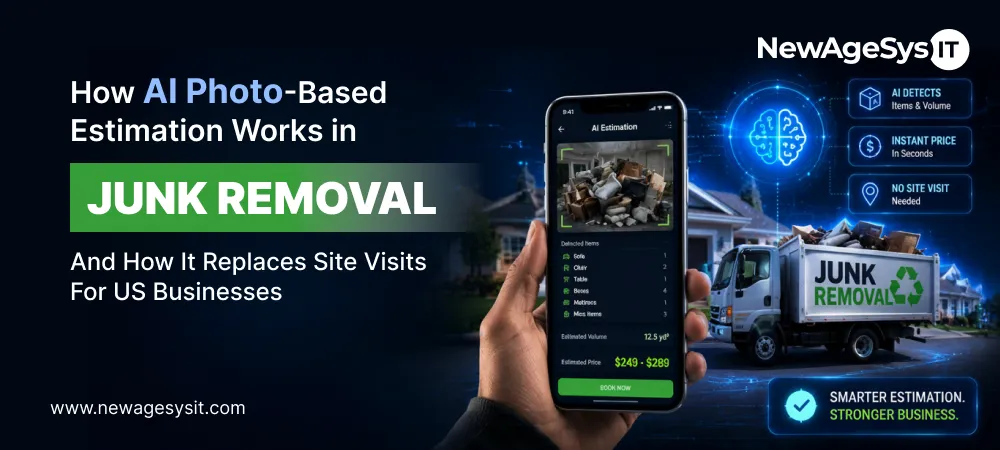
AI photo-based estimation replaces site visits for 70 to 85 percent of residential jobs. It analyzes images to generate volume-based price ranges. Only complex scenarios, such as oversized items or demolition debris, require manual inspection. Businesses using custom junk removal software development systems reduce field visits. They also increase quote throughput and pricing consistency.
When combined with a junk removal mobile app development setup for field crews, this approach improves execution flow. Estimated job details and item data move directly into operations. No manual re-entry is required. The result is faster quoting, higher booking conversion, and better truck utilization.
How AI Photo Estimation Works: The Technical Flow
Junk removal photo estimation follows a structured flow that converts customer-uploaded images into a usable price range. This process typically completes within 15 to 90 seconds for fully automated systems.
In cases requiring validation, human-reviewed estimates are delivered in under 5 minutes. This speed removes quoting delays and increases quote handling capacity without adding dispatcher workload.
Customer Photo Upload
The customer captures two to three images using a phone or desktop booking portal. The system requires a wide-angle shot of the full pile. It also requires a closer image to identify item types. A reference object, such as a door or vehicle, provides scale. On-screen prompts guide each step to ensure usable inputs.
AI Volume and Item Analysis
A computer vision model processes uploaded images to estimate cubic yard volume. It then classifies items such as furniture, appliances, and construction debris. The system also flags hazardous materials for special handling.
The model is trained on labeled job data. It prioritizes volume accuracy and enables item-based pricing and disposal logic. This is often built as a cloud-hosted service for junk removal platforms, with model retraining scheduled as new job data accumulates
Pricing Engine Output
The AI volume estimate feeds a pricing engine that applies cubic yard rates and item-specific surcharges. It also includes zone-based disposal fees and minimum load charges. This generates an AI quote for junk removal within a defined price range. The system presents an instant junk removal quote with a direct booking option.
Human Review Gate
For jobs above defined thresholds, such as estimates exceeding $400 or loads over 8 cubic yards, the system flags them. The system routes the AI output to a human reviewer. The reviewer adjusts estimates for unclear images or unusual items. The estimate is approved before booking.
What AI Estimation Can and Cannot Do
AI estimation performs reliably when inputs are clear and structured. It delivers 80 to 92 percent accuracy for single-room residential furniture and household items. It also performs well for garage cleanouts with visible piles. It performs well for clearly photographed estate jobs.
In these scenarios, photo-based junk removal pricing produces consistent volume estimates. Operators use these estimates to standardize pricing across dispatch and booking. Accuracy drops when critical details are not visible in images. Hidden or underground items reduce estimation accuracy.
Wet or compacted materials often appear smaller than their actual volume. Specialty items such as hot tubs, pianos, or trampolines introduce additional pricing complexity. These cases typically require manual review or pricing adjustments at job completion. This helps maintain margin accuracy.
Model performance improves over time as more job data is collected. Systems trained on real job photos, weight tickets, and cubic yard confirmations refine their predictions. After six months of operational data, estimation accuracy improves significantly. This improvement is clear compared to the initial deployment with baseline training alone.
Customers generally respond positively to transparent pricing ranges. They prefer immediate estimates over waiting 24 hours for a callback. Photo-based junk removal pricing reduces pricing disputes and increases booking confidence at the point of quote.
The Business Impact of Eliminating Site Visits
Replacing site visits with AI estimation increases job capacity and revenue output. Technicians previously assigned to unpaid visits can complete one to two additional jobs per week. In a 5-truck operation, this adds 5 to 10 jobs weekly. At an average ticket of $250, that generates $1,250 to $2,500 in incremental weekly revenue without increasing labor.
AI estimation enables 24/7 quoting. A customer visiting the website at 10pm on a Friday can receive pricing immediately. They can then book a Saturday slot without dispatcher involvement. This captures demand that would otherwise be lost to competitors offering online booking. It also removes dependence on office hours.
Removing phone-based quoting increases total quote volume. Businesses implementing AI estimation typically see a 40 to 80 percent increase in quote requests within 60 days. This increase occurs because the friction of calling for a quote is removed.
This volume feeds directly into systems supported by custom Android app development for junk removal field crews. It also connects with custom iOS app development for junk removal field operations. These systems ensure job data flows from quote to execution without manual entry.
Conversion rates also improve. Customers who receive immediate pricing are more likely to book compared to those waiting for callbacks. This reduces drop-offs during the decision window.
Integrating AI Estimation With the Booking and Dispatch System
Once a customer accepts the AI-generated price range, the system creates a job record. This job record is populated with estimated cubic yards, identified item types, and flagged hazardous materials. This booking handoff eliminates dispatcher re-entry. It ensures consistent data from quote to execution.
It forms the operational backbone of AI estimation for junk removal software. The estimated volume is immediately used for capacity planning. The dispatch system allocates truck space for the selected time slot. This allocation is based on cubic yard availability.
It prevents overbooking on high-demand days. It also ensures each route stays within defined load limits. Dispatchers can manage multiple trucks without manually recalculating capacity for each new job.
After job completion, actual load data is captured through weight tickets and crew-uploaded photos. This data feeds back into the AI model as training input. It allows the system to refine future estimates using real job outcomes.
Platforms with continuous feedback loops improve estimation accuracy over time. This improvement happens without requiring manual recalibration of the system. If the actual job size exceeds the estimate, the crew can adjust pricing at completion.
This adjustment happens before the customer signs off on the job. The final invoice reflects the actual volume handled. This maintains pricing transparency and reduces disputes at the job site.
Final Thoughts
AI junk removal estimation in the USA is the highest-impact feature a junk removal business can implement. It removes operational bottlenecks and increases revenue capacity. It eliminates 30 to 60 minutes of unpaid site visit time per job. It enables 24/7 quoting and allows customers to receive pricing without waiting for callbacks.
This directly increases truck utilization and captures demand that would otherwise be lost after business hours. By replacing site visits with automated estimation, businesses convert technician time into revenue-generating jobs. This replaces unpaid inspections with productive work.
It reduces quote turnaround from 24 to 48 hours to under 2 minutes. It also standardizes pricing across jobs. When integrated into a junk removal software solution for US businesses, estimation becomes the starting point of the workflow. This system connects quoting, booking, and dispatch without manual handoffs.
For operations planning to scale beyond manual processes, businesses must move toward integrated systems. Working with NewAgeSysIT ensures that estimation, booking, and dispatch operate as one integrated system not separate tools requiring manual handoffs.
These functions work together instead of existing as separate tools. If your junk removal business is evaluating AI estimation, assess the volume of site visits your team runs weekly. Compare that with your average ticket value. This provides a clear view of the monthly revenue opportunity this technology can recover.





