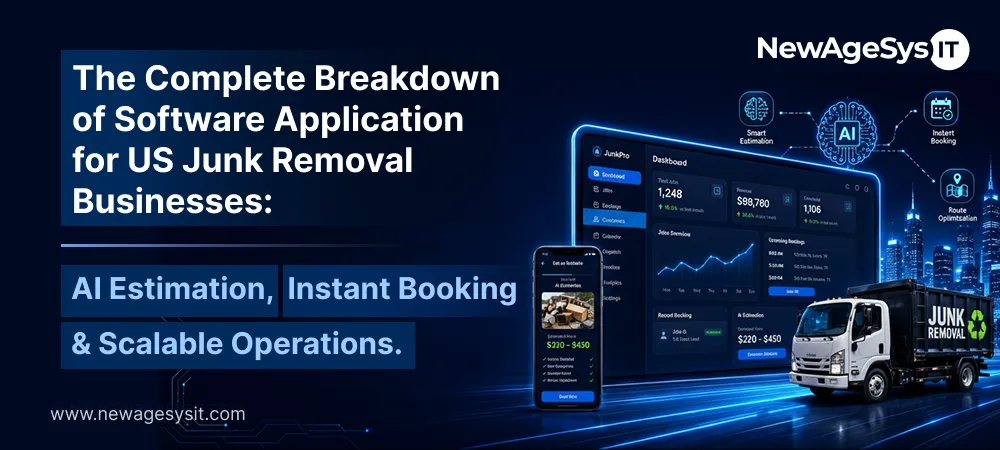
For many operators, junk removal software in the USA is no longer optional because manual systems create direct limits on growth. Quoting still depends on site visits. Booking requires phone calls. Dispatch is managed through whiteboards or spreadsheets. Inconsistent pricing across staff leads to customer confusion, team disputes, and margin erosion.
In 2026, this creates a clear competitive disadvantage. Customers expect to get a quote, choose a time slot, and pay online in under two minutes. Businesses investing in junk removal web application development are addressing these gaps. Businesses investing in custom software development for junk removal operations are addressing these gaps: systematizing booking, pricing, and dispatch rather than scaling manual systems that break under volume.
The junk removal industry is growing faster than the operational capacity of many owner-operated businesses. The companies winning market share are systematizing booking, pricing, and dispatch. They are not relying only on lower prices or more trucks. A customer visiting your website at 9 p.m. on a Sunday should be able to receive a price and place a deposit. Delivering this experience requires custom mobile app development that integrates the booking portal, AI estimation layer, and payment system not a generic booking widget bolted onto an existing website. They should also be able to confirm a booking without calling anyone.
This capability alone can improve conversion rates by 40 to 60 percent. This shift is reflected in platforms like NewAgeSysIT’s junk removal software. These systems combine AI photo estimation, instant booking, smart dispatch, and route optimization. They support businesses scaling to $2M, $5M, and $10M+. Manual operations often plateau much earlier.
This guide breaks down that full software stack. It covers estimation, booking, dispatch, routing, and the economics of custom software versus SaaS.
The Core Problem: Why Traditional Junk Removal Operations Do Not Scale
Many US junk removal businesses hit growth limits because four core systems remain manual long after demand increases. This is where junk removal business software becomes necessary for scalable operations. The first bottleneck is phone-dependent quoting.
Every quote requires a dispatcher to ask about volume, item types, and disposal complexity, then manually calculate pricing. This slows response time. It also limits daily booking volume to the hours a dispatcher is available. As a result, the sales funnel becomes constrained before jobs reach the schedule.
The second bottleneck is site visit dependency. Many operators still send technicians for free on-site estimates for larger jobs. Each visit consumes 30 to 60 minutes of productive labor without generating revenue. Across multiple trucks, those lost hours reduce weekly job capacity.
The third issue is paper or whiteboard dispatch. Manual truck assignments cannot update in real time when jobs run long, cancellations occur, or urgent bookings come in. They also cannot optimize for route efficiency. They cannot provide customers with reliable arrival windows.
The fourth bottleneck is inconsistent pricing. Without a structured pricing engine based on load size, item type, and disposal variables, pricing decisions vary across team members. Different team members may quote different prices for the same job.
That creates customer confusion, internal disputes, and margin erosion. At scale, these four operational gaps become growth constraints, not minor inefficiencies.
AI Photo-Based Estimation: Replacing Site Visits with Instant Quotes
AI junk removal estimation is one of the most transformative features in modern junk removal software. It replaces slow, labor-intensive quoting with near-instant pricing. It removes one of the largest operational bottlenecks to scale. Customers upload photos of a junk pile through a booking portal or mobile app.
The AI analyzes the images to estimate cubic yards and identify item categories such as furniture, appliances, or construction debris. The system generates an instant price range instead of a fixed quote. This accounts for estimation variance.
Customers can accept that range and move directly into booking. They can also use it to request a follow-up call for more complex jobs. For operators, removing the site visit can eliminate 30 to 60 minutes of unpaid technician time per large quote.
A 10-truck business handling five site visits per week can recover 25 to 50 technician hours weekly. Well-trained models can reach 80 to 92 percent volume estimation accuracy for clean residential loads. Accuracy drops on mixed commercial debris and specialty items.
Instant Booking: Converting Website Visitors to Paid Jobs Without a Phone Call
An instant junk removal booking system is a core capability in modern operations. It converts website traffic into confirmed revenue without dispatcher involvement. A customer can receive a price, choose a time slot, and enter payment details in under 60 seconds. They can confirm a booking without calling the office or waiting for a callback.
The booking flow connects directly to real-time truck and crew availability. Customers only see appointment windows that match available capacity in their service zone. This eliminates overbooking at the system level. In many modern booking systems, this availability logic supports scalable scheduling without dispatcher involvement. Deposit collection also improves booking quality.
Requiring a $25 to $75 deposit can reduce no-shows by 60 to 80 percent. The deposit is applied to the final invoice at job completion. Once confirmed, bookings flow automatically into the dispatch board. Jobs are assigned by zone, capacity, and existing schedule without dispatcher re-entry.
Automated SMS and email confirmations send the booked time slot and preparation instructions. They also set clear job expectations. This reduces cancellations. It also reduces “where is my truck?” calls on service day.
Smart Dispatch and Route Optimization: More Jobs, Less Fuel
For junk removal businesses operating five or more trucks, manual dispatch often becomes a full-time task. It still produces inefficient routes. Junk removal dispatch software USA solutions replace this manual process. Smart dispatch systems assign jobs based on proximity, load capacity, crew availability, and equipment requirements.
They can reduce total drive time by 15 to 30 percent compared to manual planning. A real-time dispatch board gives dispatchers visibility into each truck’s GPS location and remaining capacity. It also shows the next job and estimated completion time.
When a new booking is added, jobs can be inserted into active routes with automatic ETA recalculation. This avoids rebuilding the entire schedule manually. Dynamic route optimization recalculates optimal routes when jobs are added, canceled, or modified.
Customer notification integration improves the service experience. Automated SMS updates notify customers when a truck is en route. They also provide live tracking links with real-time arrival windows. This reduces “where is my truck?” calls. These calls can represent 30 to 50 percent of inbound service volume in manual operations.
Custom Software vs SaaS: The Economics for Growing US Junk Removal Companies
Most US junk removal businesses begin with SaaS platforms such as Jobber, Hauler Hero, or Load Runner. These tools typically cost $50 to $300 per month. They handle scheduling, invoicing, and basic CRM for businesses operating one to three trucks. The economics begin to shift as revenue approaches $500,000 to $1,000,000.
Operational complexity increases alongside this growth. SaaS limitations become more visible as the business expands. Pricing engines may not support load-based variable pricing or disposal fee logic. Dispatch tools may not accommodate zone-based capacity rules.
Standard platforms also cannot support AI estimation or branded booking portals. That is where custom junk removal software becomes a strategic decision. Custom software makes economic sense when SaaS costs and lost revenue increase together.
Missing features such as instant booking, AI estimation, and route optimization reduce potential revenue. These combined costs can exceed the amortized cost of custom development over three to five years. For many operators, this crossover begins between five and ten trucks. It also aligns with $1 million to $2 million in annual revenue.
Key Software Modules Every US Junk Removal Business Needs
These six modules form the complete operational system for scalable junk removal operations. Most SaaS tools cover only two or three adequately. Custom platforms support all six, configured to the business’s pricing structure and service area.
Customer-Facing Booking Portal
A customer-facing booking portal combines web and mobile access with AI photo upload and instant pricing. It also supports time slot selection, deposit payment, and booking confirmation.
It functions as the front-end revenue engine, converting marketing traffic into booked jobs without dispatcher involvement. It also improves after-hours booking capture.
Pricing Engine
A pricing engine applies rule-based logic for cubic yard rates and item-specific pricing. It also supports zone-based pricing, disposal fee pass-through, and minimum load charges. It standardizes quoting across the team. It ensures every team member quotes the same price for the same job while protecting margins.
Dispatch and Job Management Board
A real-time dispatch board displays truck locations, job assignments, available capacity, and daily schedules in one operational view. New bookings can be inserted automatically. Status updates from the field app are reflected in real time. This improves coordination, scheduling accuracy, and dispatch responsiveness.
Field Crew App
A junk removal app USA operators use gives truck crews access to job details, customer notes, and navigation. It also supports before-and-after photo capture, weight ticket uploads, digital signatures, and final invoice presentation.
Many businesses rely on custom Android app development for junk removal crews and custom iOS app development for field service teams for field service teams.
Customer Communication and CRM
Customer communication and CRM tools automate SMS and email at every job stage. This includes booking confirmation, truck en route updates, job completion, invoicing, and review requests. They also maintain customer history, job records, and communication logs for every account to support retention.
Reporting and Business Intelligence
Reporting and business intelligence modules track revenue by zone, truck, job type, and crew, alongside fuel and disposal costs. They monitor first-visit conversion rates, no-show rates, and average ticket value. This helps owners identify profitable operations and areas where margins are underperforming.
Compliance and Operational Requirements for US Junk Removal Software
Junk removal software in the United States must support compliance requirements beyond scheduling and dispatch. One critical requirement is hazardous waste flagging. Federal and state rules restrict hauling materials such as paint, batteries, chemicals, tires, and refrigerant-based appliances.
Software should include pre-booking hazardous material checks. It should also flag jobs that require specialized disposal handling. Customer data compliance also matters. Businesses collecting names, addresses, and payment data from California customers must comply with CCPA data rights.
This applies if they meet applicable thresholds. Secure data handling and customer rights workflows become essential software requirements. Electronic waste documentation is another operational need. Many states require records showing proper e-waste disposition.
Software can capture item types during booking. It can also connect with certified recyclers. This simplifies documentation and reduces compliance risk. For commercial accounts, insurance certificate management can affect revenue flow. Some clients require proof of general liability insurance before scheduling work.
Document modules can store and share certificates on demand. This reduces administrative delays in closing commercial jobs. Because hazardous waste, e-waste, and privacy requirements vary by state and locality, these features should be treated as planning safeguards.
Specific compliance decisions should be reviewed with qualified legal and regulatory counsel.
Software Development Cost: Custom vs SaaS for US Junk Removal
For a five-truck junk removal operation, SaaS costs include $150 to $500 per month for the primary platform. They also include $50 to $100 for GPS tracking and $30 to $80 for communication tools. This creates an annual software spend of roughly $2,800 to $8,200.
Those costs may appear manageable early on. They often exclude advanced capabilities such as AI estimation or branded booking tools. Custom software development for a full-featured junk removal platform typically ranges from $40,000 to $150,000.
This depends on feature scope, AI complexity, and the development team model. While the upfront investment is higher, there are no recurring license fees. The business also retains full data ownership. The five-year comparison often changes the economics.
A business paying $8,000 annually in SaaS fees spends $40,000 over five years. This does not include custom routing, AI estimation, or a branded booking portal. By comparison, a $60,000 custom platform may recover its cost in three to four years.
It does so through efficiency gains and additional revenue from features SaaS platforms do not provide. The break-even point depends heavily on the revenue generated by those missing capabilities.
Final Thoughts
US businesses using junk removal software in the USA to systematize booking, pricing, and dispatch consistently outgrow manual operations. These businesses rely less on phone quoting and manual coordination. The combination of AI estimation, instant booking, and smart routing is not a luxury feature set.
It is the operational foundation that allows a three-truck business to perform like a much larger fleet. The broader advantage is not just automation. It comes from software aligned with pricing logic, service zones, dispatch workflows, and reporting needs.
Businesses planning growth beyond SaaS or manual systems often work with NewAgeSysIT to build operational platforms designed specifically around junk removal pricing logic, service zones, and dispatch workflows. If your business is evaluating next steps, define your requirements across estimation, booking, dispatch, and reporting first.
This process helps clarify the capabilities you need. It also ensures your software decision supports long-term growth.





