
Welcome to Blogs
Discover actionable insights, in-depth research, and expert perspectives, all in one place.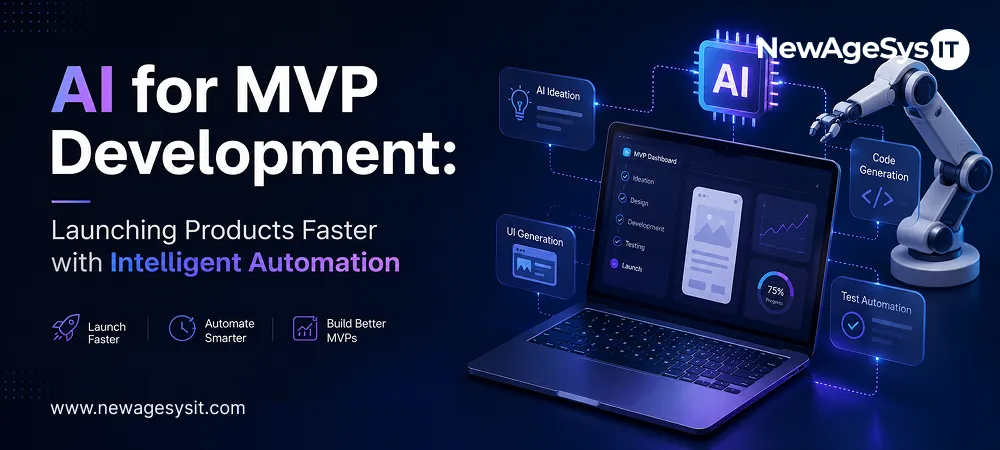
Artificial Intelligence 10 min read
AI in MVP Development: Launching Products Faster with Intelligent Automation

| This article is part of our series on AI-Powered Product Development: How Companies Build Smarter Digital Products Faster |
AI in MVP development is changing the timeline math for product teams. The old MVP cycle ran on hand-coded prototypes, manual QA, and weekly demos that often shipped late. That timeline cannot compete in markets where the first credible product wins.
AI compresses the build, the test, and the launch into something tighter. Code generation tools handle the repetitive layers. Automated testing catches bugs earlier. Prototyping platforms turn descriptions into working flows in hours, not days.
AI-powered product development promises faster cycles, and the MVP phase is where that promise gets tested first. This article goes deep into what AI actually does at the MVP stage. It shows how product teams are using it to launch sooner, without cutting corners on quality.
What is AI-Assisted MVP Development?
AI-assisted MVP development uses AI tools, automated coding platforms, and machine learning technologies to accelerate building and launching minimum viable products. Instead of manual coding, exhaustive testing cycles, and slow prototyping workflows, product teams use intelligent automation to handle the repetitive layers and free engineers for higher-judgment work.
The approach supports several stages of the MVP lifecycle. Teams that need structured guidance on embedding AI into existing workflows benefit from AI integration and adoption services that map tooling choices to their specific build stack. AI coding assistants automate code generation for boilerplate, scaffolding, and API integrations. Rapid prototyping tools turn written specifications into clickable flows. ML-based testing platforms predict regression risk and accelerate quality checks. Deployment automation handles environment setup and release.
The underlying technologies fall into a few clear categories: machine learning models trained on large code repositories, AI coding assistants integrated into developer environments, low-code platforms with embedded intelligence, and development automation platforms that orchestrate the build and release pipeline. Startups adopt these tools because they shorten the path from idea to market without expanding the team.
Why MVP Development is Critical for Product Innovation
The MVP is the first real test of whether a product idea holds up outside of slide decks and internal discussion. Building it well is what separates teams that find product-market fit from teams that burn runway on assumptions.
A strong MVP validates demand before heavy investment. It puts a working product in front of actual users and reveals which features matter, which assumptions were wrong, and which use cases the team did not anticipate. That signal is far more valuable than survey data or competitor analysis.
The MVP also reduces development risk. Releasing a small, focused version surfaces technical and operational issues at a manageable scale, rather than after a full launch. Early user feedback shapes the next build cycle, so each iteration moves closer to something people will pay for.
Faster MVP development matters because the cost of waiting is real. Markets shift, competitors move, and the team that ships first sets the reference point that everyone else has to respond to. For startups and innovation-driven companies, compressed MVP timelines directly translate into more learning cycles per quarter.
Why Traditional MVP Development Stalls
Most MVPs do not stall because the idea is wrong. They stall because the execution path is full of small delays.
Engineers spend large portions of early sprints writing boilerplate. Authentication, basic CRUD, API endpoints, and form handling repeat across nearly every project. None of it is hard. All of it takes time.
QA cycles add more friction. Manual testing scales poorly. Each new feature adds regression risk that the team cannot fully cover with the testing time available. Bugs slip through to launch and burn credibility.
Then there is the last-mile problem. Deployment, environment setup, and integration with third-party services often eat up the final week of an MVP plan. Teams ship late, or they ship on time with rough edges that hurt early traction.
Coordination overhead is the silent killer. As the team grows past three or four, coordination costs spike. Time spent in standups, code reviews, and design syncs starts to outweigh time spent shipping. The MVP idea may have been simple. The execution surface is not. One effective way to shrink that surface before the build begins is AI-driven requirement analysis and product planning catching scope gaps and ambiguities before they become sprint blockers.”
How AI Code Generation Accelerates Build Time
AI code generation tools have moved from novelty to standard tooling for rapid MVP development. They are not replacing engineers. They are removing the lowest-value parts of the engineer’s day.
Boilerplate, APIs, and Scaffolding
Most early-stage code in any MVP follows known patterns. AI generates that code on demand: route handlers, model definitions, API integrations, basic UI components, form validation logic. The engineer reviews, refines, and integrates.
The output is not always perfect. It is consistently good enough to skip the slow first-draft phase. A pattern that took two hours to write now takes fifteen minutes to refine.
Where Engineers Should Stay Hands-On
AI code generation works well for known patterns. It works less well for architectural decisions, performance tuning, and security-sensitive code. Senior engineers still own those areas.
The successful pattern is clear: AI handles volume, engineers handle judgment. Teams that try to push AI past its useful boundary end up with code that compiles but does not scale.
AI Prototyping Tools and Rapid Iteration
AI prototyping tools take written descriptions and turn them into clickable, working prototypes. Not static mockups. Functional flows that users can interact with.
From Description to Working Prototype
A product manager describes a feature in plain English. The AI prototyping tool generates the screens, the navigation between them, and basic interactivity. The team has something testable inside a single working session.
That speed changes the validation loop. Instead of debating concepts in meetings, the team puts something in front of users and watches what happens. Decisions get made faster because they are made on evidence.
AI in Automated Testing and QA for MVPs
Machine learning test automation has shifted QA from a calendar-blocking task to something that runs continuously alongside development.
Predictive Bug Detection
AI testing tools learn the patterns in a codebase and flag changes that are statistically likely to cause regressions. A pull request that touches code historically linked to bugs gets extra scrutiny automatically.
That predictive layer catches issues before they ship. It also focuses human QA effort where it matters: the riskier areas, not the routine ones.
Visual regression testing is another high-value area. AI compares UI states across builds and flags unintended changes. Designers no longer need to manually verify that a backend change did not break the layout.
How AI Improves MVP Testing and User Feedback Analysis
Shipping an MVP is only the start. The harder work is understanding how users actually interact with it, then turning that signal into the next iteration. AI has become a meaningful layer in that loop.
User behavior data is one of the highest-value inputs an MVP team can collect. AI tools analyze session recordings, click patterns, and navigation flows to surface where users drop off, where they get confused, and which features get repeated use. Patterns that would take a human analyst days to spot show up automatically.
Customer feedback is another area where AI compresses the cycle. Natural language models cluster open-ended responses, support tickets, and review text into themes. The team sees the top three issues without reading every message.
Feature engagement metrics close the loop. AI flags features with adoption gaps, ties them back to specific user segments, and suggests where the next iteration should focus. These fast feedback loops are what make rapid UX iteration possible inside an MVP timeline.
Low-Code and AI-Assisted Development for MVPs
Low-code platforms with embedded AI have lowered the barrier for non-engineers to contribute to MVP builds. Product managers can wire up internal tools. Designers can build interactive prototypes without engineering time.
This shifts the team’s bandwidth equation. Engineers stay focused on the core product surface. Supporting tools, admin panels, and internal workflows can be built outside the engineering queue.
Where Low-Code Fits and Where It Does Not
The pattern works best when boundaries are clear. Customer-facing core flows belong in the engineered codebase. Internal tools and one-off integrations are good candidates for low-code paths.
Teams that blur the line tend to regret it later. A low-code dashboard that started as an internal tool sometimes becomes a customer feature, and the foundation cannot scale. Setting the boundary early saves rework.
Challenges of Using AI in MVP Development
AI in MVP development delivers real speed, but adoption comes with friction that teams should plan for.
Expertise gaps are the most common issue. Using AI tools well requires engineers who understand both the tool’s strengths and its blind spots. Teams without that experience often accept low-quality output or apply AI in the wrong places.
Data quality limits what AI can do. Code generation, prototyping, and testing tools all perform poorly when the inputs are incomplete or inconsistent. Cleaning data and codifying patterns upfront is rarely glamorous, but it determines what comes out.
Integration complexity is another barrier. AI tools rarely plug cleanly into existing toolchains. The friction shows up clearly across custom Android app development and custom iOS app development workflows, where platform-specific build systems and SDK constraints often need careful adaptation before AI tooling pays off.
Overreliance on automation is the subtler risk. Teams that stop reviewing AI output ship bugs they could have caught. Infrastructure cost is another factor: GPU-backed AI tools and continuous testing pipelines can scale faster than early-stage budgets expect.
How Product Teams Are Putting AI MVP Development Into Practice
Teams getting real value from AI in MVP development tend to follow a consistent playbook. They do not rebuild the entire toolchain at once. They target the tightest bottleneck first.
A practical adoption order looks like this:
• Identify the slowest phase in your last three MVPs. Apply AI there first. Common answers: boilerplate writing, manual QA, or static mockup cycles.
• Set explicit quality gates for AI-generated code. Tests must pass. Senior engineers must review architecture-sensitive paths.
• Pair AI tools with experienced engineers. AI is most useful when reviewed by someone who knows what good code looks like.
• Track speed metrics from day one. Time from spec to demo, time from PR to merge, time from build to deploy. AI value shows up in these numbers.
• Plan for what AI does not do. Customer interviews, strategic decisions, and edge-case handling still need human attention.
Future of AI in Startup Product Development
The current generation of AI tools handles assistance. The next generation is moving toward autonomy.
Autonomous coding tools are already being used in production. Instead of suggesting code line by line, they take a task description and complete it end-to-end, writing, testing, and submitting a pull request for human review. Startups that adopt this pattern will compress development cycles further.
AI-driven product engineering will extend beyond code. Architecture suggestions, performance tuning, and dependency management will shift from manual tasks to AI-assisted decisions, with engineers acting as reviewers rather than authors of every change.
Automated product testing in production is another emerging area. AI agents will run synthetic user flows continuously, catching regressions before real users hit them. Real-time user analytics, powered by AI, will surface issues and opportunities the moment they appear in the data, not days later in a weekly review.
Final Thoughts
The MVP phase is where good ideas either reach users or get stuck in the build queue. Teams that compress that phase get more shots at finding product-market fit inside the same budget.
AI in MVP development raises the floor on speed without lowering the ceiling on quality. It removes the slow, routine work and lets the team focus on the decisions that actually shape the product. The teams that adopt early build a rhythm that competitors who delay will struggle to match.
If your team is evaluating AI for MVP work, start with your biggest recent bottleneck. Apply one tool, measure the change, and expand from what works. Working with an AI-powered MVP development partner that has implemented these workflows across multiple product types shortens the learning curve and reduces the risk of applying AI where it does not fit.
Core Development
Keep exploring the custom services.

AI Software Development
Custom AI Software Development
Build intelligent, production-ready software from machine-learning models to AI-driven automation designed around your business goals.
Learn more
Mobile App Development
Custom Mobile Application Development
Native and cross-platform mobile apps that are fast, secure, and built to scale across iOS and Android.
Learn more
Web App Development
Custom Web Application Development
Scalable, secure web applications, from customer portals to complex dashboards, tailored to how your business actually works.
Learn more



