
Welcome to Blogs
Discover actionable insights, in-depth research, and expert perspectives, all in one place.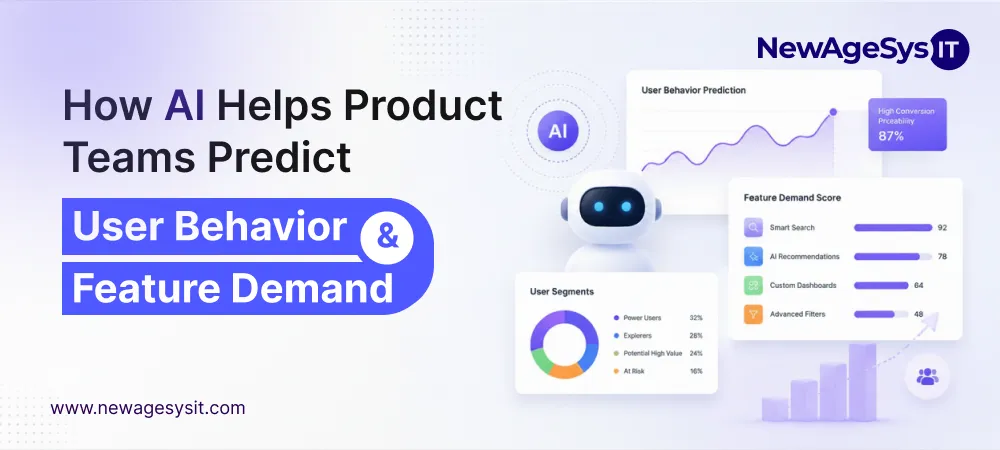
Artificial Intelligence 11 min read
AI in User Behavior Prediction: How Product Teams Forecast Feature Demand

| This article is part of our series on AI-Powered Product Development: How Companies Build Smarter Digital Products Faster |
AI in user behavior prediction is shifting product strategy from reaction to anticipation. Most product teams react to what users did last quarter. The teams winning right now are reading what users are about to do next.
That shift matters. Building features users do not want is the most expensive mistake in product work. AI prediction tools do not eliminate the risk. They lower it sharply. Teams building this capability work with AI product and agent development services designed to integrate predictive analytics into existing product workflows without replacing the judgment that makes those predictions actionable.
What Is AI-Driven User Behavior Prediction?
AI-driven user behavior prediction uses machine learning models and product analytics tools to analyze how users interact with a product and forecast what they are likely to do next. Instead of relying on quarterly survey results or one-off user interviews, prediction systems work continuously from live interaction data.
The technology stack pulls together three layers. Machine learning models detect patterns across large volumes of user activity. Predictive analytics translates those patterns into probabilities and forward-looking signals. Behavioral data modeling structures the raw interaction data, clicks, sessions, and feature use, drop-offs into a form that the models can learn from.
Organizations rely on this approach because product decisions made on opinion or stale research carry real cost. Data-driven product decision-making replaces hunches with evidence. Embedding this capability typically starts with AI integration and adoption services that map the right tools to the team’s existing data infrastructure and product stack. The product team sees what users are actually doing and where they are headed, then plans the roadmap against signals rather than assumptions.
Why Understanding User Behavior is Critical
Understanding user behavior is the foundation of every product decision that matters. Without it, teams ship features no one uses, miss the moments where churn begins, and pour engineering time into work the market does not reward.
Behavior insight directly improves usability. When teams see where users hesitate, abandon flows, or repeat the same action, the friction points become obvious and fixable. The same insight sharpens feature prioritization. The roadmap stops being a list of stakeholder requests and starts reflecting what users actually need.
Strong behavior data also tightens product-market fit. Teams learn which segments derive the most value and double down on serving them. Retention improves as a result, because the product evolves toward what keeps users engaged.
The cost of missing this insight is concrete. Roadmaps fill up with unnecessary features. Development budgets get burned on work that never lands. The user experience drifts away from what the actual user base needs.
The Hidden Cost of Building for Imagined Users
Most product roadmaps run on assumptions about who the user is and what they want. Personas describe imagined users. Survey responses describe what users say they will do. Neither matches what real users actually do once a feature ships.
The cost shows up late. A feature gets scoped, designed, built, tested, and launched. Then the data comes in. Adoption is below forecast. The team scrambles to fix it or quietly retires the feature six months later.
Every cycle of that pattern costs engineering time, calendar weeks, and team morale. The truth is simple. Most product bets fail not because the engineering was wrong. They fail because the prediction about user behavior was wrong from the start.Getting the prediction right starts earlier in the cycle with AI-driven UX research and user insights that surface what real users need before a single feature enters the roadmap
Reading the Signals That Actually Predict Behavior
Predictive product analytics works because behavior leaves footprints. Every click, every abandoned form, every session length, every feature ignored. Each adds to a picture of what the user values and where the user is heading.
From Static Personas to Dynamic User Models
Traditional personas freeze in time. The ‘power user’ persona built two years ago is stale. It does not match the actual power users in the product today. AI builds dynamic user models that update as behavior shifts.
Each user gets a profile that adjusts in real time. The profile reflects what the user has done. It draws on what similar users tend to do next. It also surfaces which features are likely to matter in the next 30 days.
What Predictive Actually Means
Prediction is not a guess dressed up in math. It is a probability score. The score is based on patterns the model has seen across thousands of similar user trajectories.
Say a model predicts a user is 70 percent likely to upgrade in the next two weeks. That is not magic. It is pattern matching against users who showed similar behavior and went on to upgrade.
Forecasting Feature Demand Before You Build
AI feature adoption forecasting answers a question every product team has dodged for years. Will this feature actually get used?
How Adoption Scoring Works
Before a feature enters the engineering queue, the AI looks at three inputs. The behavior of users who match the target audience for the feature. The performance of similar features the team has shipped before. The performance of comparable features in adjacent products where data is available.
It returns an adoption likelihood score with a breakdown. Product managers can see why the score is what it is. They see which segments are most likely to adopt and where the risk concentrates. Decisions get made on evidence, not opinion. That same evidence-first principle applies at the MVP stage teams that pair adoption scoring with AI-accelerated MVP development ship faster and iterate on signals rather than assumptions.
Spotting Churn Before Users Disappear
AI churn prediction is the highest-ROI use of behavior modeling for most product teams. The economics are simple: keeping a user is cheaper than acquiring one.
Churn signals show up well before a user actually leaves. Session frequency drops. Feature exploration narrows to a few familiar paths. Support ticket sentiment shifts. AI models pick up on these patterns and flag at-risk users automatically.
Acting on Churn Signals in Time
The signal is only useful if the team acts on it. The teams getting the most lift are pairing churn predictions with targeted interventions. A check-in email. A guided tour of an unused high-value feature. A direct outreach from customer success.
The intervention does not have to be elaborate. It has to be timely. A user flagged at the first signs of disengagement is easier to bring back. A user who has already stopped logging in is much harder.
AI Tools Used for Product Analytics and User Insights
The tools powering AI user behavior prediction have matured into a recognizable category. Predictive product analytics platforms forecast metrics like adoption, churn, and conversion at the user and segment level. The output is no longer a static dashboard but a forward-looking signal teams can act on.
User journey mapping tools trace how users move through the product. AI versions go further than visualizing the path; they surface where users branch unexpectedly, where they stall, and which sequences correlate with long-term value.
Automated behavioral analysis tools run continuously in the background. They flag pattern changes, segment shifts, and emerging cohorts without requiring an analyst to ask the right question first.
Engagement tracking rounds out the stack. Modern tools measure not just session counts but depth of use, feature stickiness, and the recovery patterns of users who lapse and return.
For teams building mobile-first products, the same predictive layer applies whether you are working on custom Android app development or custom iOS app development. The underlying behavioral signals are platform-agnostic; the tooling adapts to where the user lives.
The Personalization Loop That Learns in Real Time
Recommendation systems built on machine learning user insights do more than suggest the next item to click. They reshape the product surface for each user. The shape depends on what that user is likely to need next.
The loop runs continuously. The user takes an action. The model updates. The next experience reflects the new signal. Over weeks, each user converges on a personalized version of the product. That version fits their needs more closely than any one-size-fits-all design could.
That continuous adaptation is the part most teams underestimate. A static, rules-based personalization system goes stale in months. A learning system stays relevant as the user evolves. The product feels less generic and more like a tool built for that specific person.
What Product Teams Gain from AI Behavior Prediction
Teams that wire prediction into their workflow see real movement on four metrics that matter:
• Lower waste in the roadmap. Features with low predicted adoption get reworked or cut before they consume engineering time.
• Higher retention. Churn prediction paired with timely intervention reduces avoidable losses.
• Sharper feature design. Predictive insight informs which segments to design for and which paths to optimize.
• Better resource allocation. Engineering time flows toward work with the highest predicted impact.
The compounding effect is the real prize. Each correct prediction sharpens the next one as the model learns from outcomes.
Challenges of Using AI for User Behavior Prediction
AI behavior prediction is powerful, but it brings real challenges that teams need to plan for. Incomplete user data is the most common failure mode. Models trained on partial event streams or fragmented identity data produce predictions that look confident but miss key segments entirely.
Data privacy is a hard constraint, not an afterthought. Regulations like GDPR and CCPA shape what data can be collected, how long it can be retained, and how users must be informed. Teams need to design the data pipeline with consent and minimization built in from the start.
Incorrect model assumptions also distort outcomes. If the model is trained on users from one geography or pricing tier, applying it broadly can produce systematic errors. Misinterpretation of AI insights is another risk; a probability is not a certainty, and treating it as one leads to brittle decisions.
Integration complexity rounds out the list. Connecting prediction tools to existing analytics, CRM, and product surfaces takes engineering effort that is easy to underestimate.
Best Practices for Using AI in Product Analytics
Getting reliable value from AI prediction comes down to a handful of disciplined practices that turn the model from a demo into a tool the team trusts.
• Build strong data pipelines first. Predictions are only as good as the data feeding the model. Clean event tracking, consistent user identification across surfaces, and stable schemas matter more than model sophistication.
• Collect reliable interaction data at every meaningful touchpoint. Gaps in the funnel become blind spots in the prediction. Teams that invest early in instrumentation see compounding returns as the model gets sharper.
• Validate AI predictions with real user testing. Run shadow predictions for a quarter and compare them against actual outcomes before betting the roadmap on the model. Calibration is what turns a number into a decision input.
• Combine AI insights with product management expertise. The model surfaces patterns; the PM interprets them in context. Small segments, new launches, and qualitative signals still need human judgment.
• Wire prediction into existing rituals. Adoption scores belong in roadmap reviews. Churn flags belong in weekly retention syncs. A dashboard nobody opens has no impact on the roadmap.
• Match the intervention to the prediction. A churn flag is useful only if a clear playbook follows it. Build prediction reviews into post-mortems and ask why before adjusting the model.
• Treat product optimization as continuous, not episodic. The model gets better with every cycle of prediction, outcome, and feedback. The teams that build this loop early pull ahead and stay ahead.
Future of AI in Product Analytics and Feature Planning
The next phase of AI in product analytics is already taking shape. Real-time product analytics is replacing periodic reporting. Instead of waiting for a weekly or monthly cut, teams see what users are doing now and how those patterns are shifting hour by hour.
Predictive user journey mapping is moving from a research lens to an operational tool. The model does not just show where users have been, it forecasts where they are heading and flags the inflection points before they make decisions.
Automated feature optimization is the next layer. Systems will increasingly test, measure, and adjust feature variants without waiting for a manual experiment cycle. The product surface tunes itself toward what works.
The broader shift is that AI-driven product management tools are making data-driven prioritization the default. Roadmaps built on opinion will look as outdated as engineering done without version control. The teams adopting these tools now are setting the standard that the rest of the industry will catch up to.
Final Thoughts
Predicting user behavior is no longer a research project. It is a working capability. The strongest product teams use it to decide what to build and what to fix. They also use it to decide which users to fight to keep.
AI in user behavior prediction does not replace product judgment. It sharpens it. The teams that adopt it early build a head start. That head start compounds with every shipped feature and every retained user. Once it forms, it is hard for late movers to close.
If your team is exploring prediction, start with one decision that consistently goes wrong. Feature picks that miss adoption targets. Users who churn without warning. That is where the first model will earn its place.
To explore how predictive analytics can fit into your product strategy, learn more about our work as a US AI product development company.
Core Development
Keep exploring the custom services.

AI Software Development
Custom AI Software Development
Build intelligent, production-ready software from machine-learning models to AI-driven automation designed around your business goals.
Learn more
Mobile App Development
Custom Mobile Application Development
Native and cross-platform mobile apps that are fast, secure, and built to scale across iOS and Android.
Learn more
Web App Development
Custom Web Application Development
Scalable, secure web applications, from customer portals to complex dashboards, tailored to how your business actually works.
Learn more



