
Welcome to Blogs
Discover actionable insights, in-depth research, and expert perspectives, all in one place.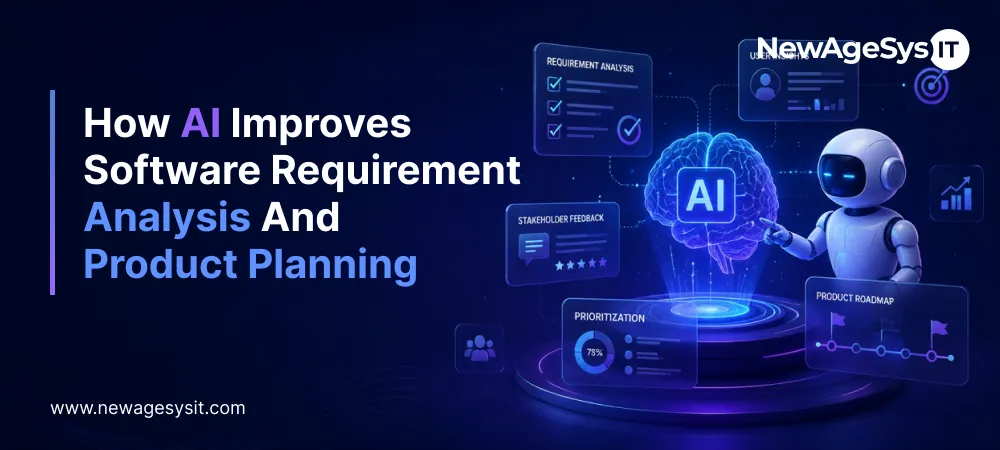
Artificial Intelligence 9 min read
AI in Software Requirement Analysis: How It Improves Product Planning

| This article is part of our series on AI-Powered Product Development: How Companies Build Smarter Digital Products Faster |
AI in software requirement analysis is reshaping how product teams turn fuzzy stakeholder input into clean, ranked requirements. The old approach is slow. Teams sit through interview cycles, write up notes, debate scope, and still ship features users did not ask for.
AI changes the inputs and the speed. It pulls signals from the channels users already speak in, like support tickets, reviews, and sales calls. It groups, scores, and surfaces those signals in hours instead of weeks.
Teams evaluating AI-powered product development often look at engineering and design first, but the requirement analysis layer is where many of the fastest, most measurable gains show up. This article goes deep on that phase, where the cost of getting it wrong is highest. Teams that build a strong foundation often start with custom software development services or custom mobile app development to ensure their planning translates into reliable execution.
What is AI-Driven Software Requirement Analysis?
AI-driven software requirement analysis uses natural language processing and machine learning to analyze product documentation, stakeholder feedback, and user data at scale. It turns scattered input into structured, ranked requirements that planning teams can act on.
The technology supports requirement work in several concrete ways. It processes large volumes of documentation in minutes. It identifies inconsistencies and gaps across specifications. It categorizes inputs into functional and non-functional requirements automatically. It links related items so duplicates and dependencies do not slip through.
The stack typically combines NLP for text understanding, machine learning models for pattern detection, and data analytics for surfacing trends across sources. Each layer handles a slice of work that humans cannot do at scale.
Organizations adopt AI-assisted requirement analysis to cut planning cycles, raise requirement quality, and reduce the rework that comes from missed or misinterpreted needs. The result is a tighter link between user reality and product backlog.
Challenges of Traditional Requirement Analysis
Traditional requirement analysis is constrained by five recurring challenges. Each one quietly degrades the quality of the final backlog.
Unclear requirements head the list. Stakeholders describe outcomes in their own language, and that language often hides assumptions the product team cannot see. Communication gaps follow. A requirement passes through interviews, notes, user stories, and tickets, and each handoff strips context. The version the engineer reads rarely matches the version the customer described.
Scope changes are constant. Markets move, priorities shift, and a roadmap built three months ago no longer reflects current needs. Without a fast way to reread the inputs, teams either ignore the drift or rebuild plans from scratch.
Inaccurate assumptions creep in when teams rely on small samples. A few loud users get over-represented while quieter signals are missed entirely. And documentation is slow. Specifications take weeks to write and review, and the writing time alone often outlasts the validity of the underlying research.
How AI Transforms Requirement Gathering
AI requirement gathering reads what teams cannot. It processes support tickets, reviews, sales transcripts, and community discussions in bulk. Natural language processing identifies common themes, recurring complaints, and unmet needs.
Instead of a product manager skimming a few dozen tickets, the AI reads thousands and surfaces the patterns. The output is not raw text. It is a ranked list of themes, with sentiment scores, frequency counts, and links back to the source quotes.
From Unstructured Feedback to Clean Inputs
AI converts messy text into structured data. A complaint like “the export feature is too slow when I have a lot of data” gets categorized as a performance issue. The system ties it to a specific feature, with severity inferred from tone.
That structured output plugs directly into planning tools. Themes that show up across hundreds of tickets get flagged automatically. Edge cases that one user mentioned once stay visible but get scored lower.
Reading Tone and Urgency
AI requirement gathering goes beyond keyword matching. Modern NLP models read tone. They flag tickets where users sound frustrated, even when the wording is polite. They detect urgency from phrasing like “we cannot ship without this” versus “it would be nice to have”.
That signal feeds prioritization. A feature request mentioned by ten frustrated enterprise customers carries a different weight than the same request from ten casual users.
AI in Product Planning and Roadmap Building
AI product planning takes the structured requirements and aligns them with business goals. The machine learning product roadmap models score each requirement against revenue impact, strategic fit, technical cost, and adoption likelihood.
Roadmaps That Update Themselves
The output is a roadmap that updates as data updates. New ticket volume on an issue raises that issue’s score. A feature shipped successfully lowers the urgency of related items. The roadmap reflects current reality, not last quarter’s planning meeting.
This matters most for teams running multiple products or large backlogs. Manual prioritization at scale is unreliable. AI keeps the ranking consistent and explainable across products.
AI Feature Prioritization in Practice
AI feature prioritization replaces gut-feel ranking with multi-criteria scoring. The AI weighs each candidate feature against the criteria the team chooses: revenue lift, user demand, engineering effort, strategic alignment, and risk.
How Multi-Criteria Scoring Works
Each feature gets a composite score. The team sees the score and the breakdown. If a feature ranks low on engineering effort but high on user demand, that combination shows up clearly. The product manager still makes the call. The AI removes the noise around it.
Predictive models add another layer. Before a feature gets built, the AI estimates the likelihood of adoption based on similar features in the product or in comparable products. That estimate becomes part of the score, which means resources flow toward features users will actually use.
AI Tools That Support Product Planning and Roadmapping
A growing ecosystem of AI tools now plugs into the planning stack. Four categories are doing the heaviest lifting.
Predictive product analytics tools score backlog items against likely impact before any work begins. They learn from past releases, which features moved the metric, which did not, and apply those patterns to new candidates.
Automated roadmap suggestion tools propose sequencing based on dependencies, capacity, and strategic weights. Product managers still approve the plan, but the first draft arrives ready instead of blank.
Customer feedback analysis tools sit on top of support, review, and sales data. They cluster themes, flag spikes, and route relevant findings into the planning tool automatically.
Feature demand forecasting tools project future demand for a feature based on early signals and comparable releases. That estimate shapes which bets get funded.
Most of these tools integrate directly with project management platforms like Jira, Asana, and Linear. The data flows where the work already happens.
How AI Predicts Product Demand and User Needs
Demand forecasting has moved from spreadsheet guesswork to data-driven prediction. AI models read historical usage, churn, expansion, and external signals to estimate which features will see real adoption.
The same models support customer segmentation. Machine learning clusters users by behavior rather than firmographics alone. Product teams can then see which segment actually needs a capability versus which segment merely asks for it.
Behavioral pattern detection adds the next layer. AI watches in-product signals feature usage, drop-off points, session sequencing, and flags shifts that precede churn or expansion. Planning teams react earlier, often before the trend is visible in dashboards.
The net effect is lower development risk. Investments are aimed at features with measurable demand from paying segments. Money moves away from ideas that test well in interviews but never get used. This predictive approach holds across platforms whether teams are building for web, Android development, or iOS development environments.
This predictive approach holds across platforms. The same logic applies whether teams are building for web, Android development, or iOS development environments.
Surfacing Hidden Requirements with NLP and ML
Some of the most valuable requirements are the ones users do not state directly. They show up in workarounds, repeated questions to support, and friction points in usage data. AI catches all three.
NLP models scan support transcripts and flag recurring workarounds. If many users describe building the same external script to get a report out of the product, that signals a missing feature. The gap is real, even though no one filed a feature request for it.
Machine learning models combine that signal with behavioral data. A high drop-off rate on a specific screen, paired with a spike in support tickets about that screen, points to a usability or capability gap. That gap needs planning attention.
Key Benefits of AI in Software Requirement Analysis
Product teams that adopt AI in their requirement analysis and planning workflows see gains in four areas:
• Wider input coverage. AI reads support tickets, reviews, transcripts, and surveys at full scale. Nothing important slips past.
• Sharper prioritization. Multi-criteria scoring replaces gut-feel ranking and produces decisions teams can defend.
• Faster planning cycles. Roadmaps update on live data, not quarterly off-sites.
• Fewer wasted features. Predictive adoption modeling cuts investment in work that users will not use.
These gains build on each other. Better inputs lead to better scoring, which leads to better roadmaps and stronger commercial outcomes.
How Product Teams Are Putting AI Requirement Analysis Into Practice
Teams getting real value from AI requirement analysis follow a clear pattern. They do not boil the ocean. They start with the highest-leverage step in their current planning process.
A practical implementation order looks like this:
• Centralize feedback sources. Connect support, reviews, sales notes, and survey data into one pipeline before applying AI.
• Pick one prioritization framework. RICE, ICE, or a custom scoring model. AI works better when the criteria are explicit.
• Run AI alongside humans for one full quarter. Compare AI rankings to PM rankings. Investigate the disagreements; those are where real learning happens.
• Tie outputs to specific KPIs. Track whether AI-prioritized features actually moved the metric they were scored on.
• Refine the criteria, not just the data. Most prioritization failures come from wrong weights, not wrong data. Requirement planning mistakes are among the most costly in product development, learn to avoid them in Common Mistakes Companies Make When Using AI in Product Development.
The Future of AI in Product Management and Planning
The product manager role is shifting. AI is taking over the data-gathering and synthesis work, and PMs are moving up the stack into strategic interpretation.
Automated requirement documentation will become standard. AI will draft specifications from meeting transcripts, support tickets, and product analytics, then route them to humans for approval rather than authorship.
Predictive product roadmaps will run on live data. Instead of quarterly off-sites that freeze a plan for ninety days, roadmaps will adjust as signals shift. The AI surfaces what changed and why.
Real-time product performance insights will close the loop between planning and outcome. PMs will see in hours whether a shipped feature is delivering its scored impact. The next planning cycle starts with that evidence already in hand.
The result is a planning function that is faster, sharper, and far more honest about what works.
Final Thoughts
Requirement analysis and product planning have always been the highest-leverage moments in product development. Get them right, and the rest of the work compounds. Get them wrong, and engineering ships the wrong thing fast.
AI in software requirement analysis raises the floor on both. It widens the input net, sharpens the scoring, and keeps the roadmap honest as the market shifts. Teams that adopt it early move with more confidence and fewer expensive U-turns.
Evaluating AI for planning? Start with one bottleneck. The outcome is shorter planning cycles and sharper prioritization.
Core Development
Keep exploring the custom services.

AI Software Development
Custom AI Software Development
Build intelligent, production-ready software from machine-learning models to AI-driven automation designed around your business goals.
Learn more
Mobile App Development
Custom Mobile Application Development
Native and cross-platform mobile apps that are fast, secure, and built to scale across iOS and Android.
Learn more
Web App Development
Custom Web Application Development
Scalable, secure web applications, from customer portals to complex dashboards, tailored to how your business actually works.
Learn more



