
Welcome to Blogs
Discover actionable insights, in-depth research, and expert perspectives, all in one place.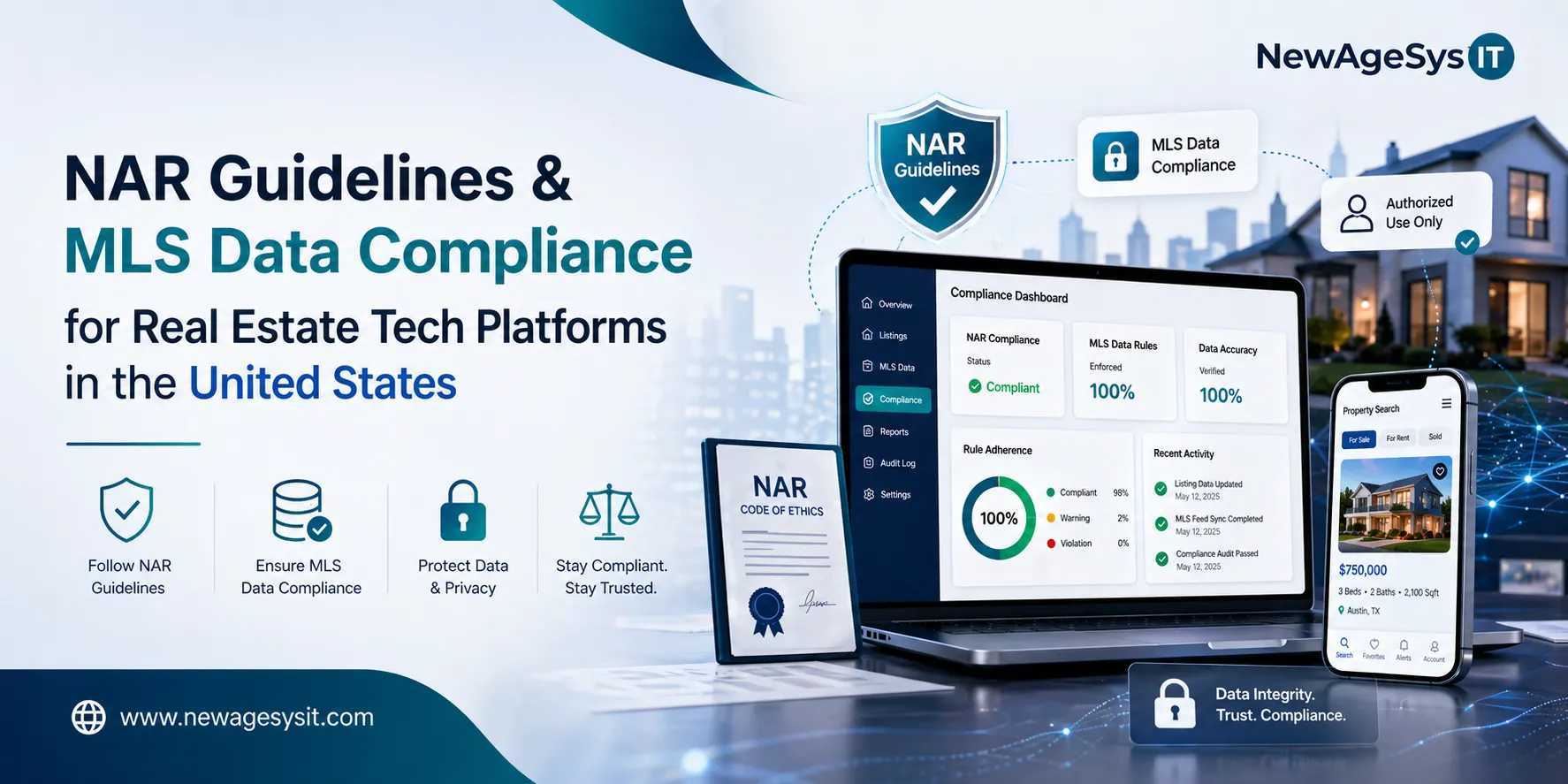
Real Estate 8 min read
NAR Guidelines & MLS Data Compliance for Real Estate Tech Platforms in the United States

| This article is part of our series on Real Estate Software Compliance, Security & Regulatory Strategy for US Developers. |
NAR MLS data compliance for real estate platforms is an operational requirement that determines whether a product can access and display property listings. MLS data access underpins most consumer real estate platforms, and violations of MLS data use agreements can result in MLS membership termination, immediately cutting off the data feed the platform depends on. For teams building listing-driven applications ormaking real estate platform architecture decisions, this creates a direct dependency in which compliance decisions affect platform viability.
NAR policies define the framework for IDX, VOW, and Clear Cooperation Policy requirements, but enforcement occurs at the local MLS level, where each MLS defines its own data use agreement and display rules. Compliance, therefore, requires aligning platform behavior with both the NAR model policy and the specific local MLS data use agreement for each integration.
MLS data compliance is not a one-time implementation. Data use agreements are updated, display rules change across markets, and new NAR policies introduce additional requirements over time. This creates an ongoing compliance discipline, especially for platforms expanding across multiple MLS markets, including those managing client and transaction workflows across regions.
MLS compliance requirements vary across more than 600 local MLS systems in the United States. While NAR defines the framework, local MLS data-use agreements contain the binding compliance requirements governing data access and display. Each MLS integration requires review of the current agreement, and compliance decisions should be validated with qualified real estate legal counsel.
This layer of NAR guidelines and MLS data compliance operates within the broader US real estate software compliance framework, where regulatory requirements, platform architecture, and operational controls must align to maintain uninterrupted data access.
NAR IDX Policy: The Foundation of Listing Display Compliance
NAR IDX compliance allows brokers participating in an MLS to display listing data on their websites and applications, subject to the specific requirements defined in each MLS data use agreement. IDX policy requirements establish how listing data can be presented, and platforms must enforce these rules at the display layer to remain compliant.
Every IDX listing must include attribution to the listing broker. While the format varies by MLS, including broker name, company name, or logo, the requirement itself is universal and must be validated before any listing is rendered. IDX listing display compliance also requires data freshness, with most MLSs mandating updates within 12 to 24 hours. Displaying sold, withdrawn, or under-contract listings as active constitutes a compliance violation.
IDX policy further requires equal display of listings. Platforms cannot suppress competitor listings or prioritize their own inventory without clear disclosure, making ranking logic and listing visibility part of compliance enforcement. Confidential field restrictions also apply, as MLS data use agreements define which fields can be publicly displayed. This requires field-level controls built into platform implementation logic to prevent restricted data exposure.
Some MLSs prohibit displaying IDX data in frames or within third-party interfaces without specific authorization, making frame restrictions a technical requirement that must be reviewed for each MLS integration.
NAR Clear Cooperation Policy: Engineering Implications
The NAR Clear Cooperation Policy (1.31) requires MLS participants to submit listings to the MLS within one business day of marketing them to the public. Public marketing includes any outward-facing activity, such as yard signs, social media posts, email campaigns, or website promotion, making listing visibility tightly coupled with MLS submission timing.
For platforms managing listing workflows, this requirement must be enforced at the system level. Listing management software must prevent agents from initiating public marketing without triggering or completing MLS submission within the required timeframe, ensuring compliance with Clear Cooperation requirements.
Real estate software must also maintain a listing management audit trail, logging the timestamp of every public marketing action alongside MLS submission timestamps. This supports compliance documentation if a Clear Cooperation violation is alleged and aligns with broader regulatory requirements under RESPA, CCPA, and the Fair Housing Act, as addressed in US Real Estate Software Development.
Features such as coming-soon listings and pocket listings require careful design. Pre-market exposure must be controlled, as policy rules limit how listings can be marketed before MLS submission. Office exclusive listings represent a specific exception, allowing internal brokerage marketing only, which platforms must enforce by restricting any form of public exposure.
VOW Policy: Expanded Data Access and Its Compliance Requirements
Virtual Office Website (VOW) compliance enables participating brokers to access and display additional MLS data fields beyond standard IDX, including active status history, off-market data, and listing agent contact information, but only for registered users. This expanded data access model introduces stricter requirements for controlling and monitoring user access.
VOW policy requires user registration before accessing restricted MLS data. Real estate platforms must enforce registration-gated access, capture user agreement to terms of use, and maintain records of registered users as part of compliance enforcement.
The displaying broker is accountable for all user activity within a VOW environment. Platforms must maintain detailed access logs and user registration records to support compliance documentation and, if required, demonstrate adherence to MLS rules.
VOW implementation should be evaluated against product requirements. Not all platforms require VOW access, as the additional compliance obligations are justified only when the expanded dataset creates measurable value beyond IDX capabilities.
Local MLSs may modify or limit VOW data access. The specific data fields and compliance requirements can vary from the NAR model VOW policy, requiring review of local MLS rules for each integration.
RESO Web API: Technical Compliance for MLS Data Integration
RESO Web API compliance defines the technical standard for MLS data integration in modern real estate platforms. NAR requires all NAR-affiliated MLSs to provide RESO Web API access, making it the primary integration method for platforms building new MLS data connections. Legacy RETS-based integrations are being phased out, requiring migration planning to maintain uninterrupted data access.
RESO Data Dictionary compliance standardizes field names and data structures across MLS systems. Aligning the platform’s data model with RESO-defined fields reduces mapping complexity and ensures consistency across multiple MLS integrations.
RESO Web API uses OAuth 2.0 client credentials for authentication. Platforms must implement secure token-based authentication to ensure stable and authorized access to MLS data feeds, particularly for secure mobile access to MLS data.
MLS data access through RESO APIs must be logged and monitored. Platforms should maintain detailed records of API requests, field mappings, and data transformation processes to support MLS data use agreement compliance and audit requirements.
As MLSs continue retiring RETS feeds, platforms relying on legacy integrations must implement RESO Web API migration strategies to prevent disruption to listing data access and platform functionality.
MLS Data Use Agreements: Operational Enforcement and Platform Risk
MLS data access is governed by a signed MLS data use agreement, which defines how listing data can be accessed, displayed, stored, and used within a real estate platform. Each MLS enforces its own agreement, making compliance a binding requirement for maintaining data access.
MLS data use agreements define both permitted and prohibited use of listing data, including display rules, data storage limitations, and restrictions on redistribution or resale. These requirements must be enforced at the system level, as non-compliant platform behavior constitutes a direct violation of MLS contract terms.
Failure to comply with MLS agreement requirements can result in suspension or termination of MLS data access. Because MLS feeds are foundational to listing-driven platforms, a single violation can disrupt the entire product, not just the non-compliant feature.
For platforms operating across multiple MLS markets, each integration introduces a separate data use agreement with distinct requirements. This creates operational complexity, requiring systems to track agreement-specific rules, updates, and enforcement conditions across regions, as addressed in Why US PropTech Startups Need a Regulatory and Technology Consultant Before Building.
MLS data use agreement compliance is, therefore, an ongoing operational discipline, where platform behavior must continuously align with evolving MLS requirements to maintain uninterrupted access to listing data.
MLS Compliance Violations: Risk, Enforcement, and Prevention
PropTech MLS compliance failures most commonly occur in listing attribution, data freshness, confidential field exposure, workflow enforcement, and data redistribution. These violations arise when platform behavior does not enforce MLS data use agreement requirements at the system level.
Missing or incorrect listing attribution requires automated attribution enforcement in the listing display layer, verified against each MLS’s required attribution format before any listing is rendered. Stale listing data must be addressed through automated data freshness monitoring that flags or suppresses listings not updated within the MLS-required refresh interval, preventing the display of sold or expired properties as active.
Confidential field exposure must be controlled through a per-MLS field allowlist that defines which fields can be displayed publicly. Clear Cooperation Policy violations must be prevented through listing workflow enforcement that blocks public marketing before MLS submission, with timestamp logging that creates the compliance audit trail. Unauthorized data redistribution must be restricted at the API layer by enforcing data use agreement terms that prohibit sharing MLS data with third parties.
MLS compliance violations are identified through audits, broker complaints, and automated monitoring. Enforcement actions range from warnings and penalties to suspension or termination of MLS data access, making prevention through system-level controls an operational requirement rather than a one-time configuration.
Final Thoughts
NAR MLS data compliance for real estate platforms defines the operational discipline required to maintain uninterrupted MLS data access. US real estate platforms that embed IDX enforcement, Clear Cooperation controls, and MLS data use agreement management into their architecture maintain MLS relationships and avoid disruption caused by violations, as part of MLS data governance in the US real estate ecosystem. Designing these controls requires translating MLS rules into system behavior, particularly when aligning listing workflows and data integration layers with evolving requirements, as seen in real estate platform compliance and integration design approaches.
If your organization is building or operating a US real estate platform with MLS data access, establishing IDX compliance automation, MLS data use agreement version management, and RESO Web API as the technical foundation protects both the platform’s data access and its MLS relationships.
Core Development
Keep exploring the custom services.

AI Software Development
Custom AI Software Development
Build intelligent, production-ready software from machine-learning models to AI-driven automation designed around your business goals.
Learn more
Mobile App Development
Custom Mobile Application Development
Native and cross-platform mobile apps that are fast, secure, and built to scale across iOS and Android.
Learn more
Web App Development
Custom Web Application Development
Scalable, secure web applications, from customer portals to complex dashboards, tailored to how your business actually works.
Learn more



