
Welcome to Blogs
Discover actionable insights, in-depth research, and expert perspectives, all in one place.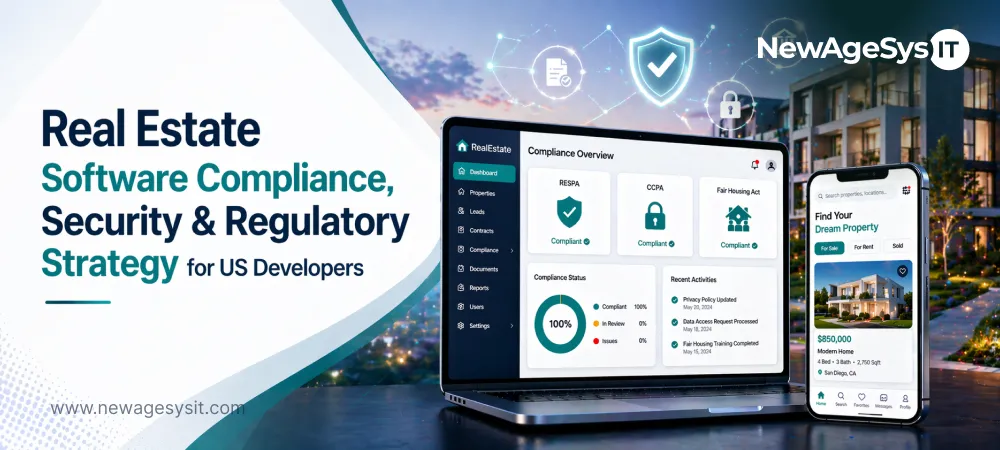
Real Estate 13 min read
Real Estate Software Compliance, Security & Regulatory Strategy for US Developers

In the context of real estate software compliance in the USA, compliance is not a legal review applied after development. It is a core engineering discipline that defines what can be built, how client data is handled, and what the platform can legally enable within the US real estate market. For teams building real estate platforms, compliance must be embedded into architecture from the outset.
This is especially critical because transaction workflows, client data handling, and real estate data security are core system components governed directly by regulatory requirements.
Compliance requirements directly shape how real estate platforms are engineered, from user-facing property applications to backend systems that manage client relationships and transaction workflows, influencing architecture, integrations, and data governance decisions from the outset. These requirements apply to real estate mobile and web app development services from property search and listing display platforms to transaction coordination tools and client relationship systems — where regulatory constraints are embedded into core system design.
Teams building real estate software and CRM development services must map these requirements to their specific product scope, transaction workflows, client data handling, and MLS integrations, each carry distinct obligations. US real estate software operates within a multi-layer compliance environment that is unique among industries. It combines federal requirements under RESPA, civil rights obligations under the Fair Housing Act, CCPA, and CPRA, evolving state privacy laws, industry-specific governance through NAR guidelines and MLS data use agreements, and state licensing requirements.
These frameworks apply simultaneously and directly influence product design, data architecture, and system behavior. As a result, a regulatory strategy must be defined before architecture decisions are made.
Failures in compliance can lead to RESPA penalties, Fair Housing enforcement actions, termination of MLS data access, and state licensing sanctions, all of which can disrupt operations. Cybersecurity is both a compliance requirement and an operational necessity, and inadequate client data protection increases exposure to risks such as wire fraud. Non-compliance also limits partnerships, as financial institutions, enterprise brokerages, and MLS organizations require a clearly defined compliance posture before engagement.
Building compliance into architecture from the beginning is widely recognized in industry practice as significantly more cost-effective than retrofitting it later, where remediation typically requires substantial system rework.
This article maps the full compliance landscape that US real estate software developers must navigate before any architectural decision is made.
The US Real Estate Software Compliance Stack
US real estate software operates within a layered compliance stack of regulatory frameworks that developers must navigate simultaneously, and compliance with one does not ensure compliance with others. For teams defining a US real estate regulatory strategy, each framework directly shapes platform behavior, data usage, and transaction workflows.
RESPA (Real Estate Settlement Procedures Act) governs settlement service provider relationships, including kickbacks and fee arrangements in real estate transactions. Software that manages referral relationships, preferred vendor programs, or settlement service integrations must be designed around RESPA Section 8 requirements.
The Fair Housing Act prohibits discrimination in housing based on protected characteristics and applies to software systems that manage property search, lead routing, marketing, and recommendations. Algorithmic systems carry the same Fair Housing obligations as human agents.
CCPA, CPRA, and evolving state privacy laws require real estate platforms with US users to provide consumer data rights. Search history, behavioral data, and client records are in scope for these requirements.
NAR guidelines and MLS data governance define how listing data can be used, displayed, and stored. IDX compliance is an ongoing operational requirement, not a one-time implementation, and must align with MLS data use agreements.
State licensing requirements govern broker supervision technology, transaction documentation, and advertising rules, which vary by state. Multi-market real estate software must accommodate these state-specific compliance requirements.
These frameworks do not operate independently, and their overlap creates direct architectural constraints at the system design level. For example, RESPA audit trail requirements for referral decisions must be designed alongside CCPA and CPRA obligations for data deletion, with compliance logs separated from personal data. Similarly, MLS data use restrictions affect how behavioral data can be stored and used within CCPA-compliant workflows.
In contrast, Fair Housing limits how user and location data can be applied in algorithms. As a result, real estate software cannot be designed for one framework at a time and must support coordinated data governance and system controls that address overlapping regulatory requirements.
They represent the applicable regulatory requirements for US real estate software, with specific obligations within each framework varying based on jurisdiction, business model, and evolving enforcement guidance. This section presents regulatory information accurately and factually as strategic and technical guidance and is not intended as legal advice. Organizations should consult qualified real estate legal counsel for specific compliance requirements.
RESPA, CCPA, and Fair Housing: The Core Compliance Triad
RESPA, the Fair Housing Act, and CCPA/CPRA form the core compliance triad that most directly affects US real estate software design. These frameworks move beyond regulatory policy into system-level requirements, shaping how platforms manage referral relationships, algorithmic decision-making, and consumer data. Each framework introduces specific engineering obligations that must be addressed during system design to avoid regulatory exposure.
1. RESPA (Real Estate Settlement Procedures Act)
• RESPA Section 8: Prohibits kickbacks and unearned fees in connection with federally related mortgage transactions. RESPA software that routes leads to settlement service providers, manages affiliated business arrangements, or facilitates marketing services agreements must be designed to support RESPA compliance, including required disclosures.
• RESPA engineering implications: Audit trails for referral routing decisions, AfBA disclosure delivery and logging, and documentation of any fee arrangements between the platform and settlement service providers.
2. The Fair Housing Act
• Fair Housing Act: Algorithmic systems such as recommendation engines, lead routing, geographic marketing, and search filters carry the same Fair Housing obligations as human decisions. Disparate impact on protected classes creates enforcement exposure regardless of intent.
• Fair Housing engineering implications: Recommendation algorithm testing for disparate impact, prohibited data inputs such as neighborhood demographics and school district racial composition, and an audit trail for algorithmic decisions.
3. CCPA/CPRA (California) and State Privacy Laws
• CCPA/CPRA: Real estate platforms with California users must support consumer data rights, including the right of access, right to deletion, and the right to opt out of sale or sharing within defined response timeframes. Property search history, behavioral analytics, and saved listing data are all in scope.
• CCPA engineering implications: Data subject rights automation, such as deletion pipelines and export functionality, consent management for behavioral tracking, and privacy-protective defaults.
These requirements illustrate how deeply RESPA, Fair Housing, and CCPA/CPRA are embedded into real estate software architecture, making compliance a continuous engineering responsibility rather than a one-time implementation.
Cybersecurity: The Operational Foundation of US Real Estate Software Compliance
Real estate software handles some of the most sensitive consumer data collected by any industry, including client financial information, home addresses, financial capacity, transaction details, client identity documents, and, in showing apps, property access credentials. This makes cybersecurity simultaneously a compliance requirement, a client trust requirement, and a licensing board expectation, requiring real estate data security to be embedded into platform design.
Wire fraud is the highest-impact cybercrime in US real estate. Business email compromise attacks targeting real estate transactions are widely recognized as one of the largest sources of cybercrime-related financial loss in the United States, making it essential for real estate software to implement security controls that reduce wire fraud vectors.
State licensing boards in many US states now require brokerages to implement and document cybersecurity programs, reinforcing the growing intersection of cybersecurity and licensing compliance. In addition, most US states have data breach notification laws that apply to real estate platforms, where timeline requirements, notification scope, and regulatory reporting obligations vary by state.
To address these risks, compliant real estate platforms must implement zero-trust security architecture, end-to-end encryption for transaction documents, multi-factor authentication for access to client financial data, and penetration testing as part of their operational security baseline.
NAR Guidelines and MLS Data Compliance
NAR guidelines and MLS data governance define how real estate software platforms access, display, and manage listing data, making MLS data compliance an ongoing operational requirement rather than a one-time implementation. Real estate platforms must continuously align with evolving MLS data use agreements, policies, and technical standards across markets.
IDX (Internet Data Exchange) policy defines the baseline rules for how MLS listing data can be displayed on broker and agent websites. While NAR provides a model IDX policy, local MLSs implement these rules with specific variations that platforms must accommodate.
The NAR Clear Cooperation Policy requires that listings be submitted to the MLS within one business day of marketing. Software that facilitates listing management must support this requirement to prevent MLS violations for broker clients.
VOW (Virtual Office Website) policy enables expanded data access for registered users beyond standard IDX. Platforms offering buyer portals with enhanced listing data must comply with VOW requirements, which differ from IDX rules.
RESO Web API compliance is now the required technical approach for MLS data integration. Platforms relying on legacy RETS feeds face increasing maintenance challenges as MLSs retire RETS support.
MLS data use agreement enforcement is strict. Violations of IDX display rules, including incorrect attribution, stale listing data, or prohibited field display, can result in MLS membership termination, eliminating data access for the platform.
At the product level, these requirements directly affect platform viability. Features built without reviewing local MLS data use agreements are frequently found to violate display rules or restricted data usage after launch. When such violations are determined, MLSs can terminate data access for the entire platform, beyond the non-compliant feature. This means a single non-compliant implementation can disrupt core product functionality, making pre-build MLS compliance review a product-level requirement rather than a post-launch correction.
MLS data use agreements vary by local MLS. IDX rules, Clear Cooperation Policy implementation, and VOW requirements differ across the 600+ US MLSs. Always review the current data use agreement for each MLS and consult qualified real estate legal counsel.
The Real Cost of US Real Estate Software Compliance
Building compliant real estate software in the US requires a clear understanding of both upfront and ongoing investments. Proactive compliance integrates regulatory requirements into the system architecture from the outset, while reactive compliance involves retrofitting systems post-launch, often requiring significant rework across data structures, workflows, and integrations.
The following figures represent indicative planning ranges based on typical industry implementations and should not be interpreted as fixed costs or guarantees. Actual investment varies based on the complexity of the product, market scope, regulatory exposure, and vendor selection.
| Cost Component | Estimated Investment | Key Considerations |
|---|---|---|
| Proactive Compliance Architecture | Adds 15–25% to development cost | Reduces long-term risk and avoids expensive rework |
| Reactive Compliance (Post-Launch) | Adds 40–80% of the original development cost | Requires system redesign, delays, and operational disruption |
| MLS Data Compliance (Ongoing) | Recurring operational cost | Includes data use agreement renewals, display rule updates, and RESO Web API version migrations |
| Fair Housing AI Audits | $10,000–$30,000 (initial) + annual audits | Disparate impact analysis required for AI-driven platforms |
| Legal Counsel (PropTech Scale) | $15,000–$50,000 initial + $20,000–$60,000/year | Ensures regulatory alignment and risk mitigation |
| Cost of Non-Compliance | $10,000 per violation + potential criminal exposure | Includes RESPA penalties, Fair Housing enforcement actions, and MLS access termination risks |
The cost distribution highlights a consistent pattern: investment in early-stage compliance architecture is significantly lower than the cumulative cost of post-launch remediation, legal exposure, and operational disruption.
Beyond initial implementation, compliance remains an ongoing operational requirement. MLS data governance, Fair Housing obligations, and evolving regulatory standards require continuous engineering oversight and legal alignment. The cost of non-compliance can escalate quickly, from civil penalties and consent decrees to complete platform disruption caused by MLS membership termination.
Why Regulatory Strategy Must Come Before Architecture
Regulatory strategy must be defined before architecture design in US real estate software, as early decisions directly determine compliance feasibility, system behavior, and long-term cost. The most expensive compliance mistakes occur in the first 60 days, when architecture is defined without regulatory input, creating compliance debt that compounds across the product lifecycle. For organizations developing real estate software in the US, maintaining regulatory compliance from the outset requires early-stage alignment between legal requirements and system design.
RESPA analysis of planned features must happen before architecture. Preferred vendor integrations, referral routing logic, and marketing services agreement structures must be reviewed before engineering begins to avoid violations and rework.
MLS data use agreement review is equally critical before development. IDX rules define what features are permissible with MLS data, and features designed without reviewing local MLS data use agreements frequently violate display and usage policies.
Fair Housing assessment must also precede implementation. Recommendation engines, lead routing systems, and geographic targeting features must be evaluated for Fair Housing risk before development, rather than after a complaint or enforcement action.
Pre-build regulatory strategy consultation, typically ranging from $15,000 to $50,000, prevents compliance architecture decisions that can cost $100,000 to $500,000 or more to correct during development or post-launch.
Building a Compliance-First US Real Estate Software Architecture
A compliance-first architecture in US real estate software is not more expensive than standard architecture. It is a different approach that embeds regulatory requirements into system design from the outset rather than treating compliance as a post-development overlay. This approach ensures scalability, audit readiness, and alignment with evolving regulatory expectations.
RESPA Compliance Infrastructure
An effective RESPA layer requires audit trails for all referral routing decisions, settlement service provider relationships, and fee arrangements, supported by immutable logs with timestamps and user identity for regulatory examination. AfBA disclosure delivery systems must present required disclosures at defined transaction points and log acknowledgment as a legal record of compliance.
Fair Housing-Compliant Algorithm Design
Algorithmic systems must be designed to meet Fair Housing technology compliance requirements by excluding protected-class-correlated features from model inputs and incorporating regular disparate impact testing into governance processes. Search filters must enable legitimate functionality without introducing discriminatory outcomes, and should be reviewed for geographic filters, school district data, and neighborhood characteristics.
MLS/IDX Compliance Layer
Platforms must implement automated listing-attribution enforcement, data-freshness monitoring, and display-rule compliance checks to prevent IDX violations. MLS data use agreement compliance records must document signed agreements, rule versions, and audit history across markets.
Client Data Protection
For platforms delivering these controls across mobile, custom mobile app development must treat encryption, role-based access, and data subject rights automation as baseline architecture requirements — not optional enhancements added post-launch. Client data protection requires encryption at rest and in transit for financial data, identity documents, and transaction records, supported by role-based access control. Data subject rights automation, including deletion, export, and consent management, must be built into the architecture rather than handled through manual processes.
Implementing these capabilities requires custom software development with scalable backend architecture, secure data pipelines, and system-level controls that ensure consistent protection of sensitive data across web and mobile environments.
State Licensing Compliance Documentation
Compliance also requires structured documentation, including transaction record retention aligned with state-specific timelines and broker supervision audit trails that record managing broker oversight of agent transactions, as required by most state licensing boards.
Common US Real Estate Software Compliance Failures
Many US real estate software compliance failures are not caused by complexity, but by avoidable planning gaps. For teams focused on PropTech compliance, these failures often originate from early product decisions made without regulatory alignment, leading to costly rework and enforcement exposure.
• RESPA-violating preferred vendor features: Building lead routing to mortgage lenders, title companies, or insurance providers without RESPA review creates compliance risk. What begins as a standard feature request can become a liability if referral structures and required disclosures are not designed correctly.
• Fair Housing algorithm deployment without testing: Launching AI recommendation engines or lead scoring systems without disparate impact testing creates enforcement exposure that may only surface during a complaint investigation.
• MLS data use agreement violations: Implementing IDX display features without reviewing local MLS data use agreement restrictions often results in non-compliant data display or prohibited usage identified after launch.
• CCPA non-compliance for California users: Building platforms serving California users without implementing required consumer data rights, including access, deletion, and opt-out mechanisms, remains one of the most common compliance gaps.
• Transaction record retention failure: Inadequate document retention architecture prevents platforms from producing complete transaction records during licensing audits, creating avoidable regulatory risk.
Final Thoughts
US Real estate software compliance is a multi-layer strategic discipline that must be addressed before architecture design begins. RESPA, the Fair Housing Act, CCPA/CPRA, MLS data governance, cybersecurity, and state licensing requirements collectively define how real estate software is designed, deployed, and scaled in regulated markets.
Software built with compliance as a foundational engineering requirement, rather than as a legal review overlay, is safer for clients, more defensible in regulatory investigations, and more trusted by enterprise brokerages and MLS organizations that control market access. This approach also supports faster enterprise sales cycles, stronger MLS relationships, and lower enforcement risk.
If your organization is building US real estate software, aligning compliance architecture with regulatory requirements and MLS data governance from the start significantly reduces legal exposure and accelerates market access. NewAgeSysIT works with US real estate teams to build compliance-first architectures — covering RESPA, Fair Housing, MLS data governance, and cybersecurity — as foundational engineering requirements from day one.
Core Development
Keep exploring the custom services.

AI Software Development
Custom AI Software Development
Build intelligent, production-ready software from machine-learning models to AI-driven automation designed around your business goals.
Learn more
Mobile App Development
Custom Mobile Application Development
Native and cross-platform mobile apps that are fast, secure, and built to scale across iOS and Android.
Learn more
Web App Development
Custom Web Application Development
Scalable, secure web applications, from customer portals to complex dashboards, tailored to how your business actually works.
Learn more



