

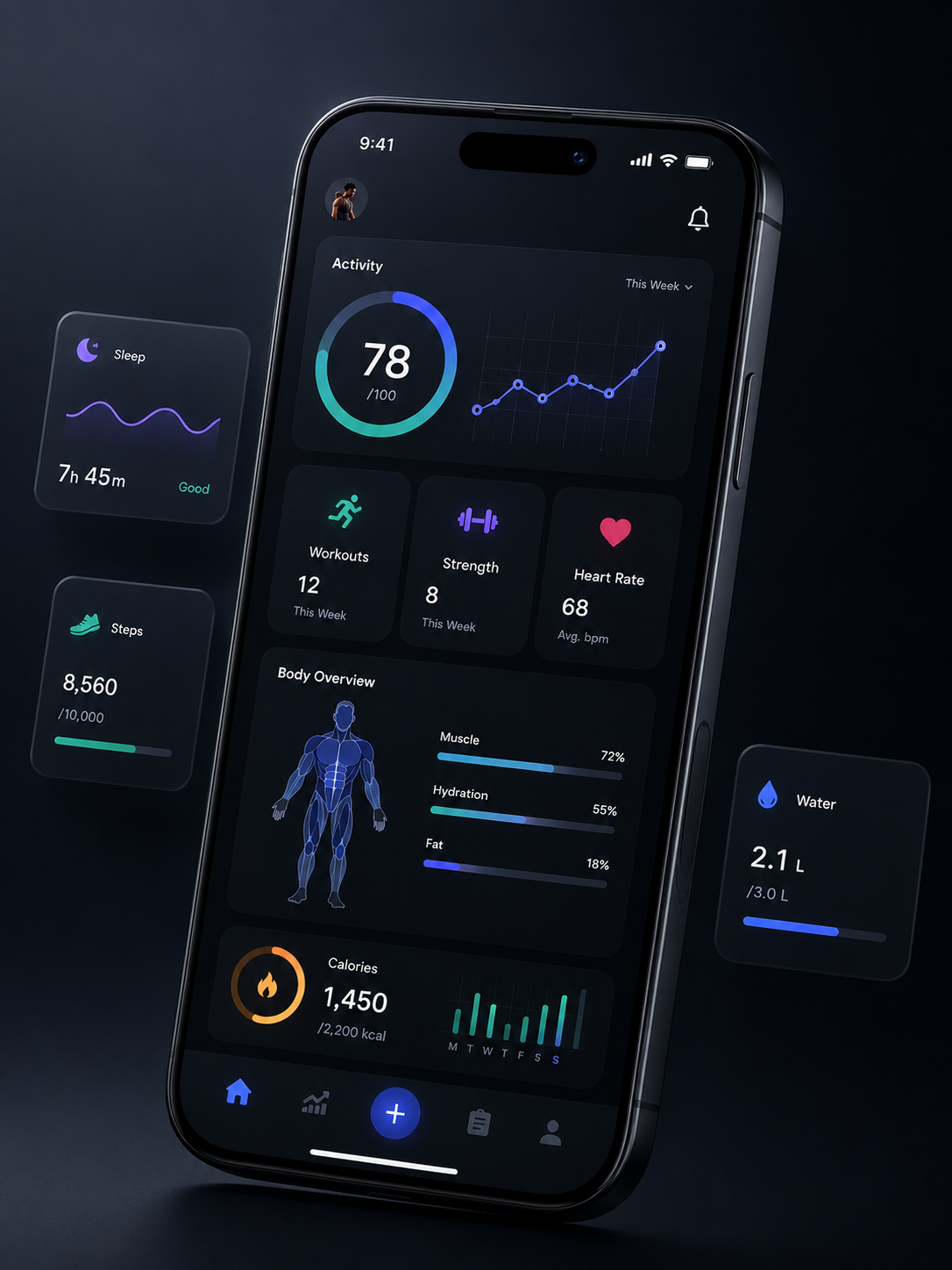


Building a fitness app starts with choosing a niche. Workout and training, activity tracking, nutrition, on-demand classes, and AI coaching are the main niche options. Next, pick a platform strategy. You can go cross-platform with Flutter or React Native. Or you can choose native Swift and Kotlin.
Health data integration comes next, connecting Apple HealthKit, Google Fit, and wearables like Fitbit and Garmin. Finally, you ship an MVP with onboarding, workout logging, progress tracking, push reminders, and subscription billing. MyFitnessPal and Strava are strong reference points for this baseline.
In the US in 2026, a lean MVP costs $25,000–$70,000. A mid-tier app with AI personalization and wearable sync runs $70,000–$160,000. An advanced, Peloton-class platform starts around $200,000–$350,000+.
This guide covers the full path from idea to launched US fitness app. It includes features, wearable and health-data integration, tech stack, cost, timeline, and compliance. The global fitness app market is valued at roughly $13.5–$15.4 billion in 2026.
North America holds the largest regional share, around 35–36%. AI-driven coaching and wearable sync are now baseline user expectations.
Who this guide is for
This guide is for fitness founders, gym and studio owners, non-technical entrepreneurs, product managers, and CTOs. By the end, you will be able to scope, budget, and brief a fitness app build with confidence. Teams without in-house engineers often partner with a specialist for custom fitness app development.
What is a Fitness App?
A fitness app is a mobile or web application. It helps users track, plan, and improve physical activity and health behaviors. Workout training, activity tracking, nutrition logging, sleep and recovery, and on-demand classes are all within its scope. Biometric data flows in from Apple HealthKit, Google Fit, Fitbit, Garmin, and Apple Watch.
A fitness app handles several core jobs. Onboarding and goal-setting set the personalization foundation. Workout and activity tracking forms the daily core loop. Content delivery brings videos and training plans to the user. Progress analytics surface improvement over time. Social features connect users around shared goals. AI coaching is now an increasingly standard layer on top of all of this.
Several main app types serve this space. They span workout and training, activity tracking, nutrition and diet, on-demand classes, and gym and studio management. Apps like MyFitnessPal, Strava, and Peloton represent the range. Each type is covered in full in the next section.
Most US products ship as cross-platform mobile apps backed by a web admin. Health data flows in from HealthKit and Google Fit. It flows out to wearables via Bluetooth Low Energy (BLE). Gyms and studios often pair the consumer app with fitness software and CRM development services for member management and retention.

Estimate Your App Development
Cost in Seconds
Discover your project budget with our interactive AI-powered app cost calculator.
Why Build a Fitness App in 2026? (US Market & Opportunity)
The case for building a fitness app in 2026 is straightforward. Demand is large, the revenue is recurring, and AI has reset user expectations entirely.
$13.5–15.4B
Global market, 13–14% CAGR
~35–36%
North America regional share
$84.9B
Fitness-tracker / wearable segment
$10.7B
AI-in-fitness market (2025), ~19% CAGR
The global fitness app market reached roughly $13.5–$15.4 billion in 2026, growing at a 13–14% CAGR. North America accounts for the largest regional share at roughly 35–36%, per Straits Research. The US fitness app market alone is approximately $2.6 billion.
The fitness-tracker and wearable segment is valued at $84.9 billion in 2026, per Towards Healthcare. The AI-in-fitness market reached $10.7 billion in 2025. It is growing at roughly 19% CAGR, per Grand View Research and Mordor Intelligence. Both firms track AI-in-fitness as one of the fastest-growing segments globally.
Real momentum supports these numbers. WHOOP Coach and Fitbit's Gemini integration have turned static plans into two-way AI dialogue. Strava carries a $2.2 billion valuation. The GLP-1 wave, driven by semaglutide and tirzepatide adoption, is pulling fitness apps toward preventive health.
The opportunity is in specialization, not imitation
Incumbents like MyFitnessPal, Strava, Peloton, and Nike Training Club own the broad categories. White space exists in focused niches. Strength training, running, women's health, senior fitness, rehab and physio, corporate wellness, and AI form-correction are all underserved. A focused app can out-personalize the incumbents in its lane.
What Types of Fitness Apps Can You Build?
Fitness apps fall into several distinct categories. Workout and training, activity tracking, nutrition, and on-demand classes are the core types. AI coaching and gym management round out the category. Each type carries a different data model, user base, and monetization path. The type you choose determines your scope, your cost, and your compliance load.
Workout & Training Apps
Workout and training apps deliver guided exercise programs, exercise libraries, and structured training plans. Form instruction videos are a key feature. Nike Training Club, Freeletics, and Fitbod are leading examples in this category.
Activity & Step Trackers
Activity trackers log GPS runs and rides, step counts, heart rate, and social challenges. They require deep wearable sync. Strava, Google Fit, Garmin Connect, and Apple Watch are the defining names here.
Nutrition & Diet Apps
Nutrition apps handle calorie and macro logging, food databases, meal planning, and barcode scanning. MyFitnessPal, Noom, Lifesum, and YAZIO represent the range of products in this category.
On-Demand & Live Class Platforms
These platforms stream live and recorded workouts. Instructor content, leaderboards, and hardware tie-ins are core to the model. Peloton, Apple Fitness+, and Zwift are the benchmark products.
AI Coaching Apps
AI coaching apps deliver adaptive plans, real-time form feedback, and conversational coaching. Runna, WHOOP Coach, and Fitbod lead this category. Most rely on the OpenAI API or custom ML models.
Gym / Studio Management Apps (B2B)
These are B2B tools for managing memberships, class scheduling, billing, and member retention. Mindbody, Glofox, and ABC Fitness are the primary platforms in this space.
Got Problems? Let Us Help You With the Right Solution


What Features Does a Fitness App Need? (Must-Have + Advanced)
A fitness app needs frictionless onboarding with goal-setting at minimum. It also needs workout and activity tracking, a content library, progress dashboards, and push notifications.
Social login, wearable sync, and subscription billing complete the MVP foundation. Advanced builds add AI-personalized plans, real-time form correction, live and streamed classes, gamification, and nutrition tracking.
Wearable and health-data sync and subscription mechanics are the two features that quietly drive both cost and retention. Plan your feature set around these two pillars from day one.
Core / MVP
Onboarding and goal-setting collects user goals, fitness level, and preferences at first launch. It sets the personalization baseline for the entire app experience.
Workout and activity logging records sets, reps, duration, and intensity. It is the core loop users return to daily.
Exercise and content library stores workouts, videos, and training plans. Users browse and select based on their goals.
Progress dashboard and history displays completed workouts, streaks, and improvement over time. Firebase or a custom analytics backend typically powers this.
Push reminders drive re-engagement and habit formation. Apple Push Notification service (APNs) and Firebase Cloud Messaging (FCM) handle delivery.
Registration, authentication, and social login secure user accounts. Firebase Auth handles this reliably across both platforms.
Apple HealthKit and Google Fit sync connect the app to the on-device health hub. This brings in steps, heart rate, sleep, and other biometrics automatically.
Subscription and paywall monetizes the app through recurring billing. Stripe and RevenueCat are the standard tools for managing this layer.
Advanced / Differentiating
AI-personalized adaptive plans adjust workout and recovery schedules based on performance data. The OpenAI API or a custom model typically powers the recommendation engine.
Real-time form and pose correction uses computer vision to analyze movement. TensorFlow and MediaPipe are the primary libraries for this capability.
Live and on-demand video classes stream instructor-led workouts to users. Agora handles live delivery. Mux handles on-demand video infrastructure.
Wearable deep-sync connects to Fitbit, Garmin, and Apple Watch beyond basic HealthKit data. It uses the Fitbit API and Garmin Health API for richer biometric streams.
Gamification and challenges drive engagement through badges, streaks, and peer competition. Social challenges improve retention measurably.
Nutrition and calorie tracking with barcode scan adds diet management to the product. It widens the app's daily utility significantly.
Community and social feed connects users around shared goals. Social accountability is a proven retention driver in fitness.
Voice coaching delivers audio cues during workouts. It keeps users engaged without requiring them to look at the screen.
How Do You Build a Fitness App? Step-by-Step
You build a fitness app in seven stages. First, validate the niche and define an MVP. Second, plan health-data and wearable integrations early. Third, design onboarding and tracking UX. Fourth, choose the tech stack and platform strategy.
Fifth, develop the app, backend, and integrations. Sixth, test across devices, sensors, and BLE edge cases. Seventh, deploy to the App Store and Google Play, then iterate with analytics and retention loops.
-
1
Validate and scope the MVP
Define your niche and target persona first. Cut your feature list to three to five core capabilities. Validate demand before writing code. Produce a PRD that locks scope before development begins.
-
2
Plan health-data and wearable integrations
Decide on HealthKit, Google Fit, Fitbit API, Garmin Health API, and any BLE device support early. These integrations shape your architecture from day one. Permissions and consent flows must be planned before development begins, not retrofitted later.
-
3
UX and onboarding design
Design the goal-setting flow, activity tracking UX, and progress dashboards in Figma. Deliver wireframes and a data-integration plan before development starts. Onboarding is where most fitness apps lose new users. A clear, low-friction first session is the foundation of retention.
-
4
Choose tech stack and platform
Decide between cross-platform and native. Flutter and React Native cut initial cost and shipped to both stores from one codebase. Native Swift and Kotlin are preferred for intensive sensor work, camera-based form tracking, and BLE hardware. Choose your backend framework, database, and cloud provider at this stage.
-
5
Develop app, backend, and integrations
Build the tracking features, content delivery layer, wearable sync, and billing integration in parallel where possible. This stage produces your architecture diagram and the release build candidate. This is the core custom software development phase. Node.js and PostgreSQL are the standard backend combination for fitness apps. Host on AWS, Microsoft Azure, or Google Cloud.
-
6
Test
Build a device and sensor test matrix. Cover BLE pairing, background tracking, battery impact, and load handling. Wearable data accuracy varies across hardware. Test on real devices, not only simulators. App Store review for health-data apps is more rigorous than standard submissions.
-
7
Deploy and iterate
Submit through App Store Connect and Google Play Console. Instrument analytics from day one. Set up notification and retention loops before launch, not after. Measure churn, session frequency, and feature adoption in the first 30 days. Iterate from real user data.
How Do You Integrate Wearables & Health Data (HealthKit, Google Fit, Fitbit, Garmin)?
You can integrate wearables and health data by connecting to Apple HealthKit on iOS. Google Fit or Health Connect can be also integrated on Android as the primary on-device health hubs. Then you add device-specific APIs. The Fitbit Web API and Garmin Health API both use OAuth 2.0 and require developer-program approval.
Direct Bluetooth Low Energy (BLE) connections handle proprietary hardware that does not support those APIs.
On-device aggregators
These integrations work in layers. HealthKit, Google Fit, and Android Health Connect act as on-device aggregators. Users already trust them. They hold steps, heart rate, sleep, workouts, and dozens of other data types. Your app requests access to specific data types only. Requesting more than necessary creates friction and erodes trust.
Vendor APIs go deeper
Vendor APIs go deeper. The Fitbit Web API and Garmin Health API provide richer biometric streams, including HRV, stress scores, and device-specific metrics. Both require OAuth 2.0 authentication and approved developer accounts. Factor in approval timelines when planning your build schedule.
Direct BLE connections
Direct BLE connections are required for proprietary hardware not covered by HealthKit or vendor APIs. Note that progressive web apps cannot use BLE. Native modules are required for direct hardware connectivity.
Practical constraints to plan for
Practical constraints matter here. Background data refresh impacts battery life. Sensor accuracy varies across hardware manufacturers. Health data permissions trigger explicit consent UX requirements. Request the minimum health data your app actually needs. This is both a user-experience principle and a compliance requirement.
What Tech Stack Is Used to Build a Fitness App?
The dominant 2026 tech stack for a US fitness app is Flutter or React Native for cross-platform mobile. For native work, Swift handles iOS and Kotlin handles Android. Node.js or Python with Django or FastAPI serves the backend. PostgreSQL is the standard database.
AWS, Microsoft Azure, or Google Cloud handle hosting. Apple HealthKit and Google Fit manage health data. Agora or Mux handle live and on-demand video. Stripe and RevenueCat manage subscriptions. TensorFlow and the OpenAI API power AI coaching.
| Layer | Recommended Tools | Why |
|---|---|---|
| Mobile (cross-platform) | Flutter, React Native | One codebase for iOS and Android |
| Mobile (native) | Swift (iOS), Kotlin (Android) | Best for sensor, BLE, and camera work |
| Backend | Node.js, Python (Django, FastAPI) | Scalable, widely supported |
| Database | PostgreSQL, Firebase, Supabase | Relational + real-time options |
| Cloud / Infra | AWS, Microsoft Azure, Google Cloud | Enterprise-grade scalability |
| Health Data | Apple HealthKit, Google Fit | On-device health aggregation |
| Video / Streaming | Agora (live), Mux (on-demand) | Purpose-built for fitness streaming |
| Payments | Stripe, RevenueCat | Subscription billing and analytics |
| Notifications | APNs, Firebase Cloud Messaging | iOS and Android push delivery |
| AI / ML | TensorFlow, OpenAI API | Coaching, form correction, personalization |
| Analytics | Firebase Analytics, Mixpanel | Retention and behavior tracking |
Cross-platform frameworks cut initial cost and timeline significantly. They ship to both stores from a single codebase. Native is the right choice when the app relies heavily on sensors, camera-based form tracking, or direct BLE hardware. For the web application development layer, a React or Next.js admin dashboard handles content management and analytics.
For dedicated mobile app development, the choice between cross-platform and native depends on your feature set. Heavy sensor work or BLE integration calls for iOS app development or Android app development with native tooling.

Speak With Our Consultant
Partners
Get expert guidance before you invest in AI software development. Work directly with Giovanni and Bibin to validate your technology direction, align AI with business goals, and make confident decisions that reduce risk and accelerate outcomes.
Request a Strategic Consultation
What AI & Automation Features Belong in a 2026 Fitness App?
The AI features that define a competitive 2026 fitness app are adaptive workout personalization, real-time form correction, conversational AI coaching, AI nutrition analysis, and predictive recovery scoring. These are typically built on the OpenAI API, TensorFlow, and cloud ML platforms like AWS SageMaker and Google Cloud Vertex AI.
Adaptive workout personalization
Adaptive workout personalization adjusts plans based on performance, recovery data, and stated goals. It consumes workout history, heart rate, sleep, and HRV data. This is the feature that turns a static tracker into a coaching product.
Real-time form & pose correction
Real-time form and pose correction uses computer vision to analyze movement during exercise. MediaPipe and TensorFlow are the primary libraries. This feature requires significant processing power and is typically native-only.
Conversational AI coaching
Conversational AI coaching replicates a personal trainer interaction inside the app. WHOOP Coach and Fitbit's Gemini integration are the benchmark products. The OpenAI API enables this at scale. AWS SageMaker and Google Cloud Vertex AI support custom model deployment for teams building proprietary coaching engines.
AI nutrition analysis
AI nutrition analysis identifies food and calculates macros from photos or barcode scans. It reduces logging friction significantly. Users are more likely to track consistently when the barrier is low.
Predictive recovery & readiness scoring
Predictive recovery and readiness scoring uses HRV, sleep quality, and training load to recommend rest or intensity. WHOOP built its brand around this single capability.
Accuracy & disclaimers matter
AI is the primary retention lever separating a commodity tracker from a sticky coaching product. However, accuracy matters more than novelty here. Inaccurate AI recommendations destroy trust quickly. All AI-generated health guidance must carry appropriate disclaimers. These apps are not medical devices unless explicitly built and cleared as such by the FDA.
How Much Does It Cost to Build a Fitness App in the US? (2026)
In the United States in 2026, a fitness app costs $25,000–$70,000 for a lean MVP. A mid-tier app with AI personalization and wearable sync runs $70,000–$160,000. An advanced, Peloton-class platform starts at $200,000–$350,000+. The biggest cost drivers are AI and ML features, wearable and BLE hardware integration, live and on-demand video, and ongoing maintenance.
A properly built MVP with wearable sync, AI personalization, and subscription management is a mid-five-figure project at minimum in 2026. Sub-$20,000 fitness app builds do not deliver production-grade wearable integration or AI features. Cross-platform builds on Flutter reduce cost at the MVP tier without sacrificing core functionality.
Cost by Build Tier (MVP / Mid-Tier / Advanced)
| Tier | Scope | Typical US Range | Timeline |
|---|---|---|---|
| MVP | Core tracking, HealthKit/Google Fit sync, auth, subscription billing | $25,000–$70,000 | 3–5 months |
| Mid-Tier | AI personalization, wearable deep-sync, content library, video | $70,000–$160,000 | 6–9 months |
| Advanced | Live video, AI form correction, full wearable suite, community | $200,000–$350,000+ | 10–14+ months |
These ranges cover design, development, QA, and launch. They exclude ongoing operations, cloud costs, and content production.
Use this simple estimator. Start with your scope tier. Add your platform strategy cost. Then add applicable feature costs below. Apply a 10–25% risk buffer. Finally, add post-launch ops.
For subscription-based fitness products built on recurring-revenue architecture, SaaS development expertise reduces billing complexity and speeds time to market.
What Drives Fitness App Cost the Most?
QA across devices and sensors is frequently underbudgeted. BLE testing across real hardware adds weeks to the timeline.
Ongoing & Hidden Costs
- • Maintenance typically runs 15–25% of your build cost annually.
- • Cloud and video bandwidth on AWS and Mux scales with your user base.
- • Third-party API fees for wearable integrations accumulate over time.
- • Wearable API changes require periodic maintenance effort.
- • Content production for video-based apps is an ongoing operational cost.
- • Security monitoring and compliance audits are real budget lines, not optional extras.
- • RevenueCat subscription analytics add a monthly fee that grows with revenue.
How Long Does It Take to Build a Fitness App?
The duration length depends on the requirements and size of the app. A fitness app takes about 3–5 months for a lean MVP. A mid-tier app with AI and wearable sync takes 6–9 months. An advanced video and AI platform takes 10–14+ months. Wearable integration, BLE device testing, and live-video infrastructure frequently add weeks that teams underestimate.
Discovery and design takes 4–6 weeks. Health-data and wearable integration planning runs in parallel with design. Core development is the longest phase. QA across devices and sensors comes next. App Store Connect and Google Play Console submission takes 1–2 weeks.
Two factors uniquely extend fitness app timelines
First, BLE device testing must happen on real hardware. Emulators do not replicate sensor behavior accurately. Second, App Store review for health-data apps under Apple HealthKit is more thorough than standard reviews. Build this into your schedule. A launch buffer of two to three weeks is prudent for health-category apps.
What Are the Biggest Challenges & Mistakes When Building a Fitness App?
The biggest mistakes are over-scoping the MVP and treating wearable and health-data sync as an afterthought. Ignoring retention from day one is another critical error teams consistently make. Underestimating live-video and BLE complexity creates costly delays and technical debt later in development.
Making unverified health claims exposes your product to serious legal and regulatory risk. Neglecting health-data privacy and consent is a compliance failure no enterprise can afford.
Over-scoping the MVP
Over-scoping the MVP is the most common failure pattern. Teams try to compete with Peloton on a startup budget. Cut to three to five features. Launch, learn, then expand.
Treating wearable sync as an afterthought
Treating wearable sync as an afterthought breaks architecture. HealthKit and Google Fit permissions define your data model before a single line of backend code is written. Retrofitting them is costly. Plan integrations before you write backend code.
Ignoring retention and churn
Ignoring retention and churn is fatal in fitness. Fitness apps have notoriously high cancellation rates. Onboarding quality, habit-forming notifications, and social features must be designed before launch. RevenueCat provides the subscription analytics needed to monitor churn early.
Underestimating BLE complexity
Underestimating BLE complexity extends timelines. Bluetooth Low Energy device pairing fails in edge cases. Battery drain from background tracking frustrates users. Test on real hardware across multiple device models.
Making unverified health claims
Making unverified health claims creates regulatory exposure. The FTC actively enforces misleading health product claims. Do not position your app as a medical device unless it is cleared by the FDA.
Neglecting privacy and consent
Neglecting privacy and consent is both a legal and trust risk. Apple HealthKit policies prohibit health data use for advertising. Users abandon apps that request unnecessary health permissions. Request minimum data. Make consent flows explicit and easy to understand.
What Compliance & Security Rules Apply to US Fitness Apps?
US fitness apps must protect biometric and health data under the FTC Act and the FTC Health Breach Notification Rule. They must comply with CCPA and CPRA and other US state privacy laws. GDPR applies when serving EU users. Apple HealthKit and Google Fit data-use policies govern how health data is used and shared. HIPAA applies only when handling protected health information on behalf of a covered healthcare entity.
Health-data privacy frameworks
Health-data privacy is governed by several overlapping frameworks. The FTC Act prohibits deceptive and unfair data practices. The FTC Health Breach Notification Rule now reaches many consumer health apps. It requires notification to users and the FTC when health data is breached. CCPA and CPRA give California residents rights over their personal data. Other US states have passed similar laws with varying requirements.
Platform policies
Platform policies add another layer. Apple HealthKit rules prohibit using health data for advertising purposes. Google Fit and Android Health Connect carry equivalent restrictions. Violating these policies results in app removal from the respective stores.
HIPAA nuance
HIPAA nuance is frequently misunderstood. Most consumer fitness apps are not HIPAA-covered entities. However, apps integrated with healthcare providers, insurers, or employer health plans may be. Verify your specific use case with legal counsel.
Security baseline
Security baseline requirements include encryption in transit and at rest. Explicit opt-in consent flows are mandatory for health-data collection. Data minimization limits collection to what is genuinely needed. MFA and biometric login protect user accounts. Secure API design prevents unauthorized data access. Security hardening and consent flows are real budget lines in every compliant fitness app build.
This section does not constitute legal advice. Verify current compliance requirements with qualified legal counsel before launch.
How Do Fitness Apps Make Money? (Monetization Models)
Fitness apps make money primarily through subscriptions and freemium upgrades. This is the dominant model and is powered by Stripe and RevenueCat. Other models include in-app purchases for premium plans or content, one-time hardware bundles. In-app advertising, corporate wellness contracts, and B2B SaaS fees for gym and studio management tools completes the list.
Freemium subscription
Freemium subscription offers a free tier with limited features. Paid tiers unlock AI coaching, advanced analytics, or content libraries. Strava and MyFitnessPal both use this model effectively.
In-app purchases
In-app purchases sell individual training plans, coaching sessions, or premium content packs. They supplement subscription revenue without requiring a full paywall.
Hardware bundles
Hardware bundles tie the app to a physical product. Peloton and WHOOP have built their entire business model around this approach. Hardware drives subscription lock-in.
In-app advertising
In-app advertising works for free apps with large user bases. It is incompatible with health-data monetization under Apple HealthKit policies. Use with caution.
Corporate wellness contracts
Corporate wellness contracts sell app access to employers for their workforce. These are B2B deals with higher contract values and longer sales cycles.
B2B SaaS fees
B2B SaaS fees apply to gym and studio management apps. Mindbody and Glofox charge per-location or per-member fees. This model requires admin dashboards, reporting tools, and API integrations.
Subscription and retention economics are the defining business challenges in fitness. High churn makes lifetime value hard to sustain. Architecture must support subscription billing through Stripe and RevenueCat from the first build. Corporate wellness and B2B products require separate admin infrastructure. Monetization choice shapes your architecture before development begins.
Key Takeaways
1 Apple HealthKit and Google Fit integration is not optional — it's a baseline US user expectation.
2 AI coaching is now the primary retention lever, separating commodity trackers from sticky products.
3 FTC health-data privacy rules apply to most consumer fitness apps, not just medical ones.
4 Wearable and BLE complexity must be planned early — never retrofitted after architecture is set.
5 A focused MVP can launch in 3–5 months from roughly $25,000–$70,000.
6 Specialization beats imitation — out-personalize the incumbents in one underserved lane.