



A dating app build comes down to three decisions. Pick a niche and matching model. Ship an MVP with profiles, a matching engine, real-time chat, and geolocation. Then build trust and safety into the architecture from the start, not as an afterthought.
In the United States in 2026, a swipe-based MVP costs $25,000 to $70,000. A full-featured app with AI matching, video, and verification runs $80,000 to $200,000. A Hinge or Bumble-class platform reaches $200,000 to $600,000 or more.
This guide covers the full path from idea to a launched US dating app. It includes matching models, core features, trust and safety, tech stack, cost, timeline, and compliance. Over 350 million people use dating apps globally.
Roughly 1 in 3 US adults has tried online dating, per Pew Research Center. The US accounts for approximately 30% of global dating revenue. The market generates billions annually and continues to shift from growth-led to trust-led and quality-led.
Match Group and Bumble control roughly 60 to 70% of the Western market. The winning move is a focused niche plus best-in-class safety, not a generic Tinder clone.
Who this guide is for
This guide is written for founders, niche-community builders, product managers, and CTOs. By the end, you will be able to scope, budget, and brief a dating app build with confidence. Founders without in-house engineers often partner with a specialist for custom dating app development.
What is a Dating App?
A dating app is a mobile or web platform built for romantic discovery and connection. Users find, match with, and message potential partners through it. It combines profile creation, a matching engine, geolocation-based discovery, real-time chat, and trust-and-safety systems like photo verification and moderation. Tinder, Bumble, and Hinge are the most recognized examples in the US market.
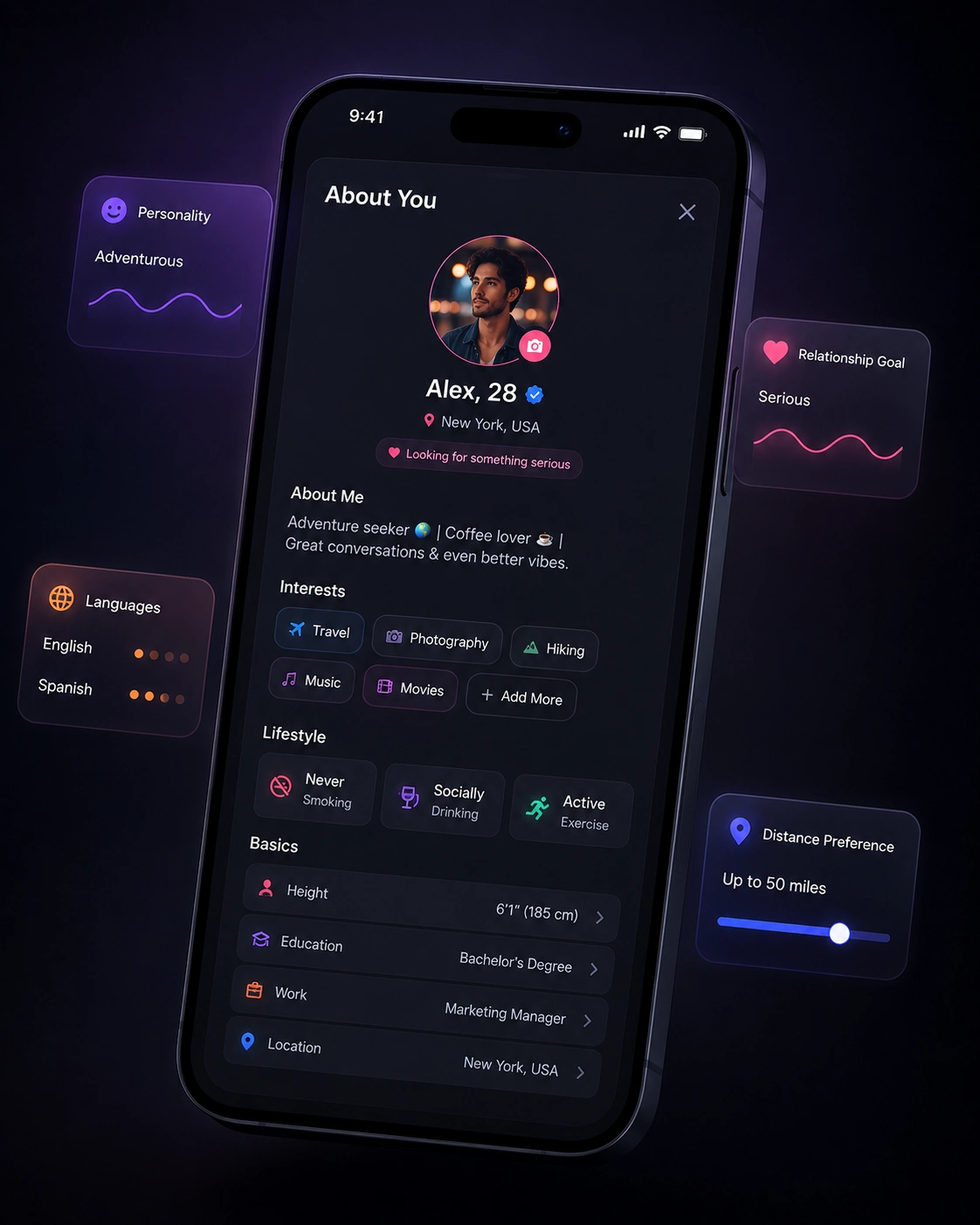
Here is what a dating app actually does. Users create a profile with photos and personal details during onboarding. The discovery layer surfaces candidates via a swipe deck or curated recommendations. The matching engine determines who sees whom and in what order. Real-time messaging connects matched users once mutual interest is confirmed. A safety layer handles verification, reporting, blocking, and content moderation throughout.
Dating apps fall into distinct categories. Swipe and location-based apps like Tinder prioritize quick discovery. Compatibility apps like Hinge and OkCupid use questions, prompts, and preference data. Women-first apps like Bumble give one side control over who initiates contact. Niche apps serve communities defined by faith, profession, or lifestyle. Apps like Grindr serve specific LGBTQ+ communities. Video-first apps add streaming and live interaction layers.
The matching engine and trust-and-safety layer separate a credible dating app from a generic social app. Unlike broader social discovery platforms, dating apps carry explicit romantic intent. That intent raises both the matching quality bar and the platform safety responsibility bar from day one.

Estimate Your App Development
Cost in Seconds
Discover your project budget with our interactive AI-powered app cost calculator.
Why Build a Dating App in 2026? (US Market and Opportunity)
You build a dating app in 2026 because the demand base is large, recurring, and shifting in character. The global user base has crossed 350 million. About one in three US adults has tried online dating at some point. The market is no longer growing on volume alone. It is reorienting around trust, verification, and intentional matching.
350M+
Global dating app users
~30%
US share of global dating revenue
$672M+
US romance-scam losses (FBI IC3)
60–70%
Match + Bumble Western market share
The US accounts for approximately 30% of global dating app revenue. Incumbents' declining paying users and a documented romance-scam trust crisis open clear room for focused, safety-first entrants.
Here are the signals that define the opportunity today. Romance scams drove more than $672 million in US losses, according to FBI IC3 data. Paying users at Match Group and Bumble platforms have declined even as revenue-per-user has risen. Swipe burnout is real and well-documented among younger adult users. The fastest-growing user segment is adults over 50. Verification-first platforms are gaining measurable trust advantages over those that treat safety as secondary.
Match Group and Bumble together hold roughly 60–70% of the Western market. That consolidation closes the door on generic competitors but not on focused ones. Niche dating is projected to grow approximately 12% by 2027. Faith-based, profession-specific, LGBTQ+, serious-relationship, and over-50 communities remain underserved by Tinder, Hinge, and other mass-market products.
The opportunity is in specialization, not imitation
The strategic frame is clear. Do not out-Tinder Tinder. Win a specific community or intent with superior safety and conversation quality. That is where the 2026 opportunity sits for any new US market entrant.
What Types of Dating Apps Can You Build?
There are five main types of dating apps. They range from swipe-and-match and compatibility apps to women-first, niche, and video-first models. Each carries a different matching model, feature depth, and cost profile. Matching depth and niche fit are the two variables that drive both build cost and competitive advantage.
Swipe & Location-Based Apps
Tinder is the defining example of this category. The core mechanic is a geolocation-powered swipe deck. Distance, recency, and basic filters determine who appears in a user's queue. The Google Maps API handles proximity calculations. This is the lightest architecture to build and the least differentiated product in 2026.
Compatibility & Algorithmic Apps
Hinge and OkCupid anchor this category. Users complete prompts and answer questions during onboarding. A compatibility-scoring engine weighs stated preferences and behavioral signals together. The matching engine is 20–40% more complex than a swipe app. Match quality and retention tend to be meaningfully stronger in this category.
Women-First & Structured Apps
Bumble is the defining model in this space. Structural rules govern who sends the first message after a match. The UX reduces unwanted contact from the ground up. Bumble's Deception Detector adds an AI safety layer on top of those structural rules.
Niche & Community Apps
These apps serve a defined and specific community. Faith, profession, lifestyle, LGBTQ+, and over-50 are the most active segments in the US. Total addressable market is smaller than a mass-market app. Engagement and retention rates are typically higher because relevance drives behavior.
Video-First & Live Apps
Video profiles, live dating sessions, and in-app video calls define this category. Agora and similar streaming platforms power the underlying infrastructure. Video moderation adds meaningful cost and operational complexity from day one. This is the highest-cost category to build and to operate.
Got Problems? Let Us Help You With the Right Solution


How Does the Matching Algorithm Work?
A dating app's matching algorithm works by combining explicit signals and implicit behavioral signals. Explicit signals include preferences, age, distance, and filters. Implicit signals include swipes, likes, message activity, and profile dwell time. AI compatibility models increasingly layer on top of both to rank and surface candidates. This ranges from simple geolocation-plus-filter logic in swipe apps to ML-driven recommendations like Hinge's most compatible feature.
The matching spectrum has four levels. They move from simple rule-based logic to behavioral and machine-learning-driven ranking.
Rule-Based & Geolocation-Driven
The first level is rule-based and geolocation-driven. Distance, filters, and recency determine the candidate queue. This is the simplest and least expensive matching layer to build.
Collaborative Filtering
The second is collaborative filtering. The system learns from swipe and engagement patterns over time. It surfaces profiles based on what similar users engaged with, similar to recommendation logic used in streaming and e-commerce.
AI Compatibility Scoring
The third is AI compatibility scoring. Machine learning models trained on profile and behavioral data predict mutual interest before a swipe occurs. TensorFlow and the OpenAI API are common tools at this layer.
ELO-Style Desirability Scoring
The fourth is ELO-style desirability scoring. Modern apps have moved beyond pure attractiveness ranking. Intent, conversation quality, and mutual engagement now carry more weight in ranking decisions.
Matching depth is a primary cost and differentiation lever. The 2026 competitive standard has shifted toward quality-first matching. Apps now optimize for match-to-conversation conversion, not just raw swipe volume.
Profile completeness feeds the algorithm directly. Apps that incentivize users to complete prompts and verify identity collect richer signal data. Richer data produces better match predictions. This creates a compounding advantage for apps that make onboarding thorough without making it feel burdensome.
What Features Does a Dating App Need? (Must-Have + Advanced)
Every dating app requires a defined set of core features. At minimum, these cover profile creation, swipe matching, geolocation discovery, real-time chat, notifications, authentication, and safety tools.
Advanced builds add AI matching, video profiles and in-app calls, premium subscriptions, ID verification, and AI moderation. Trust and safety is a first-class feature set, not an add-on.
Verified profiles receive approximately 56% more matches, per Bumble data. Tinder's Face Check reduced bad-actor reports by approximately 40%. Plan your feature set around matching quality and safety from day one.
Core / MVP
Registration and login must support both social login and phone-number authentication. Firebase Auth handles this layer reliably at scale.
Profile creation includes photo upload, bio text, and preference settings. It is the foundation every match decision is built on.
The swipe or matching engine drives the core discovery loop. It is the central mechanic users return to.
Geolocation discovery uses the Google Maps API to surface nearby profiles within user-defined distance ranges.
Real-time chat connects matched users instantly. Twilio and Firebase are common choices for this layer.
Push notifications via FCM and APNs keep users returning to active conversations and new match alerts.
Weak chat performance or slow notification delivery reduces return visits more than any other technical failure. These are architecture decisions that must be made carefully at the MVP stage.
Trust & Safety
Photo and selfie verification confirms that profile photos match the real user behind the account.
Persona and Onfido handle ID verification at a deeper identity layer.
AWS Rekognition provides AI-powered image analysis for inappropriate content detection.
In-chat scam and abuse detection flags suspicious message patterns before harm reaches the user.
Reporting and blocking tools give users direct control over their own experience. Fast report response from a moderation team reinforces platform trust in a way that automated systems alone cannot replicate.
Face Check-style verification is a table-stakes feature for any US dating app launching in 2026.
Advanced / Differentiating
AI matching and compatibility scoring improves recommendation quality as behavioral data accumulates.
Video profiles and in-app video calls, powered by Agora, add depth and authenticity to early-stage connections.
Premium subscriptions, boosts, and super-likes are monetized via Stripe and RevenueCat.
Icebreakers and prompts, modeled on Hinge's approach, reduce the friction of starting a first conversation.
Read receipts, community features, and in-app events extend engagement beyond one-on-one matching.
How Do You Build a Dating App? Step-by-Step
You build a dating app in seven stages. First, pick a niche and define the MVP. Second, design the matching model and trust-and-safety approach. Third, design the profile and discovery UX. Fourth, choose the tech stack and platform strategy.
Fifth, develop the app, backend, matching engine, real-time chat, and verification systems. Sixth, test across devices, real-time messaging scenarios, and safety edge cases. Seventh, deploy to the App Store and Google Play and iterate based on real user data.
-
1
Pick a niche and define the MVP
Define the community or intent your app serves with precision. Identify the core user flow from signup to first match. Set a clear feature cut-line between MVP and post-launch scope. Document this in a product requirements document.
-
2
Design matching model and trust and safety
Decide on algorithm depth before any development begins. Rule-based, collaborative filtering, and ML-driven compatibility each carry different build costs and data requirements. Define your verification approach at this stage. Plan your moderation workflow before a single line of code is written. Retrofitting safety systems after launch is significantly more expensive than building them in.
-
3
Design profile and discovery UX
Map the onboarding flow, swipe deck or recommendation feed, and chat interface in full. Wireframe every screen in Figma before development begins. Keep onboarding efficient. Users who face excessive signup steps drop off before reaching the core product.
-
4
Choose tech stack and platform
Decide between cross-platform and native development based on budget and performance requirements. React Native and Flutter reduce mobile build cost without sacrificing core functionality. Choose your real-time backend architecture early. This decision is difficult and expensive to reverse at scale.
-
5
Develop app, backend, matching, chat, and verification
This is the core build stage and the largest portion of total project cost. The backend handles profile data, matching logic, and API communication between all system layers. The matching engine runs on Node.js or Python with PostgreSQL and Redis. Real-time chat uses Firebase, WebSocket, or Stream. Verification integrates Persona or Onfido. Build the admin and moderation dashboard in parallel with the main app. Founders who engage an experienced custom software development partner at this stage avoid costly rework from under-scoped builds.
-
6
Test
Run a full device matrix across iOS and Android hardware. Load-test real-time messaging under realistic concurrent user volumes. Test safety edge cases thoroughly. Fake profile creation attempts, scam-pattern messages, and inappropriate image uploads all need documented test coverage. QA the moderation reporting flow end to end.
-
7
Deploy and iterate
Submit to App Store Connect and Google Play Console with full compliance documentation in place. Both platforms review dating apps with closer scrutiny than most other app categories. Monitor retention rates, match rates, and match-to-conversation conversion from day one. Use analytics data to drive the first post-launch iteration cycle.
What Tech Stack Is Used to Build a Dating App?
React Native or Flutter is the standard frontend choice for cross-platform mobile in 2026. Node.js or Python powers the backend, with PostgreSQL and Redis managing matching logic and sessions. The remaining layers use specialized services for real-time chat, geolocation, video, verification, and AI moderation.
Swift and Kotlin remain the right choice for native builds where performance requirements demand it.
| Layer | Recommended Tools | Why |
|---|---|---|
| Frontend Mobile | React Native, Flutter, Swift, Kotlin | Cross-platform reduces cost; native maximizes performance |
| Backend | Node.js, Python | Scalable API layer for matching logic and session management |
| Database and Cache | PostgreSQL, Redis | Relational profiles; Redis enables fast match queue operations |
| Real-Time Chat | Firebase, WebSocket, Stream | Low-latency messaging architecture for concurrent user scale |
| Geolocation | Google Maps API, Mapbox | Proximity-based discovery and configurable distance filtering |
| Video | Agora, Twilio | In-app video calls, video profiles, and live interaction features |
| Verification | Persona, Onfido | Photo verification, selfie matching, and identity document checks |
| Moderation and AI | AWS Rekognition, TensorFlow, OpenAI API | Image analysis, behavioral moderation, and ML-powered matching |
| Payments | Stripe, RevenueCat | Subscription billing, in-app purchase management, revenue tracking |
| Notifications | APNs, FCM | Reliable iOS and Android push notification delivery |
| Cloud | AWS, Google Cloud, Microsoft Azure | Scalable hosting, object storage, and global content delivery |
Real-time chat and geolocation at scale are the two architecture decisions that most affect performance and long-term infrastructure cost. The admin and moderation dashboard is a substantial build in its own right. It requires dedicated web application development effort and ongoing maintenance as moderation volume grows.
For most MVP-stage builds, React Native or Flutter is the practical choice. Teams that need platform-specific performance and deeper OS integration should consider native iOS app development as the stronger path.

Speak With Our Consultant
Partners
Get expert guidance before you invest in AI software development. Work directly with Giovanni and Bibin to validate your technology direction, align AI with business goals, and make confident decisions that reduce risk and accelerate outcomes.
Request a Strategic Consultation
What AI & Automation Features Belong in a 2026 Dating App?
A competitive 2026 dating app is defined by its AI capabilities. These cover compatibility matching, content moderation, deepfake-aware photo verification, AI icebreakers, and romance-scam detection. These capabilities run on TensorFlow, the OpenAI API, and image-analysis services like AWS Rekognition.
AI compatibility matching
AI compatibility matching learns from swipe behavior, message response rates, and profile engagement over time. It improves recommendation quality as data accumulates.
AI content moderation
AI content moderation auto-detects spam, scam-pattern messages, and inappropriate images before they reach other users. It reduces the human moderation workload without eliminating the need for it.
AI-powered photo verification
AI-powered photo verification checks that uploaded images are real, recent, and consistent with the identity claim being made.
Deepfake detection
Deepfake detection identifies AI-generated photos or manipulated video content. This matters more in 2026 than in any prior year. AI-generated profile photos and AI-written opening messages are a documented and growing threat to user trust.
AI icebreakers
AI icebreakers use the OpenAI API to suggest conversation starters based on shared profile content.
Fraud detection models
Fraud detection models flag accounts that match known romance-scam behavioral patterns before significant user harm occurs.
AI detection is a safety requirement, not a nice-to-have
AI improves both matching quality and moderation coverage. It also fuels the deception arms race by making fake profiles easier to create at scale. AI detection is a safety requirement in this environment, not a nice-to-have. The highest-trust ROI in a 2026 dating app is AI moderation and anti-scam detection. Bumble's Deception Detector and Tinder's Face Check are the clearest market proof points for the ROI of AI safety investment.
How Much Does It Cost to Build a Dating App in the US? (2026)
In the United States in 2026, a dating app costs $25,000–$70,000 for a swipe-based MVP. A full-featured app with AI matching, video, and verification runs $80,000–$200,000. A Hinge- or Bumble-class platform reaches $200,000–$600,000+.
Matching-algorithm depth, real-time video, and trust-and-safety systems drive the largest share of build cost. Plan for ongoing maintenance at 15–25% of that build cost every year.
Cost by Build Tier (MVP / Full-Featured / Premium-Class)
| Tier | Scope | Typical US Range | Timeline |
|---|---|---|---|
| MVP (Swipe-Based) | Profile creation, swipe engine, geolocation discovery, basic real-time chat, push notifications, basic safety reporting | $25,000–$70,000 | 3–4 months |
| Full-Featured | MVP plus AI matching, video profiles, in-app video calls, ID verification via Onfido, AI moderation, Stripe subscription billing | $80,000–$200,000 | 5–8 months |
| Premium-Class | Full-featured plus deep ML compatibility engine, live streaming, advanced trust-and-safety systems, full admin and moderation dashboard, multi-platform native builds | $200,000–$600,000+ | 9–14+ months |
These ranges cover design, development, QA, and launch. They exclude ongoing operations, infrastructure costs, and user acquisition.
For subscription-based dating products built on recurring-revenue architecture, SaaS development expertise reduces billing complexity and speeds time to market.
What Drives Dating App Cost the Most?
Real-time chat at scale requires purpose-built infrastructure. It is one of the architecture decisions that most affects long-term cost.
Ongoing & Hidden Costs
- • Annual maintenance typically runs 15–25% of the initial build cost and covers bug fixes, OS updates, and feature iteration.
- • Cloud and real-time messaging bandwidth on AWS scales with active user volume.
- • Verification and moderation API fees from Persona and Agora are per-transaction costs that grow with platform usage.
- • Human content-moderation staffing remains necessary even with AI moderation systems in place.
- • User acquisition cost is often the largest post-launch expense category and is routinely excluded from development budget planning.
How Long Does It Take to Build a Dating App?
A dating app takes approximately 3–4 months for a swipe-based MVP. A full-featured app with AI matching, video, and verification takes 5–8 months. A Hinge- or Bumble-class platform takes 9–14+ months. Real-time chat, video integration, and trust-and-safety systems are the biggest timeline drivers. These components most consistently push builds beyond initial estimates.
Here is how the phases break down in practice. Discovery and design typically runs 3–5 weeks. This phase covers requirements documentation, system architecture decisions, and UX wireframes. The matching engine and real-time chat represent the core build phase and carry the most timeline risk of any component. A poorly scoped chat layer is the most common cause of timeline overruns in dating app projects.
Verification and moderation integration runs in parallel with the core build when properly planned. QA covers full device matrix testing across iOS and Android and must include safety and abuse edge-case scenarios. Store submission to App Store Connect and Google Play Console typically takes 1–2 weeks. Dating apps receive closer policy review than most other app categories. Budget additional time for this stage specifically.
Plan third-party dependencies early
Persona and Agora integrations are the third-party dependencies most likely to extend timelines when scoped late in the project. Plan for them in Stage 2, not Stage 5.
What Are the Biggest Challenges & Mistakes When Building a Dating App?
The biggest mistakes when building a US dating app are launching as a generic Tinder clone, treating trust and safety as an afterthought, ignoring the cold-start liquidity problem, under-investing in moderation, and skipping age-verification and data-privacy obligations. Each of these is avoidable with the right decisions made during scoping and design.
Launching as a generic Tinder clone
The clone trap is the most common and most costly failure mode in this market. Match Group and Bumble control roughly 60–70% of the Western market. A generic swipe app has no differentiation and no realistic path to user acquisition at viable cost. Niche focus is not a fallback strategy. It is the only viable market-entry strategy available to new entrants in 2026.
Treating trust and safety as an afterthought
Trust and safety is a brand-defining product feature. It is not a backend task or a compliance checkbox. Romance scams, catfishing, and AI-generated fake profiles erode user trust faster than any performance or UX problem. Approximately 46% of dating app users report negative experiences on the platforms they use. Verification and moderation must be designed into the product from day one to be credible.
Ignoring the cold-start liquidity problem
The cold-start problem is structural and affects every new two-sided marketplace. A platform with too few users cannot generate meaningful matches regardless of how good the matching engine is. Gender balance is a known challenge in this category. Approximately 62% of dating app users are male. Launch strategy must address geographic and demographic liquidity before the matching product can function as designed.
Under-investing in moderation
Weak moderation accelerates churn among the users most valuable to the platform. AI moderation reduces per-report workload but does not replace human review for complex or edge-case content decisions.
Compliance blind spots
Compliance blind spots create both legal exposure and reputational damage. Age verification requirements are expanding at the state level. Data minimization for sensitive personal data and platform safety policies require deliberate planning before launch, not after.
What Compliance, Safety, and Privacy Rules Apply to US Dating Apps?
Compliance for US dating apps spans legal, platform, and moderation requirements. Age verification and CCPA and CPRA privacy laws set the legal foundation. App Store and Google Play safety policies and content moderation duties apply on top of that. Encryption, secure authentication, and transparent data-handling practices are the security baseline for any platform handling intimate user data.
Age & minor protection
Age and minor protection requirements are tightening across the United States. Strict 18+ enforcement is mandatory at the platform level. US state age-verification laws are expanding in scope and specificity. ID verification via Persona or Onfido is increasingly the accepted compliance standard.
Data privacy
Data privacy rules apply with particular force to dating apps because of the sensitivity of the data involved. CCPA and CPRA govern sensitive personal data including sexual orientation, location history, and private message content. Data minimization is both a legal requirement and a user trust signal. GDPR applies to any EU-based users accessing the platform. Dating data attracts special regulatory scrutiny because mishandling it causes direct and intimate harm to real people.
Platform policies
Apple App Store and Google Play both enforce specific safety requirements for dating apps and user-generated content platforms. Non-compliance results in submission rejection or live removal from the store.
Content moderation & security baseline
Content moderation duties cover several non-negotiable responsibilities. These include handling harassment reports, removing romance-scam accounts, meeting CSAM detection and reporting. Accessible in-app reporting tools for all users are also required. The security baseline includes end-to-end encryption for all private messages, secure authentication protocols, and active abuse-prevention controls.
This section is not legal advice. Verify all current state age-verification and privacy obligations with qualified legal counsel before launch.
How Do Dating Apps Make Money? (Monetization Models)
Premium subscriptions are the dominant revenue model for dating apps. In-app purchases, freemium upgrades, advertising, and single-use microtransactions add to the mix. Subscriptions are the dominant revenue model across the US market. Tinder Platinum, Hinge X, and Bumble Premium+ are the clearest and best-documented examples. Single-use purchases are growing as a share of total platform revenue.
Premium subscriptions
Premium subscriptions give paying users access to advanced features. These typically include seeing who liked you, unlimited daily swipes, and priority placement in discovery queues. Stripe and RevenueCat handle billing logic and subscription lifecycle management.
In-app purchases
In-app purchases like boosts, super-likes, and roses generate per-transaction revenue. They can outperform subscriptions among users who prefer pay-per-use over recurring billing.
Freemium upgrades
Freemium upgrades convert engaged free users by gating high-value actions behind a paywall.
In-app advertising
In-app advertising works for high-volume apps with large free user bases. It generates lower revenue per user but adds minimal friction for non-paying users.
The 2026 revenue dynamic matters for any monetization decision. Major platforms are raising subscription prices while total paying user counts have declined. Revenue-per-payer has risen as a result. Converting engaged users to paying users matters more than maximizing raw download volume. Monetization choice shapes architecture before a line of code is written. Subscription models require Stripe and RevenueCat integration from the start. Boosts and super-likes require a credit or token system with its own logic layer. Map your monetization model during the product definition phase, not after the build is complete.
Key Takeaways
1 Own a niche rather than competing directly with consolidated incumbents like Match Group and Bumble.
2 Treat trust and safety as your primary product differentiator, not a compliance task.
3 Plan for age verification and data privacy compliance before the build begins.
4 The matching engine and real-time chat are the core build and the biggest timeline drivers.
5 A focused swipe-based MVP can launch in 3–4 months from approximately $25,000–$70,000.
6 AI moderation and anti-scam detection deliver the highest-trust ROI in a 2026 dating app.