
Welcome to Blogs
Discover actionable insights, in-depth research, and expert perspectives, all in one place.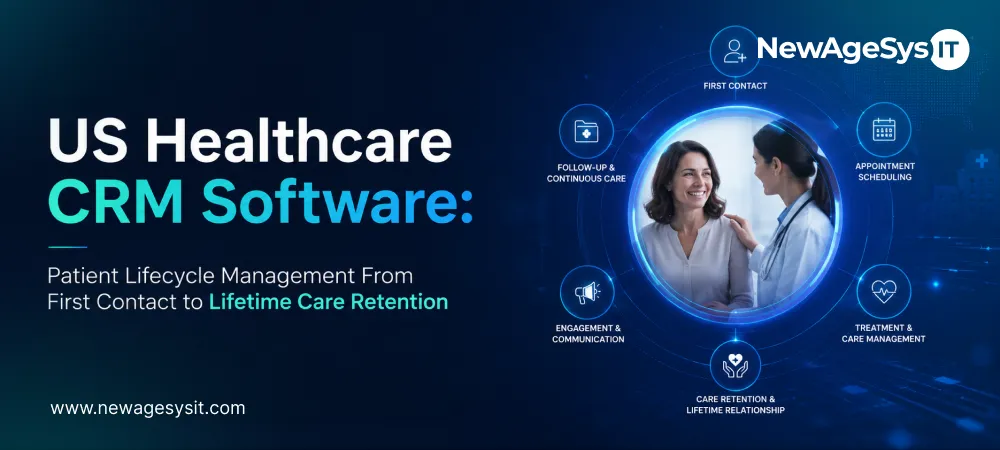
Healthcare 9 min read
US Healthcare CRM Software: Patient Lifecycle Management From First Contact to Lifetime Care Retention

Why Patient Lifecycle Management Requires More Than an EHR
EHR and EMR systems are clinical documentation tools. They record diagnoses, procedures, lab results, and treatment plans. But they do not manage the full patient relationship. Relationship management depends on timely communication, consistent outreach, referral tracking, and administrative follow-through. These are the gaps that decide whether patients stay long-term or quietly move to another practice.
Healthcare CRM software patient lifecycle management fills that gap for US businesses. A purpose-built healthcare CRM works alongside the EHR. The EHR owns clinical documentation, and the CRM owns the administrative and relationship layer.
Practices that rely on their EHR for patient engagement typically lose 20-40% of their patient panel annually to silent attrition. Patients miss preventive care milestones, skip follow-up appointments, and disengage. This is not because of dissatisfaction with clinical care, but because no administrative system is proactively maintaining the relationship.
A healthcare CRM addresses this by automating outreach, tracking care gaps, and managing communication preferences. It also delivers the retention workflows that keep patients engaged between visits.
The architecture should separate the clinical record layer from the patient relationship layer, a principle that applies to both healthcare mobile app development and custom healthcare CRM development regardless of whether the practice builds a patient-facing app or starts with a web-based administrative layer.
Practices investing in custom healthcare CRM development benefit from scoping HIPAA technical safeguards, EHR integration architecture, and BAA requirements before any vendor or development partner is selected.
Note: All content in this guide is strategic and technical in nature. HIPAA compliance determinations, Business Associate Agreement requirements, and state-specific healthcare privacy obligations require qualified legal and healthcare compliance counsel.
The Patient Lifecycle: Eight Stages a Healthcare CRM Manages
A healthcare CRM manages the patient relationship across eight distinct lifecycle stages. Understanding each stage of healthcare CRM patient management clarifies where CRM infrastructure creates measurable practice value.
Stage 1- Acquisition. New patient inquiry arrives via website, phone, or referral. The CRM captures the source, creates a lead record, and triggers a structured welcome sequence. Acquisition data also enables the practice to identify which referral channels generate the highest-retention patients.
Stage 2 – Onboarding. The first appointment is booked. Insurance verification, digital intake forms, and consent documentation are collected before the visit. The CRM manages the onboarding workflow, so clinical staff focus on care rather than administrative data collection.
Stage 3 – First Visit. The in-person or telehealth encounter is logged. The CRM records the appointment outcome, updates communication channel preferences, and triggers a post-visit follow-up sequence for the visit type.
Stage 4 – Care Plan Engagement. Ongoing scheduled care and care plan adherence are tracked. The CRM sends appointment reminders, medication adherence check-ins, and condition-relevant educational content on a structured cadence.
Stage 5 – Preventive Care Maintenance. Annual wellness visits, cancer screenings, immunizations, and preventive care milestones are tracked against clinical schedules. The CRM identifies care gaps proactively and triggers outreach before the patient becomes overdue.
Stage 6 – Chronic Condition Management. Patients with chronic conditions require more frequent touchpoints. The CRM segments chronic disease populations and delivers condition-specific communication on schedules appropriate to each condition protocol.
Stage 7 – Referral Management. Inbound and outbound referral tracking records referral sources, specialist outcomes, and conversion back to retained patients. Referral analytics help practices identify high-value referring relationships and close-loop gaps in specialist coordination.
Stage 8 – Long-Term Retention. Annual retention requires ongoing engagement, care quality recognition, and systematic reactivation of patients who have gone dormant. The CRM identifies disengagement signals early and triggers re-engagement sequences before the patient formally transfers care.
Patient Profiles, Medical History, and Consent Management
A healthcare CRM patient profile is the administrative complement to the clinical EHR record. The EHR holds diagnoses, procedures, and clinical notes. The CRM profile holds demographic and contact information, communication channel preferences, and insurance and billing information. It also holds consent documentation status, appointment history, referral history, and relationship notes that inform future interactions.
Healthcare CRM systems can store patient names linked to appointment dates, diagnoses referenced in communications, or insurance information. These are handling Protected Health Information (PHI) under HIPAA. PHI is any information that can identify a patient AND relates to their health condition, treatment, or payment for care.
The CRM must be designed with the same HIPAA technical safeguards required of the EHR. These include AES-256 encryption at rest for all PHI and TLS 1.2 or higher for PHI in transit. They also span role-based access control with minimum-necessary access, audit logging of all PHI access, and automatic session timeout.
Consent management is a distinct CRM function. CRM should store digital collection and treatment consent tracking, HIPAA-required communication preference documentation, marketing opt-in status, and telehealth consent. It should accompany a complete, timestamped audit trail. Any system storing this data on behalf of a covered entity must execute a Business Associate Agreement (BAA) before receiving PHI.
How the CRM patient profile is architected alongside the EHR clinical record, what PHI fields it stores, how consent documentation is timestamped and audited, and what HIPAA technical safeguards the profile layer must implement runs through Patient Profiles, Medical History & Consent Management in Custom US Healthcare CRM.
Automated Patient Outreach and Care-Gap Alerts
US primary care practices carry a significant portion of their patient panel who are overdue for preventive care. This spans annual wellness visits, colorectal cancer screenings, mammograms, diabetic HbA1c monitoring, hypertension follow-up, and childhood immunizations. These care gaps represent both a patient health risk and a recoverable revenue opportunity. A healthcare CRM closes care gaps by identifying overdue patients from EHR data and triggering structured outreach sequences automatically.
HIPAA-compliant CRM automated outreach requires strict attention to communication channel security. A reminder that a patient is due for a health screening is HIPAA-compliant when sent through their preferred channel.
A message referencing a specific diagnosis, medication, or test result is non-compliant unless delivered through a secure, access-controlled patient portal. The CRM must store and enforce each patient’s documented communication preferences: preferred channel, opt-out status, and any condition-specific communication restrictions.
Appointment no-show recovery is among the highest-ROI CRM functions in a busy practice. Automated follow-up sequences include a same-day rescheduling invitation and a seven-day re-outreach. These sequences recover a meaningful share of missed appointments that manual phone follow-up consistently misses at high-patient-volume practices.
How care-gap identification draws on EHR data, how outreach sequences are structured by communication channel preference, and how no-show recovery workflows recover missed appointments at scale runs through Automated Patient Outreach, Care-Gap Alerts & Retention Workflows for US Healthcare Practices.
EHR and EMR Integration: The Clinical Data Connection
A healthcare CRM that operates without EHR integration can manage appointments and send reminders. What it cannot do is identify care gaps, risk-stratify the patient population, or send clinically informed outreach. The clinical intelligence that makes a healthcare CRM valuable comes from structured access to EHR data.
HL7 FHIR (Fast Healthcare Interoperability Resources) is the current US healthcare data exchange standard. It is mandated for certified EHR technology under the 21st Century Cures Act. FHIR APIs provide structured access to clinical data from major EHR systems: Epic, Cerner (now Oracle Health), Athenahealth, and others. This enables the CRM to pull relevant patient data without manual re-entry.
Many practices require web application development for patient portals or administrative dashboards, where FHIR-based integration provides the interoperability layer that connects clinical and administrative data in a single unified view. Here, FHIR-based integration provides the interoperability layer that connects clinical and administrative data in a single unified view.
Any third-party system, including the CRM that receives PHI via EHR integration, must execute a Business Associate Agreement. It should include the covered entity before that data transfer begins. This is a non-negotiable architecture and vendor selection requirement, not an optional compliance step.
The full integration architecture, HL7 FHIR API access patterns for Epic, Cerner, and Athenahealth, BAA requirements for CRM vendors receiving PHI via EHR integration, and the unified clinical and administrative data model, runs through EHR/EMR Integration Architecture: Connecting Patient Data Across Clinical & Administrative Systems
Patient Segmentation and Risk Stratification
Patient segmentation enables a healthcare practice to communicate with precision rather than broadcasting generic outreach to the full panel. Healthcare CRM segments the patient population based on several factors. These include age, chronic condition, and care gap status, visit frequency, insurance type, and communication preference. Each segment receives messaging appropriate to its clinical status and engagement history.
Risk stratification extends segmentation into clinical prioritization. It combines EHR clinical data, like diagnosis codes, medication records, and lab values, with CRM administrative data like visit frequency and no-show history. This practice can identify patients at elevated risk for hospitalization, chronic disease progression, or care attrition. Proactive care management resources are then allocated to the highest-need patients before a preventable health event occurs.
When risk stratification is implemented through AI product and agent development, the scoring model and population health outputs must be validated against the practice’s clinical protocols and reviewed by qualified clinicians before being used to prioritize care management resources. Any AI-assisted risk stratification or clinical decision support feature must be reviewed by qualified clinicians before influencing patient care. AI-generated risk scores and population health outputs are decision support tools. They are not clinical diagnoses or care plans and must not be presented as such.
How chronic condition segmentation, care gap status, visit frequency, and EHR clinical data combine to identify patients at elevated risk for hospitalization or care attrition, and how personalized communication is structured for each segment, runs through Patient Segmentation, Risk Stratification & Personalized Communication in US Healthcare CRM.
Healthcare CRM Cost and the Build vs Configure Decision
US healthcare practices evaluating CRM infrastructure face a more complex decision than most industries. The healthcare CRM should address HIPAA compliance architecture requirements, EHR integration needs, and clinical workflow specificity. These requirements are beyond what most generic CRM platforms handle without significant customization.
HIPAA-designed CRM platforms carry distinct cost and capability profiles. Salesforce Health Cloud is the most feature-rich off-the-shelf option but carries significant implementation and licensing costs. HubSpot offers a BAA option for qualifying plans but requires architectural customization to meet healthcare-specific workflow requirements.
A custom-built healthcare CRM provides the greatest workflow specificity and EHR integration control at a higher upfront development cost. It carries the long-term advantage of avoiding per-seat licensing fees and vendor dependency.
All cost figures in this content are planning ranges only. Healthcare CRM development costs vary significantly based on EHR integration complexity and HIPAA compliance architecture scope. The costs also depend on feature requirements and the size of the patient panel the system will serve. HIPAA compliance implementation costs also vary by audit scope and qualified compliance counsel engaged.
How HIPAA compliance architecture scope, EHR integration complexity, patient panel size, and feature requirements each affect the development investment range runs through US Healthcare CRM Budget Planning: What Custom Development Actually Costs for Clinics & Practices.
Building the Administrative Layer That Protects Your Clinical Investment
A healthcare CRM manages the patient relationship layer that EHR systems are not designed for. CRM is the operational infrastructure that keeps patients engaged between clinical visits. This is ensured from the first contact through preventive care maintenance, chronic condition engagement, referral management, and long-term retention,
US healthcare practices that invest in purpose-built CRM infrastructure alongside their EHR consistently improve patient retention. These healthcare practices also improve the care gap closure rates and practice revenue per patient. Clinical care quality remains the foundation; CRM infrastructure strengthens the administrative layer around it.
Your practice might be managing patient relationships primarily through EHR appointment records and phone calls. Design a CRM layer that closes care gaps proactively and follows up on missed appointments systematically. Also, make sure the layer retains patients through structured engagement. This is the operational infrastructure investment that makes clinical excellence more economically sustainable.
A reputed AI software development agency works with health tech teams to architect, build, and integrate custom healthcare CRM systems. These systems are designed with HIPAA technical safeguards and HL7 FHIR interoperability from the ground up. Learn more about digital transformation solutions from one of the leading AI software companies in the United States.
Core Development
Keep exploring the custom services.

AI Software Development
Custom AI Software Development
Build intelligent, production-ready software from machine-learning models to AI-driven automation designed around your business goals.
Learn more
Mobile App Development
Custom Mobile Application Development
Native and cross-platform mobile apps that are fast, secure, and built to scale across iOS and Android.
Learn more
Web App Development
Custom Web Application Development
Scalable, secure web applications, from customer portals to complex dashboards, tailored to how your business actually works.
Learn more



