
Welcome to Blogs
Discover actionable insights, in-depth research, and expert perspectives, all in one place.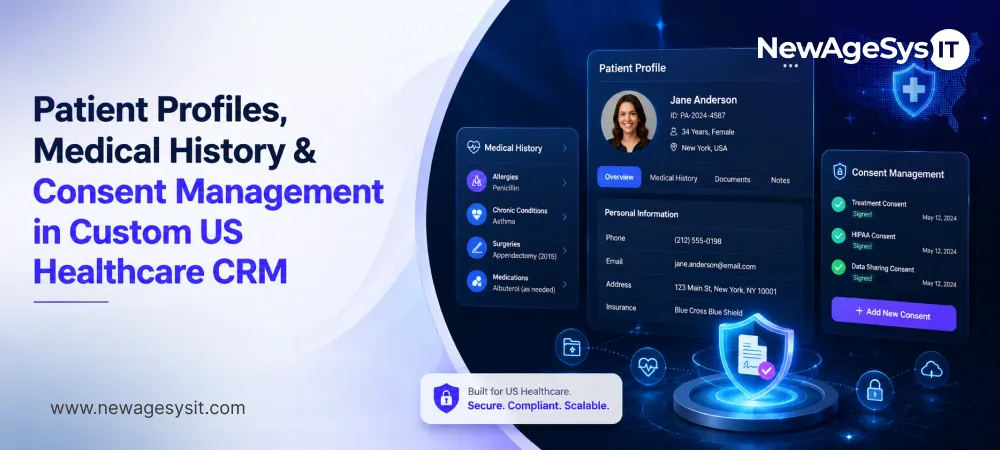
Healthcare 8 min read
Patient Profiles, Medical History & Consent Management in Custom US Healthcare CRM

| This article is part of our series on US Healthcare CRM Software: Patient Lifecycle Management From First Contact to Lifetime Care Retention |
What a Healthcare CRM Patient Profile Contains (and What It Must Not)
Healthcare CRM patient profiles consent management is a precise architectural problem for most US businesses. A healthcare mobile app development or CRM implementation that conflates the administrative patient profile with the clinical EHR record creates both structural inefficiency and HIPAA exposure from the first data entry. This creates both structural inefficiency and HIPAA exposure.
The CRM patient profile is the administrative and relationship record with communication preferences, appointment history, and consent documentation. It also includes insurance details, referral source, and engagement notes.
The EHR holds the clinical record: diagnoses, medications, lab results, and treatment documentation. These are distinct systems serving distinct functions. A well-architected custom healthcare CRM development keeps that boundary clear from day one, treating the CRM as the administrative and relationship layer and the EHR as the clinical record system
The HIPAA boundary is non-negotiable. Any patient-identifiable information that relates to health status, care provision, or payment for care is Protected Health Information (PHI). A patient’s name linked to their appointment date in the CRM is PHI.
The CRM must apply the same HIPAA technical safeguards to that data as the EHR applies to clinical records. This article provides strategic and technical guidance only. HIPAA applicability determinations for your specific system require qualified healthcare legal and compliance counsel.
Patient profiles and consent management form the foundational data layer of the full healthcare CRM patient lifecycle. It is covered in: US Healthcare CRM Software: Patient Lifecycle Management From First Contact to Lifetime Care Retention.
The Healthcare CRM Patient Profile Data Architecture
A well-structured healthcare CRM patient profile is organized in three layers. Each layer contains specific data types with distinct access control requirements.
Administrative and Demographic Layer
This layer holds the contact and identity data that powers every downstream CRM function. It encompasses legal name, date of birth, address, contact numbers, email address, emergency contact, preferred language, and communication channel preferences. Communication preference documentation is a HIPAA requirement: patients have the right to request alternative means of communication. CRM must honor and record those preferences with a timestamped audit entry for each update.
Insurance and billing information belong here as well. It incorporates the insurance plan name, member ID, group number, primary and secondary insurance carrier, and billing contact. Linking insurance data to a patient record creates PHI. Encryption at rest and role-based access controls must apply to this layer. Any custom mobile app development for patient-facing intake or insurance capture must transmit and store this data through secured channels, with TLS 1.2 minimum for transit and AES-256 encryption for storage applied from the first build sprint.
Appointment and Engagement History
Complete appointment history; scheduled, completed, cancelled, and no-show records with appointment type and treating provider drive two critical CRM functions. They are care gap identification and no-show pattern detection. This history is operationally useful precisely because it does not require access to the clinical EHR record to function. The CRM can identify a patient not attending a preventive care visit in 14 months without access to clinical notes.
Referral history sits in this layer as well. Firstly, it includes the inbound referral source (which provider, health system, or channel referred the patient to this practice). Secondly, outbound referral tracking (which specialists this practice has referred the patient to and the closure status of those referrals). Referral analytics at the practice level help identify high-value referring relationships and close coordination gaps with specialist partners.
Relationship Notes
Administrative notes added by care coordinators, front desk staff, and patient advocates record the context that makes patient communication effective. This incorporates communication history notes and patient-stated preferences. It also includes social circumstances relevant to scheduling: transportation limitations, childcare constraints, preferred appointment windows, and language interpreter requirements.
The notes must be access-controlled to authorized staff only, with role-based permissions. The permissions help determine staff roles to read, add, or edit relationship notes for any given patient record.
Medical History in the CRM: What to Include and What Belongs in the EHR
The healthcare CRM is not a clinical documentation system. Detailed clinical data, including diagnoses, active medications, lab values, imaging results, and clinical progress notes, belong in the EHR. Duplicating comprehensive clinical records in the CRM creates redundant PHI exposure without adding administrative value. It also violates the data minimization principle that sound HIPAA architecture is built on.
What the CRM receives from EHR via integration is summary clinical flags enabling administrative workflows without exposing full clinical detail. Three flag types cover most use cases. Chronic condition flags are, for example, an indicator that a patient is enrolled in an active chronic disease management program. They allow care coordinators to prioritize outreach without accessing diagnostic records.
Care gap status flags are, for example, a notation that a patient is overdue for an annual wellness visit. These are pulled from EHR scheduling and preventive care data to trigger outreach sequences. Immunization status summaries for pediatric practices enable scheduling workflows to flag incomplete immunization schedules. It is done without storing the full immunization record in the CRM.
The governing principle is the minimum necessary PHI. The CRM should hold only the clinical data required to perform its administrative and relationship management functions. Any clinical data beyond that scope belongs exclusively in the EHR, accessed by clinical staff through appropriate EHR access controls.
Patient profiles are enriched by EHR integration, and how HL7 FHIR API access delivers chronic condition flags, care gap status, and immunization summaries into the CRM without exposing full clinical records runs through EHR/EMR Integration Architecture: Connecting Patient Data Across Clinical & Administrative Systems.
Digital Consent Management Architecture
A healthcare CRM must manage five distinct consent types, and the architecture for each has different documentation requirements.
Treatment consent may reside in the EHR as the primary system of record, but the CRM should record the status. It should record whether consent has been obtained, the date, and the version of the consent document. This helps to support administrative workflows without requiring clinical staff access for status checks.
Notice of Privacy Practices (NPP) acknowledgment is a HIPAA consent management software requirement under 45 CFR 164.520. The patient’s acknowledgment of receiving the NPP must be documented in the CRM with a date and staff confirmation record.
Communication preference consent is the documented record of how each patient has requested to be contacted. It also records any channel restrictions they have specified and any opt-out actions they have taken. This record must be honored by every automated outreach workflow the CRM executes.
Marketing communication consent covers non-treatment-related communications such as newsletters, health education content, and practice announcements. Patients must affirmatively opt in. The opt-in record must be stored with a timestamp and the specific consent language presented at the time of opt-in.
Telehealth platform consent is a separate consent type from general treatment consent and must be documented independently. It should capture the patient’s acknowledgment of the specific terms of telehealth service delivery.
Digital consent collection eliminates paper consent backlogs, improves documentation completeness, and creates a searchable, timestamped audit trail. Building that consent management interface as a web application development component within the admin and patient portal layer ensures the immutable consent record, version history, and identity verification log are accessible to authorized staff without requiring access to the clinical EHR. Each digital consent record should capture: the version of the consent document presented and the date and time of signature. The identity verification method for remote consent and the IP address or device identifier for non-in-person completion should also be captured.
The consent record must be immutable after the patient’s signature. It must retain a complete history of consent versions across the patient relationship.
Profile data and communication preference records are the inputs that make outreach automation clinically appropriate and channel-compliant. How care-gap identification, no-show recovery sequences, and retention workflows draw on that profile layer runs through Automated Patient Outreach, Care-Gap Alerts & Retention Workflows for US Healthcare Practices.
HIPAA Technical Safeguards in Healthcare CRM Architecture
The HIPAA Security Rule Technical Safeguards apply in full to any healthcare CRM system that stores, transmits, or processes PHI. These are the minimum-standard implementation requirements.
Encryption. AES-256 encryption for all PHI stored at rest. TLS 1.2 minimum; TLS 1.3 preferred; for all PHI transmitted over any network, including internal networks.
Access controls. Unique user accounts for every staff member accessing the CRM with no shared credentials. Role-based access controls apply the minimum-necessary standard.
A front desk coordinator sees scheduling and communication data. While a care coordinator sees care gap flags, a billing specialist sees insurance and payment data. No role should have access beyond the scope of its function.
Audit controls. A complete, tamper-evident audit log of all PHI access: user identity, timestamp, record accessed, and action performed. The audit log must be retained per your HIPAA records retention policy. It must be available for review in the event of a breach investigation or audit.
Session timeout. Automatic session termination after inactivity; typically 15 to 30 minutes for clinical and administrative interfaces accessing PHI. This applies to both desktop and mobile CRM access points.
Business Associate Agreement. The development firm that builds and potentially hosts the healthcare CRM must execute a BAA before receiving or accessing PHI. This is a non-negotiable architecture and vendor selection requirement. It applies to third-party services: analytics platforms, email delivery services, and SMS gateways that CRM uses to process patient data.
Building Patient Data Architecture That Passes Audits and Earns Patient Trust
Healthcare CRM patient profile architecture is defined by two principles: HIPAA technical safeguard requirements and minimum-necessary PHI. Building these compliance requirements into the initial system architecture is more cost-effective. Retrofitting them after an audit finding or breach incident costs more.
Many US healthcare practices invest in compliant, well-structured patient profile architecture. The architecture can feature digital consent management, role-based access controls, and complete audit trails. CRM systems designed with compliant patient data architecture support HIPAA risk assessments, earn patient trust, and provide the administrative foundation for long-term patient care relationships.
If your healthcare CRM patient profiles store PHI without AES-256 encryption, role-based access controls, and a complete access audit log, addressing these technical safeguards before your next HIPAA risk assessment is the most urgent CRM architecture investment your practice can make.
To see how an AI healthcare software development company approaches HIPAA-compliant patient profile architecture, digital consent management, role-based access controls, and PHI audit logging for US healthcare CRM systems, explore our work with healthcare technology teams.
Core Development
Keep exploring the custom services.

AI Software Development
Custom AI Software Development
Build intelligent, production-ready software from machine-learning models to AI-driven automation designed around your business goals.
Learn more
Mobile App Development
Custom Mobile Application Development
Native and cross-platform mobile apps that are fast, secure, and built to scale across iOS and Android.
Learn more
Web App Development
Custom Web Application Development
Scalable, secure web applications, from customer portals to complex dashboards, tailored to how your business actually works.
Learn more



