
Welcome to Blogs
Discover actionable insights, in-depth research, and expert perspectives, all in one place.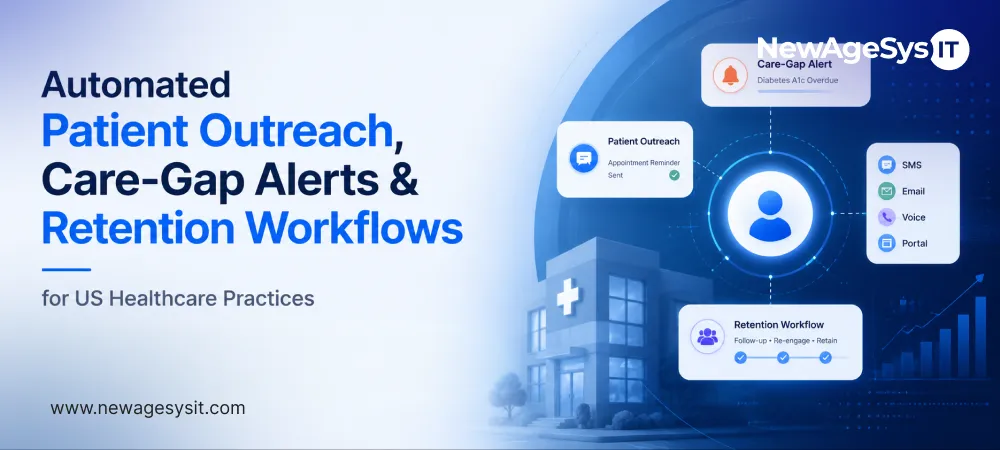
Healthcare 8 min read
Automated Patient Outreach, Care-Gap Alerts & Retention Workflows for US Healthcare Practices

| This article is part of our series on US Healthcare CRM Software: Patient Lifecycle Management From First Contact to Lifetime Care Retention |
The Care Gap as a Clinical and Financial Problem
A primary care practice with 5,000 active patients has hundreds of care gaps open at any given time–patients overdue for diabetes monitoring, cancer screenings, wellness visits, and chronic disease follow-up. A healthcare CRM with care-gap alert functionality and HIPAA-compliant automated outreach closes these gaps systematically at the scale of the full patient panel. It could be the patients overdue for diabetes monitoring, colorectal cancer screenings, mammograms, annual wellness visits, and hypertension follow-up.
Identifying and closing those gaps through manual chart review and phone outreach is operationally impossible for most staffing models. Each unaddressed gap represents both a patient health risk and a lost appointment. A healthcare CRM with care-gap alert functionality and HIPAA-compliant automated outreach closes gaps systematically, at panel scale, without adding headcount.
The infrastructure that makes this possible starts with a healthcare mobile app development and custom healthcare CRM development partner designed from the outset around HIPAA-compliant communication channels, patient preference enforcement, and EHR data integration. A partner with dedicated healthcare software development experience understands that a CRM lacking HIPAA-compliant channel architecture, preference enforcement, or EHR integration will fail to deliver compliant outreach at panel scale regardless of the automation logic built on top of it. These services are designed from the outset around HIPAA-compliant communication channels, patient preference enforcement, and EHR data integration. A CRM that lacks any one of these three foundations will fail to deliver compliant, effective outreach at scale.
Automated outreach and retention workflows are the engagement layer of the full healthcare CRM patient lifecycle guide.
Note: All outreach programs must comply with HIPAA communication requirements and respect patient-documented channel preferences. Consult qualified compliance counsel for specific program design.
HIPAA-Compliant Patient Communication Architecture
Automated outreach in a healthcare CRM operates across three communication channels, each with distinct HIPAA compliance requirements. Sending clinical detail through an unsecured channel creates PHI exposure that no outreach volume can justify.
Communication Channel Compliance
Secure patient portal messaging is the only channel where clinical detail can be transmitted without additional safeguards. Messages sent through a web application development patient portal are encrypted within the portal system and require patient authentication to access, making the secure portal the only appropriate channel for outreach that references specific diagnoses, lab results, or clinical conditions. Diagnosis-specific outreach, lab result notifications, medication reminders, and care gap messages referencing clinical conditions belong here.
SMS and phone outreach work for appointment reminders and general health outreach that doesn’t disclose specific diagnoses or clinical information. A message that reads “You are due for a health screening; call us to schedule” is appropriate. A message that references a specific condition, medication, or test result is not, unless delivered through a secured portal channel. TCPA opt-in is required before sending automated SMS to any patient.
Email carries the same PHI restrictions as SMS for content that references clinical detail. For most standard email delivery, without end-to-end encryption verification, the appropriate use is general scheduling reminders and non-clinical practice communications. Any email workflow that transmits PHI requires encryption-in-transit verification. These must only reach patients who affirmatively consent to receiving healthcare communications by email.
Communication Preference Enforcement
The CRM must enforce patient-documented communication preferences without exception. A patient opting out of SMS must not receive automated SMS outreach regardless of the message content or clinical priority. A patient who requests portal-only communication must receive outreach through the portal, even while creating additional workflow steps for staff.
Preference records must be updatable through two paths. Firstly, by the patient via the portal self-service interface, and secondly, by staff via the CRM administrative interface. Every preference change, channel addition, channel opt-out, and restriction update must be audit-logged. This should be secured with a timestamp and the identity of the party making the change.
Outreach campaigns that execute before a preference update has been applied create both compliance exposure and patient trust damage.
Care Gap Alert Automation
A healthcare CRM can receive clinical data from the EHR via the HL7 FHIR API. It can automatically identify patients overdue for specific preventive services or chronic disease monitoring. The care gap is calculated using the patient’s last recorded service date for a specific clinical measure. The date is compared with the recommended interval in clinical protocols or payer quality program requirements.
The care gap categories that generate the highest outreach volume in US primary care practices include:
- Annual wellness visits (Medicare Annual Wellness Visit and commercial insurance equivalents).
- Colorectal cancer screening (colonoscopy or FIT test per age and risk protocol).
- Breast cancer screening (mammogram per age and risk protocol).
- Cervical cancer screening (Pap smear per current USPSTF guidelines).
- Diabetes monitoring (HbA1c testing for patients with Type 2 diabetes at defined intervals)
- Hypertension follow-up (blood pressure recheck at clinically specified intervals)
- Childhood immunization schedule completion for pediatric practices.
When a care gap is identified, the CRM executes a structured outreach sequence. The initial outreach message is sent in the patient’s preferred channel. If no appointment is scheduled within 14 days, a follow-up outreach is triggered automatically. If no response is received after two outreach attempts, the record is flagged for care coordinator review. This prevents continuing automated outreach, protecting both compliance and patient experience.
Practices operating under value-based care contracts should note that many of these care gap categories align with HEDIS. HEDIS (Healthcare Effectiveness Data and Information Set) measures are used by insurance plans for quality reporting. For practices ready to extend beyond rule-based gap identification, AI integration and adoption services applied to care gap data can prioritize outreach sequences by predicted no-show risk and historical engagement response patterns, improving the efficiency of each outreach cycle without adding clinical review overhead.
Appointment No-Show Recovery and Patient Re-Engagement
A patient who misses an appointment without cancelling carries a higher attrition risk than one who calls to reschedule. The window to recover a no-show patient is narrow: automated recovery outreach within 24 hours of the missed appointment. A direct rescheduling invitation with available appointment slots recovers a meaningful share of missed appointments before disengagement sets in. Practices that rely on manual phone follow-up for no-show recovery consistently miss this window during high-volume periods.
Outreach campaigns require communication preference data from patient profiles to execute correctly. How the CRM patient profile is architected, what consent documentation it stores, and how communication preference records are maintained with a timestamped audit trail runs through Patient Profiles, Medical History & Consent Management in Custom US Healthcare CRM. Without verified preference records, no-show recovery outreach may use an unsecured or non-preferred channel. This creates both compliance exposure and a poor patient experience at an already fragile moment in the relationship.
Dormant patient re-engagement addresses the practice’s highest-risk retention segment: patients who have not attended an appointment in 12+ months. A CRM can identify dormant patients by last appointment date and trigger a structured re-engagement sequence. This includes a wellness outreach message, a preventive care milestone reminder, or a personalized message from the patient’s primary provider. It recovers patients who would otherwise transfer care by default rather than by active choice.
Timing matters: Mid-week outreach consistently outperforms Monday or Friday delivery for most US patient demographics. 48-hour appointment reminders generate higher confirmation rates than same-day reminders.
Value-Based Care and Population Health Workflows
Practices operating under value-based care contracts benefit from CRM-driven population health workflows in three specific ways. These contracts may include ACO participation, capitated payment models, and Patient-Centered Medical Home (PCMH) recognition.
- Proactive care gap closure directly improves the quality metrics that determine bonus payments.
- Chronic disease management outreach reduces avoidable hospitalizations that generate shared savings in risk-bearing contracts.
- Patient attribution management ensures that patients are correctly attributed to the practice in payer reporting systems. This is a CRM administrative function that affects practice revenue independent of clinical quality.
Risk-stratified outreach allocation is the efficiency layer that makes value-based care performance sustainable. A CRM supports risk stratification using EHR-derived clinical data, and how chronic condition segmentation, care gap status, and visit frequency combine to identify patients at elevated risk for hospitalization or care attrition runs through Patient Segmentation, Risk Stratification & Personalized Communication in US Healthcare CRM.
It enables care coordinators to direct outreach efforts to the highest-risk patients first. This avoids working through a panel alphabetically or by administrative convenience.
Any risk stratification workflow that incorporates PHI from EHR integration must apply the same HIPAA technical safeguards. This includes AES-256 encryption, role-based access, and audit logging, as well as PHI processing in the CRM.
Closing Care Gaps at Panel Scale
Automated patient outreach and care gap management deliver measurable improvements in patient health outcomes and practice revenue. These improvements are possible when built on a HIPAA-compliant communication architecture. That architecture should follow channel-appropriate PHI handling, preference enforcement, structured escalation logic, and EHR data integration. It is the foundation that makes healthcare practice outreach automation operationally and legally sustainable.
US healthcare practices need to automate care gap identification and HIPAA-compliant outreach at panel scale. This helps them scale consistently to improve quality metrics, reduce attrition, and recover appointment revenue that manual outreach misses.
Your practice should close care gaps through chart pulls at a patient call point rather than proactive panel management. Building a CRM-driven care gap alert and outreach workflow recovers the preventive care appointments. It improves patient health outcomes and supports the quality metrics that determine value-based care performance.
To see how an AI healthcare software development company approaches HIPAA-compliant outreach architecture, HL7 FHIR care-gap identification, patient preference enforcement, and no-show recovery automation for US healthcare practices, explore our work with healthcare technology teams.
Core Development
Keep exploring the custom services.

AI Software Development
Custom AI Software Development
Build intelligent, production-ready software from machine-learning models to AI-driven automation designed around your business goals.
Learn more
Mobile App Development
Custom Mobile Application Development
Native and cross-platform mobile apps that are fast, secure, and built to scale across iOS and Android.
Learn more
Web App Development
Custom Web Application Development
Scalable, secure web applications, from customer portals to complex dashboards, tailored to how your business actually works.
Learn more



